The Printed Page as a Public Battlefield
India’s press history is not only about famous editors and great publications. It is also about technology, literacy, language, law, censorship, capital and readership. A newspaper required printing presses, paper, distribution networks, trained writers, paying subscribers and political courage. In a colonial society, the printed word could become dangerous because it allowed criticism to travel. That is why the history of Indian newspapers is inseparable from the history of power.
The Arrival of Printing and Colonial Publics
Printing arrived in India before newspapers became regular institutions. Missionaries, colonial officials and commercial presses used print for religious literature, administrative notices and educational material. But a newspaper required something more: a recurring public conversation. It needed news, opinion, advertisements and readers who wanted to know what was happening beyond their immediate surroundings.
The early colonial city created such a readership. Calcutta, Bombay and Madras were centres of trade, administration and European settlement. Merchants needed commercial information. Officials watched political developments. Educated groups wanted access to debate. The newspaper emerged from this urban world, but it soon escaped narrow colonial circles and became part of wider Indian political life.
Hicky’s Bengal Gazette and the Birth of Indian Journalism
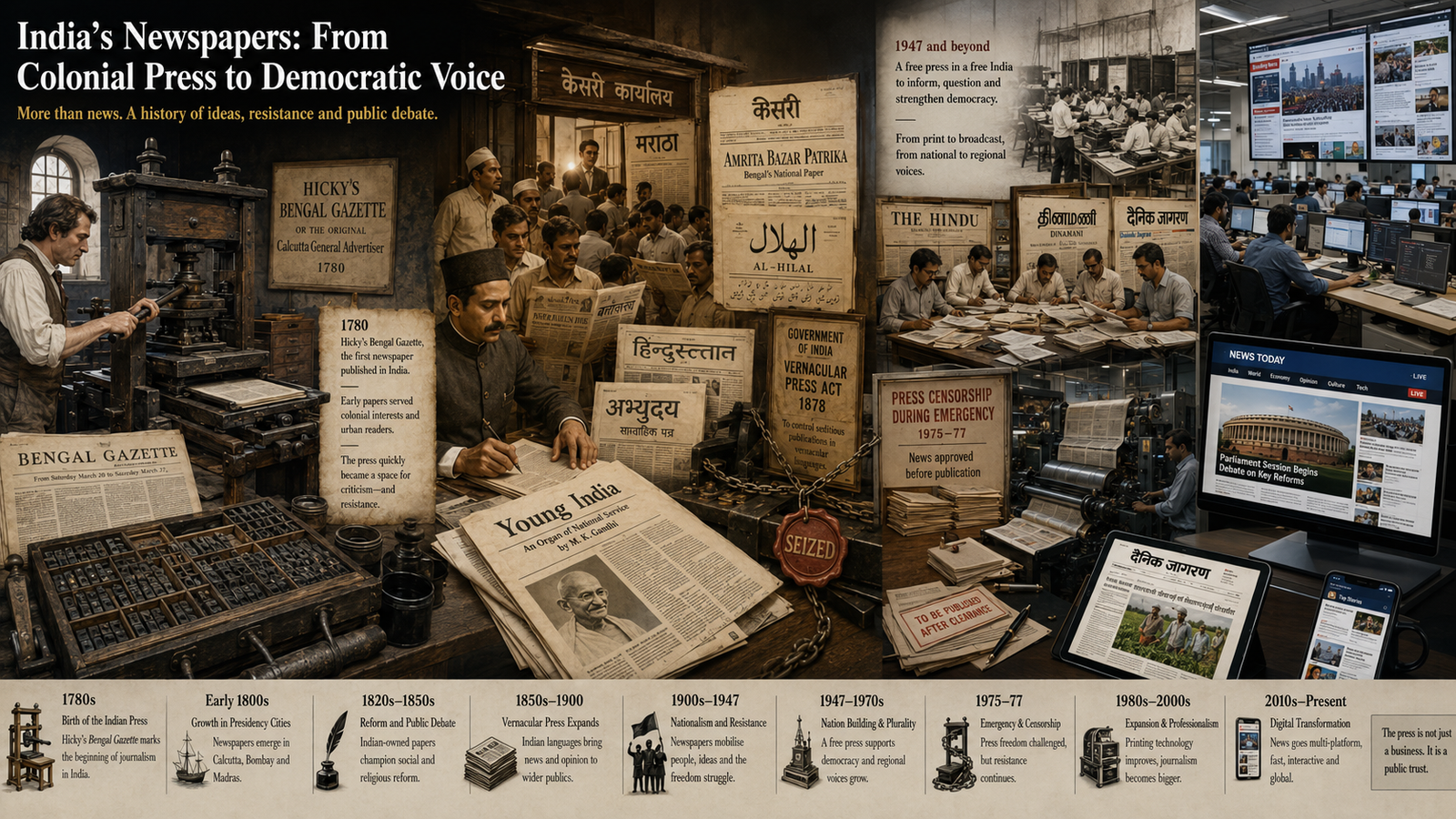
James Augustus Hicky’s Bengal Gazette, first published in Calcutta in 1780, is widely remembered as India’s first newspaper. It was a small English-language weekly, but its historical importance is large. Hicky’s paper was not merely an official notice sheet. It criticised powerful colonial figures, exposed social hypocrisy and claimed editorial independence. Its famous spirit was captured in its claim to be open to all parties but influenced by none.
The colonial authorities did not tolerate such independence for long. Hicky faced lawsuits, imprisonment and the eventual seizure of his press. The fate of the Bengal Gazette set a pattern that would recur throughout Indian press history: newspapers could become vehicles of public criticism, and governments would attempt to control them. From the beginning, journalism in India carried both commercial ambition and political risk.
Growth of the Early Colonial Press
After Hicky, newspapers appeared in Calcutta, Bombay and Madras. Many early papers served European communities and commercial interests, but Indian-owned and Indian-edited publications gradually emerged. The growth of English education, new urban elites and reform movements expanded the readership. Newspapers became spaces where social reformers could debate sati, widow remarriage, caste practices, women’s education and religious reform.
Raja Rammohan Roy understood the power of print. Publications associated with him, such as Sambad Kaumudi and Mirat-ul-Akbar, used journalism as a tool of reform and public reasoning. This was a major shift. Newspapers were no longer simply reporting events; they were arguing over society. Print helped create a new kind of Indian intellectual: one who addressed not a court or a sect alone, but a reading public.
Vernacular Newspapers and the Expansion of Public Opinion
The rise of vernacular newspapers changed the scale and meaning of Indian journalism. English newspapers reached colonial officials, educated elites and urban professionals, but vernacular papers reached wider linguistic publics. Bengali, Hindi, Urdu, Marathi, Tamil, Malayalam, Gujarati and other language newspapers carried news and opinion into regions where English had limited reach.
Vernacular journalism was politically significant because it connected modern print to local idioms, grievances and memories. It could speak of land revenue, famine, caste, religion, labour and colonial policy in languages people understood deeply. The British often feared the vernacular press more than the English press because it could mobilise wider opinion. This fear led to repressive measures such as the Vernacular Press Act of 1878, which aimed to control Indian-language newspapers critical of colonial rule.
Newspapers and the Freedom Struggle
By the late nineteenth and early twentieth centuries, newspapers had become central to Indian nationalism. Publications such as Kesari, Mahratta, Amrita Bazar Patrika, The Hindu, Bengalee, Al-Hilal, Young India, Harijan and many others shaped political consciousness. Leaders used newspapers to explain policies, criticise government, debate methods and mobilise citizens.
Bal Gangadhar Tilak’s Kesari became a powerful voice of assertive nationalism in Marathi. Mahatma Gandhi treated journalism as a form of public service and moral communication. His journals did not merely report politics; they educated readers in satyagraha, swadeshi, social reform, communal harmony and ethical discipline. Newspapers made the freedom movement intellectually continuous. A speech might reach a crowd once; a printed article could circulate, be reread, translated and preserved.
Censorship, Sedition and Colonial Control
The colonial state repeatedly tried to discipline the press. Laws on sedition, security, licensing and printing presses were used against editors and publications. Newspapers faced fines, confiscations, prosecutions and imprisonment. The press became a battlefield because the British understood that political sovereignty depended partly on controlling narratives.
Yet repression often strengthened the moral authority of nationalist journalism. When editors were prosecuted, they became symbols of resistance. When papers were censored, readers learned to read between the lines. When one publication was suppressed, another often emerged. The history of Indian newspapers under colonial rule is therefore also the history of resilience. Print culture survived because it was linked to a larger public hunger for political voice.
The Press as Social Reformer
Indian newspapers did not discuss only nationalism. They played a major role in social reform. Debates over caste discrimination, women’s education, child marriage, widow remarriage, untouchability, labour rights and religious reform unfolded in newspapers and journals. Reformers used the press to challenge conservative practice; conservatives used the same medium to defend tradition. The newspaper became an arena where Indian society argued with itself.
This internal debate is crucial. It shows that Indian newspapers were not simply anti-colonial weapons. They were also institutions of social self-criticism. A public sphere emerged in which Indians debated what kind of society they wanted to become. Print created disagreement, but disagreement itself was a sign of political modernity.
Post-Independence Expansion and Democratic Role
After 1947, newspapers entered a new phase. They were no longer fighting a foreign colonial state, but they now had to function within a democratic republic. The press became a watchdog over elected governments, political parties, bureaucracy and public policy. It reported elections, parliamentary debates, scandals, development programmes, wars, social movements and regional politics.
The Indian press also expanded in regional languages. Rising literacy, cheaper printing, better transport and political mobilisation helped newspapers reach towns and rural areas. Language newspapers often became more influential than English dailies in state politics. They shaped caste coalitions, regional identity, local leadership and electoral narratives. India’s newspaper history after independence cannot be understood only through metropolitan English media; the real depth of the press lies in linguistic diversity.
The Emergency and the Test of Press Freedom
The Emergency of 1975 to 1977 was one of the defining moments in Indian press history. Censorship, arrests and political pressure tested the independence of newspapers. Some publications submitted to pressure; others resisted or found subtle ways to communicate dissent. The period became a lasting warning that constitutional democracy requires a free press not in theory alone but in daily practice.
The Emergency also changed how journalists and readers understood press freedom. It showed that censorship could return even after independence, and that the press could be pressured by elected authority as well as colonial authority. The memory of the Emergency remains central to debates on media independence in India.
Liberalisation, Corporate Media and the Digital Turn
Economic liberalisation changed the newspaper industry. Advertising markets expanded, colour printing improved, editions multiplied and media houses became more corporate. Newspapers competed for urban middle-class readers, lifestyle coverage, supplements and market share. Journalism became more professional but also more commercialised.
Then came television news and digital media. The newspaper no longer monopolised daily information. Websites, social media platforms and mobile phones changed reading habits. Many newspapers moved online, but the business model became uncertain. Speed increased, but verification became harder. The old morning newspaper was replaced by constant updates, alerts and opinion streams. The public sphere expanded, but so did misinformation, polarisation and pressure on editorial independence.
Historical Debates Around Indian Newspapers
Several debates define Indian press history. One concerns freedom and responsibility. How should newspapers balance free expression with accuracy, fairness and social harmony? Another concerns ownership. Can media be truly independent when dependent on advertisers, corporate owners or political patronage? A third concerns language and power. English media often claims national authority, but regional-language media may shape political reality more deeply.
There is also the question of archives. Newspapers are daily documents, but over time they become historical records. They preserve public anxieties, forgotten debates, advertisements, obituaries, local events and political language. To study newspapers is to study how a society spoke to itself at a particular moment.
Legacy: The Printed Conscience of Public Life
The legacy of Indian newspapers is immense. They helped create reform movements, nationalist consciousness, democratic accountability and regional publics. They carried poetry, protest, ideology, gossip, law, advertisement and memory. They trained citizens to ask questions.
The newspaper’s form may change, but its historical mission remains urgent. Whether on paper or screen, journalism matters because power still requires scrutiny, citizens still require information and societies still need spaces for reasoned argument. Indian newspapers began with a small colonial weekly in Calcutta. They grew into one of the central institutions of Indian public life. Their history is the history of India learning to speak, read, argue and remember in public.