India’s global rise is often narrated through CEOs in Silicon Valley, students in American universities, founders in London, doctors in Britain, engineers in Singapore and Indian-origin leaders in Western democracies.
That story is powerful, but incomplete.
There is another Indian presence abroad — quieter, harder, less glamorous and far more invisible. It lives in labour camps, shared apartments, hospital dormitories, staff housing, driver rooms, construction sites, airports, supermarkets, hotels, oil-service facilities, shipping companies and domestic workplaces across the Gulf.
These are India’s Gulf workers.
They may not dominate LinkedIn success stories. They may not appear in global leadership rankings. They may not speak at diaspora conventions. But they remain one of the most important pillars of India’s overseas presence.
The scale alone is remarkable. According to the Ministry of External Affairs’ overseas Indian population data, the six GCC countries together host nearly 8.88 million overseas Indians: about 3.57 million in the UAE, 2.46 million in Saudi Arabia, 995,528 in Kuwait, 836,784 in Qatar, 686,635 in Oman and 327,807 in Bahrain. These numbers make the Gulf one of the densest zones of Indian presence anywhere in the world.
But the importance of Gulf workers is not only demographic. It is economic, diplomatic, social and strategic.
They send money home. They support families. They sustain local economies in Kerala, Uttar Pradesh, Bihar, Tamil Nadu, Telangana, Andhra Pradesh, Rajasthan, Punjab, Maharashtra and Odisha. They deepen India’s ties with West Asia. They create everyday contact between Indian society and Gulf economies. They make India’s foreign policy toward the Gulf not merely about oil, trade and rulers — but about people.
The Gulf worker is not a side story in India’s globalisation.
He is one of its foundations.
The Gulf Worker Built India’s Remittance Strength
India is the world’s leading remittance recipient, and the Gulf has historically been central to that story.
In FY25, Indians working abroad sent home a record $135.46 billion in remittances, a 14% rise over the previous financial year, according to RBI-compiled data. These inflows are recorded as private transfers, but their national significance is much larger: they support foreign exchange stability, household consumption and India’s external balance.
The source pattern is changing. Advanced economies now account for a larger share of India’s inward remittances because of skilled migration to the US, UK and Singapore. But the Gulf remains deeply important. The Department of Economic Affairs’ March 2025 review notes that the GCC countries historically dominated India’s remittance source composition, and the UAE remained India’s second-largest remittance source in 2023–24 with a 19.2% share, after the United States.
This means the Gulf worker’s contribution is not a nostalgic memory. It remains a living macroeconomic force.
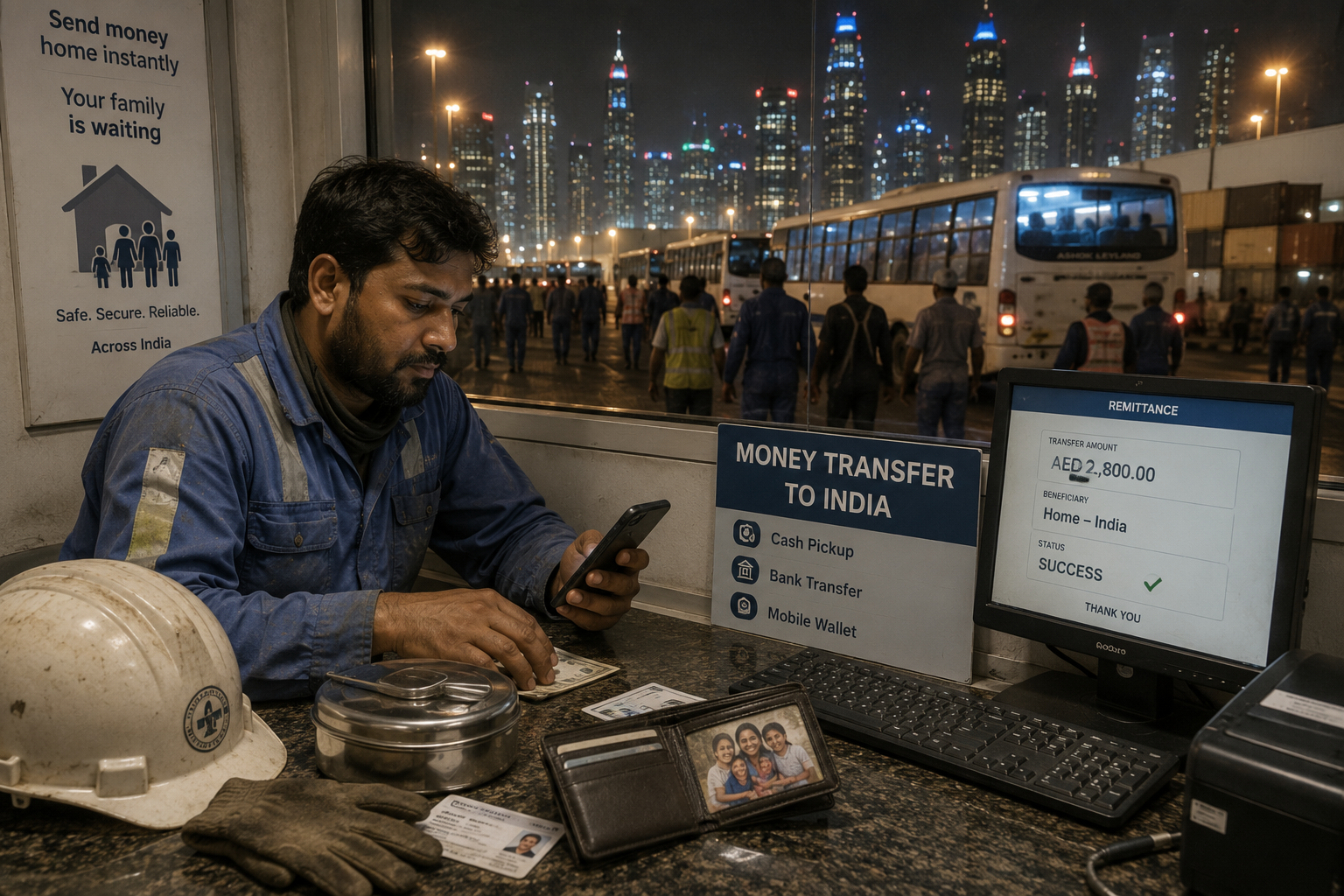
Every salary transfer from Dubai, Abu Dhabi, Riyadh, Jeddah, Doha, Muscat, Kuwait City or Manama becomes part of India’s household economy. It pays school fees, medical bills, house loans, marriages, farm improvements, small businesses and family survival.
A remittance begins as a private act of responsibility.
At scale, it becomes national resilience.
The Gulf Worker Is Different From the Western Diaspora
India’s Western diaspora is often associated with high-skilled migration: software engineers, doctors, finance professionals, academics, start-up founders and students.
The Gulf diaspora is different.
It includes professionals and entrepreneurs, but its emotional centre remains labour migration: construction workers, electricians, plumbers, welders, drivers, cleaners, security guards, hospitality staff, nurses, caregivers, retail workers, mechanics, technicians and domestic workers.
This difference matters.
A software engineer in California may negotiate salary, stock options and visa strategy. A construction worker in Saudi Arabia may worry about recruitment debt, contract substitution, passport access, accommodation, heat, medical treatment and whether his salary reaches home on time.
Both are part of India’s global story. But they do not face the same risks.
That is why Gulf migration must be understood through labour protection, not only diaspora pride.
India must celebrate global Indian success, but it must also confront global Indian vulnerability.
Gulf Migration Is a Family Strategy
For many Indian households, Gulf migration is not simply employment. It is a family strategy.
One person leaves so that the household can rise. The worker spends years away from home, often in difficult conditions, so that children can study, parents can receive medical care, a house can be built, debts can be repaid and siblings can marry or start businesses.
In many villages and towns, the Gulf has shaped aspiration for decades. A Gulf job is not just a job. It is a route to dignity, mobility and social recognition.
But the cost is severe.
Families live separated for years. Children grow up seeing a parent only during short visits. Workers miss festivals, illness, family crises and the everyday life of home. Many live with loneliness, stress and uncertainty. The money arrives, but the person is absent.
That is the emotional economy behind remittances.
India’s public conversation often sees the money. It rarely sees the loneliness that produced it.
Gulf Workers Are Central to India-Gulf Diplomacy
India’s relations with Gulf countries are often discussed through oil, gas, trade, investment, defence cooperation, ports, food security and geopolitical balancing.
All of that matters. But the presence of millions of Indians gives these relationships a human core.
The UAE is not only India’s trade partner. It is home to millions of Indians. Saudi Arabia is not only an energy partner. It is a major Indian labour destination. Kuwait, Qatar, Oman and Bahrain are not only diplomatic partners. They are workplaces for Indian citizens.
This changes India’s foreign policy.
When India negotiates with Gulf governments, it is not merely negotiating energy contracts or strategic alignments. It is also negotiating the conditions under which millions of Indians live and work.
That gives India leverage, but also responsibility.
Gulf economies benefit from Indian labour. Indian families benefit from Gulf employment. The relationship is mutually dependent. But mutual dependence does not automatically mean equal power. The worker is often the weakest person in the chain.
Therefore, India-Gulf diplomacy must always include labour welfare, wage protection, recruitment transparency, dispute resolution, accommodation standards and emergency assistance.
A strong India-Gulf relationship cannot be measured only by investment announcements. It must also be measured by how safely Indian workers live.
The Recruitment Chain Is the First Point of Vulnerability
Many Gulf worker problems begin before the worker leaves India.
A worker may be promised one salary and given another. A job may be described as skilled but turn out to be low-paid manual labour. A recruiting agent may charge illegal fees. A worker may borrow money at high interest to pay for migration. Documents may be manipulated. Families may be misled about working conditions.
By the time the worker reaches the Gulf, the trap has already been set.
India has a formal emigration system for vulnerable workers. The Emigration Act regulates recruitment of Indian nationals holding Emigration Check Required passports for overseas employment. A March 2025 parliamentary reply stated that recruitment of blue-collar Indian workers is done through the eMigrate portal, which brings foreign employers, registered recruiting agents and prospective emigrants onto a common platform; it also noted that eMigrate-V2.0 was inaugurated in October 2024.
This is important because safe migration must be documented, traceable and enforceable.
But the existence of a system does not mean exploitation disappears. Unregistered agents, informal networks and desperation still create risk. A worker who urgently needs income may ignore warnings. A family under debt pressure may trust the wrong person. A young man with limited education may not fully understand the contract he signs.
The state’s challenge is not only to create portals. It is to make safe migration easier than unsafe migration.
Women Workers Face a Different Level of Risk
Indian women working in the Gulf face specific vulnerabilities, especially in domestic work and caregiving.
Domestic workers often work inside private homes, where inspection is difficult. They may face isolation, excessive working hours, restricted mobility, unpaid wages, abuse or difficulty accessing help. Even when labour laws exist, enforcement inside households can be weak.
India has recognised this vulnerability. The March 2025 parliamentary reply stated that, as an additional safeguard, only state-run recruiting agencies are authorised to recruit Indian female ECR-category workers for overseas employment in Gulf and other ECR countries through the eMigrate portal; it also mentions a minimum age criterion of 30 years for ECR-category female workers.
This is a necessary protection, but it must be implemented seriously.
Women workers need stronger pre-departure training, emergency contact systems, shelter access, legal aid, verified employers and follow-up after arrival. A woman working inside a home abroad should not have to depend only on personal luck or informal community networks for safety.
The dignity of India’s overseas presence is tested most sharply in the treatment of its most vulnerable workers.
The Kafala Problem Has Not Fully Disappeared
The Gulf labour system has changed, but many old problems remain.
For decades, migrant workers across the Gulf were governed by versions of the kafala sponsorship system, which tied a worker’s legal status to an employer. Reforms have taken place in several countries, including Saudi Arabia, Qatar and Oman, and these reforms can improve worker mobility and protection. However, analysts continue to warn that nationalisation policies and labour-market restructuring may reduce some expatriate opportunities even as reforms improve legal protections.
The practical problem is this: law on paper and worker experience on the ground are not always the same.
A worker may technically have rights but lack language, legal knowledge, money, mobility or confidence to claim them. Employers may still hold power through accommodation, documentation, wages and threats of termination. A worker who has borrowed money to migrate may tolerate abuse because returning home empty-handed would destroy the family’s finances.
This is why Gulf worker protection cannot rely only on host-country reform announcements.
India must keep monitoring actual outcomes.
The Kuwait Fire Exposed the Human Cost
The vulnerability of Gulf workers became tragically visible in June 2024, when a fire in a labour housing facility in Mangaf, Kuwait, killed dozens of foreign workers, including many Indians. Reuters reported that India brought home the bodies of 45 workers killed in the fire, and the tragedy raised serious concerns about living conditions for foreign workers in Kuwait and the wider Gulf.
Such tragedies reveal what ordinary statistics hide.
Behind every remittance is a body at work.Behind every foreign exchange inflow is a living condition.Behind every diplomatic handshake is a worker sleeping somewhere.
The Kuwait fire was not only a disaster. It was a reminder that worker welfare cannot be reduced to compensation after tragedy. The real policy question is prevention: accommodation standards, fire safety, overcrowding, employer accountability, inspection and emergency response.
India cannot control every building in the Gulf. But it can push harder, document risks, strengthen worker registration, engage host governments and use diplomatic channels when patterns of negligence appear.
A country that depends on overseas workers must become better at protecting them before crisis.
India Has Welfare Mechanisms, But They Need Scale and Speed
India does have institutional mechanisms to support workers abroad.
The Indian Community Welfare Fund is meant to assist Indian nationals in distress abroad. MEA has stated that ICWF can be used for legal assistance, boarding and lodging, emergency medical care, air passage to stranded Indians, transportation of mortal remains, and payment of small fines and penalties for release from jail or detention.
The Pravasi Bharatiya Bima Yojana is another important mechanism. It is a mandatory insurance scheme for ECR-category Indian emigrant workers going to ECR countries for overseas employment. The 2017 scheme provides ₹10 lakh cover in case of accidental death or permanent disability, with additional medical, repatriation, family hospitalisation and maternity benefits.
India also runs Pre-Departure Orientation Training. MEA launched PDOT in 2018 to help migrant workers, especially those going to Gulf and other ECR countries, understand local culture, language, rules, welfare schemes and safe migration practices.
These are useful systems.
But the test is not whether schemes exist. The test is whether a distressed worker can actually access them quickly.
A worker in trouble needs a functioning phone number, a responsive embassy, a shelter bed, legal advice, translation help, employer pressure and a path home if needed. A family in India needs information. A dead worker’s family needs fast repatriation and compensation support.
Welfare must work at the speed of distress.
Labour Agreements Are Necessary, But Not Enough
India has labour and manpower cooperation agreements with Gulf countries, including Bahrain, Kuwait, Oman, Qatar, Saudi Arabia and the UAE. These agreements provide a bilateral framework for cooperation on labour issues and include Joint Working Groups where welfare and protection matters are raised.
This is important because labour protection cannot be handled only case by case. It needs formal diplomatic structure.
But agreements alone are not enough.
India should use these frameworks to push for enforceable wage protection, transparent contracts, employer blacklisting, faster dispute settlement, insurance compliance, recruitment fee control, worker accommodation audits and data-sharing on deaths, injuries and complaints.
The goal should be to move from reactive assistance to preventive labour diplomacy.
India should not wait for workers to suffer and then intervene. It should identify risk sectors early.
Gulf Workers Also Shape India’s Social Geography
Gulf migration has transformed parts of India.
Kerala is the most famous example. For decades, Gulf remittances shaped Kerala’s housing, education, consumption, healthcare access and social mobility. But Gulf migration is no longer only a Kerala story. Uttar Pradesh, Bihar, Telangana, Andhra Pradesh, Tamil Nadu, Rajasthan, Punjab, Maharashtra, West Bengal and Odisha are also part of the Gulf labour map.
This matters because Gulf migration affects domestic politics and state policy.
A state with high migration needs better skill training, passport services, agent regulation, family support, financial literacy and reintegration programmes for returning workers. It also needs local employment so migration remains a choice, not compulsion.
When a worker returns from the Gulf after years abroad, he may have savings but not always a stable livelihood plan. Some returnees build homes but struggle to find income. Others invest in small businesses without enough guidance. Many return with health problems, debt or emotional fatigue.
India needs a return migration policy.
A worker who spent 20 years building the Gulf should not return to India as a forgotten man.
Gulf Economies Are Changing, and India Must Adapt
The Gulf itself is changing.
Saudi Arabia’s Vision 2030, UAE diversification, Qatar’s post-World Cup development, Oman’s labour reforms and nationalisation policies across the region are reshaping labour demand. The Gulf still needs foreign workers, but the profile of demand may change: more skilled technicians, healthcare workers, hospitality professionals, logistics workers, renewable-energy technicians, construction specialists, digital workers and service-sector professionals.
This creates both opportunity and risk for India.
If India upgrades skills, certifications, language training and worker preparation, Indian workers can move up the wage ladder. If it does not, they may face competition from other labour-sending countries or pressure from Gulf nationalisation policies.
The future Gulf worker cannot remain only low-skilled and vulnerable.
India should treat Gulf migration as a skill-export strategy. Workers should leave with recognised certifications, verified contracts, financial literacy, legal awareness and destination-specific training.
The next stage is not simply sending more workers. It is sending better-protected and better-skilled workers.
The Gulf Worker Is Also a Cultural Bridge
Indian workers in the Gulf have created a deep social bridge between India and West Asia.
They run shops, staff hospitals, maintain infrastructure, drive taxis, manage logistics, build towers, cook food, provide services, work in ports, serve in hotels and support households. Over decades, they have made India familiar to Gulf societies.
This everyday familiarity strengthens bilateral relations in ways official diplomacy cannot.
Indian food, languages, festivals, cinema, schools, religious institutions, social clubs and community networks have become part of Gulf urban life. In cities like Dubai, Abu Dhabi, Doha, Muscat, Manama and Kuwait City, Indian presence is not foreign in the ordinary sense. It is woven into the functioning of the city.
This gives India soft power.
But it is soft power built by workers, not only artists, diplomats or CEOs.
A construction worker may not call himself a cultural ambassador. Yet his presence has helped make India visible, useful and trusted.
The Invisible Worker Must Become Visible in Policy
India’s diaspora policy often celebrates success.
That is understandable. The rise of Indian-origin CEOs, politicians, investors and professionals is a source of pride. But diaspora policy must not become class-biased.
The Gulf worker deserves the same respect as the Silicon Valley engineer.
In fact, he may need more state attention because he has less bargaining power. A wealthy professional can hire a lawyer. A low-wage worker may not even know whom to call. A student can email a university office. A domestic worker may be isolated inside a private home. A senior executive can return home if a job fails. A debt-burdened labourer cannot.
Visibility is the first step toward justice.
India should collect better data, publish worker complaint trends, create state-wise migration dashboards, regulate agents more aggressively, strengthen embassies’ labour wings and expand shelter capacity.
The worker should not become visible only when he dies.
The Counter-View: Is Gulf Migration Still as Important?
A counter-view says Gulf migration is becoming less central.
Advanced economies now account for a larger share of India’s remittances. Skilled migration to the US, UK, Canada, Australia and Singapore is rising. Younger Indians increasingly prefer student and professional pathways rather than traditional Gulf labour routes. Gulf countries are also pushing localisation policies to employ more nationals.
This argument has merit.
India’s migration profile is changing. The Gulf is no longer the only remittance story. High-skilled migration is increasingly important. The future of Indian global mobility will be more diversified.
But the counter-view misses scale and vulnerability.
Nearly 8.88 million overseas Indians in GCC countries cannot be treated as yesterday’s story. The Gulf remains one of the largest concentrations of Indians abroad. It remains a major remittance source. It remains central to India’s energy, trade, logistics and West Asia diplomacy. Most importantly, it hosts many workers who need active protection.
Strategic importance is not measured only by glamour. It is measured by consequence.
By that standard, Gulf workers still matter enormously.
What India Should Do Next
India needs a stronger Gulf worker policy built around six priorities.
First, recruitment must be cleaned up. Unregistered agents, illegal fees and false job promises should be treated as serious economic crimes.
Second, every worker should receive practical pre-departure preparation: language basics, labour rights, emergency contacts, contract literacy, cultural orientation, financial planning and mental health awareness.
Third, embassies in Gulf countries need stronger labour welfare capacity. Helplines, shelter homes, legal panels, translation support and employer dispute systems must be easy to access.
Fourth, India should negotiate stronger enforcement in labour agreements. Wage theft, passport retention, unsafe accommodation and contract substitution should be raised systematically, not only after media attention.
Fifth, families in India should be included in migration policy. A worker’s wife, parents and children need financial literacy, insurance awareness and emergency communication channels.
Sixth, returning workers need reintegration support. Skills learned abroad should be recognised. Savings should be guided into safe investment. Returnees should receive entrepreneurship and employment support.
This is not charity.
This is national interest.
What Happens Next
The future of Indian Gulf workers will be shaped by five forces.
First, Gulf economies will continue to diversify beyond oil, creating demand in construction, logistics, tourism, healthcare, retail, energy transition and services.
Second, labour nationalisation policies may reduce some low-skilled opportunities while increasing demand for certified, higher-skilled workers.
Third, worker rights reforms will continue, but implementation will remain uneven.
Fourth, India’s domestic job market will influence migration pressure. If India cannot create enough dignified employment at home, Gulf migration will remain a necessity for many families.
Fifth, India’s diplomatic maturity will be tested by whether it can protect vulnerable workers while maintaining strong strategic ties with Gulf governments.
The Gulf worker remains the invisible pillar of India’s overseas presence because he connects India to the world through labour, sacrifice and remittance.
He builds foreign cities and Indian homes at the same time.
He powers Gulf infrastructure and Indian household security at the same time.
He lives outside India, but much of his life is still organised around India.
India must finally see him clearly.
Not only as a remittance sender.Not only as a passport holder in distress.Not only as a statistic in migration data.But as a worker whose labour has quietly strengthened India’s economy, diplomacy and society for generations.
The Indian Gulf worker has carried India abroad.
Now India must carry his welfare with equal seriousness.