Introduction: A Country Learned to See Itself on Screen
From the first silent screenings in colonial cities to modern streaming platforms reaching global audiences, Indian cinema has repeatedly changed its form while retaining one central power: it brings together audiences across class, language and region. The film theatre became a public space where strangers laughed, cried, worshipped stars and argued about society. Cinema did not simply reflect India; it participated in making modern India visible to itself.
Early Encounters with Moving Pictures
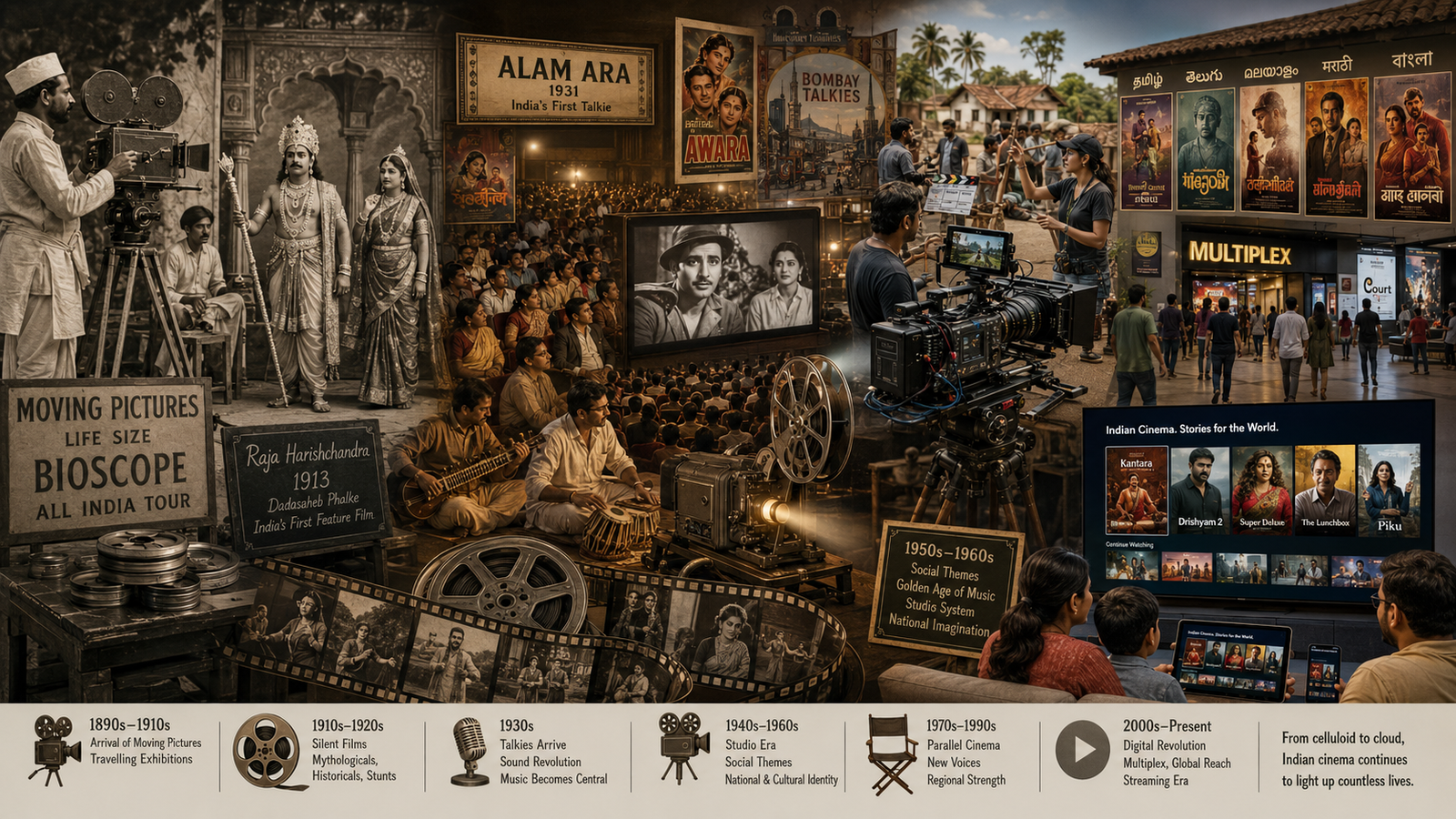
Moving pictures arrived in India soon after their European debut. In the late nineteenth century, travelling exhibitors and colonial entrepreneurs screened short films in Bombay, Calcutta and Madras. These early shows were technological wonders rather than fully developed narrative cinema. Audiences saw trains, street scenes, royal events and foreign spectacles. The novelty lay in motion itself.
Indian photographers, theatre practitioners and entrepreneurs soon began experimenting with the medium. The existing culture of Parsi theatre, mythological storytelling, music-drama and visual spectacle created fertile ground for cinema. India already had rich performance traditions; cinema offered a new machine through which these traditions could be recorded, rearranged and commercialised. The camera did not arrive in a cultural vacuum. It entered a world already full of epic stories, devotional images, dramatic gesture and public performance.
Dadasaheb Phalke and the Birth of the Indian Feature Film
Dhundiraj Govind Phalke, better known as Dadasaheb Phalke, occupies a foundational place in Indian cinema. His 1913 film Raja Harishchandra is generally regarded as India’s first full-length feature film. The film drew upon a familiar mythological story, allowing audiences to encounter a new technology through a known moral universe. Phalke wrote, produced, directed, edited and distributed the film, demonstrating that cinema required not only artistic imagination but technical mastery and entrepreneurial courage.
The choice of mythology was significant. In a colonial society, mythological cinema gave Indian audiences sacred and cultural material on screen. Gods, kings, sages and moral dilemmas entered a modern medium. Phalke’s work showed that cinema could be Indian not merely by being made in India but by drawing from Indian narrative worlds. Silent cinema then expanded through mythologicals, historicals, stunt films and social themes. Even without spoken dialogue, films could travel across linguistic boundaries through gesture, music, intertitles and familiar stories.
The Studio Era and the Coming of Sound
The arrival of sound transformed Indian cinema. Alam Ara, released in 1931, is remembered as India’s first talkie. Sound did not merely add dialogue; it changed the structure of Indian film. Song became central. Music connected cinema to theatre, devotional traditions, folk performance and urban popular culture. The Indian film song became one of the most durable cultural forms of the twentieth century.
Studios emerged in Bombay, Calcutta, Pune, Madras and other centres. Companies such as Bombay Talkies, New Theatres, Prabhat and others developed production systems, stars and technical crews. The studio era brought professionalisation, but Indian cinema remained porous. It borrowed from literature, theatre, classical music, folk forms and political debates. Social reform films addressed widow remarriage, caste, women’s education, poverty and modernity. Devotional films reached mass audiences. Historical films created heroic memories. Cinema was becoming a popular public language.
Cinema and Nationalism
During the freedom struggle, cinema operated under colonial censorship but still carried nationalist emotion indirectly. Direct political criticism was often risky, so films encoded ideas through historical allegory, moral struggle, social reform and songs. The figure of the suffering mother, the just ruler, the corrupt oppressor or the self-sacrificing hero could speak to audiences beyond the literal plot.
Indian cinema also helped create a wider public sphere. Film songs travelled through gramophone records and radio. Stars became public figures. The film poster became a visual language in bazaars and towns. Even when films avoided explicit politics, they shaped ideas of community, justice, gender, sacrifice and belonging. By the time India became independent in 1947, cinema had already become one of the country’s most influential cultural industries.
Post-Independence Cinema: Nation, Society and Dream
After independence, Indian cinema confronted a new question: what kind of country was India becoming? Films of the 1950s and 1960s often explored poverty, migration, inequality, morality and the promise of modernity. Directors such as Raj Kapoor, Bimal Roy, Mehboob Khan and Guru Dutt created films that combined popular appeal with social concern. The village, the city, the worker, the mother, the orphan and the migrant became recurring figures in national storytelling.
This was also the golden age of film music, lyric writing and playback singing. The playback system separated the singing voice from the actor’s body but joined them in public memory. Audiences knew singers, composers and lyricists as deeply as they knew actors. The film song became an archive of emotion, language and aspiration. It could carry romance, devotion, patriotism, grief and philosophical reflection.
Regional Cinemas and Linguistic Worlds
Indian cinema is often wrongly reduced to Hindi cinema. In reality, it has always been a federation of film cultures. Tamil, Telugu, Malayalam, Kannada, Bengali, Marathi, Assamese, Odia, Punjabi and other industries developed their own stars, genres, politics and aesthetics. Regional cinema often expressed linguistic pride and local social experience more directly than all-India cinema could.
Tamil and Telugu cinemas built powerful star cultures and political connections. Bengali cinema produced both popular and art-house traditions. Malayalam cinema became known for literary realism and social detail. Marathi cinema retained deep links with theatre and reformist traditions. Kannada cinema explored language identity and literary adaptation. These regional industries show that Indian cinema is not a single river but a network of cinematic worlds, each shaped by language, audience and history.
Parallel Cinema and the Realist Turn
Alongside popular cinema, a powerful tradition of realist and parallel cinema emerged. Satyajit Ray’s Pather Panchali and the Apu trilogy brought international recognition to Indian filmmaking. Ritwik Ghatak, Mrinal Sen, Shyam Benegal, Adoor Gopalakrishnan, Govind Nihalani and others explored partition, poverty, caste, class, gender, political violence and moral ambiguity. This cinema rejected formulaic spectacle and insisted that the ordinary life of common people deserved artistic attention.
Parallel cinema was not anti-Indian cinema; it was another Indian cinema. It showed that the film medium could be poetic, critical and introspective. It also raised difficult questions. Could serious cinema survive without mass markets? Should the state support alternative film cultures? How should filmmakers balance artistic freedom and public reach? These debates remain relevant in the streaming age.
The Age of the Superstar and Mass Politics
From the 1970s onward, the figure of the superstar became central. Amitabh Bachchan’s angry young man expressed urban frustration, unemployment, corruption and moral rebellion. In the South, actors such as M.G. Ramachandran, N.T. Rama Rao, Rajinikanth and others became larger-than-life cultural icons, some crossing directly into politics. Stardom in India often became more than celebrity; it became a relationship of devotion, identification and public trust.
The single-screen theatre was crucial to this culture. It created collective viewing: applause, whistles, repeat audiences and ritualised fandom. Posters, cut-outs, fan clubs and opening-day celebrations turned cinema into social event. The popular film became a democratic spectacle, enjoyed by audiences who might otherwise be divided by class, region or education.
Liberalisation, Multiplexes and Global Audiences
The economic liberalisation of the 1990s changed Indian cinema. Satellite television, music channels, advertising, overseas markets and corporate financing expanded the industry. The Non-Resident Indian audience became important, and films began imagining global Indian identity. Multiplexes changed viewing habits and allowed smaller urban films to find niche audiences, while big-budget films became more aggressively marketed.
Technology also transformed production. Digital cameras, computerised editing, visual effects and online promotion altered the filmmaking process. The boundaries between film, television, music video and advertising became fluid. Later, streaming platforms created new possibilities for long-form storytelling, documentaries, regional content and independent cinema. The theatrical film did not disappear, but it now existed within a much larger screen ecosystem.
Historical Debates Around Indian Cinema
Several debates shape the study of Indian cinema. One concerns realism versus spectacle. Critics have often accused popular cinema of escapism, but spectacle can carry social meaning. Songs, melodrama and fantasy may express desires that realistic cinema cannot. Another debate concerns gender. Indian films have produced powerful female icons but have also repeated patriarchal stereotypes. A third debate concerns nationalism and censorship: cinema is celebrated as national culture but also controlled when it challenges dominant narratives.
There is also the question of preservation. Much of early Indian cinema is lost because film stock was fragile, storage was poor and preservation was neglected. The loss of silent films and early talkies is not merely a technical tragedy; it is the loss of cultural memory. Film archives therefore matter as much as monuments and manuscripts.
Legacy: India’s Most Democratic Art Form
Indian cinema’s legacy lies in its scale, diversity and emotional reach. It has created shared memories across generations. It has given language to love, grief, rebellion, devotion and aspiration. It has turned actors into icons, songs into public memory and stories into social conversation. It has carried India to global audiences and brought the world into Indian imagination.
The history of Indian cinema is ultimately the history of a modern society negotiating tradition and change through images. It began with silent mythological scenes and now moves through digital platforms, global festivals and mass spectacles. Yet its deepest power remains unchanged: in a darkened space, whether theatre or phone screen, it allows millions to see versions of themselves, their fears and their dreams.