Why Trees Are Important: Benefits for Climate, Water, Soil, Wildlife and Cities
Trees are often described as sources of oxygen, shade and timber. All three matter, but they capture only a small part of what trees actually do.
A mature tree is continuously exchanging water, carbon and energy with its surroundings. Its roots alter soil structure. Its leaves intercept rainfall and sunlight. Its canopy changes temperature and humidity. Its flowers, fruits and seeds feed other organisms. Its trunk stores carbon. Its cavities provide shelter. Even after death, its wood can support fungi, insects, decomposers and nutrient cycling.
At the scale of a forest, watershed, farm or city, these processes become something comparable to living infrastructure.
Trees help regulate climate, influence water cycles, reduce soil erosion, support biodiversity, contribute to agriculture, provide food and livelihoods, cool cities and store carbon. Their benefits vary by species, age, climate and location, which is why environmental policy must look beyond simply counting how many trees have been planted.
Why Are Trees Important?
Trees matter because they participate in several environmental systems simultaneously.
Their major roles include:
| Role of trees | Why it matters |
|---|---|
| Carbon storage | Removes carbon dioxide from the atmosphere and stores carbon in biomass |
| Water regulation | Intercepts rainfall, influences infiltration and returns water to the atmosphere |
| Soil protection | Roots, canopies and litter can reduce erosion and improve soil structure |
| Wildlife habitat | Provides food, nesting sites, shelter and ecological connections |
| Agricultural support | Can provide shade, wind protection, pollinator habitat and nutrient cycling |
| Urban cooling | Shade and evapotranspiration can reduce local heat exposure |
| Food and livelihoods | Supplies fruits, nuts, timber, fuel, medicines and other products |
| Cultural value | Trees can serve as landmarks, sacred places and parts of community identity |
These functions are interconnected.
A forest that protects soil can also influence water quality. A tree that cools a street may simultaneously store carbon and provide habitat for birds and insects. A tree on a farm may reduce wind exposure while producing fruit or fodder.
The importance of trees therefore comes from systems of benefits rather than one isolated service.
Trees Store Carbon and Influence the Climate
Trees absorb carbon dioxide during photosynthesis and convert some of that carbon into wood, roots, leaves and other tissues.
Forests also store carbon in soils, deadwood and organic matter.
According to the FAO information cited in the source material, forests cover roughly 31% of the world's land surface and hold enormous quantities of carbon. Protecting those existing stocks is an important part of climate policy.
But tree-based climate solutions need to be described carefully.
Trees do not absorb carbon at exactly the same rate throughout their lives. Forests can also lose stored carbon through:
- wildfire,
- drought,
- decomposition,
- logging,
- land clearing,
- severe ecosystem degradation.
Different ecosystems also store very different amounts of carbon above and below ground.
A mature tropical forest, a dry woodland, a mangrove and a commercial plantation cannot be treated as interchangeable carbon stores.
The climate role of trees therefore involves at least two strategies:
protecting existing carbon-rich forests, and
restoring tree cover where ecological conditions make restoration appropriate.
Neither should be treated as a substitute for reducing fossil-fuel emissions.
Planting trees can contribute to climate action. It cannot compensate indefinitely for continued large-scale greenhouse-gas emissions.
Trees and the Water Cycle
Trees are deeply connected to the movement of water through landscapes and the atmosphere.
When rain falls onto a forest, some water first strikes leaves, branches and bark rather than bare ground.
This canopy interception can change how quickly rainfall reaches the soil.
Roots create channels in the ground, while leaf litter protects the soil surface and can promote infiltration under suitable conditions.
Tree cover may also help reduce erosion and the movement of sediment into rivers.
At the same time, trees consume water.
They draw moisture from the soil and release much of it into the atmosphere through transpiration. Combined with evaporation, this process forms part of evapotranspiration.
Atmospheric moisture originating from vegetation can influence humidity, cloud formation and rainfall patterns.
This makes forests important components of regional water cycles.
Do Trees Increase Water Availability?
Not always.
This is where oversimplified claims become dangerous.
Trees can improve infiltration, soil structure and watershed protection while simultaneously reducing streamflow in some environments because they use more water than the vegetation they replace.
In a dry catchment, planting dense tree cover can sometimes reduce the amount of water reaching rivers.
The effect depends on factors such as:
- rainfall,
- species,
- soil,
- tree density,
- previous vegetation,
- climate,
- watershed characteristics.
So the statement “trees create water” is too simplistic.
A better conclusion is:
Trees influence how water moves through soils, vegetation, rivers and the atmosphere, and the result depends strongly on ecological context.
Trees Protect Soil
Bare soil is vulnerable to erosion from rain and wind.
Trees can reduce that vulnerability in several ways.
The canopy intercepts rainfall before it reaches the ground at full force.
Leaf litter cushions the soil surface.
Roots help bind soil and can stabilise slopes, riverbanks and other vulnerable areas.
Organic matter from fallen leaves and woody material can also contribute to soil structure and nutrient cycling.
In agricultural landscapes, lines of trees can function as windbreaks, reducing wind speed and helping protect crops and topsoil.
On sloping terrain, appropriate tree and forest cover may reduce erosion compared with exposed or poorly managed land.
However, trees do not make landscapes immune to landslides, flooding or soil loss.
Extreme rainfall, geology, slope, land management and infrastructure can still overwhelm vegetation's protective effects.
Trees should therefore be understood as one component of watershed and land-management systems rather than a universal shield against natural hazards.
Trees Are Habitat From Roots to Canopy
To wildlife, a tree is not simply landscape scenery.
It can be an entire habitat.
Different parts of a tree support different organisms:
Bark can support insects, lichens and microorganisms.
Leaves provide food for caterpillars and browsing animals.
Flowers provide nectar and pollen.
Fruits and seeds feed birds, mammals and insects.
Branches provide perches and nesting structures.
Cavities can shelter birds, bats and other animals.
Roots interact with fungi, microbes and soil organisms.
Deadwood supports decomposers, fungi and insects.
The ecological significance of trees therefore continues throughout their lives—and often after they die.
Why Tree Species Matter for Biodiversity
Planting ten trees does not automatically provide the same biodiversity value as protecting ten mature native trees.
Species identity matters.
Native tree species often have long ecological relationships with local insects, fungi, birds and mammals.
Some insects may depend on particular plant groups for food or reproduction.
An introduced ornamental species may still provide shade, beauty or carbon storage but support a different set of ecological relationships.
Age matters as well.
Large old trees can contain hollows, deadwood, thick bark and complex branch structures that young trees may take decades to develop.
This is why biodiversity-oriented tree policy should consider:
- native species,
- age diversity,
- habitat connectivity,
- structural complexity,
- surrounding vegetation,
- deadwood,
- long-term survival.
Counting seedlings alone does not reveal whether a functioning habitat has been created.
Trees Support Agriculture
Forests and agriculture are often presented as competing land uses.
At the frontier of deforestation, they frequently are.
But trees can also support farming.
They may provide habitat for wild pollinators and natural predators of agricultural pests.
Windbreaks can protect crops from wind damage.
Shade trees can reduce heat stress for livestock and for some crops.
Roots and litter can influence nutrient cycling and soil conditions.
Forested catchments can contribute to water and soil protection.
This relationship is especially visible in agroforestry, where trees are deliberately integrated with crops or livestock.
Examples can include:
- trees combined with pasture,
- shade-grown crops,
- fruit trees integrated into farms,
- shelterbelts,
- tree-based boundary systems.
Agroforestry is not suitable for every crop or every climate, and poorly chosen trees can compete with crops for light or water.
But it demonstrates that productive landscapes do not always have to be divided sharply into “forest” and “farm.”
Trees Provide Food, Fuel and Livelihoods
The importance of trees is also highly practical.
Tree and forest products can include:
- fruits,
- nuts,
- seeds,
- mushrooms,
- honey,
- fodder,
- medicines,
- fibres,
- resins,
- timber,
- fuelwood.
For many rural households, these resources contribute directly to food security and income.
Some forest products are consumed by families rather than sold through formal markets, which can make their economic importance difficult to measure.
Trees can also function as a buffer during difficult periods.
When crops fail, employment falls or grazing conditions deteriorate, forest foods, fodder or saleable products may provide alternative resources.
The benefits can therefore extend beyond conventional forestry statistics.
Why Trees Matter in Cities
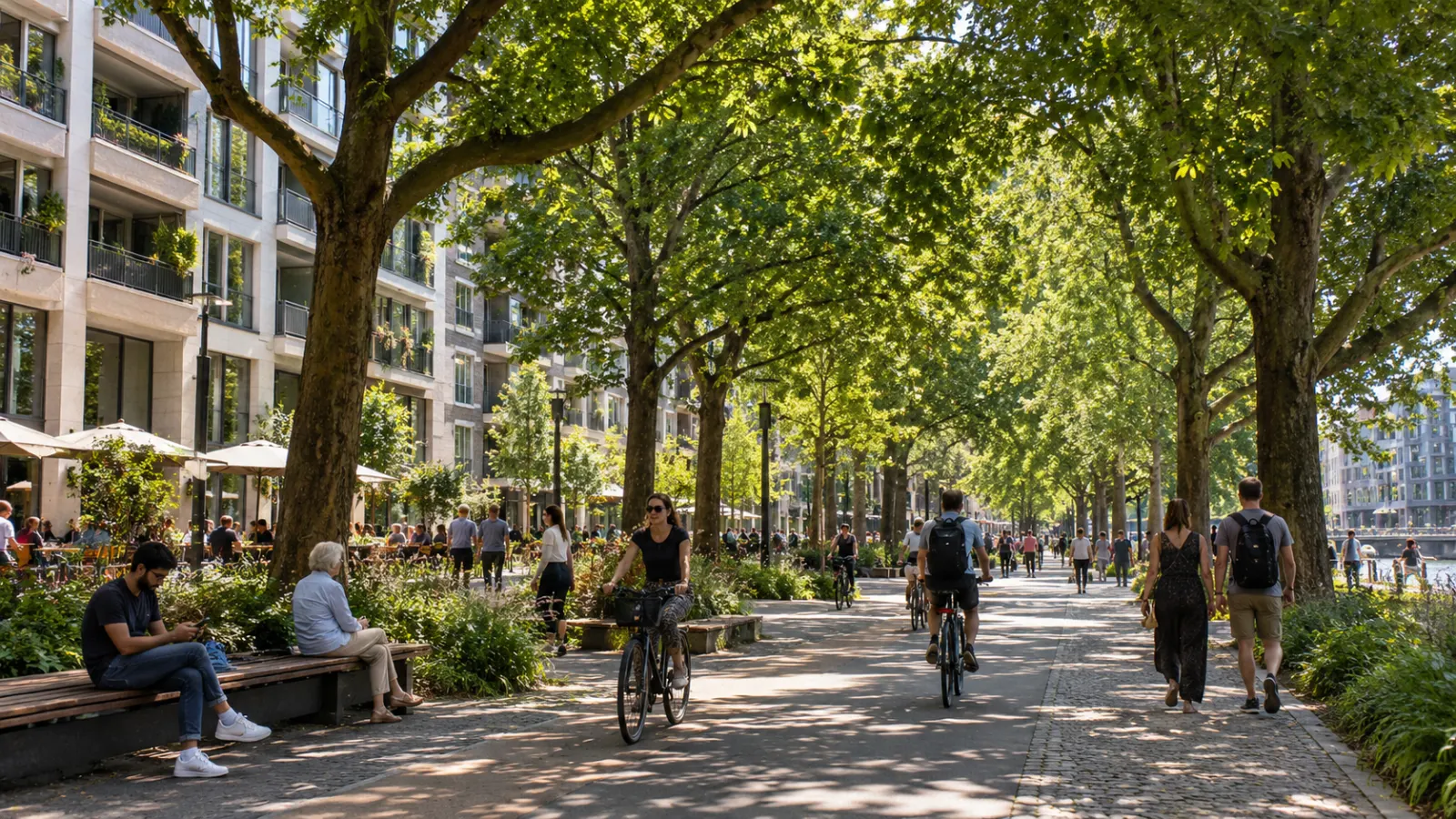
Urban trees perform a somewhat different set of functions from trees in natural forests.
One of the most important is heat reduction.
Tree canopies shade:
- roads,
- pavements,
- buildings,
- public spaces,
- pedestrians.
Shade reduces the amount of solar energy absorbed by artificial surfaces.
Trees also release water through transpiration, which can contribute to local cooling.
Together, shade and evapotranspiration can help moderate urban heat.
This is particularly valuable as cities experience more intense heatwaves.
Urban Trees Can Function as Public Infrastructure
Urban tree canopy can also contribute to:
- stormwater interception,
- habitat for urban wildlife,
- noise reduction,
- visual amenity,
- recreation,
- contact with nature.
But urban forestry is not simply a matter of planting as many trees as possible.
Trees have to survive for decades to provide many of their largest benefits.
That requires attention to:
- available soil volume,
- water,
- species selection,
- heat tolerance,
- root space,
- pruning,
- construction damage,
- disease,
- storm resilience.
Poorly selected trees can create problems.
Roots may conflict with infrastructure. Some species can become invasive. Certain trees may produce substantial allergenic pollen. Weak structures can fail during storms.
A city should therefore treat tree canopy as long-term infrastructure requiring design and maintenance, not a one-time planting campaign.
Do Trees Produce the Oxygen We Breathe?
Trees release oxygen during photosynthesis.
That fact is real.
But the popular description of forests as the “lungs of the Earth” can create a misleading picture.
Terrestrial plants are not the only major producers of oxygen. Photosynthetic organisms in the oceans also contribute enormously to global oxygen production.
And ecosystems consume oxygen as well.
Plants respire.
Animals respire.
Microorganisms consume oxygen during decomposition.
Mature ecosystems therefore recycle much of the oxygen produced through photosynthesis.
Meanwhile, Earth's atmosphere already contains an enormous oxygen reservoir.
The immediate reason to protect forests is therefore not that humanity will suddenly run out of breathable oxygen if forests decline.
The stronger reasons include:
- carbon storage,
- biodiversity,
- water regulation,
- soil protection,
- local climate moderation,
- food,
- livelihoods,
- cultural value.
Trees are important enough without exaggerating their oxygen role.
A Tree Plantation Is Not the Same as a Natural Forest
One of the most important distinctions in environmental policy is between tree cover and ecosystem quality.
A commercial plantation may contain many trees.
So may an orchard.
A roadside avenue can have substantial canopy.
A natural forest also contains trees.
Yet these systems are ecologically different.
| Tree system | Primary characteristics |
|---|---|
| Natural forest | Complex habitat, multiple species and ecological relationships |
| Timber plantation | Often designed primarily for wood production |
| Orchard | Designed primarily for food production |
| Urban trees | Shade, cooling, amenity and local habitat |
| Agroforestry | Integrates trees with agriculture |
| Mangrove forest | Coastal habitat with specialised ecological functions |
All can have value.
But their functions are not interchangeable.
A hectare of monoculture plantation cannot automatically replace a hectare of mature biodiverse forest simply because both contain tree cover.
Why Mature and Old Trees Matter
Large old trees can provide benefits that young trees cannot immediately replace.
They may contain:
- substantial stored carbon,
- large canopies,
- nesting hollows,
- deadwood,
- complex branches,
- deeply developed root systems,
- specialised microhabitats.
A newly planted sapling may eventually develop some of those characteristics.
But “eventually” can mean decades or longer.
This creates an important conservation principle:
protecting existing ecological capital and creating future ecological capital are different tasks.
Planting trees is valuable.
Preventing unnecessary loss of mature trees is also valuable.
One cannot always substitute instantly for the other.
Is Planting More Trees Always Good?
No environmental intervention is automatically beneficial everywhere.
Tree planting can fail when:
- inappropriate species are used,
- naturally non-forest ecosystems are planted,
- water demand is ignored,
- invasive species are introduced,
- monocultures replace diverse habitats,
- seedlings die because long-term maintenance is absent.
Grasslands, savannas and other naturally open ecosystems should not automatically be treated as empty land waiting for forests.
Likewise, restoring a degraded native forest is different from establishing a commercial plantation.
The more useful question is not:
How many trees were planted?
It is:
Were the right trees established in the right place, and are they likely to survive and provide the intended ecological function?
Trees and Climate Adaptation
Trees can also contribute to adapting to a changing climate.
Urban shade can reduce heat exposure.
Vegetation can help stabilise some erosion-prone landscapes.
Mangroves and other coastal vegetation can reduce some wave energy.
Agroforestry may help certain farming systems cope with heat, wind or rainfall variability.
Connected forest habitat can give some wildlife more opportunities to move as environmental conditions change.
But tree-based adaptation works best when it reflects local ecological conditions.
There is no universal tree-planting formula that works in every city, catchment, farm or ecosystem.
How Should Tree-Planting Success Be Measured?
Counting planted seedlings is easy.
Measuring successful restoration is harder.
A serious programme should ask:
How many trees survived after five or ten years?
Were appropriate species used?
Did soil condition improve?
Did biodiversity benefit?
Did canopy cover increase?
Was water availability affected?
Did local communities benefit?
Was existing natural habitat protected?
This distinction matters because planting campaigns can produce impressive numbers while ecological outcomes remain uncertain.
The meaningful measure is not simply the number of planting events.
It is the long-term function of the landscape that emerges.
Frequently Asked Questions About Trees
Why are trees important?
Trees store carbon, influence water cycles, protect soil, provide wildlife habitat, support food and livelihoods, contribute to agriculture and cool urban environments.
How do trees help reduce climate change?
Trees remove carbon dioxide through photosynthesis and store carbon in biomass and soils. Protecting existing forests can also prevent large stored carbon stocks from being released.
Do trees prevent soil erosion?
Tree roots, canopy and leaf litter can reduce erosion under many conditions by stabilising soil, intercepting rainfall and reducing exposed ground, although trees cannot prevent every landslide or erosion event.
How do trees help wildlife?
Trees provide food, nesting sites, shelter, cavities, insects, fruits, seeds and habitat from their roots to their canopies. Dead trees can also support fungi, insects and decomposers.
Why are trees important in cities?
Urban trees provide shade and evapotranspirative cooling, can intercept some stormwater and provide habitat and recreational value.
Do trees produce oxygen?
Yes. Trees release oxygen through photosynthesis, but global oxygen production also comes from marine organisms and much oxygen is recycled through respiration and decomposition.
Is planting trees enough to stop climate change?
No. Tree conservation and restoration can contribute to climate mitigation, but they cannot substitute for substantial reductions in fossil-fuel greenhouse-gas emissions.
Is planting any tree good for biodiversity?
Not necessarily. Biodiversity benefits depend on the species, ecosystem, location, age, management and ecological relationships involved.
Why are old trees important?
Old trees can store large amounts of carbon and provide hollows, deadwood and complex habitat structures that may take decades to develop.
Trees Are Living Infrastructure
Trees matter because many environmental and human systems depend on the processes they perform.
They can store carbon.
They influence water.
They protect soil.
They support wildlife.
They provide food, timber and livelihoods.
They shade cities.
They form parts of farms, watersheds and cultural landscapes.
But perhaps the most important lesson is that trees are not interchangeable units.
A mature forest tree is different from a seedling.
A native woodland is different from a plantation.
A mangrove is different from a street tree.
An urban shade tree solves different problems from an agroforestry tree.
The environmental question should therefore move beyond simply asking whether trees are good.
A more useful question is:
Which trees, in which place, managed for which purpose, as part of which ecosystem?
Answering that question well is what turns tree planting, forest conservation and urban forestry from symbolism into effective environmental policy.