Why Handwashing Matters: How Soap Helps Prevent Infection
Hands are remarkably efficient transport systems.
Throughout an ordinary day they touch phones, door handles, keyboards, food, railings, children, animals, money and other people. Most of those contacts are harmless. Human skin is naturally covered with microorganisms, and the goal of hygiene is not to create permanently sterile hands.
The problem begins when a disease-causing organism reaches the hands and is then transferred somewhere it can cause infection: the eyes, nose or mouth; food that another person will eat; a wound; a child; or a shared surface that someone else touches.
Handwashing interrupts that chain.
CDC describes washing with soap and clean running water as one of the most important everyday ways to reduce the spread of respiratory and diarrheal infections. Germs on unwashed hands can reach the body when people touch their eyes, nose or mouth, contaminate food during preparation, or transfer organisms onto objects that others later touch. (cdc.gov)
That does not mean washing prevents every infection.
A respiratory virus can spread through inhaled particles without ever travelling through your hands. Food can become contaminated before it reaches your kitchen. Someone can practise excellent hygiene and still become ill.
Handwashing works by reducing opportunities for transmission.
At population level, enough interrupted transmission opportunities translate into fewer infections.
Soap, friction and water work together
A quick rinse under water is better than nothing, but soap substantially improves cleaning.
Human skin contains oils, dirt, organic material and microorganisms. Some microbes can become trapped within that material or adhere to the skin.
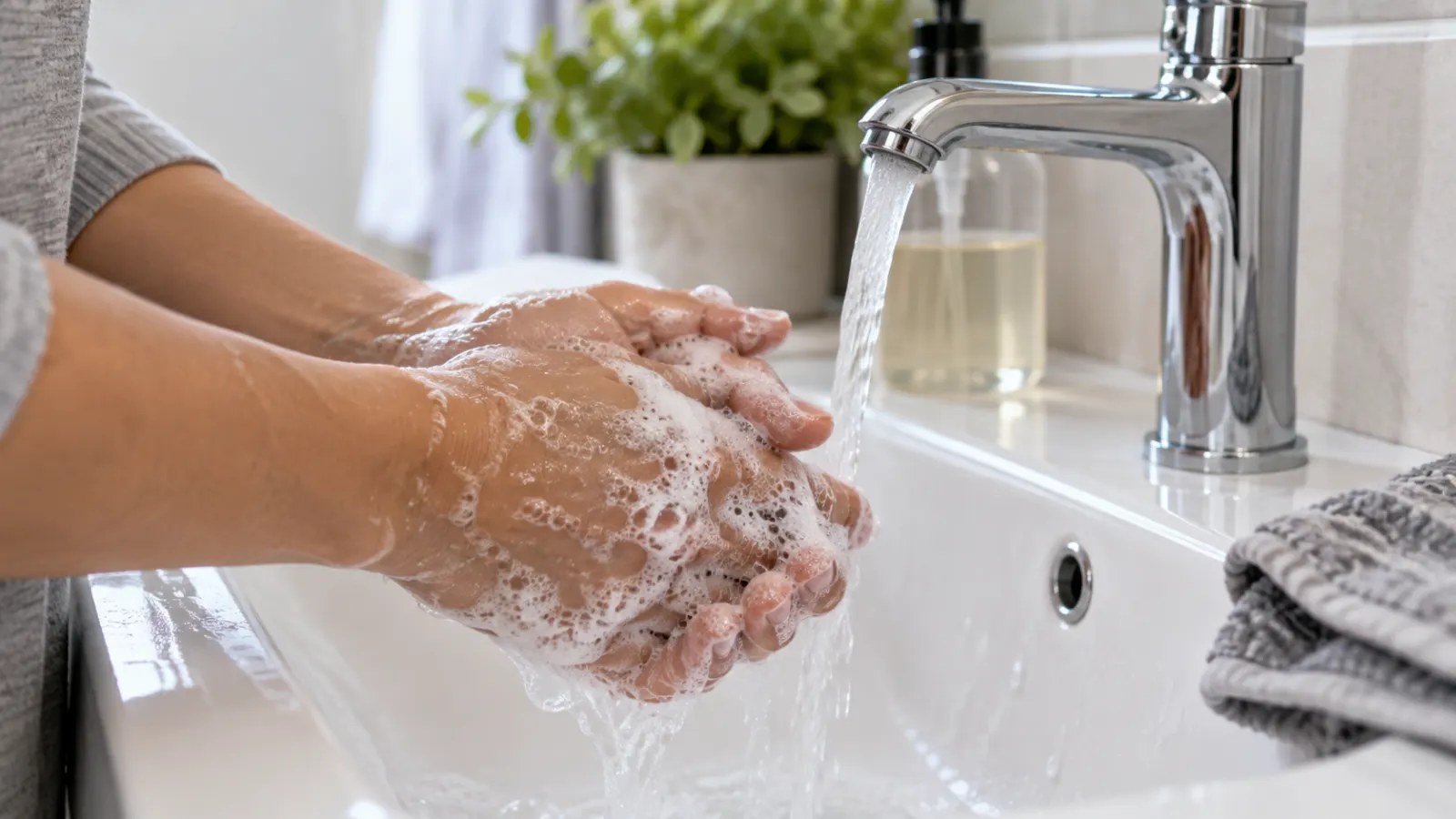
Soap molecules help loosen and suspend oils, dirt, microorganisms and certain chemicals. When soap is worked into a lather, structures called micelles help trap material so that it can be lifted from the skin. Rubbing the hands creates friction and helps dislodge microbes from areas where they may otherwise remain.
Running water then carries that loosened material away.
CDC describes the mechanism primarily as physical removal: soap, lathering and scrubbing help detach germs and chemicals, which are then rinsed down the drain. (cdc.gov)
That mechanical removal gives soap and water an important advantage.
Alcohol-based sanitizer works mainly by inactivating many susceptible microorganisms on the skin. Washing can additionally remove dirt, grease, chemicals and organisms that sanitizer may not handle as reliably.
This is why the two methods are useful but not perfectly interchangeable.
Why twenty seconds?
The recommendation to scrub for about 20 seconds can sound strangely precise.
It is not because something magical happens at the twentieth second.
The practical purpose is to allow enough time for people to cover the entire hand rather than perform a two-second rinse.
CDC recommends scrubbing for at least 20 seconds in community settings and specifically advises covering the palms, backs of the hands, between the fingers and under the nails. Shorter washing removes fewer germs. (cdc.gov)
The useful sequence is simple:
wet → lather → scrub → rinse → dry.
Coverage matters alongside duration.
Someone can wash for 20 seconds while repeatedly rubbing only the palms and still miss fingertips, thumbs, spaces between fingers and areas around the nails.
The number is therefore better understood as a behavioural tool than a biological threshold.
It makes hurried washing less likely.
The right moments matter more than washing constantly
Good hand hygiene does not mean washing after every object you touch.
That would be impractical and, for some people, damaging to the skin.
The stronger approach is risk-based handwashing: clean your hands when contamination is especially likely or when transfer would have greater consequences.
CDC identifies key moments including before, during and after food preparation; before eating; after using the toilet; after changing diapers or cleaning a child who has used the toilet; after blowing the nose, coughing or sneezing; before and after caring for someone who is sick with vomiting or diarrhoea; after touching animals or animal waste; and after handling garbage. (cdc.gov)
The logic changes slightly depending on the situation.
After toilet use, the concern is preventing microscopic faecal contamination from reaching food, surfaces or other people.
Before preparing food, the concern is preventing whatever is on the hands from entering something another person may eat.
After coughing or blowing the nose, handwashing reduces the chance of transferring respiratory organisms onto shared objects or directly to the face.
Before caring for a vulnerable person or a wound, the objective is to reduce what the hands might introduce.
This is much more useful than trying to keep hands permanently “germ-free.”
They will not remain germ-free.
The goal is to reduce microbial transfer at moments when the transmission chain is most likely to succeed.
Handwashing reduces illness at population level
The preventive effect is measurable.
CDC's current handwashing evidence summary states that handwashing education can reduce diarrheal illness by roughly 23–40% and respiratory illnesses such as colds by approximately 16–21% in studied populations. CDC often summarises these findings as preventing about 30% of diarrhoea-related illness and about 20% of respiratory infections. (cdc.gov)
These are population-level estimates.
They do not mean that washing correctly gives an individual a guaranteed 20% reduction in every respiratory infection they might otherwise catch.
Results vary with setting, pathogen, behaviour, sanitation and baseline risk.
The broader conclusion is more useful:
When enough people clean their hands at important moments, fewer pathogens complete the journey from one host to another.
That is especially important for diarrheal diseases, where faecal-oral transmission can occur through tiny quantities of contamination that are invisible to the eye.
Respiratory infections and stomach infections do not spread in exactly the same way
Handwashing is sometimes promoted as though every infectious disease uses the same transmission route.
They do not.
For respiratory viruses, inhalation and close-range exposure can be extremely important. Hand hygiene is therefore one layer rather than the entire prevention strategy.
CDC's current respiratory-virus guidance combines hand hygiene with covering coughs and sneezes, cleaning frequently touched surfaces and measures that improve air quality or reduce exposure when respiratory illness is circulating. Handwashing helps because organisms transferred to the hands can reach the respiratory system when people touch their eyes, nose or mouth. (cdc.gov)
This is why a familiar scenario remains plausible:
someone coughs into their hand;
touches a shared object;
another person touches the same object;
then rubs their nose or eyes.
Washing reduces that route.
But it cannot replace cleaner air or staying away from other people when actively infectious.
No single hygiene measure carries the full prevention burden.
For many gastrointestinal infections, handwashing can be even more central because the transmission route is more directly linked with contaminated hands, food and surfaces.
Norovirus is an important example.
Norovirus is highly contagious and can spread through microscopic amounts of vomit or faecal material. CDC specifically recommends washing with soap and water for at least 20 seconds and warns that hand sanitizer alone does not work well against norovirus. (cdc.gov)
That does not mean sanitizer has no value.
It means the pathogen matters.
Some organisms are particularly well handled by alcohol-based products.
Others are more reliably removed through soap, friction and rinsing.
This is why “Which hand-cleaning method is stronger?” is the wrong universal question.
The better question is:
What am I trying to remove, and what cleaning method fits the situation?
Hand sanitizer is highly useful—but it has limits
Soap and running water are not always available.
People travel.
Workers move between locations.
Children spend time in classrooms.
Someone may be on public transport or outdoors with no sink nearby.
In these situations, CDC recommends an alcohol-based hand sanitizer containing at least 60% alcohol. Enough product should be applied to cover all surfaces of the hands and rubbed until the hands are dry. (cdc.gov)
Sanitizer is fast, portable and effective against many common microorganisms when used correctly.
But it is not simply “soap without water.”
CDC notes several important limitations. Hand sanitizers do not eliminate every type of germ, may work less effectively when hands are visibly dirty or greasy, and do not reliably remove harmful chemicals such as some pesticides and heavy metals. Soap and water are also more effective against organisms including norovirus, Cryptosporidium and Clostridioides difficile. (cdc.gov)
So a person leaving a toilet should wash with soap and water where possible.
Someone with visibly muddy or greasy hands should wash.
During a norovirus outbreak, soap-and-water handwashing becomes especially important.
If a sink is unavailable during routine travel or work, properly used sanitizer is an excellent alternative for many situations.
The mistake is not using sanitizer.
The mistake is assuming that every cleaning method performs identically against every form of contamination.
Drying, soap type and skin care matter more than they seem
Handwashing does not end when the water is turned off.
Hands should be dried thoroughly.
CDC notes that germs transfer more readily from wet hands than from dry hands. It currently finds insufficient evidence to declare either a clean towel or an air dryer universally superior in ordinary settings; the important point is to dry the hands completely using a clean method. (cdc.gov)
This is useful because debates about dryers versus paper towels can distract from the far more important issue: hands that remain wet can transfer material more easily.
Ordinary soap is usually enough
The word antibacterial sounds as though it should mean superior protection.
For ordinary community handwashing, that assumption is not supported.
FDA says there is insufficient evidence that over-the-counter antibacterial soaps prevent illness better than washing with plain soap and water. In 2016, the agency prohibited the marketing of consumer antiseptic washes containing several active ingredients when manufacturers failed to demonstrate that they were both safe for long-term daily use and more effective than ordinary soap. (fda.gov)
CDC likewise recommends plain soap for routine community use. Bar soap and liquid soap can both work. (cdc.gov)
Healthcare is different.
Hospitals and clinical procedures may require specialised antiseptic products because patients, invasive procedures and healthcare-associated infections create risks that do not apply to normal household washing.
A hospital hand-hygiene protocol should not automatically become a rule for someone's kitchen sink.
Washing has to be sustainable
More washing is not always better if it becomes excessive.
Frequent exposure to soap, detergents, water and alcohol products can irritate skin, particularly in people with eczema, sensitive skin or occupations requiring repeated hand hygiene.
Dryness can progress to cracking and inflammation.
That matters because painful hands make it harder to maintain good hygiene consistently.
A sustainable routine may involve milder products, avoiding unnecessarily hot water and using suitable moisturisers where needed.
The goal is effective repeated hygiene, not damage produced by compulsive cleaning.
This distinction is important psychologically too.
Public-health recommendations identify high-value moments for handwashing precisely because washing constantly is unnecessary.
A person does not need to wash after every harmless contact with the outside world.
Small details become more important when the consequences of infection are larger
Most healthy adults tolerate many common infections without serious complications.
The consequences can be much greater for someone who is very young, very old, immunocompromised or medically fragile.
That makes hand hygiene especially valuable around:
newborns;
older adults;
people receiving cancer treatment;
people with weakened immune systems;
people with wounds;
and anyone actively ill with a contagious infection.
Someone preparing a meal for several people is also in a different position from someone touching only their own belongings.
A food handler's hands can connect one contaminated source with many meals.
A caregiver's hands can move between one sick person, household surfaces and another vulnerable individual.
This is why handwashing is simultaneously personal protection and source control.
You are not only trying to avoid bringing a pathogen into your own mouth, nose or eyes.
You are reducing the chance that your hands become the bridge carrying it to somebody else.
Attention to fingertips, thumbs, spaces between fingers and areas around the nails becomes useful for the same reason. These are easily missed when washing is rushed.
Routine community washing does not require surgical hand preparation.
It simply requires enough coverage to clean the surfaces most likely to touch people, food and objects.
Why such a simple intervention still matters
Handwashing has no futuristic technology behind it.
No artificial intelligence is required.
No sophisticated diagnostic system needs to identify the microorganism before the intervention begins.
Its strength comes from something much more basic.
Many infections depend on repeated opportunities for transfer.
A pathogen reaches a hand.
The hand reaches food, a face, another person or another surface.
That process happens constantly.
Soap, friction, rinsing and drying interrupt some of those transfers.
Repeated across households, schools, workplaces, healthcare settings and food preparation, a simple interruption becomes a population-level prevention strategy.
Handwashing cannot stop every respiratory infection.
It cannot compensate for unsafe drinking water, poor sanitation, contaminated food systems or inadequate ventilation.
Hand sanitizer cannot substitute for soap in every circumstance.
And permanently sterile hands are neither realistic nor necessary.
The useful principle is narrower:
clean hands at the moments when contamination is most likely to move from one place or person to another.
That is why twenty careful seconds at the right time can matter far more than constant anxious washing.
A sink, clean water and ordinary soap remain among the simplest tools in infection prevention—not because they eliminate every microbe, but because they repeatedly break one of the easiest routes by which harmful ones travel.
Medical note
This article provides general health information and is not a substitute for individual medical advice. Healthcare workers and people caring for medically vulnerable patients may need hand-hygiene procedures specific to their clinical setting.