Children learn money before adults start teaching it
Children begin learning about money long before parents sit them down for a formal lesson. They observe how adults spend, argue, save, borrow, compare, hide, donate and worry. They notice whether money is discussed calmly or fearfully. They watch whether every desire is instantly fulfilled or thoughtfully delayed. Family behaviour becomes the first financial curriculum.
This is why teaching children about money cannot be limited to pocket money. It is about building habits, language and judgment. A child who learns that money is limited, choices have consequences and saving creates future freedom develops a healthier relationship with finance. A child who hears only fear or sees only impulsive consumption may carry those patterns into adulthood.
The goal is not to make children money-minded in a narrow sense. It is to make them capable, calm and responsible. Money education should not destroy innocence. It should give children the tools to understand real life without making them anxious about adult burdens.
Start with the idea that money is earned and allocated
The first lesson is simple: money does not appear magically. It is earned through work, enterprise, service, skill or investment. Children do not need complex economics, but they should understand that money represents effort and choice.
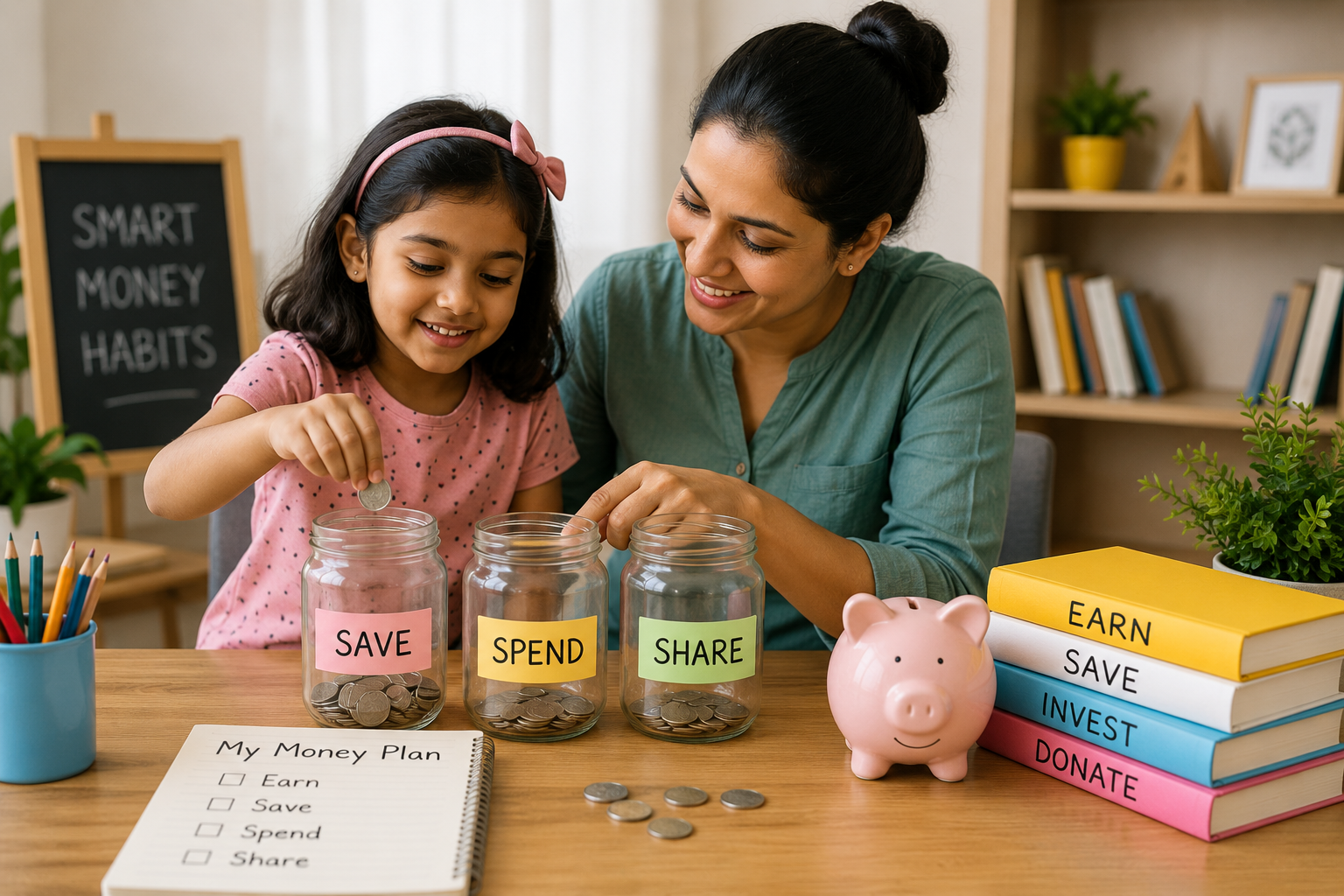
The second lesson is allocation. Money can be spent, saved, shared or invested. When a child receives pocket money or gift money, parents can help divide it into categories. One part may be for small spending, one for saving toward a goal, and one for giving or helping. The exact percentages matter less than the habit of thinking before spending.
This teaches children that money has jobs. If all money is for immediate spending, there is no patience. If all money is hoarded, there is no joy. Balanced money education teaches usefulness, not fear.
Use real-life examples, not lectures
Children learn best from visible examples. A grocery trip can teach budgeting. A toy purchase can teach comparison. A birthday gift can teach saving. A broken item can teach replacement cost. A family outing can teach planning. A delayed purchase can teach patience.
Instead of saying, "Money is important," parents can say, "We have Rs 500 for snacks this week. Which options give us the most value?" Instead of saying, "Do not waste money," they can ask, "Will this still matter to you tomorrow?" Questions develop judgment better than scolding.
Money lessons should be age-appropriate. A six-year-old can understand coins, needs and wants. A ten-year-old can understand saving goals and comparison. A teenager can understand bank accounts, digital payments, interest, budgeting, fraud and long-term planning. The curriculum should grow with the child.
Teach needs, wants and trade-offs
One of the most important lessons is the difference between needs and wants. Food, school, basic clothing, medicine and safe housing are needs. Toys, gadgets, branded items, restaurant meals and upgrades are wants. But the lesson should not shame wants. Wants make life enjoyable. The issue is priority.
Children should learn that choosing one thing often means not choosing another. This is opportunity cost in simple form. If they spend all pocket money on snacks today, they may not have money for a book next week. If they save for a bicycle, they may need to delay smaller purchases.
Trade-offs teach realism. Adults who never learned trade-offs often struggle with debt, impulse buying and lifestyle inflation. Children who understand trade-offs early become better decision-makers later.
Pocket money as a teaching tool
Pocket money can be useful if it is treated as a learning system, not a bribe or entitlement. The amount should be age-appropriate and consistent. Children should be allowed to make small mistakes. If they spend too quickly, parents should resist immediately rescuing them unless the situation is serious. The discomfort of running out of money teaches planning.
Parents can encourage children to keep a simple money diary: money received, money spent, money saved and goal progress. The diary builds awareness. It also helps children see patterns. They may discover that small daily expenses add up.
Pocket money should not become a tool for emotional control. It should not be randomly given to avoid tantrums or removed unpredictably. Consistency creates learning. Randomness creates confusion.
Saving goals and delayed gratification
Saving becomes meaningful when attached to a goal. A child may save for a cricket bat, art kit, book set, bicycle, school trip or gadget contribution. The goal should be visible. A chart, jar or notebook can show progress.
Delayed gratification is one of the most valuable money habits. It teaches that not every desire must be fulfilled immediately. But parents must present delay positively. The message should be, "You are building toward something bigger," not, "You cannot have anything."
Children who experience the satisfaction of reaching a savings goal learn a powerful emotional lesson: patience can produce pride. That feeling is more important than the object purchased.
Introduce digital money carefully
Children today see digital money everywhere. They see QR codes, UPI payments, cards, app wallets and online shopping. Because digital money is invisible, it can feel unreal. Parents must explain that tapping a phone still moves real money from an account.
Teenagers should learn basic digital safety. They should never share OTPs, passwords or PINs. They should understand that receiving money does not require entering a UPI PIN. They should recognise fake links, gaming-payment traps, in-app purchases and influencer-driven spending pressure.
Digital literacy should also include privacy. Children should know that financial apps, shopping sites and games collect information. Convenience should not replace caution.
Teach earning without making money everything
Children can learn earning through small age-appropriate tasks, creative work, school projects, entrepreneurship activities or family responsibilities. But parents should be careful. Not every household duty should become paid labour. Children should also learn contribution, cooperation and responsibility without expecting money for every act.
The better lesson is that skill creates value. A child who paints cards, helps organise books, runs a small school fair stall or saves from gifts learns that effort and planning matter. Teenagers can learn about internships, freelancing, business ideas and career skills.
The purpose is not to make children chase money early. It is to show that money follows value creation, discipline and responsibility.
Talk about advertising and peer pressure
Children are surrounded by advertising. Toys, games, clothes, shoes, phones, snacks and online subscriptions are designed to create desire. Social media makes comparison worse. A child may want something not because they need it, but because friends have it or influencers promote it.
Parents should teach children to pause before buying. Who is trying to sell this? Why do I want it? Will I use it? Is there a cheaper alternative? Am I buying because of pressure? These questions build consumer intelligence.
Financial literacy must include media literacy. A child who understands advertising becomes harder to manipulate.
India angle: family culture and money silence
In many Indian families, children are either kept completely away from money discussions or exposed only to money stress. Both extremes are harmful. If children never hear practical conversations, they enter adulthood unprepared. If they hear only fear and conflict, they may associate money with anxiety.
Indian households can teach money naturally through festivals, school fees, travel planning, grocery budgets, savings goals and charity. Children can learn why families compare prices, why parents save for education, why health insurance matters and why debt must be used carefully.
The Indian context also includes joint families, gifting, gold, property, education pressure and social functions. Children should learn generosity and tradition, but also budgeting and boundaries. Culture and financial discipline can coexist.
What not to do
Parents should avoid using money as the only reward for good behaviour. This can make children transactional. They should avoid shaming children for wanting things. Desire is normal; discipline must be taught. They should avoid saying, "We cannot afford anything," if the real lesson is prioritisation. Constant fear language can create scarcity anxiety.
Parents should also avoid hiding all financial reality. Children do not need adult-level burden, but they can understand limits. A calm explanation such as, "We are saving for something important, so we will not buy this now," teaches maturity.
Finally, parents should avoid hypocrisy. Children notice when adults preach saving but spend impulsively, warn against debt but misuse credit cards, or talk about honesty but hide money matters. Example is stronger than advice.
Final takeaway
Teaching children about money is not a single conversation. It is a long, gentle training in choices. Children need to learn earning, spending, saving, sharing, digital safety, patience, value, advertising awareness and responsibility.
The best money education is practical. Give children small decisions before they face big ones. Let them save, compare, wait, make mistakes and reflect. Let money be discussed calmly, not secretly or fearfully.
A child who learns money well does not become materialistic. They become prepared. They understand that money is not the purpose of life, but it is a tool that affects dignity, freedom and security. Teaching that lesson early may be one of the most valuable gifts a family can give.