The real problem is not laziness; it is attention design
Most students think focus is a personality trait. They believe some people are naturally disciplined while others are naturally distracted. That belief is comforting because it makes failure feel fixed, but it is also dangerous because it hides the real problem. Focus is usually not a matter of willpower alone. It is a matter of attention design. A student who studies beside a buzzing phone, unclear syllabus, messy desk, open social media tab, poor sleep and no fixed target is not weak. The student has simply placed the brain inside an environment built to interrupt it.
To stay focused while studying, the first shift is conceptual. You are not trying to become a machine that can concentrate for ten hours without difficulty. You are trying to build a study system in which concentration becomes easier to start, easier to protect and easier to restart after interruption. This distinction matters because most students lose focus, feel guilty, and then waste even more energy judging themselves. The better approach is to accept that attention is limited, fragile and trainable. Once you understand this, you can stop fighting distraction only at the mental level and begin redesigning the conditions around your study.
Why the mind wanders during study
The mind wanders for several reasons. Sometimes the topic is too easy, so the brain searches for stimulation. Sometimes the topic is too difficult, so the brain escapes the discomfort. Sometimes the task is vague, so there is no clear next action. Sometimes the student is tired, hungry or emotionally stressed. Sometimes the study material is passive, such as rereading notes without a question to answer. In each case, the loss of focus is not random. It is the brain reacting to low clarity, low reward, high friction or high fatigue.
Digital distraction makes this worse because phones and apps are designed around variable rewards. A notification may be unimportant, but the possibility that it could be interesting creates a powerful pull. Even when the phone is silent, its presence can create a mental invitation. The student is no longer simply studying a chapter. The student is studying a chapter while resisting a parallel world of messages, videos, news, entertainment and social comparison. That resistance consumes energy. This is why a serious focus routine begins before the book opens.
Define the study target before the study session begins
A focused session needs a precise target. “Study chemistry” is not a target. “Revise chemical bonding from pages 42 to 57 and solve ten previous-year questions” is a target. The more specific the target, the less mental energy you spend deciding what to do next. A vague session invites drifting because the brain cannot measure progress. A specific session creates direction, boundaries and a small sense of completion.
Before every study block, write three lines. First, write the topic. Second, write the output expected from the session. Third, write the time boundary. For example: “Topic: fundamental rights. Output: one-page summary and fifteen recall questions. Time: 45 minutes.” This tiny planning step turns studying from an open-ended intention into a defined task. It also protects you from the common trap of sitting with books for hours while producing very little real learning.
Remove the most predictable distractions
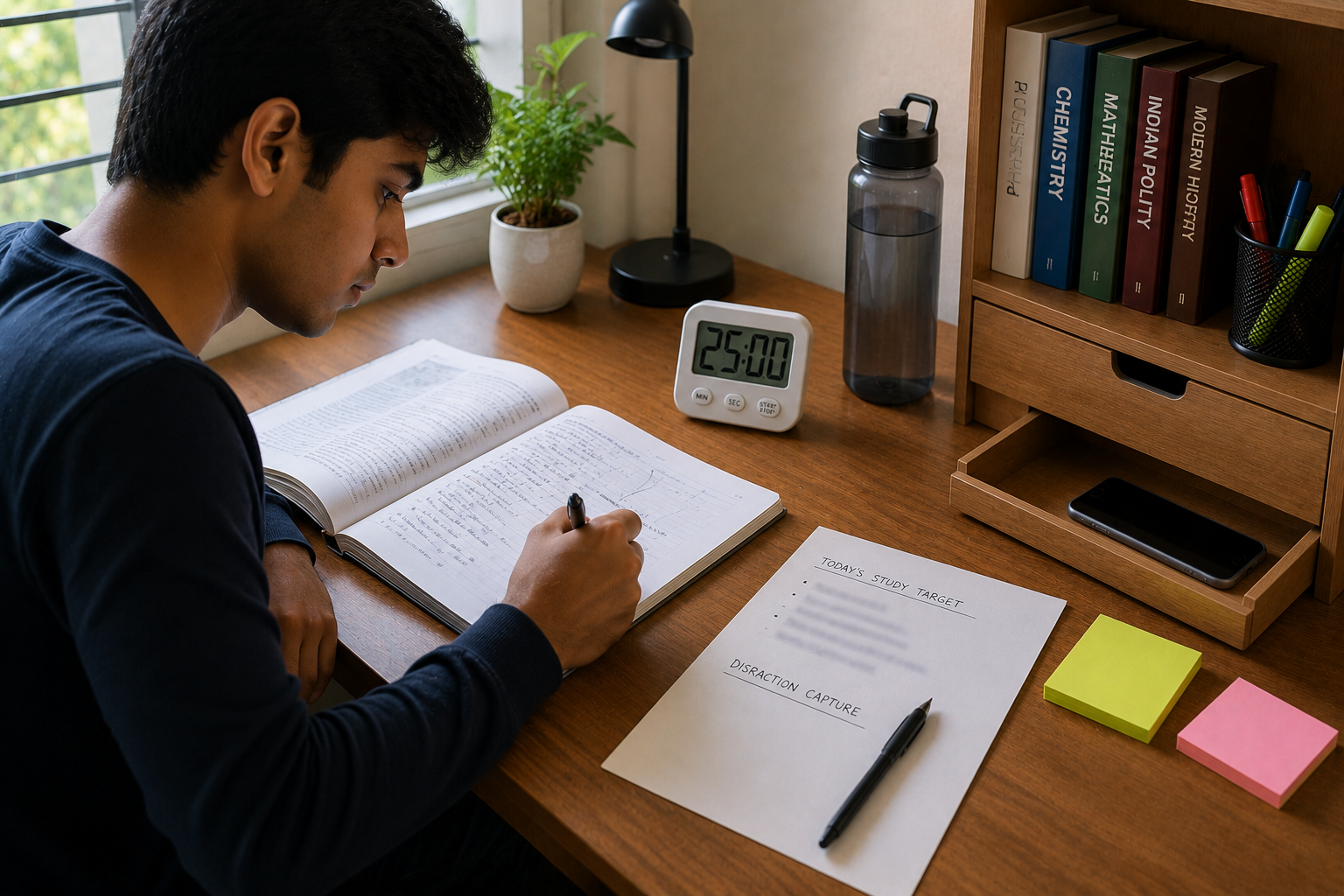
The best way to resist temptation is not to keep proving that you can resist it. The better way is to remove the temptation from the immediate environment. Put the phone in another room, inside a drawer, or at least beyond arm’s reach. Use website blockers if you study on a laptop. Keep only the required books, notebook and water bottle on the table. If you study in a noisy home, use earplugs, instrumental background sound or a fixed corner that signals study mode.
This is not about creating a perfect aesthetic desk. It is about reducing decision friction. Every extra object on the table can become an invitation. Every open tab can become a rabbit hole. Every message preview can become a broken thought. Focus becomes easier when the environment gives your attention fewer options. A clean study space is not a moral statement; it is an attention strategy.
Study in blocks, not in vague marathons
Many students plan study sessions like marathons: “I will study for six hours today.” The problem is that the brain does not experience six hours as one clear unit. It experiences the next minute, the next page, the next question and the next urge to escape. Long, undefined study sessions often collapse into half-study and half-distraction. A better method is to divide study into blocks.
A block can be twenty-five minutes, forty minutes, fifty minutes or ninety minutes depending on the task and your current stamina. The key is that a block has a beginning, a target and an end. During the block, you do one task. After the block, you take a short break and reset. This rhythm works because it respects attention as a limited resource. It also makes study psychologically manageable. You do not have to defeat the whole day. You only have to protect the next block.
Use active tasks to keep the brain engaged
Focus becomes harder when study is passive. Rereading a page can feel productive, but it often allows the mind to drift because the brain is not being forced to respond. Active study creates friction in a useful way. Instead of asking, “Did I read this?” ask, “Can I explain this without looking?” Instead of underlining many lines, write three questions from the section. Instead of watching a lecture continuously, pause and summarise the argument in your own words.
Active tasks include solving problems, recalling definitions, teaching the topic aloud, making comparison tables, writing exam-style answers, drawing flowcharts and creating flashcards. These methods do more than improve memory. They also improve focus because they convert study into action. The brain stays more engaged when it has to retrieve, organise and apply information.
Create a distraction capture page
Even in a good study environment, random thoughts will appear. You may suddenly remember a message to send, a bill to pay, a video to watch, a question to search or a worry about tomorrow. Many students either follow these thoughts immediately or try to suppress them completely. Both approaches can fail. A better method is to keep a distraction capture page.
During the study block, whenever an unrelated thought appears, write it quickly on the page and return to study. Do not solve it immediately. Do not argue with it. Just park it. At the end of the block, review the list and decide what actually matters. This method reassures the brain that the thought has not been lost, while still protecting the current session. Over time, you may notice patterns: the same apps, worries or unfinished tasks repeatedly disturb your study. Those patterns can then be handled outside the study block.
Match task difficulty to your energy level
Focus is strongly connected to energy. A difficult chapter attempted at midnight after a tiring day will feel impossible. A light revision session attempted during your best mental hour may waste your strongest energy. Good students learn to match task difficulty with energy level. Use your highest-energy time for the hardest cognitive work: problem solving, conceptual understanding, answer writing and unfamiliar topics. Use lower-energy periods for revision, organising notes, flashcards or light reading.
This prevents a common mistake: blaming yourself for poor concentration when the real issue is poor task placement. You may not need more discipline. You may need better scheduling. If your mind is freshest in the morning, protect that time. If evenings are your only available slot, begin with a short warm-up and avoid starting with the most intimidating task. Focus improves when the task and the body are not fighting each other.
Build a pre-study ritual
A ritual is a repeated sequence that tells the brain what is about to happen. It does not need to be dramatic. It can be as simple as clearing the table, placing the phone away, filling a water bottle, opening the notebook, writing the session target and starting a timer. When repeated daily, the ritual reduces the emotional effort needed to begin.
Starting is often the hardest part of focus. Once a session begins, momentum can take over. The ritual works because it removes negotiation. You are no longer asking, “Should I study now?” You are following the opening steps of a known routine. The more consistent the ritual, the faster the brain recognises study mode. This is especially useful for students preparing for long-term exams because motivation naturally rises and falls, but rituals can remain stable.
Take breaks before attention collapses
Breaks are not the opposite of focus. Poorly timed breaks are the problem. If you wait until your attention collapses completely, the break may become an escape and returning will be harder. If you take a short break after a defined block, the break becomes recovery. Stand up, stretch, drink water, rest your eyes or walk for a few minutes. Avoid turning every break into social media because the brain may come back more scattered than before.
A useful rule is to keep breaks low-stimulation. The goal is to refresh attention, not flood the mind with new content. This is why scrolling for five minutes often becomes twenty minutes and leaves you mentally noisier. A good break should make the next block easier. If a break makes study harder to restart, it needs redesign.
Use accountability without becoming dependent on pressure
Accountability can help focus. Studying with a serious friend, reporting daily targets, using a study group or joining a library environment can create external structure. But accountability should not become a substitute for self-management. Some students can study only when someone is watching, only when deadlines are near or only when guilt becomes unbearable. That pattern is unstable.
Use accountability as a support, not as the engine. For example, you can tell a friend your target before a session and report completion after it. You can study in a shared quiet space but work on your own tasks. You can maintain a daily tracker without turning it into self-punishment. The aim is to make focus more visible and measurable, not to create fear.
What to do when focus breaks
No student stays focused perfectly. The real skill is recovery. When you realise you have drifted, do not start a long self-critical monologue. Ask three questions: What was I supposed to do? What distracted me? What is the next small action? Then restart with a smaller block, even ten minutes if needed. Recovery should be quick, practical and unemotional.
This matters because guilt can become a second distraction. A student may lose five minutes to the phone and then lose another thirty minutes feeling bad about it. The better response is: notice, reset, resume. Over months, the ability to restart becomes more valuable than the fantasy of never losing focus. Consistency is built through repeated returns.
Common mistakes that destroy focus
The first mistake is studying with no clear output. Reading without a goal creates the illusion of work. The second mistake is keeping the phone nearby and relying only on self-control. The third mistake is starting with the hardest task when energy is lowest. The fourth mistake is confusing long hours with deep work. The fifth mistake is using breaks that overstimulate the brain. The sixth mistake is changing methods every few days instead of stabilising a simple routine.
Another mistake is trying to focus on everything equally. Not all tasks deserve the same mental intensity. Some topics require deep conceptual work. Others require revision. Some require memorisation. Others require answer practice. When you know the nature of the task, you can choose the right focus method. A single study style for all tasks often leads to frustration.
A practical focus checklist
Before study, choose the topic, define the output, set the time block and remove the phone. During study, keep only one task open, use active recall, write distractions on a capture page and protect the block. After study, mark what was completed, note what remains and plan the next session. This checklist sounds simple because focus is not built by complex theory alone. It is built by repeated execution of simple rules.
The deeper lesson is that focus is not something you wait for. It is something you design. Students who focus well are not always more motivated. They have fewer avoidable distractions, clearer tasks, better recovery habits and more realistic study blocks. If you treat attention as a resource, you can protect it. If you treat it as magic, you will keep wondering why it disappears.