How Plastic Harms Wildlife: Ingestion, Entanglement and Habitat Damage
How plastic harms wildlife cannot be explained by one dramatic image of a turtle caught in fishing line or a seabird with plastic in its stomach. Plastic pollution affects animals through several distinct pathways, including entanglement, ingestion, abandoned fishing gear, habitat damage and exposure to increasingly small plastic particles. The severity of the harm depends on the type and shape of the debris, the species involved, the animal’s feeding behaviour, the habitat and how long exposure continues.
The scale of contact is substantial. NOAA says marine debris has been documented to affect more than 700 species, ranging from plankton and fish to seabirds, sea turtles and marine mammals. More recent evidence cited by the U.S. Environmental Protection Agency indicates that more than 1,500 marine and terrestrial species are known to ingest plastics. These figures demonstrate how widespread exposure has become, but they should not be interpreted as meaning that every affected species experiences the same injury or population-level threat.
Entanglement and ghost fishing can turn plastic into a physical trap
Some of the most immediate wildlife injuries come not from plastic’s chemical composition but from its shape. Fishing line, nets, packing straps, plastic rings, bag handles and other looped materials can wrap around an animal’s body while it swims, feeds or moves through its habitat. Once trapped, the animal may struggle to swim, breathe, feed or escape predators.
The effects can become progressively worse. Material wrapped around a young seal’s neck may cut more deeply as the animal grows. Fishing line can slice into skin and underlying tissue. A whale dragging fishing gear may continue swimming for weeks or months while expending additional energy. NOAA Fisheries documents consequences including deep wounds, infection, blood loss, reduced body condition and, in severe cases, starvation, strangulation or drowning.
Sea turtles, seabirds and other marine animals face similar dangers. NOAA’s Marine Debris Program reports that hundreds of species have been documented becoming entangled and that all seven sea turtle species have been recorded in marine-debris entanglements.
Fishing gear creates a particularly important form of this problem because nets, traps and lines were deliberately designed to catch animals. When gear is lost, abandoned or discarded, it can continue doing that job even though no fisher controls it. This phenomenon is known as ghost fishing.
A lost net may continue catching fish, turtles, seabirds or marine mammals. Trapped animals may attract scavengers and predators, which can themselves become caught. NOAA notes that derelict nets and traps can continue ghost fishing for years, depending on the type of equipment and environment.
This is why it is misleading to treat all wildlife entanglement simply as ordinary consumer litter. Plastic waste from households is part of the problem, but fishing and other ocean-based activities create their own forms of hazardous debris. Prevention therefore has to address different sources differently, including better gear management, reporting of lost gear, retrieval programmes and designs that reduce the ability of abandoned equipment to continue catching animals.
Rescuing an entangled animal can save an individual life, but it is not a substitute for prevention. Large-whale disentanglement in particular is dangerous and requires trained, authorised response teams. NOAA warns that whales may carry gear for days, months or even years, and untrained members of the public should not attempt such rescues themselves.
Animals can swallow plastic intentionally or accidentally
Plastic ingestion is another major pathway of harm. An animal does not have to deliberately decide that plastic is food. Debris may resemble prey, be consumed while attached to natural food, enter the mouth during filter feeding or already be present inside another animal that is eaten.
NOAA reports that more than 700 species have been confirmed to ingest plastic, including fish, seabirds, sea turtles, marine mammals, shellfish and plankton. The amount and type of plastic swallowed often depend on how an animal feeds.
Large pieces can cause relatively direct injuries. Sharp or rough fragments may damage the digestive tract. Other objects can create intestinal blockages or occupy space in the stomach, reducing an animal’s urge or ability to eat normal food. Severe obstruction, internal injury or nutritional loss can contribute to starvation or death.
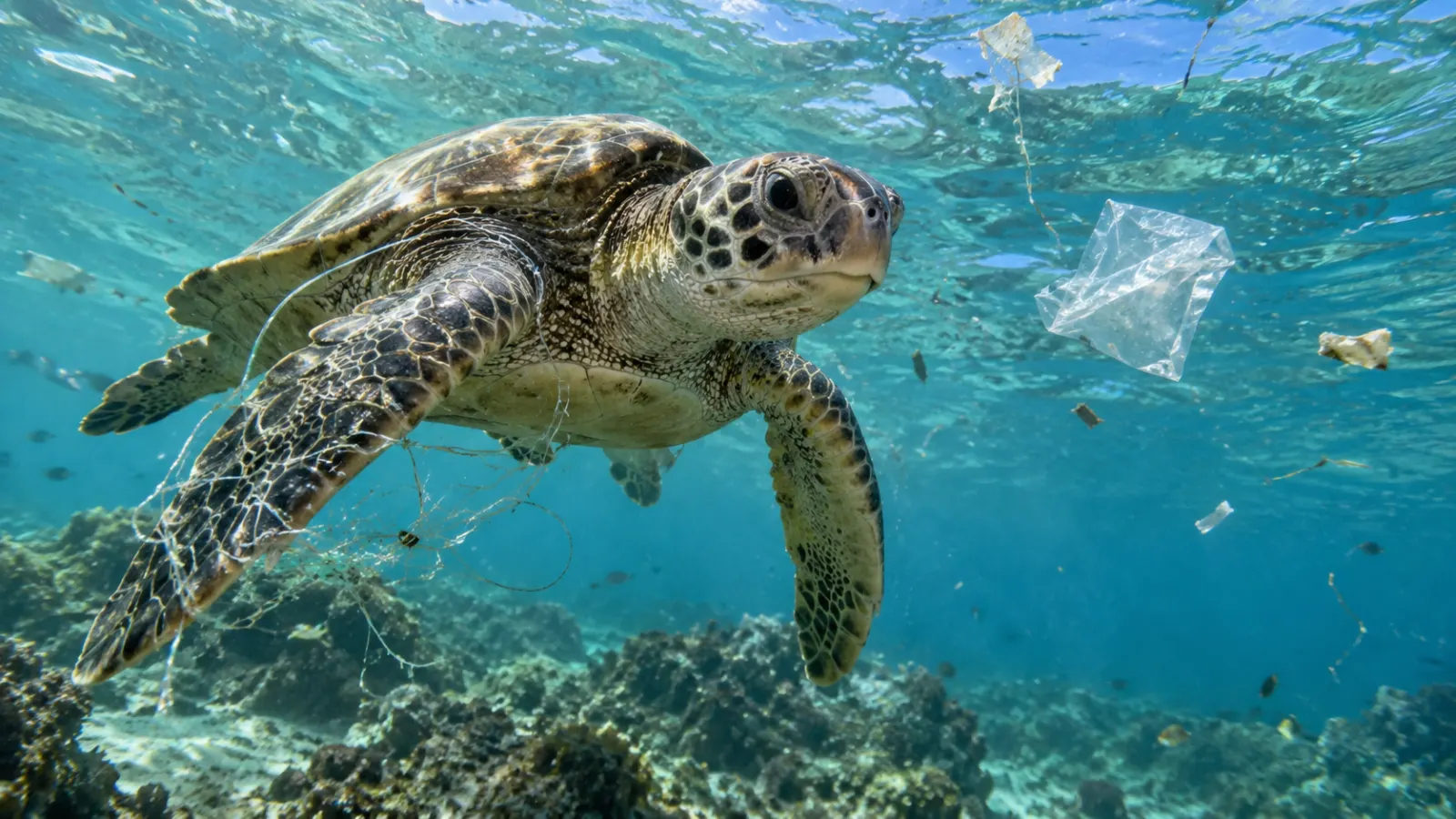
Sea turtles are particularly well known examples. All seven sea turtle species have been documented ingesting marine debris. Plastic bags and sheets can resemble prey such as jellyfish, while turtles also encounter fishing lines and nets capable of entangling them. Young animals that occupy ocean convergence zones may feed in the same areas where floating plastics accumulate, increasing the opportunity for exposure.
Seabirds are another heavily studied group because many species forage over large areas of ocean and encounter debris floating at or near the surface. Albatrosses, fulmars and shearwaters have all been documented ingesting plastics. Adults can also transfer debris to chicks when they regurgitate food. NOAA reports that chicks containing large quantities of plastic have been observed at lower body weights, illustrating how ingestion can affect nutrition even when the debris does not immediately kill the bird.
The presence of plastic in an animal’s stomach, however, should not automatically be reported as the cause of its death. Scientists examine the amount, size and shape of debris alongside body condition, injuries, nutritional status and other possible causes. A few fragments that pass through the digestive system are biologically different from a major obstruction or stomach heavily loaded with debris.
That distinction is important for accurate environmental reporting. Plastic ingestion is clearly widespread and can cause serious harm, but exposure, injury and population-level effects are not interchangeable measurements.
Microplastics expand the number of organisms that can be exposed
Plastic pollution does not disappear when a bottle, bag or fishing rope becomes brittle. Larger plastics can fragment under sunlight, waves, heat and mechanical wear into progressively smaller pieces.
Particles smaller than 5 millimetres are generally classified as microplastics. They include fragments, fibres, films, foam, pellets and other small particles. Some are manufactured at small sizes, while others form when larger plastic products, synthetic clothing, tyres, fishing equipment and other materials break down.
Size changes which organisms can encounter the material. A zooplankton organism could never swallow an intact plastic bottle, but it may consume microscopic fragments or fibres suspended in water. Microplastics have been documented in zooplankton, fish, shellfish and much larger animals, including whales.
Particles can also move through feeding relationships. A filter feeder may ingest a particle, and a predator may then eat that organism. That demonstrates food-web transfer, but it is important not to automatically describe every such transfer as biomagnification. Different plastic particles can be retained, excreted, redistributed or broken down differently, so the concentration does not necessarily increase at every level of a food chain.
This is one area where the certainty of the evidence needs careful wording. Widespread microplastic exposure is well established, and laboratory research has documented biological effects under various experimental conditions. Determining how particular particle types and concentrations affect survival, reproduction and populations in complex natural ecosystems remains an active field of research. NOAA similarly notes that more research is needed to understand the consequences of microplastic exposure for wildlife under different circumstances.
Plastic can also contain chemical additives or interact with contaminants already present in the environment. When an animal swallows plastic, researchers therefore investigate not only the particle’s physical effects but also potential chemical exposure.
The interpretation is not simple. An environmental contaminant detected in an animal did not necessarily originate from the plastic it swallowed; the same chemical may also have been encountered through water, sediment or ordinary food. NOAA consequently treats chemical exposure as a potential pathway while emphasising remaining uncertainty about its importance under different environmental conditions.
Plastic can damage entire habitats, not just individual animals
Wildlife does not need to swallow or become trapped in plastic for ecosystems to be affected. Large debris can physically change habitats that many organisms depend upon.
Heavy derelict fishing nets can snag on coral reefs, breaking or abrading structures and smothering organisms. Other large debris can crush sensitive habitats or remain lodged in places where currents repeatedly move it across the seabed. NOAA identifies coral reefs among the environments vulnerable to physical damage from abandoned fishing gear and other large marine debris.
This form of harm receives less public attention because it is harder to represent in a single photograph. An entangled turtle is immediately recognisable as an injured animal; degradation of a reef or benthic habitat may be less visually dramatic even though many organisms depend on that habitat for food, shelter or reproduction.
Floating plastic can create another ecological pathway by acting as transport. Organisms may attach themselves to debris and travel with it over long distances. NOAA describes these organisms as “hitchhikers” and notes that marine debris can move species into areas where they would not otherwise occur, creating another potential mechanism for biological introductions.
Plastic pollution therefore operates at several ecological scales simultaneously. One piece of fishing line can injure one animal. A derelict net can repeatedly catch many animals. Accumulated debris can alter habitat used by entire communities. Microplastic particles can broaden exposure to organisms that would never interact with a large plastic object.
Why some species are more vulnerable than others
Not every plastic object is equally dangerous and not every species encounters plastic in the same way. Much of the risk comes from the interaction between the form of the debris and the behaviour of the animal.
A loop is particularly hazardous to an animal that can put its head, flipper or body through it. Floating film is more likely to be swallowed by a species whose prey has a similar shape. Filter-feeding organisms encounter particles suspended in the water, while surface-feeding seabirds encounter buoyant fragments. Lost fishing equipment remains especially dangerous because its original purpose was to capture animals.
This helps explain why simply measuring the mass of plastic in an environment does not reveal the complete ecological risk. Ten kilograms of harmlessly contained material is not biologically equivalent to ten kilograms of loose monofilament line, abandoned netting or small fragments distributed across a feeding ground.
Location also matters. Ocean currents can concentrate both food and floating debris in convergence zones. Animals attracted to productive feeding areas may therefore encounter unusually high concentrations of plastic at precisely the places where they are actively searching for food.
Wildlife already facing other pressures may also be less able to absorb additional mortality or injury. Plastic pollution can interact with pressures from fishing, habitat destruction, climate change, vessel traffic, invasive species and disease. For a threatened population, preventing avoidable deaths can therefore matter even when plastic is not its only or largest conservation problem.
Preventing wildlife exposure matters more than rescuing animals afterwards
Wildlife rescue and clean-up programmes have clear value. Removing plastic from a turtle’s digestive tract, freeing a seal from a packing strap or disentangling a whale can save an individual animal. Beach and ocean clean-ups can also remove large material before it breaks into smaller pieces.
But those interventions operate after plastic has already escaped into the environment.
Plastic pollution originates through product design, production, consumption, waste collection, transport, fishing activities and failures to recover or contain material at the end of its useful life. Addressing wildlife harm therefore requires prevention alongside clean-up.
That can include reducing unnecessary plastic products, improving waste collection and recycling systems, preventing litter from entering waterways, redesigning products that create avoidable entanglement hazards and recovering abandoned fishing equipment. UNEP identifies better waste management, plastic reduction strategies and international cooperation among the measures needed to reduce marine plastic pollution.
For fishing gear, more targeted interventions may include gear marking, retrieval programmes, loss reporting, improved disposal facilities at ports and equipment designed to reduce long-term ghost fishing if it is lost.
The central lesson is that plastic’s wildlife impact depends as much on form, location and exposure as on the material itself. A loop can become a trap. A sheet can resemble prey. A sharp fragment can injure the digestive tract. A net can continue fishing after being abandoned. A microscopic particle can expose organisms far smaller than those capable of swallowing conventional litter.
That is why the statement “plastic harms wildlife” should be understood as a description of multiple mechanisms rather than a single environmental slogan.
The strongest conservation response is not to wait until an injured animal becomes the photograph that attracts public attention. It is to prevent dangerous material from reaching wildlife in the first place, remove existing debris where practical and design fishing, waste and production systems that reduce future exposure.
Frequently Asked Questions
How does plastic pollution kill animals?
Plastic can kill wildlife through entanglement, drowning, strangulation, severe wounds, digestive obstruction, internal injury and starvation. The precise mechanism depends on the type of plastic and the species involved.
Why do animals eat plastic?
Animals may mistake plastic for natural prey, swallow it accidentally while feeding or consume it inside another organism. Filter feeders can also ingest small plastic particles suspended in water.
What is ghost fishing?
Ghost fishing occurs when lost, abandoned or discarded fishing gear continues catching animals after it is no longer under a fisher’s control. Nets, traps and other equipment can remain dangerous for extended periods.
Are microplastics harmful to wildlife?
Wildlife exposure to microplastics is widespread, and experimental studies have identified a range of potential biological effects. However, the consequences depend on particle size, material, concentration, species and exposure conditions, and scientists are still determining the significance of many effects at wild-population and ecosystem scales.
Can plastic pollution damage habitats?
Yes. Large marine debris and abandoned fishing gear can crush, snag, abrade or smother sensitive habitats such as coral reefs. Floating debris can also transport organisms to new locations.
How many species are affected by plastic pollution?
NOAA reports that marine debris has been documented to affect more than 700 species. The EPA reports that research has identified more than 1,500 marine and terrestrial species known to ingest plastics. These figures measure documented interactions and should not be interpreted as identical levels of ecological harm for every species.