Gyanesh Kumar and the Election Commission: What the Internal Dispute Actually Means
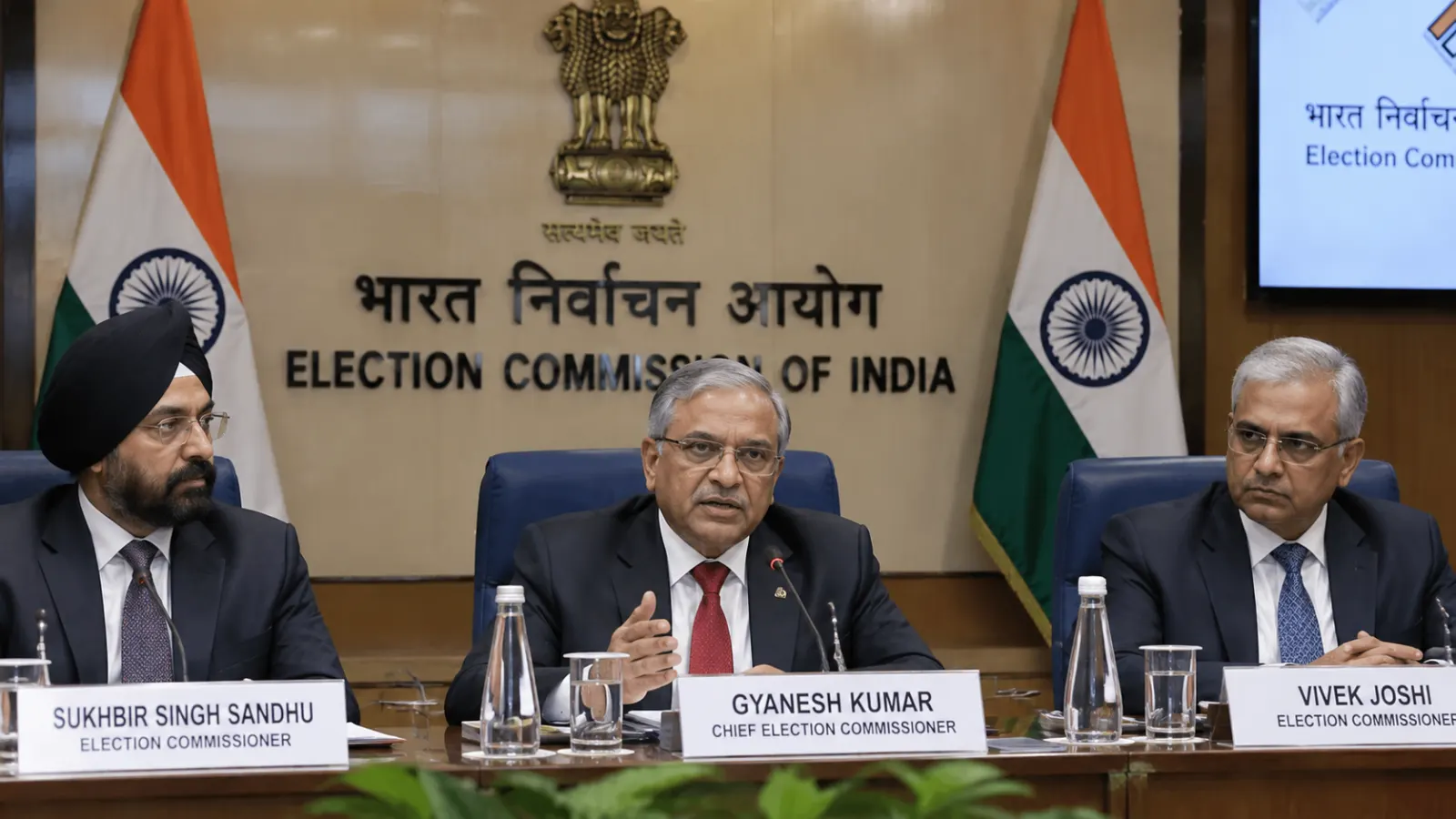
India’s Election Commission is facing unusual scrutiny after a reported series of internal objections raised by Election Commissioners Sukhbir Singh Sandhu and Vivek Joshi during Chief Election Commissioner Gyanesh Kumar’s tenure. An investigation published by The Indian Express on September 23, 2026, said the two commissioners recorded objections on at least 14 occasions over roughly 10 months on matters involving voter registration, deletion of names, changes to Form 6 and control over electoral-roll software.
The Election Commission has rejected the suggestion that these objections demonstrate a breakdown in its functioning. It said differences and suggestions are a normal part of institutional deliberation and maintained that the Commission’s final decisions over the past year, including those relating to the Special Intensive Revision of electoral rolls, were taken unanimously by the full three-member Commission.
The distinction is important. Internal disagreement is not automatically evidence of illegality, political bias or institutional failure. At the same time, disagreements involving voter inclusion, deletion and control of electoral databases concern some of the Election Commission’s most consequential functions. Understanding the controversy therefore requires looking beyond competing political claims and examining how the Commission is legally supposed to operate.
What was reportedly disputed inside the Election Commission?
The reported objections were not all about a single decision. According to The Indian Express, Sandhu and Joshi raised concerns at different points about changes affecting electoral-roll administration.
One dispute concerned Form 6, which is used by people seeking inclusion in the electoral roll. The report said questions connected with the Special Intensive Revision had been added to the online process, including whether an applicant or their parents or grandparents appeared on electoral rolls during an earlier revision. The two commissioners reportedly objected that the change had not followed the required process and argued that it should be withdrawn.
Another reported disagreement concerned the degree of centralised control over electoral-roll software. The investigation said the commissioners raised concerns about systems being controlled from Election Commission headquarters in Delhi in ways that could affect the role of field-level electoral authorities. They reportedly also raised the issue with the Cabinet Secretary when administrative changes were proposed that they believed could further centralise control.
The broader investigation reported objections connected with additions and deletions from voter rolls during the Special Intensive Revision exercise. These are particularly sensitive matters because electoral rolls determine who is registered to participate in elections.
These reports describe objections made during the Commission’s internal functioning. They do not by themselves establish that any final ECI decision was unlawful or improperly motivated.
The Election Commission says the final decisions were unanimous
The Election Commission’s response draws a clear distinction between deliberation and decision.
It said commissioners and officials are entitled to offer observations and suggestions while matters are being considered. According to the Commission, highlighting selected internal notes without considering the eventual decisions gives only part of the institutional picture. The ECI said its electoral-roll revisions and other reforms during the preceding year were ultimately approved unanimously by the full Commission.
That response matters because disagreement inside a multi-member constitutional institution is not necessarily unusual. Commissioners can question proposals, suggest changes or object to aspects of an administrative process before arriving at a collective decision.
The present controversy therefore turns partly on how those two stages should be interpreted. Critics have focused on the nature and frequency of the reported objections. The ECI emphasises that the final institutional decisions were unanimous.
Those statements are not necessarily mutually exclusive. Commissioners can object during deliberation and subsequently agree to a modified or final proposal. Determining what happened in each individual case would require examining the relevant records, chronology and final decisions rather than treating either the existence of objections or the eventual unanimity as the entire story.
Does the Chief Election Commissioner have more decision-making power?
The title “Chief Election Commissioner” can create the impression that the CEC can simply overrule the other commissioners. Legally, the structure is more nuanced.
Article 324 of the Constitution places the superintendence, direction and control of electoral rolls and elections in the Election Commission, rather than exclusively in the Chief Election Commissioner. It provides for a Chief Election Commissioner and such other Election Commissioners as may be appointed, with the CEC serving as chairman when other commissioners are in office.
The 2023 law governing the Commission’s functioning further provides that its business should, as far as possible, be conducted unanimously. If the Chief Election Commissioner and the other Election Commissioners disagree on a matter, the issue is to be decided according to the majority opinion.
That means a three-member Commission is institutionally different from an organisation in which the chief executive has the final vote on every issue. On a disputed matter, two commissioners can constitute a majority.
This legal framework makes the reported objections significant in a specific way. If two commissioners formally disagreed with a proposal and continued to disagree when the matter was finally decided, they would together represent the majority. If, however, their concerns were addressed during discussion and they ultimately supported the final decision, unanimity would be entirely consistent with the law.
The existence of earlier dissent therefore does not by itself tell us what the legal status of the final decision was.
Why electoral-roll disputes matter
Electoral rolls can appear administrative compared with campaigning, voting machines or counting votes, but they determine something even more basic: whether a citizen appears on the list required to vote.
Article 324 specifically places the preparation of electoral rolls within the Election Commission’s constitutional responsibilities.
This is why disputes over enrolment procedures, deletion of names or software controls attract intense scrutiny. A technically small procedural change can affect a very large number of voters when applied across states or nationally.
The Special Intensive Revision has already generated wider debate over voter verification and deletion procedures. In a separate development this week, the Supreme Court reportedly questioned aspects of notices issued during Delhi’s SIR exercise, including whether some notices appeared to have been generated mechanically, and discussed making responses easier through electronic means such as email or WhatsApp.
That judicial scrutiny should not be conflated with the reported disagreement among commissioners. They are separate developments. Together, however, they illustrate why electoral-roll administration is receiving unusually close institutional and public attention.
Internal disagreement can be healthy — but procedure still matters
There is nothing inherently alarming about members of an independent institution disagreeing.
In fact, a multi-member body exists partly so that important decisions are subjected to more than one person's judgment. Commissioners may interpret law differently, identify operational risks that colleagues have overlooked or disagree about how rapidly a reform should be implemented.
Indian law explicitly anticipates this possibility. The requirement that matters should be decided unanimously “as far as possible,” while allowing majority decisions where views differ, acknowledges that consensus will not always occur.
The more consequential question is therefore not simply whether disagreement existed. It is whether the institution’s established decision-making processes were followed, whether commissioners received adequate information before decisions were implemented, whether legal requirements governing electoral procedures were met, and whether the final institutional position accurately reflected the Commission’s collective decision.
Those questions require documentary evidence. Public commentary should distinguish them from allegations about political motive, which cannot be established merely from the existence of internal objections.
Why the controversy has become political
Opposition parties responded quickly to the September 23 reports. Several leaders demanded Gyanesh Kumar’s resignation or removal and called for investigation into the Election Commission’s functioning. Some described the reported objections as support for their longstanding criticism of the SIR process.
Those are political demands and allegations, not findings by a court or independent investigation.
The Election Commission has rejected the broader interpretation being placed on the internal notes and says its decisions were collectively approved.
For voters, the more useful approach is to separate three different questions that can easily become mixed together.
The first is factual: what exactly did the two commissioners object to, and when?
The second is procedural: were those concerns resolved before the final decisions were taken, and were the Commission’s legal procedures followed?
The third is political: what conclusions should be drawn about the leadership of the Commission or the motives behind its decisions?
The first two can potentially be answered through records, law and judicial scrutiny. The third is where political parties are likely to offer sharply competing interpretations.
What would clarify the dispute?
Greater clarity would come from the chronology of the disputed decisions.
For each reported objection, the relevant questions are straightforward: What proposal was originally placed before the commissioners? What objection was recorded? Was the proposal subsequently changed? Did the commissioners approve the revised version? Was the final decision formally recorded as unanimous, or was no full-Commission decision required at that stage?
Those details matter because an objection that led to a policy being corrected tells a very different institutional story from an objection that was ignored while implementation continued.
The Commission's statement that final decisions were unanimous addresses an important part of the controversy, but it does not by itself explain the history of each reported objection. Conversely, the presence of strongly worded internal objections does not establish that the commissioners opposed the ultimate decisions after further deliberation.
Public understanding would therefore benefit most from evidence showing how each disputed issue moved from proposal to deliberation to final decision.
The larger issue is institutional trust
The controversy surrounding Gyanesh Kumar is ultimately about more than one individual.
The Election Commission administers the electoral process for hundreds of millions of voters. Because political parties have an obvious interest in election outcomes, confidence in the institution depends heavily on procedures that can withstand scrutiny regardless of which party is in government or opposition.
Independence does not mean the absence of disagreement. Nor does institutional credibility require every commissioner to think identically.
It requires a decision-making system in which legal authority is clear, disagreements can be expressed, records are maintained, procedures are followed and final decisions can be explained when legitimate questions arise.
The current dispute presents a test of those principles. The reported internal objections deserve examination because they involve voter registration and electoral administration. The Election Commission’s explanation that its final decisions were unanimous is equally relevant and should form part of any account of the controversy.
What cannot yet responsibly be concluded from the available material is that the objections alone prove misconduct, political direction or illegality by Gyanesh Kumar or any other commissioner.
The stronger question is narrower and more important: were India's electoral rules and the Election Commission's own collective decision-making procedures followed at every stage?
That is ultimately an evidentiary question rather than a partisan one—and the answer matters irrespective of which political party benefits from any particular election.