The Global Water Crisis: Why Billions Still Lack Water Security
Earth is often described as a water planet. Oceans cover most of its surface, rivers cross continents, groundwater lies beneath vast areas of land and water continually circulates through evaporation, clouds, rainfall, snow, rivers and aquifers. Against that background, the phrase global water crisis can sound almost contradictory.
The contradiction disappears when the question changes. The important issue is not whether water exists somewhere on Earth. It is whether safe freshwater is available where people need it, when they need it, in sufficient quantity, at an affordable cost, and without exhausting the ecosystems and aquifers that must supply future generations.
Viewed that way, there is no single global water crisis. There are several overlapping crises. Some communities lack safe drinking-water services. Others have water but inadequate sanitation. Some cities possess water sources but lose enormous volumes through leaking pipes. Agricultural regions may withdraw groundwater faster than aquifers recharge. Rivers can be physically full yet too polluted to use economically. Climate change can turn already stressed systems into unreliable ones through drought, flooding and changing rainfall.
Water insecurity is therefore simultaneously a question of hydrology, public health, infrastructure, agriculture, economics, climate, pollution and governance.
That complexity also contains an important reason for hope. Different causes require different solutions. There is no single technology capable of solving the entire water crisis, but there are many well-understood interventions capable of addressing particular failures.
The First Water Crisis Is Access to Safe Drinking Water
One of the clearest dimensions of global water insecurity is the continuing lack of safely managed drinking-water services.
The WHO strategy cited in your source reports that around 2.1 billion people still lack safely managed drinking water. That category means more than having access to a pipe, well or borehole. A safely managed service should provide drinking water from an improved source that is available on the premises, available when needed and free from relevant contamination.
Each part of that definition matters.
A household connected to a network that supplies water for only a few hours every several days does not have the same security as a household with reliable continuous supply. A borehole may appear physically protected yet contain naturally occurring arsenic. A municipal pipe can deliver water to the home but still fail the safety standard if sewage enters through leaks or treatment is unreliable.
Infrastructure therefore cannot be judged simply by counting connections.
A tap is useful only when safe water actually comes out of it.
Reliability Is Part of Water Access
Water access statistics can look better than people's lived experience when reliability is ignored.
In many cities, households officially connected to municipal networks still store water because supply is intermittent. Families may depend on rooftop tanks, underground reservoirs or privately purchased tanker water during interruptions.
This creates additional problems.
Intermittent supply can allow pressure inside distribution pipes to fall. If damaged pipes run through contaminated ground, polluted water can potentially enter through leaks. Household storage also creates another opportunity for recontamination if tanks are poorly maintained.
A water system therefore needs to do more than reach a neighbourhood.
It must function consistently.
Reliability is one of the differences between having water infrastructure and having actual water security.
The Sanitation Crisis Is Also a Drinking-Water Crisis
Safe drinking water cannot be separated from sanitation.
The same WHO strategy reports that approximately 3.4 billion people still lack safely managed sanitation. Where sewage and faecal waste are poorly managed, rivers, lakes, groundwater and living environments can become contaminated.
This creates a basic systems problem.
A government can invest heavily in drinking-water treatment while allowing sewage to enter the source upstream. Treatment then has to work harder and becomes more expensive. If treatment fails even temporarily, the health consequences can be severe.
Poor sanitation can also contaminate shallow wells, particularly in densely populated communities where latrines, septic systems and groundwater sources exist close together.
Water supply and sanitation should therefore be thought of as one public-health system.
Providing cleaner water while failing to control human waste leaves one of the most important contamination pathways open.
Unsafe Water and Sanitation Still Cause Preventable Disease
The consequences extend far beyond inconvenience.
WHO estimates cited in the source associate unsafe water, sanitation and hygiene with at least 1.4 million preventable deaths each year. The burden includes diarrhoeal diseases and other infections that spread more easily where safe drinking water, sanitation and hygiene facilities are inadequate.
Mortality captures only part of the cost.
Repeated illness can affect childhood nutrition, education and household income. Parents may lose working days while caring for sick family members. Clinics and hospitals absorb diseases that could have been prevented through better infrastructure. Children who repeatedly miss school because of water-related illness can accumulate educational disadvantages.
Water therefore affects human development through several channels at once.
A safer water system is simultaneously a health intervention, an education intervention and an economic intervention.
The Second Crisis Is Freshwater Scarcity
Water insecurity is not always caused by unsafe services. Some regions face genuine scarcity because renewable freshwater resources are small relative to population and demand.
FAO's 2025 AQUASTAT update, cited in your source, reports that renewable freshwater availability per person declined by about 7 per cent over the preceding decade. Population growth, changing consumption and increasing pressure on rivers and aquifers can all contribute to falling per-capita availability.
Scarcity should not be confused with the planet literally running out of water.
Water remains within the global hydrological cycle.
The problem is local and regional availability.
Rain falls unevenly. Aquifers recharge at different rates. Rivers cross political boundaries. Population and economic activity are concentrated in particular places. Water demand may therefore become far larger than the sustainable supply available within one basin.
A country can be water-rich overall and still contain severely water-stressed cities.
Agriculture Dominates Global Water Withdrawals
Household drinking water attracts public attention because it is essential for survival, but domestic consumption represents only part of total freshwater demand.
Agriculture accounts for around 72 per cent of global freshwater withdrawals, according to the FAO figures cited in the article. Irrigation therefore lies at the centre of the global water-security problem.
Food production requires water.
This creates difficult allocation choices, especially in dry regions.
Water used for agriculture supports food supply, rural livelihoods and national economies. But irrigation can also place severe pressure on rivers and aquifers if withdrawals exceed renewable supply.
The water crisis is therefore deeply connected to the food system.
Changing irrigation practices, crop choices and agricultural efficiency can sometimes produce far larger water savings than household conservation campaigns alone.
Efficiency Helps, but Efficiency Is Not Automatically Conservation
Improved irrigation can reduce the water required to grow a particular crop under some conditions.
But the relationship between efficiency and total water use is not automatic.
A farmer who saves water per hectare may respond by irrigating more land. A region may invest in efficient technologies while total agricultural withdrawals remain high because production expands.
This is why water planning needs basin-level accounting.
The relevant question is not merely whether one farm uses water more efficiently.
It is whether the entire river basin or aquifer is being used within sustainable limits.
A technical improvement can be valuable without necessarily reducing total consumption unless policy and allocation rules reinforce the savings.
Groundwater Is the Invisible Water Bank
Groundwater has become one of the world's most important buffers against drought and unreliable rainfall.
Aquifers store water underground, sometimes across enormous areas. Because the water is protected from direct surface evaporation, groundwater can provide reliable supplies when rivers and reservoirs decline.
Cities pump it.
Farmers irrigate with it.
Rural households depend on wells.
The difficulty is that groundwater is largely invisible.
A reservoir visibly shrinks when withdrawals exceed inflow. An aquifer can decline for years while ordinary life on the surface appears unchanged.
Wells simply need to be drilled deeper.
Pumps operate longer.
Electricity costs rise.
Eventually, however, water tables may fall beyond the reach of existing infrastructure.
Groundwater Can Be Spent Faster Than Nature Replaces It
Some aquifers recharge relatively quickly.
Others contain water accumulated over extremely long periods.
When groundwater extraction exceeds recharge, the system effectively transfers water from the future into the present.
This can remain politically attractive for years because the immediate benefits are obvious. Farmers receive irrigation water. Cities expand. Industries obtain supply.
The costs emerge later.
Wells fail.
Pumping becomes more expensive.
Shallow users lose access first.
Land can subside as underground formations compact.
In coastal regions, excessive pumping can encourage saline water to move into freshwater aquifers.
Groundwater therefore illustrates one of the most difficult problems in environmental governance: the resource can be depleted before the public clearly sees what is happening.
Water Quality Can Create Scarcity Without Reducing Quantity
A river can contain a large volume of water and still fail to provide useful supply.
Pollution effectively reduces the amount of water available for safe use.
Untreated sewage can create microbial hazards. Agricultural runoff can introduce nutrients, pesticides and nitrates. Industrial activity can release chemicals and metals. Groundwater may naturally contain substances such as arsenic or excessive fluoride. Coastal intrusion can raise salinity.
The water is physically present.
Using it may require expensive treatment or may become impractical altogether.
This is why discussions of water scarcity that consider only cubic metres can be misleading.
Water quality is part of water quantity.
A polluted water source reduces usable supply just as surely as a drought does.
Pollution Prevention Can Function Like Water Supply
This leads to an important policy insight.
Protecting a watershed from contamination can increase effective water availability without producing a single additional litre of rainfall.
If a river remains clean enough for economical treatment, more of its physical flow remains usable. If groundwater is protected from industrial contamination, communities avoid losing an aquifer that may be extremely difficult to restore.
Wastewater treatment can have similar benefits.
Instead of allowing polluted wastewater to degrade downstream supplies, treatment can reduce environmental damage and, in some systems, allow water to be reused.
Protecting quality is therefore not separate from increasing supply.
It is one of the ways usable supply is preserved.
Cities Can Lose Water After They Have Already Captured and Treated It
Water scarcity does not always begin at the source.
A city may possess a river, reservoir, treatment plant and distribution network yet still lose enormous quantities before water reaches consumers.
The WHO/UNICEF GLAAS figures cited in your draft report average non-revenue water of about 39 per cent among countries providing relevant data. Non-revenue water includes physical leakage as well as commercial losses such as inaccurate metering and unauthorised consumption.
Not every percentage point represents water physically disappearing into the ground, but high losses can indicate serious system inefficiency.
Repairing pipes can therefore function as a new source of water.
A city that reduces leakage may be able to serve additional households without immediately constructing a new dam or drilling another well.
Old Infrastructure Creates a Slow Water Emergency
Water pipes can remain underground for decades.
Unlike a new reservoir or treatment plant, replacing ageing distribution networks rarely produces dramatic photographs or political ceremonies.
But maintenance may be one of the most important investments in water security.
Small leaks accumulate.
Pressure problems worsen.
Broken valves reduce system control.
Meters become inaccurate.
Intermittent supply can place additional stress on infrastructure.
Deferred maintenance is therefore a form of hidden borrowing.
Governments save money today by postponing repairs and leave future users with a more expensive and unreliable system.
The Water Crisis Is Also a Governance Crisis
Engineering receives much of the attention because water systems are physically visible.
Governance is less dramatic and often equally important.
The GLAAS assessment cited in your source found that fewer than 13 per cent of participating countries reported sufficient financial and human resources to implement their WASH plans.
A country can possess excellent policy documents and still fail to deliver services if utilities lack engineers, technicians, regulators, laboratories, maintenance budgets or institutional authority.
This creates what might be called the implementation gap.
The plan exists.
The staff do not.
The standards exist.
Monitoring is weak.
Infrastructure is constructed.
Maintenance financing disappears.
The global water crisis therefore cannot be solved solely by inventing better technology.
Institutions must be capable of operating the technology continuously.
Building a Water Project Is Easier Than Maintaining a Water Service
Large infrastructure is frequently financed as a construction project.
The ribbon is cut.
The borehole begins operating.
The treatment plant opens.
But water infrastructure is not a one-time asset.
Treatment chemicals need to be purchased every year. Pumps consume electricity. Laboratories require equipment and trained personnel. Pipes need repair. Filters must be replaced. Waste and sludge need management.
A system funded only for construction may slowly deteriorate after donors, governments or political leaders move attention elsewhere.
This distinction between building infrastructure and financing a service is central to durable water security.
A reliable system needs money every year, not only during construction.
Climate Change Intensifies Existing Water Problems
Climate change interacts with water more directly than many other parts of environmental policy.
Drought can reduce river flows and reservoir storage. Changing snowpack can alter the seasonal timing of water availability. Extreme rainfall can overwhelm drainage and sanitation systems. Floods can contaminate wells and damage treatment plants. Rising sea levels can increase salinity risks in coastal groundwater.
The UN World Water Development Report cited in your draft emphasises that climate change, scarcity and disasters can intensify existing inequality.
Climate change therefore should not be treated as one additional water problem placed beside all the others.
It changes the reliability of the water cycle on which those systems depend.
Infrastructure designed around twentieth-century rainfall patterns may perform poorly under increasingly variable conditions.
The Average Can Hide the Real Problem
A region might receive approximately the same annual rainfall in the future yet experience greater water insecurity.
Why?
Because timing matters.
Rain arriving gradually over several months can recharge soil and groundwater differently from the same total falling in a few intense storms. Long dry periods followed by extreme rainfall may create both drought and flood risk within the same year.
Reservoirs, drainage systems and irrigation networks were often designed using assumptions based on historical variability.
Climate adaptation therefore requires planning not only for average conditions but for greater extremes and uncertainty.
Water Insecurity Is Unequal
Global statistics can make the water crisis appear evenly distributed.
It is not.
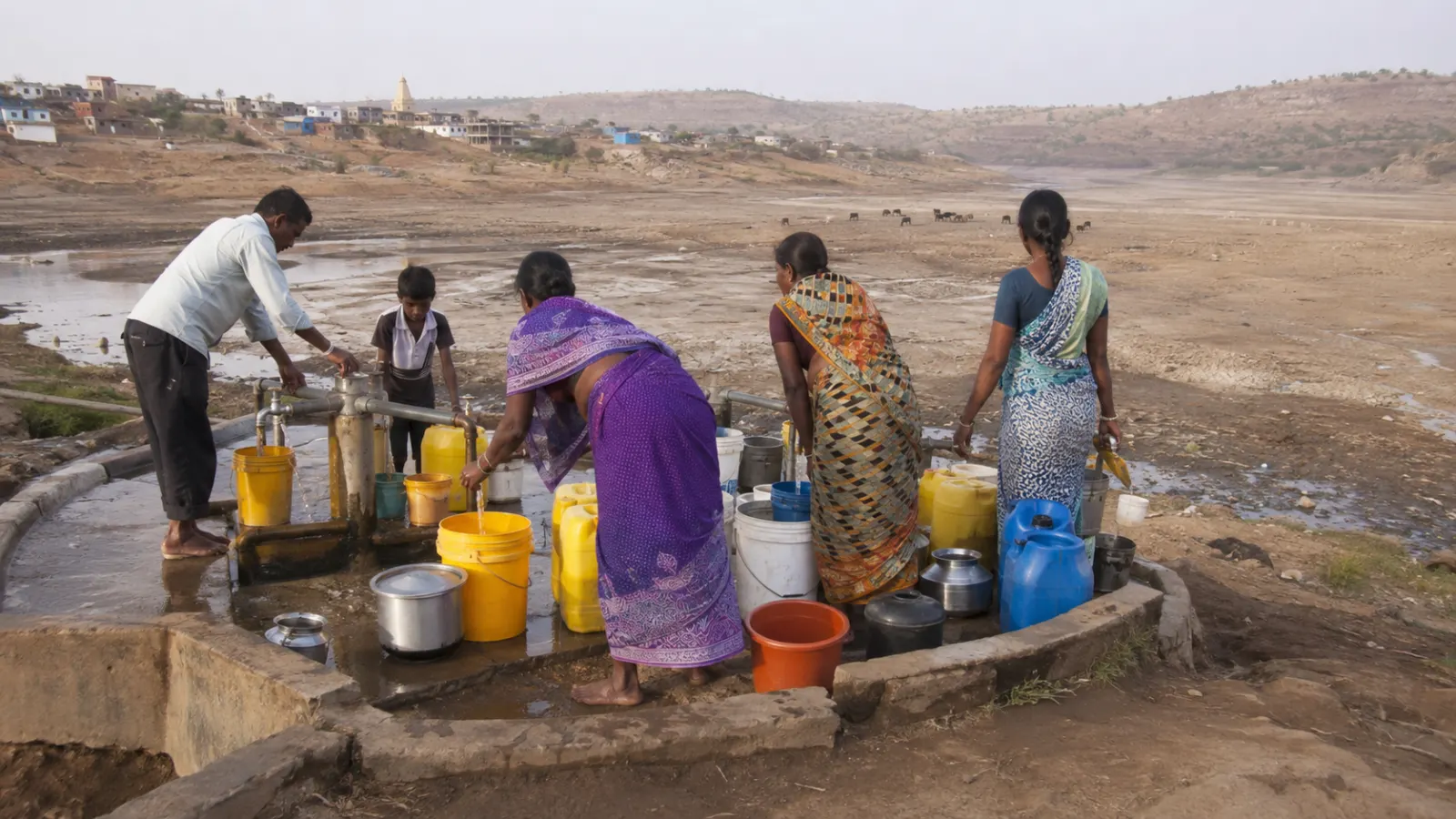
The UN report cited in your draft estimates that women and girls spend roughly 250 million hours every day collecting water.
This represents far more than physical effort.
Time spent collecting water is time unavailable for education, paid employment, childcare, leisure or other productive activities.
Poor households may also pay more for water than wealthier households connected to reliable municipal systems. Informal settlements often depend on vendors, tankers or shared collection points. Wealthier households can purchase rooftop tanks, private pumps, filtration systems or alternative supplies that protect them from service failure.
A city can therefore face the same drought while different residents experience very different levels of insecurity.
Water scarcity becomes inequality when access to backup systems depends on income.
Distance From Water Is a Development Indicator
When households must spend substantial time collecting water, the consequences extend across generations.
Children may assist with collection.
School attendance can suffer.
Physical burdens may fall disproportionately on women and girls.
Households may ration water for hygiene because transporting sufficient quantities is difficult.
Bringing reliable water closer to the home therefore changes more than drinking-water access.
It changes how time can be used.
Infrastructure can produce social opportunity by removing hours of unpaid labour from daily life.
Why Earth Does Not Simply Run Out of Water
The global water cycle continuously moves water between oceans, atmosphere, land, rivers, ice and groundwater.
Humanity is not consuming water in the sense of permanently destroying the planet's total supply.
The crisis occurs because most of Earth's water is saline, while freshwater is unevenly distributed geographically and seasonally. Human activity can also contaminate freshwater or withdraw it from rivers and aquifers faster than local systems can replenish it.
Water security is therefore fundamentally a management problem constrained by physical geography.
The objective is not to manufacture a second global hydrological cycle.
It is to organise human demand within the limits of the one that already exists.
Water Recycling Can Expand Effective Supply
Wastewater need not always be treated solely as something to dispose of.
With appropriate treatment, recycled water can serve agriculture, industry, landscaping and, under sufficiently advanced systems and regulatory controls, other uses.
Recycling becomes particularly attractive where freshwater is scarce and wastewater is already collected centrally.
The principle is simple.
Every litre safely reused can reduce pressure on another freshwater source.
But treatment requirements depend on the intended use. Water used for industrial cooling does not necessarily require the same treatment as drinking water.
Recycling therefore requires strong standards, monitoring and public confidence.
Desalination Can Help—but It Is Not a Universal Answer
Desalination converts saline water into freshwater and has become an important part of water supply in several coastal regions.
Its appeal is obvious.
Oceans contain enormous quantities of water, and seawater availability does not depend on local rainfall in the same way as reservoirs.
But desalination has trade-offs.
Plants require substantial infrastructure and energy. Costs can be high relative to conventional sources. Concentrated brine must be managed responsibly. Inland areas do not have easy access to seawater.
Desalination can therefore be highly valuable where geography, energy systems and economics make it appropriate.
It is not a single global solution capable of replacing sustainable freshwater management everywhere.
Rainwater Harvesting Can Strengthen Local Resilience
Rainwater harvesting provides another example of a useful but context-dependent intervention.
Capturing rainfall from roofs or other surfaces can provide water for particular household, agricultural or urban uses and reduce pressure on central systems.
In regions with seasonal rainfall, storage can help bridge shorter dry periods.
But harvested rainwater cannot solve every scarcity problem.
A large city with millions of residents may require water volumes far beyond what rooftop collection alone can provide.
The appropriate role of rainwater harvesting is therefore usually complementary.
It can diversify supply and increase resilience without replacing larger water systems.
Watersheds Are Water Infrastructure Too
Forests, wetlands, soils and river catchments are sometimes treated as environmental assets separate from infrastructure.
In reality, healthy ecosystems can perform water-management functions.
Wetlands can store water and influence flooding.
Vegetation affects runoff and erosion.
Healthy soils can improve infiltration.
Protected catchments may reduce sediment and pollution entering reservoirs.
This is sometimes described as natural infrastructure.
It should not be romanticised as a replacement for pipes, treatment plants or engineered flood protection in every situation.
But ignoring watershed condition can make engineered infrastructure work harder and cost more.
Water Allocation Creates Political Choices
When water is scarce, someone must decide who gets how much.
Agriculture needs irrigation.
Cities need household supply.
Industries require water for production.
Power systems may depend on cooling or hydropower.
Rivers and wetlands need sufficient flow to maintain ecosystems.
There is no purely technical formula capable of resolving every conflict.
Allocation reflects economic priorities, legal rights, political power and social values.
Water governance therefore becomes especially difficult when scarcity intensifies.
Efficiency cannot eliminate every trade-off.
Sometimes societies must choose which uses receive priority.
Transboundary Rivers Add Another Layer of Complexity
Many important rivers and aquifers cross national borders.
Water decisions made upstream can therefore affect communities and ecosystems downstream.
Dams, diversions, pollution or large irrigation projects can become international issues.
Cooperation can allow countries to share data, coordinate reservoir operations and manage drought collectively.
Conflict can make scarcity harder to manage.
The hydrological system does not respect national boundaries.
Governance therefore often has to operate at the scale of the basin rather than the state.
Data Is Part of Water Infrastructure
A water system cannot be managed effectively if nobody knows what is happening.
Governments need reliable information about groundwater levels, river flows, reservoir storage, water quality, household access, withdrawals and distribution losses.
Without monitoring, groundwater can decline unnoticed.
Leaks remain hidden.
Pollution can spread before regulators identify it.
Drought may become a crisis before allocation rules change.
Data therefore should be treated as part of water infrastructure.
Meters, laboratories, monitoring wells, remote sensing and transparent reporting can improve physical management by making invisible problems visible.
Measurement Also Makes Accountability Possible
Water data serve another function.
They allow governments, utilities and the public to ask whether promised improvements actually occurred.
Did leakage fall?
Did treatment compliance improve?
Are poorer neighbourhoods receiving more reliable supply?
Is groundwater decline slowing?
Were sanitation investments maintained?
Without credible measurement, infrastructure announcements can substitute for outcomes.
Good governance requires not simply investing in water but knowing whether the investment delivered the expected service.
Water Security Requires System-Level Thinking
Individual interventions can fail when the wider system is ignored.
A city may build a new reservoir yet continue losing large amounts of water through leaking pipes. A village may receive a new borehole but lose the benefit when the pump breaks and nobody is responsible for maintenance. A farm may adopt efficient irrigation but expand its irrigated area enough that total withdrawals increase.
The result is a recurring lesson.
Water problems cannot always be solved one component at a time.
Managers need to know how much water enters the system, how much is withdrawn, where it goes, how much returns, what quality it has, what ecosystems require and how demand may change.
This is the difference between installing water technology and managing water security.
Financing Is the Difference Between an Announcement and a Service
The global water crisis contains enormous financing needs.
But money is not required only for major construction.
Operations and maintenance are often more important for whether a system survives.
Treatment plants require chemicals and energy every day. Skilled operators need salaries. Sewers must be cleared. Pipes must be repaired. Laboratories need supplies. Pumps need replacement parts.
When governments budget mainly for new infrastructure while neglecting operating expenses, systems can deteriorate long before their expected lifetime.
Financial sustainability therefore needs to be designed from the beginning.
Who pays?
How are low-income households protected?
How much revenue does the utility need to maintain the system?
What happens when electricity or chemical costs rise?
These questions are as important as engineering design.
Water Pricing Is Necessary and Politically Difficult
Providing safe water costs money.
Treatment, pumping, maintenance and monitoring all require continuing finance.
Yet water is also a basic human need.
This creates a difficult policy balance.
Tariffs set too low may leave utilities unable to maintain infrastructure. Tariffs set too high can exclude poor households from reliable service.
Good water policy therefore needs a way to finance operations while protecting basic access.
Different countries use different combinations of tariffs, public subsidies and cross-subsidisation.
The objective should not simply be the cheapest possible water bill.
It should be financially sustainable universal access.
There Is No Single Global Solution
The phrase “solve the water crisis” can be misleading because the underlying problems differ.
A village without safe drinking water needs different interventions from a megacity losing half its supply through ageing pipes.
An agricultural basin pumping groundwater unsustainably needs different policy from a coastal city considering desalination.
A polluted industrial river requires source control and wastewater treatment.
A drought-prone region may need diversified storage and demand management.
A country with excellent infrastructure but weak affordability may face a social-access problem rather than a physical shortage.
The first step in solving a water crisis is therefore diagnosing which crisis is actually present.
Frequently Asked Questions
What is the global water crisis?
The global water crisis refers to overlapping problems involving safe drinking-water access, sanitation, freshwater scarcity, pollution, groundwater depletion, infrastructure, climate risk and unequal access.
Is the world running out of water?
The planet is not literally losing all of its water. The problem is that usable freshwater is unevenly distributed and can be polluted or withdrawn faster than local sources recover.
How many people lack safely managed drinking water?
The WHO strategy cited in this article reports that approximately 2.1 billion people still lack safely managed drinking-water services.
How many people lack safely managed sanitation?
The same source reports approximately 3.4 billion people without safely managed sanitation.
What uses the most freshwater globally?
Agriculture accounts for the largest share of global freshwater withdrawals, at around 72 per cent according to the FAO data cited here.
Why is groundwater important?
Groundwater provides water for households, cities and irrigation and can buffer drought. Excessive extraction can lower water tables and create long-term depletion.
Can polluted water cause water scarcity?
Yes. Pollution can make physically available water unsafe or expensive to use, effectively reducing usable freshwater supply.
What is non-revenue water?
Non-revenue water is water placed into a distribution system that does not generate revenue because of physical leaks, inaccurate metering, unauthorised use or other losses.
How does climate change affect water security?
Climate change can alter rainfall, drought, flooding, snow and ice, river flow and coastal salinity, making water systems less reliable.
Can desalination solve the global water crisis?
Desalination can provide important supply in some coastal regions but involves cost, energy use and brine-management challenges. It is not a universal solution.
Can wastewater be reused?
Yes. Properly treated wastewater can be reused for several purposes depending on treatment standards and local regulation.
Why do women and girls bear a large water burden?
In many communities they are disproportionately responsible for collecting household water, turning unreliable access into a major burden on time, education and economic opportunity.
Can fixing leaks increase water supply?
Yes. Reducing physical losses can increase the quantity of treated water that reaches consumers without immediately developing a new source.
Why is sanitation part of water security?
Poor sanitation can contaminate rivers, groundwater and living environments, increasing disease risk and the treatment burden on drinking-water systems.
Why is water governance important?
Water systems require financing, skilled staff, regulation, monitoring, maintenance and clear institutional responsibility. Infrastructure alone cannot deliver reliable service indefinitely.
What is the best solution to water scarcity?
There is no universal best solution. The appropriate combination may include demand management, sustainable groundwater use, efficient irrigation, recycling, storage, leakage reduction, watershed protection or desalination depending on local conditions.
The Global Water Crisis Is Really a Systems Crisis
The most useful way to understand the global water crisis is to stop imagining one empty reservoir representing the entire problem.
One community may have abundant water but no sanitation.
Another may have excellent treatment yet unreliable distribution.
A farming region may possess productive aquifers but pump them unsustainably.
A city may have enough raw water while losing huge volumes from ageing pipes.
A polluted river can create scarcity in the middle of a wet climate.
Climate change can intensify each of these failures.
The crisis is therefore systemic.
That also means progress can occur at many different points.
The Central Idea
A water-rich planet can still leave billions of people without water security because water abundance at the planetary scale is not the same thing as reliable access to safe freshwater at the human scale.
The source you supplied captures this distinction clearly. The crisis includes drinking-water access, sanitation, scarcity, pollution, groundwater depletion, infrastructure loss, financing, climate pressure and unequal access rather than one simple global shortage.
The figures illustrate the scale of the problem. Around 2.1 billion people still lack safely managed drinking-water services, while about 3.4 billion lack safely managed sanitation. Agriculture accounts for roughly 72 per cent of freshwater withdrawals, demonstrating that the problem cannot be solved through household conservation alone. Infrastructure losses can consume a significant share of already treated water, while weak institutional capacity can prevent good policies from becoming functioning services.
Climate change adds volatility to this already stressed system. Droughts can reduce supply, extreme rainfall can overwhelm sanitation, sea-level rise can threaten coastal aquifers and shifting weather patterns can make historically reliable infrastructure less dependable.
But none of these trends makes failure inevitable.
Water is one of the most actively managed resources on Earth.
Governments can protect watersheds, regulate groundwater extraction, treat wastewater, repair pipes, improve irrigation, expand sanitation, diversify supply and build climate resilience. Utilities can reduce leakage and improve monitoring. Communities can participate in source protection and accountability. New technologies can improve treatment and measurement where appropriate.
The difficult part is that these interventions have to be maintained.
A treatment plant without skilled operators eventually fails. A borehole without repair financing stops delivering water. A groundwater rule without monitoring exists only on paper. A wastewater plant without energy and maintenance cannot protect the river downstream.
The next phase of global water policy therefore needs to move beyond counting infrastructure and toward measuring service, reliability, quality and sustainability.
The ultimate objective is not simply to place more pipes in the ground.
It is to build systems capable of delivering safe water continuously while leaving enough water in rivers, aquifers and ecosystems for the future.
That is the real meaning of water security.