Geothermal Energy Explained: How It Works, Types, Benefits and Challenges
Geothermal energy begins with a simple physical fact: Earth contains an enormous amount of heat beneath its surface. Some of that heat remains from the planet’s formation, while some is continually produced by the radioactive decay of naturally occurring elements inside Earth. Where underground heat is accessible, it can be used to generate electricity, heat buildings, supply industrial processes or help heat and cool homes through ground-source heat pumps.
This range of uses is why geothermal energy should not be imagined as one technology. A large geothermal power station drilling kilometres into a hydrothermal reservoir is fundamentally different from a ground-source heat pump exchanging heat with shallow soil beneath a house. Direct geothermal heating is different again because it can use naturally hot groundwater without converting the heat into electricity first.
The common resource is thermal energy stored beneath the ground. The engineering challenge is determining how hot that resource is, how deeply it lies, whether fluid can move through it, how much drilling is required and whether useful energy can be extracted economically without damaging the reservoir or surrounding environment.
Geothermal has an unusual position within the wider energy transition. Unlike solar and wind generation, geothermal power can operate continuously in suitable reservoirs and is not directly dependent on sunlight or weather. Yet geothermal projects can be much harder to develop because developers may need to spend large amounts on geological exploration and deep drilling before they know exactly how productive a reservoir will be. New technologies such as enhanced geothermal systems, closed-loop geothermal and advanced drilling aim to reduce the geographical limitations that historically kept geothermal electricity concentrated in a relatively small number of favourable locations.
What Is Geothermal Energy and Where Does Earth’s Heat Come From?
Geothermal energy is energy derived from heat within Earth. Temperature generally rises with depth, although the rate of increase varies significantly according to geology. In volcanic and tectonically active regions, magma and hot rock can bring very high temperatures relatively close to the surface. Groundwater circulating through fractured hot rock can then create hydrothermal reservoirs that may be accessible through wells.
Natural hot springs, fumaroles and geysers are visible examples of underground heat interacting with groundwater, but economically useful geothermal resources do not always produce dramatic surface features. Heat exists beneath almost every location; what differs is its depth, temperature, geological structure and accessibility.
For conventional geothermal electricity production, the U.S. Department of Energy identifies three especially important ingredients: heat, fluid and permeability. Hot rock supplies thermal energy, underground fluid carries that heat and permeable fractures or pores allow the fluid to circulate through the reservoir. When nature provides all three in the right combination, wells can bring hot water or steam to the surface for electricity generation.
This explains why conventional geothermal power has historically been concentrated in geologically favourable regions. Heat alone is not enough. Extremely hot rock that contains little water or has almost no connected fractures may hold enormous theoretical energy while remaining difficult to use with traditional geothermal technology.
Modern geothermal engineering increasingly attempts to overcome that limitation. Enhanced geothermal systems can improve permeability artificially, while closed-loop concepts attempt to circulate working fluids inside sealed underground pipes rather than depending on natural reservoir flow. If these approaches become commercially competitive, the map of geothermal electricity could become much larger than the map of natural hydrothermal fields.
How Geothermal Power Plants Generate Electricity
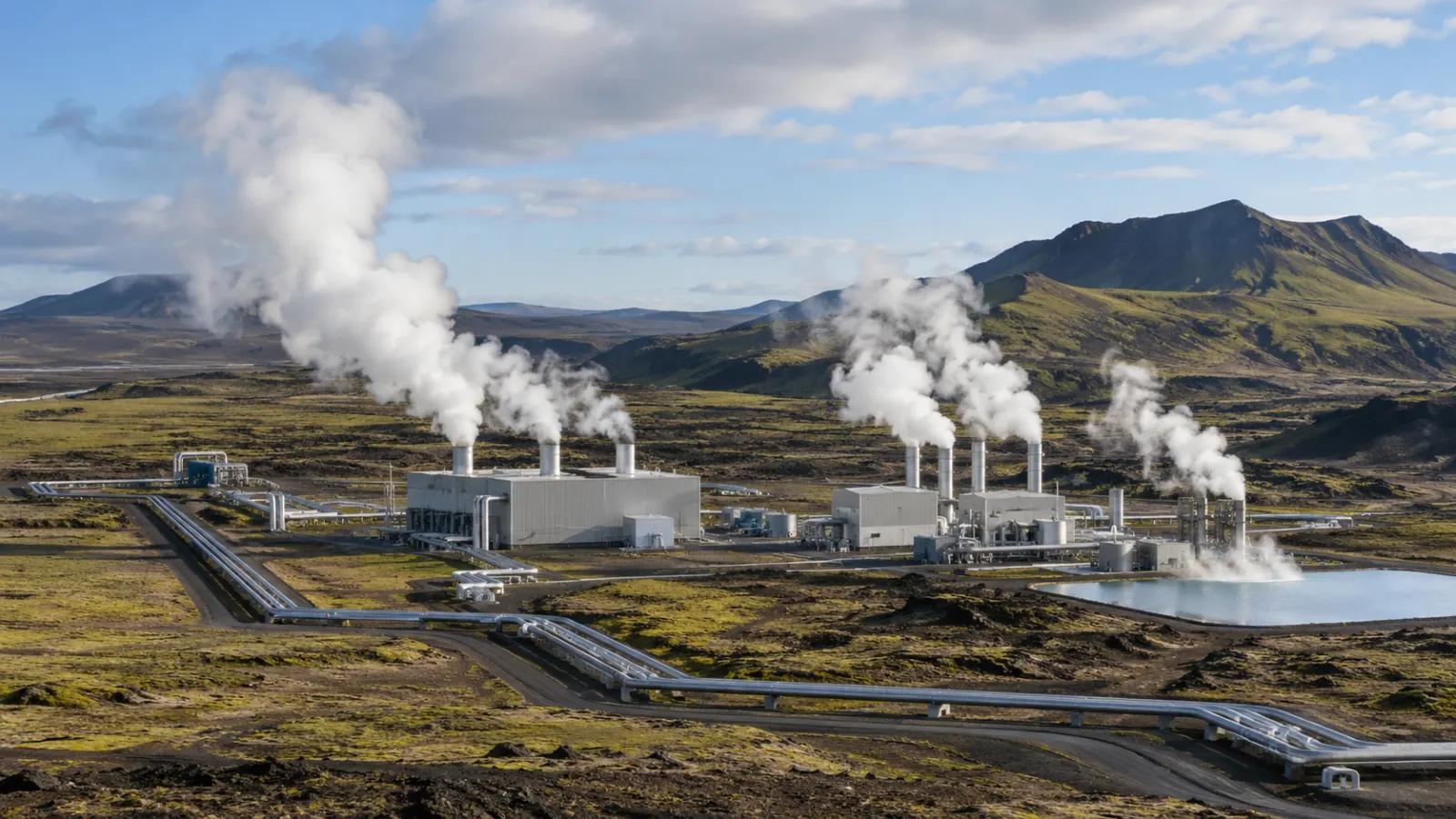
A geothermal power plant differs from a coal or gas plant because it usually does not burn fuel to create heat. Instead, wells tap underground steam or hot fluid containing heat already stored within the Earth. The thermal energy is brought to the surface and converted into mechanical energy in a turbine, which drives a generator.
The exact process depends on the temperature and physical state of the geothermal resource. Three conventional designs dominate: dry-steam, flash-steam and binary-cycle power plants.
A dry-steam plant uses naturally occurring underground steam directly. Steam travels from production wells toward a turbine, turns the turbine-generator system and is then generally condensed. Dry-steam resources are relatively uncommon because the underground reservoir must naturally produce steam rather than predominantly hot water.
A flash-steam plant uses extremely hot pressurised groundwater. Underground pressure keeps the water liquid even at temperatures above its normal surface boiling point. When that fluid reaches equipment at lower pressure, some of it rapidly “flashes” into steam. That steam then drives the turbine.
A binary-cycle plant keeps geothermal fluid separate from the turbine’s working fluid. Hot geothermal water passes through a heat exchanger and transfers its thermal energy to another liquid with a lower boiling point. The secondary fluid vaporises and drives the turbine while the geothermal fluid remains in a separate circuit. Binary plants can therefore use lower-temperature geothermal resources than many traditional steam systems and can keep much of the geothermal brine contained within a closed process.
After thermal energy has been extracted, geothermal fluid is commonly reinjected underground. Reinjection can help maintain reservoir pressure, reduce surface disposal requirements and support the long-term management of the geothermal resource. The precise production and reinjection strategy depends on local geology because injecting cooled water too close to a production zone could cool the resource prematurely.
Geothermal power plants are particularly valuable because they can operate for long periods with highly predictable output. DOE describes geothermal electricity as both firm and flexible: plants can produce power around the clock and some systems can adjust output in response to grid conditions.
This gives geothermal a different role from weather-dependent renewable generation. Solar electricity is strongest when sunlight is available, while wind output depends on changing wind conditions. Geothermal heat underground does not disappear after sunset or during calm weather. A grid containing large amounts of variable renewable electricity can therefore benefit from clean generating resources whose output is more controllable.
That does not mean geothermal automatically competes better than solar or wind. Solar and wind projects can often be developed rapidly and across much wider areas without deep drilling. The strength of geothermal lies in complementarity rather than universal superiority.
Geothermal Heating, Direct Use and Ground-Source Heat Pumps
Electricity generation attracts much of the attention around geothermal energy, but converting underground heat into electricity is only one way of using the resource. In many cases it can be more efficient to use geothermal heat directly.
Direct-use geothermal systems bring naturally heated water from underground and use the thermal energy for buildings or industrial processes without first generating electricity. DOE lists applications including space heating, greenhouses, aquaculture, food processing and other industrial uses. Direct-use resources typically operate at substantially lower temperatures than those required for many electricity-generating systems.
A district-heating system can use one geothermal resource to serve many buildings through a network of hot-water pipes and heat exchangers. This avoids the additional conversion losses involved in generating electricity and then using that electricity to produce heat. Where suitable geology and urban density coincide, direct geothermal heat can therefore be extremely effective.
Geothermal heat pumps, also called ground-source heat pumps, operate differently from both geothermal power plants and direct-use systems. They generally do not require extremely hot underground rock at all. Instead, they exploit the fact that shallow ground temperature remains much more stable through the year than outdoor air temperature.
DOE explains that ground-source heat pumps use the earth as both a heat source and a heat sink. During winter, the system extracts heat from the relatively warmer ground and transfers it into the building. During summer, it reverses direction, moving heat from the building into the cooler ground.
The heat pump still consumes electricity. It does not create unlimited free heating from the ground. Its advantage is that it uses electricity primarily to move heat rather than creating all heating directly through electrical resistance.
Ground loops can be installed in several configurations depending on available land and geology. Horizontal loops may be used where enough land exists, while vertical boreholes can provide the necessary heat-exchange area on smaller sites. Networks can also connect many buildings rather than serving only one home.
This distinction is important because statements such as “geothermal energy only works near volcanoes” are misleading. Deep geothermal electricity has historically depended strongly on favourable geology, but ground-source heat pumps can work in many climates because they rely on relatively stable shallow-earth temperatures rather than volcanic heat. DOE describes geothermal heat pumps as usable in urban or rural settings and across a broad range of climates.
Enhanced Geothermal Systems Could Change Where Geothermal Power Works
Conventional hydrothermal geothermal systems require useful underground heat to coincide naturally with both fluid and permeability. Enhanced geothermal systems, usually abbreviated EGS, attempt to engineer some of the missing reservoir conditions.
In a simplified EGS design, developers drill into sufficiently hot rock, inject fluid and stimulate existing fractures or create additional connected pathways through which fluid can circulate. Water travelling through the hot rock absorbs thermal energy and returns through production wells. At the surface, the heat can then be converted into electricity using technologies similar to conventional geothermal generation.
The importance of EGS is geographical. Hot rock is much more widespread than naturally productive hydrothermal reservoirs. If engineers can reliably create long-lasting underground heat exchangers, geothermal electricity could expand beyond regions containing naturally abundant hot water and fractures.
This potential has generated considerable investment. The 2025 U.S. Geothermal Market Report found that next-generation geothermal technologies had attracted more than $1.5 billion in private capital since 2021. It also reported that U.S. geothermal installed nameplate electricity capacity reached 3,969 MW in 2024, up about 8% from 2020, while more than 1,000 MW of new capacity commitments had been represented in power-purchase agreements signed since the previous market report.
DOE has continued expanding next-generation geothermal work. In February 2026 it announced $171.5 million for field-scale next-generation geothermal testing and exploration drilling, illustrating how development is increasingly focused on reducing geological and drilling uncertainty rather than merely improving conventional turbines.
DOE's published geothermal projections have also become more ambitious as next-generation approaches develop. Earlier GeoVision modelling identified scenarios reaching around 60 GW of U.S. geothermal electricity by 2050, while subsequent EGS analysis raised one potential scenario to about 90 GW. More recent DOE material in 2026 discusses substantially larger technical deployment possibilities. These figures are scenarios and estimates rather than forecasts, and their realisation depends heavily on drilling costs, commercial performance, permitting and reservoir engineering.
Closed-loop geothermal systems represent another emerging approach. Instead of relying on an open fractured reservoir through which injected water circulates, they use sealed underground pipes containing a working fluid. The fluid absorbs heat through the pipe walls and returns to the surface without needing to flow through the surrounding rock. DOE compares this concept loosely to an underground radiator.
Closed-loop systems could reduce dependence on natural permeability and potentially reduce some fluid-management challenges, but they face their own difficulties. Heat must move efficiently through rock into the closed pipes, very deep drilling remains expensive and large underground heat-exchange areas may be necessary to produce commercially useful output.
The broader significance of next-generation geothermal is therefore not that electricity can suddenly be generated anywhere. The important change is that engineers are increasingly trying to manufacture access to heat resources that conventional geothermal development could not economically use.
Is Geothermal Energy Renewable and Low Carbon?
Geothermal energy is generally classified as renewable because the Earth's internal heat reservoir is enormous and is continually supplemented by radioactive decay. DOE notes that heat flowing from Earth’s interior will remain available for billions of years.
That planetary-scale definition does not mean individual geothermal reservoirs cannot be mismanaged. A specific field can decline if heat or fluid is extracted more rapidly than local geological processes replenish useful reservoir conditions. Sustainable geothermal production therefore requires reservoir modelling, reinjection, monitoring and adjustment over time.
The distinction is important: renewable does not mean impossible to overuse locally.
Geothermal electricity also has relatively low greenhouse-gas emissions compared with fossil-fuel generation, but the emissions are not necessarily zero. Drilling rigs, construction materials and plant development create lifecycle emissions. Some natural geothermal fluids also contain gases such as carbon dioxide or hydrogen sulphide that can reach the surface depending on reservoir chemistry and plant design.
Binary plants can contain geothermal fluids more completely than some open steam systems. Environmental performance therefore differs among technologies and reservoirs rather than being represented accurately by one universal emissions figure.
Geothermal systems also require physical infrastructure including wells, roads, pipelines, power equipment and transmission. Their surface land requirement can nevertheless be relatively compact, particularly when compared over a long plant lifetime with energy systems requiring much larger fuel extraction or land areas. DOE includes relatively small land footprint among geothermal's potential advantages.
Water use is similarly site-specific. Some projects depend heavily on underground fluids and reinjection, while different cooling systems and next-generation designs have different water requirements. In dry regions, water availability can become a significant constraint. DOE therefore treats water use as one of several environmental factors requiring project-specific analysis rather than assuming every geothermal facility has the same impact.
Another emerging possibility is mineral recovery from geothermal brines. Some geothermal fluids contain lithium and other dissolved minerals. Research is exploring whether valuable materials can be extracted while the fluid is already being processed for energy production. If commercially successful, this could combine geothermal generation with mineral supply, although water use, chemistry and economics still require careful assessment.
Can Geothermal Energy Cause Earthquakes?
Geothermal development can cause induced seismicity, particularly when fluid injection changes underground pressure and stresses around existing fractures.
This issue is most closely associated with enhanced geothermal systems because creating or increasing permeability commonly requires reservoir stimulation. Injected fluid changes effective stress in the rock, and small movements along fractures can produce microearthquakes.
Most of these events are extremely small. DOE describes induced seismicity associated with EGS as generally consisting of microseismic events, many of which are too small to be felt at the surface. However, the risk is not zero, and geothermal projects in several countries have produced earthquakes large enough to be felt by local communities.
The actual risk depends on local geology, nearby faults, injection pressure, depth, fluid volume and the distance between the reservoir and populated areas. This is why statements that “geothermal causes earthquakes” or “geothermal cannot cause earthquakes” are both too simplistic.
Modern EGS development uses seismic monitoring and risk-management protocols. DOE-funded projects are required to follow induced-seismicity procedures intended to characterise baseline seismic conditions, understand local faults, continuously monitor activity and modify operations when risk thresholds are reached.
Induced seismicity demonstrates a broader principle in energy engineering. Subsurface technologies do not operate inside uniform rock. Geological conditions can vary dramatically over short distances, and uncertainty remains even after extensive surveying.
Responsible geothermal development therefore requires not simply drilling expertise but geophysics, reservoir modelling, monitoring and transparent risk management.
Why Geothermal Energy Is Still Relatively Underused
Given its ability to provide continuous renewable power, geothermal might appear as though it should already be a much larger part of global electricity systems. Its relatively limited deployment reflects several economic and geological barriers.
The first is exploration risk. A solar developer can measure sunlight directly at the surface. Wind developers can gather detailed wind data before installing full-scale turbines. Geothermal developers often need geophysical surveys and expensive exploration wells to learn exactly what exists kilometres underground.
A well that does not discover adequate temperature, permeability or fluid flow can represent a major financial loss before a project has generated any electricity.
The second barrier is drilling cost. Oil and gas industries have spent decades improving deep-well technology, but geothermal wells can face extreme temperatures and hard rock that increase tool wear and technical difficulty. Next-generation geothermal depends heavily on transferring and improving drilling techniques developed elsewhere in the energy sector.
The third barrier is project timing. Resource assessment, exploration drilling, permitting, reservoir confirmation, production wells and power-plant construction can make geothermal developments slower and more complex than many solar or wind projects.
The fourth is geography and infrastructure. A good geothermal resource may be far from transmission lines or population centres. Direct heating additionally requires customers to be physically close enough for heat networks to make economic sense.
Financing becomes difficult because these risks appear early. Investors must commit substantial capital before the productive capacity of the underground resource is fully known.
This is why much of current geothermal innovation focuses not on the turbine but on reducing uncertainty beneath the ground. Better imaging, drilling, sensors, reservoir models and field testing can potentially lower exploration risk and make financing easier.
The 2025 U.S. market report provides evidence that commercial interest is increasing even while these barriers remain. U.S. geothermal capacity grew modestly between 2020 and 2024, but private investment and power-purchase commitments for next-generation projects increased significantly.
Geothermal Energy Compared With Solar, Wind and Hydropower
No clean-energy source is ideal in every location, so geothermal is best evaluated according to the service it provides rather than as a universal replacement for other renewables.
| Energy source | Major strength | Major limitation |
|---|---|---|
| Geothermal | Firm, continuous electricity and direct heat where resources are accessible | High exploration and drilling risk; conventional resources geographically limited |
| Solar | Rapidly deployable and widely available | Output depends strongly on sunlight and time of day |
| Wind | Large low-carbon electricity potential in suitable regions | Variable output and location-dependent wind resource |
| Hydropower | Dispatchable generation and possible energy storage | Strong dependence on geography, water systems and ecological impacts |
| Ground-source heat pumps | Efficient heating and cooling using stable shallow-ground temperatures | High initial installation cost and site-specific drilling or ground-loop requirements |
The table shows why energy systems increasingly rely on portfolios rather than one supposedly perfect technology. Solar may provide inexpensive daytime electricity. Wind may produce strongly at different hours or seasons. Batteries can shift energy over time. Hydropower can provide flexibility where geography permits. Geothermal can supply long-duration firm electricity or directly reduce demand for electricity used in heating.
DOE increasingly discusses geothermal in this complementary role, particularly as data centres and other electricity-intensive users seek reliable around-the-clock power. The 2025 market report notes growing geothermal power-purchase agreements associated with data-centre demand.
Heating may ultimately be just as important as electricity. DOE's recent geothermal heating-and-cooling work highlights thermal-energy networks, ground-source heat pumps and direct-use systems as ways to reduce building energy demand and pressure on electricity grids.
Frequently Asked Questions About Geothermal Energy
What is geothermal energy? Geothermal energy is thermal energy obtained from beneath Earth's surface. It can be used to generate electricity, provide direct heat or support heating and cooling through ground-source heat pumps.
Where does geothermal energy come from? It comes from heat within Earth, including residual heat from planetary formation and heat generated by radioactive decay inside the planet.
How does geothermal energy generate electricity? Wells bring underground steam or hot fluid to the surface. Its heat is used to drive a turbine-generator system directly or indirectly through a secondary working fluid.
What are the three types of geothermal power plants? The three main conventional designs are dry-steam, flash-steam and binary-cycle plants.
What does a binary geothermal plant do? It transfers heat from geothermal water to a secondary fluid with a lower boiling point. The secondary fluid vaporises and drives the turbine while the geothermal water remains separate.
What is direct-use geothermal energy? It means using underground heat directly for buildings, industrial processes, greenhouses or similar applications without first converting it to electricity.
Is a geothermal heat pump the same as a geothermal power plant? No. A geothermal power plant usually accesses deep high-temperature resources to generate electricity. A geothermal or ground-source heat pump uses relatively stable shallow-ground temperatures to heat and cool buildings.
Can geothermal heat pumps work away from volcanic areas? Yes. They rely on stable shallow-earth temperatures and can be installed in many climates where deep hydrothermal electricity production would not be possible.
What is an enhanced geothermal system? An EGS is an engineered underground geothermal reservoir designed to improve fluid circulation through hot rock where natural permeability or fluid flow is insufficient.
What is closed-loop geothermal? Closed-loop geothermal circulates working fluid through sealed underground pipes so that the fluid absorbs heat from surrounding rock without depending on an open fracture network.
Is geothermal energy renewable? Yes, geothermal is generally classified as renewable because Earth's internal heat is continually replenished and enormous on human timescales. Individual reservoirs still require careful management to avoid local decline.
Does geothermal energy produce carbon emissions? Geothermal generally has much lower lifecycle greenhouse-gas emissions than fossil-fuel generation, but drilling, construction and naturally occurring reservoir gases mean impacts are not universally zero.
Can geothermal energy cause earthquakes? Fluid injection and extraction can induce seismic events, particularly during EGS reservoir stimulation. Most are small, but project-specific monitoring and risk mitigation are necessary.
Does geothermal energy use water? Many conventional and enhanced geothermal systems circulate water or geothermal brine, although consumption and withdrawal depend strongly on reservoir and plant design.
Why is geothermal energy not used everywhere? Conventional geothermal requires suitable underground heat, fluid and permeability. Exploration and deep drilling are expensive, and developers may not fully understand a reservoir until substantial capital has already been spent.
Can geothermal energy run all day? Well-managed geothermal power plants can generally generate continuously rather than depending on sunlight or wind conditions.
Can geothermal replace solar and wind? It is better viewed as complementary. Geothermal can provide firm power and heat, while solar and wind can often be installed more widely and rapidly.
Is geothermal energy expensive? Costs vary substantially. Operating costs can be attractive once a productive resource exists, but exploration and drilling can create high upfront costs and significant financial risk.
What is the future of geothermal energy? Much of its future depends on whether improved drilling, EGS, closed-loop systems and reservoir engineering can make deeper and geographically broader heat resources commercially accessible.
Earth's Heat Is Vast; Access Is the Real Constraint
The most important fact about geothermal energy is not that Earth contains heat. The amount of thermal energy beneath humanity's feet is enormous. The important question is how much of it can be converted into useful energy at an acceptable cost and risk.
Conventional geothermal power succeeds where geology has already assembled the necessary ingredients: accessible heat, fluid and pathways through which that fluid can circulate. These resources can provide remarkably steady electricity, but their geography has historically limited deployment.
Direct-use geothermal demonstrates that electricity is not always the most efficient destination for underground heat. District heating, greenhouses and industrial processes can use thermal energy directly. Ground-source heat pumps expand the concept further by showing that even relatively shallow ground can become useful energy infrastructure because its temperature is more stable than the air above it.
Next-generation geothermal addresses the remaining limitation: what happens when the heat exists but the reservoir does not naturally behave like a conventional geothermal field? Enhanced geothermal systems try to create the necessary circulation pathways. Closed-loop systems attempt to extract heat without depending on those pathways at all. Advanced drilling tries to reach deeper and hotter resources more cheaply.
These technologies could make geothermal available in many more places, but the challenges are substantial. Deep wells are expensive. Underground conditions are difficult to predict. Reservoir stimulation can create seismicity. Water and mineral chemistry need management. Projects can require years of development before the quality of the resource is fully established.
That is why geothermal's future depends less on discovering that Earth is hot than on becoming better at seeing, drilling and managing what lies underground.
The latest market evidence suggests that this transition has begun rather than been completed. U.S. geothermal capacity remains modest compared with wind and solar, but installed capacity increased between 2020 and 2024, private investment in next-generation geothermal has accelerated and new projects are being pursued for electricity-intensive loads that value reliable round-the-clock power.
Geothermal therefore occupies a potentially important niche in a diversified clean-energy system. It can generate electricity when the sun is down and the wind is weak, supply heat without converting it into electricity and reduce heating and cooling demand through ground-source systems. It will not replace every other energy source, nor does every region contain an economically viable deep geothermal resource.
The more realistic opportunity is also more interesting.
Humanity already possesses enormous amounts of renewable heat beneath the surface.
The technological problem is learning how to reach enough of it safely, predictably and cheaply enough for Earth's internal heat to become a much larger part of the energy system.