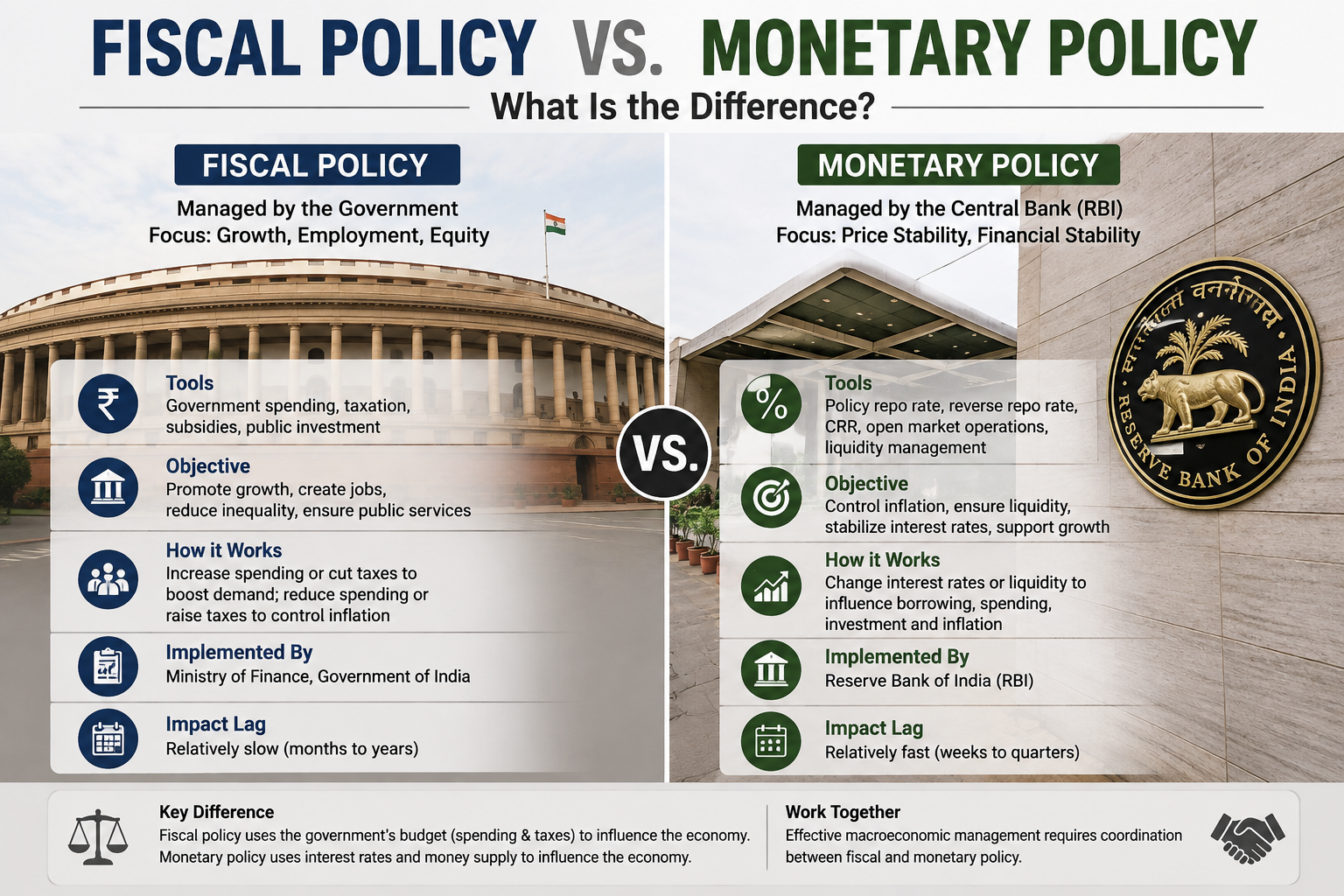
Every modern economy has two major policy engines. One is fiscal policy, controlled mainly by the government through spending, taxation and borrowing. The other is monetary policy, controlled mainly by the central bank through interest rates, liquidity and credit conditions. Both influence growth, inflation, employment, investment and financial stability. But they do so through different channels.
Understanding the difference between fiscal policy and monetary policy is essential because many public debates confuse the two. When prices rise, people ask why the central bank is not acting. When growth slows, they ask why the government is not spending more. When loan EMIs rise, they blame monetary policy. When taxes change, they blame fiscal policy. These instincts are not entirely wrong, but the relationship is more complex.
Fiscal policy is the use of government spending, taxation and borrowing to influence the economy. If the government increases infrastructure spending, cuts taxes, expands welfare transfers or raises subsidies, it is using fiscal tools. If it raises taxes, reduces expenditure or lowers borrowing, it is also using fiscal tools, but in the opposite direction.
Monetary policy is the use of central-bank tools to influence money, credit, interest rates and inflation. In India, the Reserve Bank of India is responsible for monetary policy. Its tools include the policy repo rate, liquidity operations, reserve requirements, open-market operations, regulatory measures and communication through Monetary Policy Committee decisions. The core objective under India's framework is price stability, while keeping growth in mind.
The simplest distinction is this: fiscal policy works through the government's budget; monetary policy works through the financial system.
When fiscal policy is expansionary, the government may increase spending or reduce taxes to support demand. This can help during slowdowns because public spending directly enters the economy. A road project creates orders for construction companies, jobs for workers and demand for steel, cement and equipment. A tax cut may leave households with more disposable income. A cash transfer may support consumption.
When fiscal policy is contractionary, the government may reduce spending, raise taxes or lower borrowing to cool demand or restore fiscal discipline. This can help when deficits are too high, debt is rising or inflationary demand pressures are strong. But contractionary fiscal policy can also slow growth if applied too sharply during weakness.
Monetary policy works differently. When the central bank reduces the policy rate or adds liquidity, borrowing may become cheaper and credit conditions easier. Banks may reduce lending rates, businesses may borrow more, households may take loans, and investment or consumption may improve. When the central bank raises rates or tightens liquidity, borrowing becomes costlier and demand may slow, helping control inflation.
However, monetary policy does not work like a switch. It works with lags. A repo rate change must pass through banks, bond markets, loan pricing, borrower behaviour and business confidence. If banks are risk-averse, firms are uncertain or households already carry heavy debt, cheaper rates may not produce a strong borrowing response. If inflation is caused by food shocks or oil prices, higher rates may not immediately reduce those prices, though they can prevent broader inflation expectations from becoming unanchored.
Fiscal policy can be more direct but slower to design and harder to reverse. A government can announce spending, but projects need approvals, land, procurement, contractors and execution. Tax changes require legal and administrative design. Subsidies and transfers can support people quickly, but once created they may become politically difficult to withdraw.
Monetary policy can be faster to announce but slower in transmission. A central bank can change rates quickly, but the effect on the real economy takes time. Fiscal policy is often more visible; monetary policy is often more technical. Fiscal policy is debated in Parliament and public politics. Monetary policy is conducted through institutional committees and central-bank communication.
The two policies often interact. Suppose inflation rises because demand is too strong. The central bank may raise interest rates. But if the government simultaneously expands deficit-financed spending, monetary policy may have to work harder. Suppose growth slows sharply. The central bank may cut rates, but if the government is forced into fiscal tightening, the recovery may be weaker. Coordination matters, but central-bank independence also matters because inflation control requires credibility.
India's monetary framework reflects this balance. The monetary policy framework agreement between the Government of India and the RBI set the objective of maintaining price stability while keeping growth in mind, with a medium-term inflation target around 4 percent and a tolerance band of plus or minus 2 percentage points. This means the RBI is not expected to chase growth at any inflation cost. It must anchor price expectations because high inflation hurts households, savings and investment confidence.
Fiscal policy has a different accountability structure. The government must fund national priorities: infrastructure, defence, welfare, health, education, agriculture, state transfers, subsidies and administration. It must also manage debt and deficits through the Budget and fiscal responsibility framework. Governments face electoral pressure, development needs and crisis demands. Fiscal policy is therefore both economic and political.
A central question is which policy should respond to which problem. If inflation comes from excessive demand, monetary tightening can help. If inflation comes from supply shocks, such as food shortages or imported oil-price spikes, fiscal and supply-side measures may also be needed. If unemployment rises due to weak demand, fiscal spending and monetary easing may both help. If the problem is poor infrastructure, monetary policy cannot build roads. If the problem is high inflation expectations, government spending alone cannot anchor prices.
This is why macroeconomic management requires diagnosis. A doctor cannot prescribe the same medicine for every disease. Similarly, policymakers should not use one instrument for every economic problem. Taxation, spending, borrowing, rates, liquidity, regulation and reforms each have different effects.
For households, fiscal and monetary policy enter daily life through different doors. Fiscal policy affects income tax, GST, subsidies, public services and government schemes. Monetary policy affects loan rates, deposit rates, EMIs, savings returns, bond yields and inflation expectations. A salaried person may feel fiscal policy through tax slabs and monetary policy through home-loan EMIs. A small business may feel fiscal policy through GST compliance and monetary policy through working-capital cost.
For businesses, fiscal policy shapes demand, incentives, infrastructure and tax burden. Monetary policy shapes borrowing cost, liquidity and financial conditions. A manufacturer may benefit from a production incentive or road project, but still struggle if interest rates are high. A real-estate developer may benefit from lower rates, but still depend on approvals, urban policy and household confidence.
For investors, the relationship is crucial. Expansionary fiscal policy can support growth but may raise borrowing and bond yields if markets worry about debt. Tight monetary policy can control inflation but may reduce equity valuations and credit growth. Loose monetary policy can support asset prices but may create inflation or financial stability risks if excessive. Investors therefore watch both the Budget and central-bank policy.
The best macroeconomic environment is not one where policy is always loose. It is one where policy is credible, balanced and responsive. Too much stimulus can create inflation and debt pressure. Too much tightening can damage growth and employment. Too little public investment can weaken future productivity. Too much cheap credit can create bubbles. Policy must adjust to conditions.
Fiscal policy and monetary policy are therefore not rivals. They are complementary instruments. Fiscal policy decides how the state raises and uses public money. Monetary policy decides how the financial system conditions money, credit and prices. One operates through the budget. The other operates through the central bank. A stable economy needs both to work with discipline.
The final lesson is simple: governments can spend and tax, central banks can influence money and rates, but neither can abolish trade-offs. Growth, inflation, debt, employment and stability must be balanced. The strength of an economy lies not in using one policy aggressively, but in using the right tool at the right time with credibility, transparency and restraint.
Policy credibility is the bridge between the two. If markets and citizens believe the government will keep debt under control, fiscal policy has more room to respond during crises. If people believe the central bank will protect price stability, inflation expectations remain better anchored. Credibility reduces the cost of adjustment. Without credibility, even correct policy steps may fail because households, firms and investors do not trust the direction.
There is also a distributional dimension. Fiscal policy can directly target groups through subsidies, transfers, public jobs, tax relief or social spending. Monetary policy is broader and less targeted. A rate hike may cool inflation, but it also raises borrowing costs for homebuyers and firms. A rate cut may support borrowers, but it can reduce returns for savers. This is why monetary policy is powerful but blunt, while fiscal policy is targeted but politically contested.
The most difficult moments occur when the two policies must move in different directions. A country may face high inflation and weak growth at the same time. The central bank may need to remain cautious while the government protects vulnerable households through targeted fiscal measures. Such situations demand policy maturity, not slogans. The economy is not managed by one lever. It is managed by a dashboard of instruments, constraints and expectations.
Disclaimer
This article is for general educational and editorial use. It is not investment, banking, tax, legal or policy advice. Monetary-policy decisions, interest rates, fiscal targets and Budget numbers change over time. Verify current RBI, Government of India and official Budget documents before publication or decision-making.