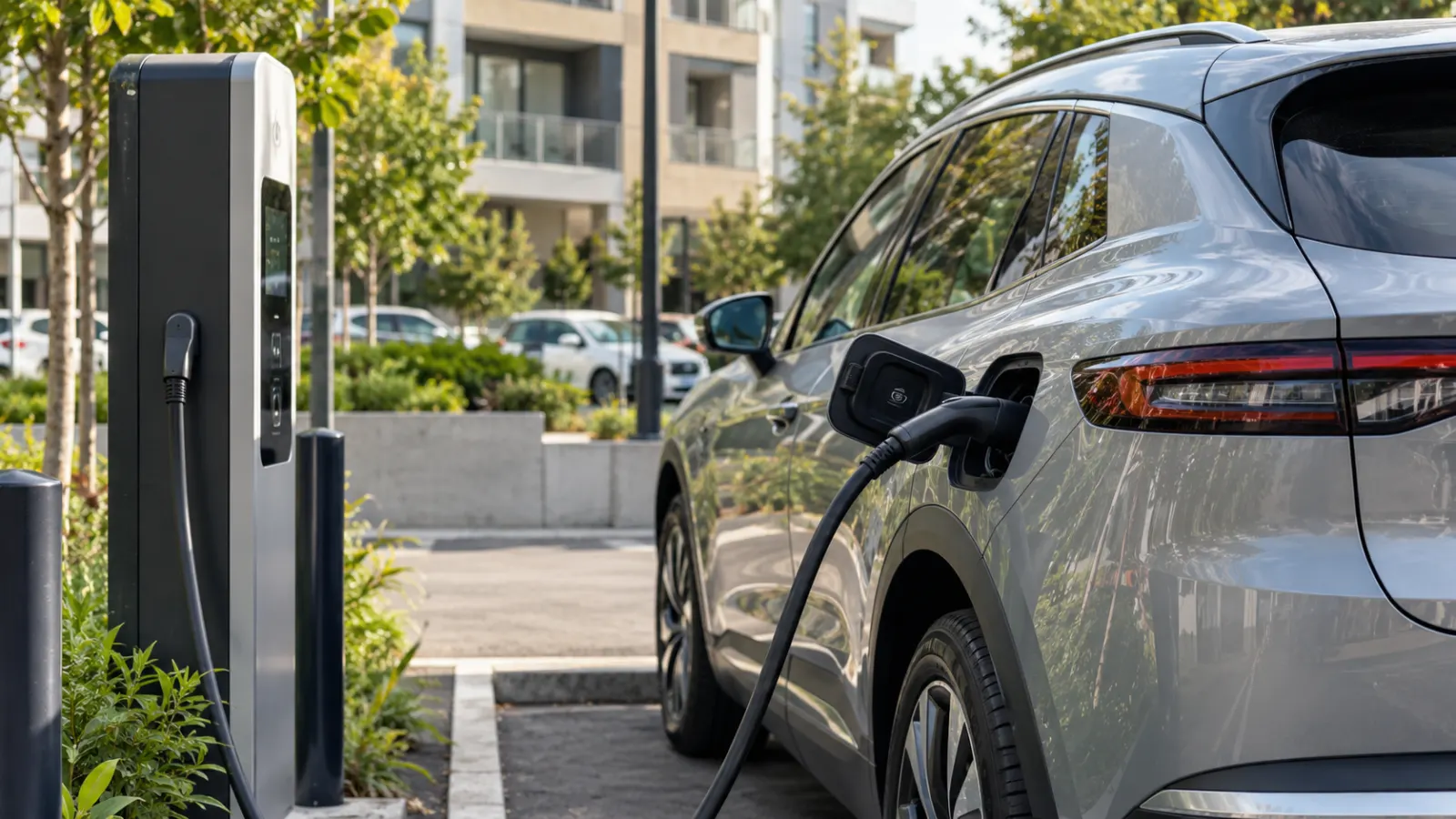
Electric Vehicles: How EVs Work, Their Benefits and What Makes Them Different
Electric vehicles are often described as conventional cars that replace petrol or diesel with a battery. Mechanically, the change is much deeper. A battery-electric vehicle replaces the fuel tank with a rechargeable battery pack, the internal-combustion engine with one or more electric motors and much of the traditional drivetrain with power electronics and relatively simple reduction gearing.
That changes how energy enters the vehicle, how efficiently it is converted into motion, where pollution is produced, what maintenance the drivetrain requires and how transport interacts with the wider energy system. A battery-electric vehicle can also become lower-emission during its lifetime as the electricity used to charge it becomes cleaner—something a petrol or diesel drivetrain cannot do without changing its fuel.
The strongest argument for EVs is therefore not that they have no environmental cost. Batteries require minerals and energy to manufacture, electricity generation can still produce emissions, tyres still wear and cars still consume road space. The stronger argument is that electric motors use energy far more efficiently than combustion engines, battery-electric vehicles eliminate tailpipe exhaust and electricity can increasingly come from low-carbon sources.
EVs have also moved far beyond the experimental stage. More than 20 million electric cars were sold worldwide in 2025, around one-quarter of global new-car sales. After a weaker first quarter, sales accelerated strongly during the second quarter of 2026, and the International Energy Agency now expects electric cars to reach approximately 29% of global new-car sales in 2026.
Understanding why that transition matters begins with the drivetrain itself.
What Is an Electric Vehicle?
The term electric vehicle, or EV, can refer to several types of vehicle, and distinguishing them prevents confusion about emissions, range and charging.
A battery-electric vehicle (BEV) is powered entirely by electricity stored in a rechargeable battery. It has one or more electric motors and no petrol or diesel engine. Because there is no fuel combustion onboard, it produces no tailpipe exhaust while driving. EPA uses this basic definition when distinguishing fully electric vehicles from plug-in hybrids.
A plug-in hybrid electric vehicle (PHEV) combines a rechargeable battery and electric motor with a combustion engine and fuel tank. It can drive some distance on electricity before the engine is required, although exactly when the engine operates depends on vehicle design, battery charge, speed, temperature and driving conditions. PHEVs therefore produce no tailpipe exhaust while operating purely electrically but do create exhaust emissions when the combustion engine runs.
A conventional hybrid, sometimes simply called a hybrid electric vehicle or HEV, also combines an electric motor with a combustion engine, but its battery is charged mainly through regenerative braking and the engine rather than from an external electrical connection. It still depends on petrol or another liquid fuel.
For most of the efficiency, tailpipe-emission and drivetrain-simplicity advantages discussed in this article, the clearest comparison is therefore between battery-electric vehicles and conventional combustion vehicles.
How an Electric Vehicle Works
The basic energy path inside a BEV is comparatively straightforward. Electricity enters through a charging connection and is stored chemically inside the high-voltage battery. Power electronics control how electricity moves between the battery and motor. The electric motor converts electrical energy into mechanical rotation, which is transferred through reduction gearing to the wheels.
When charging from ordinary alternating-current infrastructure, an onboard charger converts AC electricity into the direct current required by the battery. DC fast chargers perform much of that conversion outside the vehicle and supply high-power direct current more directly to the battery, allowing substantially faster charging.
An inverter performs another crucial function while driving by controlling electrical power delivered to the motor. Modern electric drivetrains continuously manage torque, motor speed, battery temperature, regenerative braking and power flow through software and electronic controls.
The motor itself operates through electromagnetic forces rather than combustion. That eliminates the need for cylinders, pistons, spark plugs, an exhaust system and many of the systems necessary to convert repeated fuel combustion into rotational motion.
Most EVs also do not require the complicated multi-speed transmission associated with conventional vehicles. Electric motors can produce useful torque over a much wider speed range, so many battery-electric cars use a relatively simple single-speed reduction gear.
This mechanical difference explains much of what drivers notice immediately: quiet operation, rapid response at low speed and smooth acceleration without conventional gear changes.
Why Electric Motors Are So Much More Efficient
Energy efficiency is one of the strongest technical advantages of electric vehicles.
A petrol engine converts chemical energy in fuel into heat and then attempts to convert part of that heat into mechanical work. Large amounts of energy are inevitably lost through exhaust gases, engine cooling, friction and other processes.
An electric motor does not need this combustion stage.
The U.S. Department of Energy estimates that a typical EV is about 87%–91% efficient when regenerative braking is included, compared with approximately 30% for a conventional gasoline vehicle on the referenced combined driving cycle. The DOE calculation puts direct energy reaching the wheels from the EV at about 65%–69%, with regenerative braking recovering roughly another 22%.
Individual vehicles and test cycles vary, so those figures should not be treated as universal constants. The underlying engineering difference is nevertheless large.
The IEA's latest comparison similarly estimates that a typical battery-electric car uses roughly 70% less energy per kilometre than a gasoline combustion vehicle of similar size.
This helps explain something that can initially seem surprising: an EV battery stores much less energy than the chemical energy contained in a full petrol tank, yet the car can still travel hundreds of kilometres.
The electric drivetrain wastes far less of the energy it carries.
Regenerative Braking Recovers Energy That Conventional Cars Waste
Every moving vehicle contains kinetic energy. To slow a conventional car using friction brakes, brake pads and discs convert much of that kinetic energy into heat, which then dissipates into the surrounding air.
An electric drivetrain can recover part of it.
During regenerative braking, the electric motor reverses its role. Instead of using electricity to create motion, the rotating wheels drive the motor so it acts as a generator. Electrical energy flows back toward the battery.
The process cannot recover everything. Aerodynamic drag, rolling resistance, electrical losses and braking limits remain, while conventional friction brakes are still required for strong braking, very low speeds and backup.
But regeneration substantially reduces one of the major energy losses in stop-and-go driving. It can also reduce wear on conventional brake components because the motor performs part of the slowing.
This is one reason EV efficiency can be particularly strong in urban driving, where repeated acceleration and deceleration create many opportunities to recover energy.
Electric Motors Also Change Driving Behaviour
Electric motors can generate strong torque from very low rotational speeds, allowing the vehicle to respond quickly without waiting for an engine to reach a narrow power band or for a transmission to select another gear.
That makes EV acceleration feel different even when the vehicle is not designed as a performance car.
Many EVs also offer strong regenerative deceleration when the driver lifts off the accelerator. In some vehicles this enables one-pedal driving, where the accelerator controls both acceleration and much of ordinary deceleration, although the conventional brake pedal remains available and necessary.
Electric powertrains are also comparatively quiet at low speeds because there is no combustion engine firing repeatedly. This reduces propulsion noise, although tyre and aerodynamic noise remain important at higher speeds.
The relative quietness is significant enough that regulations in several markets require electric vehicles to produce warning sounds at low speed so pedestrians can detect their approach.
Battery-Electric Vehicles Have No Tailpipe Exhaust
A BEV has no combustion engine and therefore no exhaust pipe producing pollutants from burning petrol or diesel.
While driving, it emits no tailpipe carbon dioxide, nitrogen oxides, carbon monoxide or combustion-derived particulate matter. EPA explicitly identifies zero tailpipe emissions as one of the defining characteristics of battery-electric vehicles.
This can be particularly valuable in dense cities because vehicle exhaust is emitted at street level, often close to pedestrians, homes, schools and shops.
But zero tailpipe emissions do not mean zero air pollution.
Electric vehicles still create tyre particles and road dust. Brakes can create particulate pollution, although regenerative braking can reduce friction-brake use. Electricity generation may create air pollution away from the vehicle when fossil fuels are used. Manufacturing batteries, vehicles and electricity infrastructure also has environmental consequences.
PHEVs need another qualification. They eliminate tailpipe emissions only while operating electrically. Once their combustion engine runs, they produce exhaust like other fuel-burning vehicles.
The precise claim should therefore be: battery-electric vehicles eliminate tailpipe exhaust while driving, not that they create no pollution anywhere.
Lifecycle Emissions Are the More Useful Climate Comparison
Comparing only tailpipe emissions gives an incomplete picture because an EV's battery and electricity have to come from somewhere.
Battery manufacturing requires energy and raw materials such as lithium, graphite, copper and, depending on chemistry, nickel or cobalt. Producing the rest of the vehicle requires steel, aluminium, plastics and other materials.
Charging emissions depend on the electricity system. A vehicle supplied mainly by coal-fired power has higher operational emissions than the same vehicle supplied by wind, solar, nuclear or hydropower.
Combustion vehicles also have upstream emissions that are easy to ignore when only the tailpipe is counted. Oil has to be extracted, transported, refined and distributed before petrol or diesel reaches the vehicle.
The meaningful comparison is therefore lifecycle greenhouse-gas emissions, including manufacturing, energy production and vehicle operation.
EPA's current assessment is that EVs typically have a smaller carbon footprint than gasoline vehicles even after electricity generation is included. EPA also notes that EV manufacturing can initially create more emissions because of battery production, but that total lifecycle emissions are generally lower over the vehicle's lifetime.
The exact advantage varies by battery size, vehicle size, manufacturing location, driving distance and electricity mix.
That is why a small EV operating for many years on a relatively clean grid can have a very different lifecycle footprint from a very large battery-electric SUV charged primarily with high-carbon electricity.
An EV Can Become Cleaner During Its Lifetime
One unusual advantage of vehicle electrification is that the emissions associated with using the same physical car can decline as the electricity system changes.
Imagine someone buys a battery-electric car when their regional grid still depends heavily on fossil fuels. Five years later, more renewable energy, nuclear power or other lower-carbon generation enters the system.
The vehicle has not changed.
But the electricity used to charge it now creates fewer emissions.
A petrol vehicle does not gain the same benefit automatically. Improving electricity generation cannot change the fact that burning one litre of petrol releases carbon contained in that fuel.
Vehicle electrification and electricity-sector decarbonisation therefore reinforce one another.
This does not mean governments should electrify transport while ignoring the power sector. It means cleaner electricity increases the advantage of vehicles that can actually use it.
Battery Production Creates Real Environmental and Supply-Chain Costs
The climate advantage of electric vehicles should not be used to pretend battery production is environmentally trivial.
Battery manufacturing requires substantial energy and large material supply chains. Mining and processing critical minerals can affect land, water, communities and ecosystems. Where supply chains are concentrated, geopolitical and economic-security risks also emerge.
The IEA reports that electric-vehicle battery deployment reached about 1.2 TWh in 2025, almost 30% higher than in 2024 and more than seven times the level in 2020. China accounted for about 60% of that EV battery deployment and more than 80% of global battery-cell production in 2025.
Battery technology is also changing quickly. Lithium iron phosphate, or LFP, accounted for more than half of global EV battery deployment in 2025, while sodium-ion batteries are beginning to enter applications where lower cost and reduced dependence on some minerals can compensate for lower energy density.
Recycling will become increasingly important, but there is a timing problem. Most of the enormous volume of EV batteries installed during the 2020s remains in vehicles. The IEA expects much larger end-of-life battery flows only as these vehicles age into the 2030s, so recycling cannot immediately replace primary mineral supply.
These constraints are real.
They are reasons to improve battery chemistry, mining standards, vehicle efficiency, recycling and supply-chain diversity—not reasons to pretend combustion vehicles have no material or fuel supply chain of their own.
Electric Vehicles Can Reduce Oil Dependence
Road transport consumes enormous quantities of petroleum.
A battery-electric vehicle replaces that ongoing fuel demand with electricity. Electricity can be generated from multiple domestic sources, including renewables, nuclear, hydropower, gas and other technologies.
That diversification can matter economically and strategically for countries that import large quantities of oil.
The IEA reports that electric cars represented about 5% of the global car stock in 2025 and displaced approximately 1.2 million barrels of oil consumption per day. Looking across the wider EV fleet, including additional road-vehicle categories, the IEA estimates oil displacement at roughly 1.7 million barrels per day in 2025.
Those are still small numbers relative to total global oil consumption, but they are no longer negligible.
Under current policies, the IEA expects EVs could displace around 5 million barrels per day by 2030.
Electric transport therefore changes the energy-security problem rather than eliminating it. Countries may become less exposed to crude-oil imports while becoming more concerned about electricity infrastructure, battery manufacturing and critical-mineral supply chains.
The dependencies are different.
Running Costs Can Be Lower—Especially With Home Charging
Electric vehicles can cost less to operate because electric motors use energy efficiently and residential electricity can be relatively inexpensive compared with petrol or diesel.
The IEA's Global EV Outlook 2026 finds that home charging has consistently provided running-cost savings over gasoline vehicles in major EV markets. Between 2020 and 2025, annual energy-cost savings typically ranged from approximately USD 550 to USD 1,000 in major markets, although actual savings depended heavily on local fuel and electricity prices.
The economics become much less simple for people who cannot charge at home.
IEA data show that public slow charging can cost substantially more than residential electricity and public fast charging can command an even larger premium. In some markets, a driver relying exclusively on expensive public fast charging can lose the energy-cost advantage over a gasoline car.
This creates an important equity issue.
A homeowner with a driveway may charge overnight at cheap residential rates.
An apartment resident who parks on the street may depend on public chargers and pay more for the same electricity service.
EV affordability therefore depends partly on where and how someone can charge, not simply on the vehicle's efficiency.
Maintenance Is Simpler, but EVs Are Not Maintenance-Free
A battery-electric vehicle eliminates several recurring maintenance requirements associated with combustion engines.
There is no engine oil to change, no spark plugs, no fuel-injection system in the conventional sense and no exhaust system. The drivetrain has fewer mechanical components whose purpose is to manage repeated high-temperature combustion.
Regenerative braking can also reduce wear on friction brakes.
That does not mean the car requires no maintenance.
Tyres still wear and can be an important cost, particularly on heavy or high-performance vehicles. Suspension, steering, wheel bearings, air conditioning, cooling systems, cabin filters and other components still require inspection or repair.
EV-specific components such as high-voltage electronics and battery systems can also be expensive if major failures occur outside warranty.
The responsible claim is therefore lower routine powertrain-maintenance requirements, not “zero maintenance.”
What About EV Battery Life?
Battery degradation is real. Lithium-ion batteries gradually lose some usable capacity through age, charging cycles, temperature exposure and operating conditions.
But the idea that EV batteries normally fail after only a few years is increasingly inconsistent with field experience.
EPA's updated EV-myth guidance cites recent data showing that the overwhelming majority of modern plug-in vehicles in the dataset examined remained on their original batteries outside major recalls, with replacement rates below 1% for vehicles from model year 2016 onward.
That does not guarantee every battery will last the full life of every vehicle. Battery chemistry, climate, usage, charging habits, cooling systems and manufacturing quality all matter.
Battery capacity also does not normally move from “perfect” to “failed.” More commonly, usable range declines gradually.
Used-EV markets therefore increasingly need trustworthy battery state-of-health information so buyers can distinguish a healthy older battery from one that has materially degraded.
This is likely to become as normal to used-EV purchasing as checking mileage and service history is today.
EV Range Is Now Sufficient for Most Daily Driving
Early electric cars often had genuinely restrictive ranges, and that history continues to shape public perception.
The global sales-weighted average range of battery-electric cars is now close to 380 kilometres, according to the IEA.
Individual models vary widely, and advertised test-cycle range does not always match real-world driving. Speed, weather, heating or air-conditioning use, terrain, payload and battery temperature can all affect actual range.
But daily travel is usually much shorter than full battery range.
The IEA notes that average daily driving in many markets is around 40 km, while even average U.S. driving is roughly 65 km per day—far below the average range of a modern BEV.
For someone who can charge where the car normally sits overnight, this changes the refuelling model.
Instead of driving until nearly empty and then making a special visit to a fuel station, the vehicle can begin many mornings with a replenished battery.
Long-distance travel remains different.
Highway charging coverage, charger reliability, charging speed and route planning become important in ways they are not for local commuting.
More Range Is Not Always Better
Longer range sounds automatically desirable, but it comes with trade-offs.
Increasing range by enlarging the battery adds weight, material demand and cost. A larger battery then requires additional energy to move the heavier vehicle.
The IEA notes that average global BEV range has recently plateaued near 380 km partly because manufacturers and consumers are balancing range against affordability, battery size and the increasing availability of charging infrastructure.
This is an important correction to the idea that EV progress should be measured only by how many kilometres fit into one charge.
For a household that drives 40 km per day and charges reliably overnight, paying for an enormous battery that spends most of its life nearly unused may provide limited additional value.
Charging speed, charger availability, efficiency and purchase price can sometimes matter more than maximum range.
Charging Is Fundamentally Different From Refuelling
Charging an EV takes longer than filling a fuel tank, but comparing only the minutes spent at a fast charger misses a major behavioural difference.
Cars spend most of their time parked.
If reliable charging exists where a vehicle normally sits—at home, work, a depot or another regular destination—much charging can occur while the driver is doing something else.
The inconvenience becomes much greater for people without private or workplace charging.
Apartment residents and drivers dependent on street parking may need public infrastructure for ordinary charging rather than only occasional road trips.
Public fast charging is particularly useful for long-distance travel and high-utilisation vehicles, but it is more expensive to build and electricity can cost substantially more than at home.
The strongest EV infrastructure therefore is not simply a large number of fast chargers.
It is a mix of dependable home, workplace, destination and fast charging matched to how vehicles are actually used.
EVs Can Become a Flexible Part of the Electricity System
Large EV fleets increase electricity demand, so electrifying transport requires grid planning.
But EV charging has an unusual characteristic: much of it can be flexible in time.
A vehicle might arrive home at 7 p.m. and remain plugged in until 7 a.m. even though it requires only a few hours of charging. Software can potentially delay or vary charging to avoid the most stressed periods on the grid.
This is known as managed or smart charging.
Instead of every car beginning to charge immediately when drivers return home, utilities or charging systems can shift part of the load toward periods of lower demand, cheaper electricity or higher renewable generation.
Some vehicles and chargers can go further through vehicle-to-grid, or V2G, technology, allowing electricity stored in the battery to be returned to a building or electricity network when useful.
V2G remains far from universal. Standards, tariffs, compatible vehicles, warranties, infrastructure and consumer incentives all need to align.
The larger point is that EV electricity demand does not have to behave like an inflexible appliance.
Because cars are parked for long periods, charging can potentially become a grid-management resource rather than only a burden.
Electric Vehicles Are Now a Mass-Market Technology
The scale of the industry has changed remarkably quickly.
More than 20 million electric cars were sold worldwide in 2025, an increase of more than 20% from the previous year and roughly one-quarter of global new-car sales.
The IEA initially projected approximately 23 million sales for 2026. After analysing market data through the first half of the year, it reported a strong rebound during the second quarter and raised the expected global share to about 29% of all car sales in 2026. More than 90 countries recorded year-on-year EV sales growth during the first half of the year.
China remains the industry's largest market and manufacturing centre, while adoption continues across Europe and increasingly in emerging economies.
The transition is not uniform.
Some markets already offer large numbers of competitively priced electric models and dense charging networks. Others still face high purchase prices, limited charging or weak model availability.
This is why global sales growth should not be interpreted as proof that every remaining EV problem has been solved.
Mass-market adoption is occurring while the economics remain very different from one country and household to another.
What Are the Main Advantages of Electric Vehicles?
The benefits become easier to understand when separated by mechanism rather than treated as a marketing list.
| EV advantage | Why it occurs |
|---|---|
| High energy efficiency | Electric motors waste far less energy as heat than combustion engines |
| Regenerative braking | Part of the vehicle's kinetic energy can be recovered during deceleration |
| No tailpipe exhaust from BEVs | No fuel is burned onboard |
| Lower lifecycle emissions in most comparisons | Higher efficiency offsets battery manufacturing, especially as grids become cleaner |
| Potentially lower running costs | EVs use less energy per kilometre and home electricity can be inexpensive |
| Simpler routine drivetrain maintenance | No engine oil, spark plugs or exhaust system |
| Strong low-speed torque | Electric motors generate useful torque immediately |
| Lower oil consumption | Transport energy shifts from petroleum to electricity |
| Flexible charging | Many vehicles can charge while parked and potentially shift demand in time |
| Improvement as electricity cleans up | The same EV can use lower-carbon electricity later in its life |
None of those benefits makes an electric car impact-free.
They explain why changing the drivetrain can produce substantial energy and emissions gains.
What EVs Do Not Solve
Replacing a combustion engine with an electric motor does not solve every transport problem.
An EV still takes up road and parking space. It can still be involved in crashes. It contributes to congestion. Its tyres wear. Manufacturing a large vehicle requires significant materials regardless of drivetrain.
Vehicle size matters especially.
A very large electric SUV needs a larger battery and more material than a small electric car. It consumes more electricity to move and can generate more tyre wear.
This is why electrification and transport efficiency should complement one another.
For trips that genuinely require cars, electrifying those cars can substantially reduce energy use and tailpipe pollution.
For journeys that can reasonably be shifted to public transport, walking, cycling or shared mobility, reducing vehicle dependence can save even more energy and material.
The choice should not be framed as “EVs or public transport.”
A strong transport system can use both.
Electric Cars, Public Transport and Sustainable Mobility
Electric vehicles are sometimes presented as the entire solution to transport decarbonisation.
That overstates what changing the drivetrain can accomplish.
An electric bus can move many people using one battery and one driver. Electric rail can move enormous numbers of passengers efficiently. Walking and cycling require far less material and energy than any car.
Dense cities can reduce travel distances through land-use planning.
At the same time, cars remain important for many households, rural areas, freight movements and journeys that public transport cannot efficiently serve.
The sensible objective is therefore not eliminating cars everywhere or electrifying every possible journey regardless of alternatives.
It is matching transport modes to the task while making the motor vehicles that remain much more efficient and lower-emission.
EVs are a major part of that strategy.
They are not the whole strategy.
Common Myths About Electric Vehicles
One misconception is that EVs simply move pollution from the tailpipe to the power station. Electricity generation can create emissions, but EPA's lifecycle assessment finds EV greenhouse-gas emissions are typically lower than those of gasoline cars even when charging emissions are included. The benefit increases as the grid becomes cleaner.
Another is that battery manufacturing makes EVs worse for the climate overall. Battery production can make manufacturing emissions higher initially, but lifecycle emissions are typically lower because EVs avoid combustion emissions throughout operation.
It is also misleading to claim that EV batteries normally need replacing every few years. Batteries do degrade, but modern field data do not support such frequent routine replacement.
Another myth is that EVs cannot handle ordinary daily driving. Average battery-electric range is now close to 380 km globally, while average daily travel is much shorter in many markets.
Nor is it correct that EVs require no maintenance. Their drivetrains are simpler, but tyres, suspension, thermal systems and other vehicle components still need service.
Finally, EVs should not be described as zero-impact transport. Their strongest case is comparative: much higher energy efficiency, no BEV tailpipe exhaust and lower lifecycle emissions in most realistic comparisons.
Frequently Asked Questions About Electric Vehicles
What is an electric vehicle? An electric vehicle uses an electric motor for propulsion. A battery-electric vehicle runs entirely from electricity stored in a rechargeable battery, while a plug-in hybrid combines electric propulsion with a combustion engine.
How does an electric vehicle work? Electricity stored in a battery is controlled by power electronics and supplied to an electric motor, which converts electrical energy into rotational force that drives the wheels.
What is the difference between an EV and a hybrid? A BEV has no combustion engine. A PHEV can plug into external electricity but also contains an engine. A conventional hybrid uses a smaller battery and still depends primarily on liquid fuel.
Are electric vehicles more efficient than petrol cars? Yes. DOE estimates a typical EV at roughly 87%–91% efficiency with regenerative braking included, compared with around 30% for the referenced conventional gasoline vehicle.
What is regenerative braking? Regenerative braking uses the electric motor as a generator during deceleration, returning some kinetic energy to the battery instead of wasting all of it as brake heat.
Do electric cars have zero emissions? Battery-electric vehicles have zero tailpipe exhaust, but electricity generation, battery manufacturing, vehicle production and tyre wear still create environmental impacts.
Are EVs better for the climate? EPA finds that their total greenhouse-gas emissions are typically lower than those of comparable gasoline vehicles even after electricity generation and battery manufacturing are considered.
Does the electricity source matter? Yes. EV lifecycle emissions are lower when charging electricity comes from low-carbon generation, although EVs generally retain an efficiency advantage even on many fossil-fuel-containing grids.
How far can an electric car travel? The IEA reports a global average battery-electric-car range close to 380 km, although real individual models vary considerably.
Does cold weather reduce EV range? It can. Batteries perform differently at low temperatures, while cabin heating consumes energy. The magnitude depends on vehicle technology, temperature and driving conditions.
Are EVs cheaper to run? Often, particularly when charged at home. The advantage varies with local petrol prices, electricity tariffs, vehicle efficiency and charging behaviour.
Can public fast charging be expensive? Yes. IEA data show public fast-charging electricity can cost substantially more than home electricity and can reduce or eliminate the running-cost advantage in some circumstances.
Do electric cars require less maintenance? BEVs eliminate many engine-related maintenance items, but tyres, suspension, cooling, air conditioning and other systems still require service.
How long do EV batteries last? Battery life varies, but modern batteries are designed for long service and usually lose capacity gradually rather than suddenly failing. Recent real-world data cited by EPA show very low non-recall battery-replacement rates among newer EVs.
Do EVs use lithium? Most current EV batteries use lithium-ion chemistry, although the cathode chemistry can vary. Sodium-ion technology is also beginning to enter some vehicle applications.
Can EV batteries be recycled? Yes. Battery materials can be recovered through recycling, although the global end-of-life EV battery stream is still relatively small because most EV batteries deployed during the recent sales boom remain in service.
Do EVs reduce oil consumption? Yes. Electric cars displaced about 1.2 million barrels per day of oil demand in 2025, according to the IEA. The broader EV fleet displaced approximately 1.7 million barrels per day.
Will EVs overload the electricity grid? EVs increase electricity demand, so grids require planning. But charging can often be shifted in time because vehicles remain parked for long periods, allowing smart charging to reduce peak demand.
What is vehicle-to-grid charging? Vehicle-to-grid technology allows compatible EVs to send electricity from their batteries back to a building or electricity network under certain conditions.
How many electric cars are being sold globally? More than 20 million were sold in 2025. Based on market developments through the first half of 2026, the IEA expects EVs to account for about 29% of global new-car sales in 2026.
Are EVs the complete solution to sustainable transport? No. Electrification reduces important impacts of motor vehicles, but public transport, walking, cycling, efficient freight systems and better urban design remain necessary to address congestion, road space and total resource use.
Electric Vehicles Change the Energy System Under the Car
The most important fact about electric vehicles is not the large touchscreen, the absence of engine noise or even the battery.
It is the energy conversion system.
A combustion vehicle carries fuel containing substantial chemical energy and then loses most of that energy as heat while attempting to produce motion.
An electric vehicle starts with stored electrical energy and converts a much larger share of it into movement.
Regenerative braking recovers some energy that would otherwise disappear as heat.
Removing combustion eliminates tailpipe exhaust from battery-electric vehicles.
Charging shifts transport energy demand away from petroleum and toward an electricity system that can draw from many different sources.
And as that electricity system becomes cleaner, the emissions associated with driving the same vehicle can decline.
Those are structural advantages rather than marketing features.
They are also why the electric-car transition has moved so rapidly. More than 20 million electric cars were sold during 2025, and the latest IEA data now point to electric models approaching 29% of global new-car sales during 2026.
But growing sales should not turn the technology into a slogan.
Battery manufacturing requires materials.
Mining has environmental and social consequences.
Charging access is unequal.
Public fast charging can be expensive.
Large electric vehicles consume more energy and material than smaller ones.
Electricity networks need investment.
Tyres still produce pollution.
Road congestion does not disappear because the cars sitting in it are electric.
Those limitations are real without cancelling the central engineering case.
The meaningful comparison is not perfect EV versus imperfect petrol car.
No transport technology is impact-free.
The meaningful comparison asks how much energy each system requires, where its pollution occurs, whether its energy source can become cleaner, what infrastructure it requires and which wider transport problems remain after the drivetrain changes.
On those terms, battery-electric vehicles offer substantial advantages.
They use energy much more efficiently.
They remove combustion from the vehicle.
They can reduce lifecycle greenhouse-gas emissions.
They reduce continuing oil demand.
They can often lower operating costs.
And because their energy arrives as electricity, they can participate in a broader energy transition that extends far beyond the automotive industry.
Electric vehicles should therefore be understood neither as miracle cars nor as conventional cars with batteries replacing fuel tanks.
They are a different transport-energy architecture.
Their greatest value appears when that architecture is combined with cleaner electricity, sensible vehicle sizes, reliable charging and a transport system that uses cars where cars genuinely make sense.