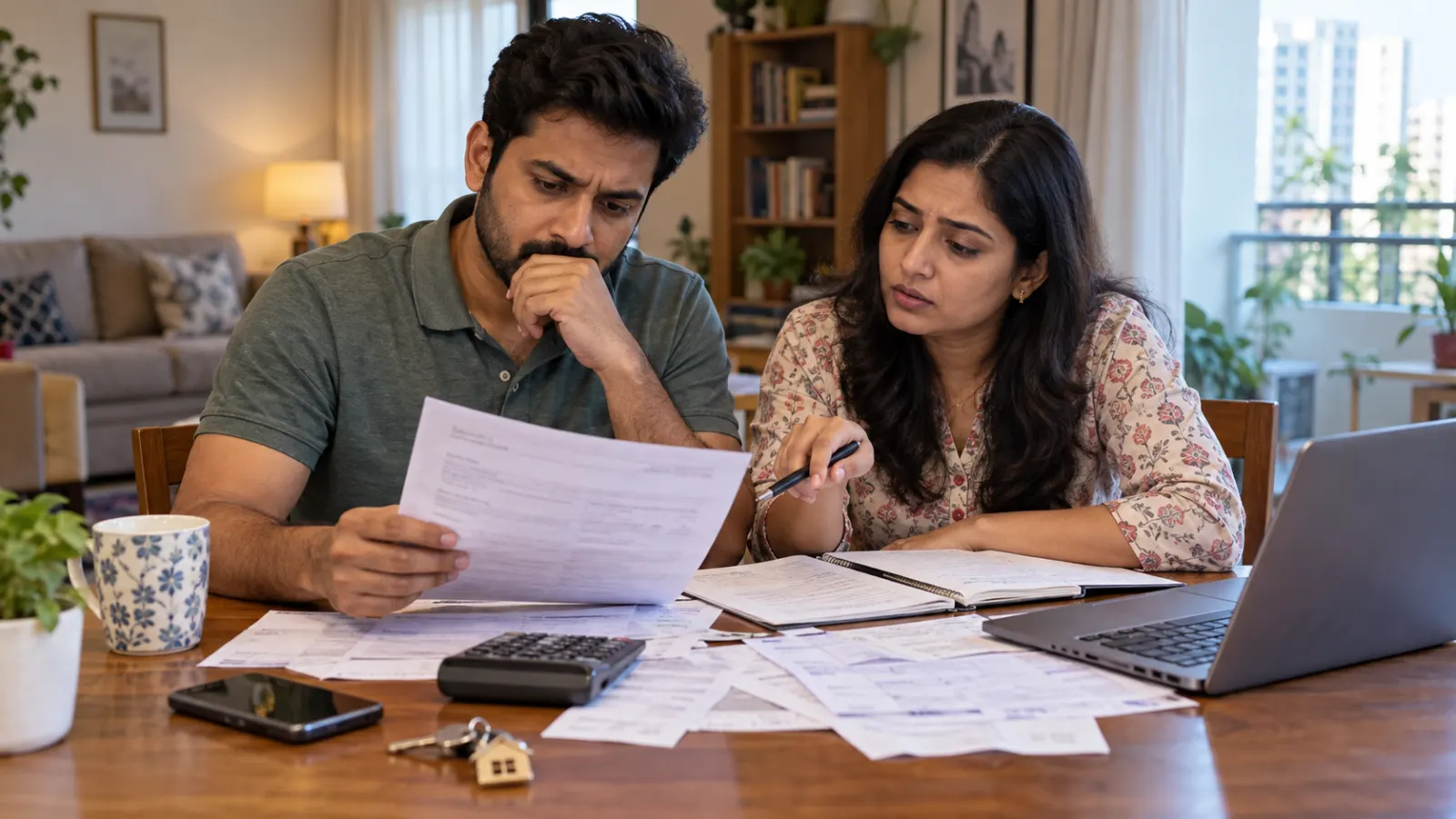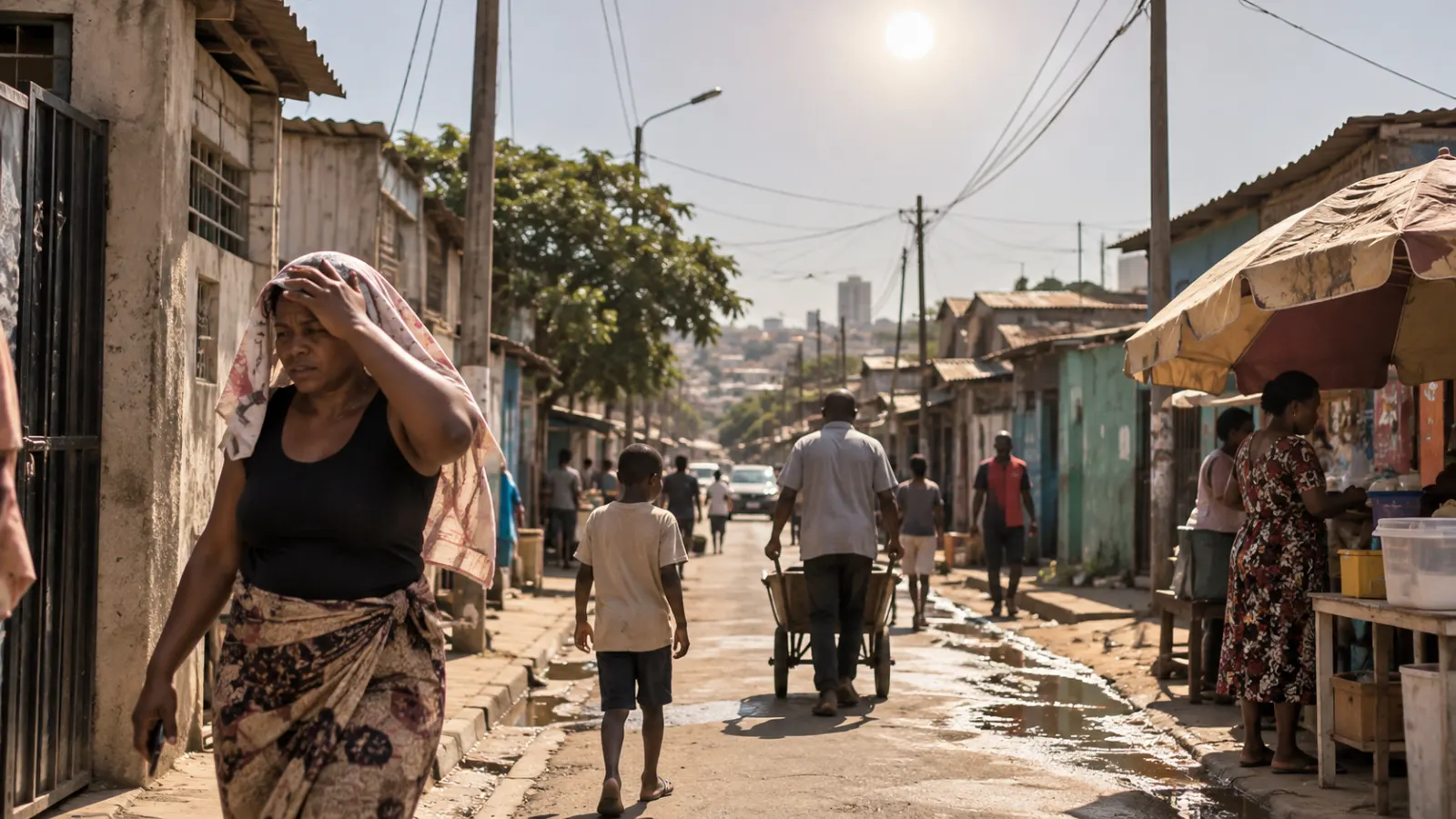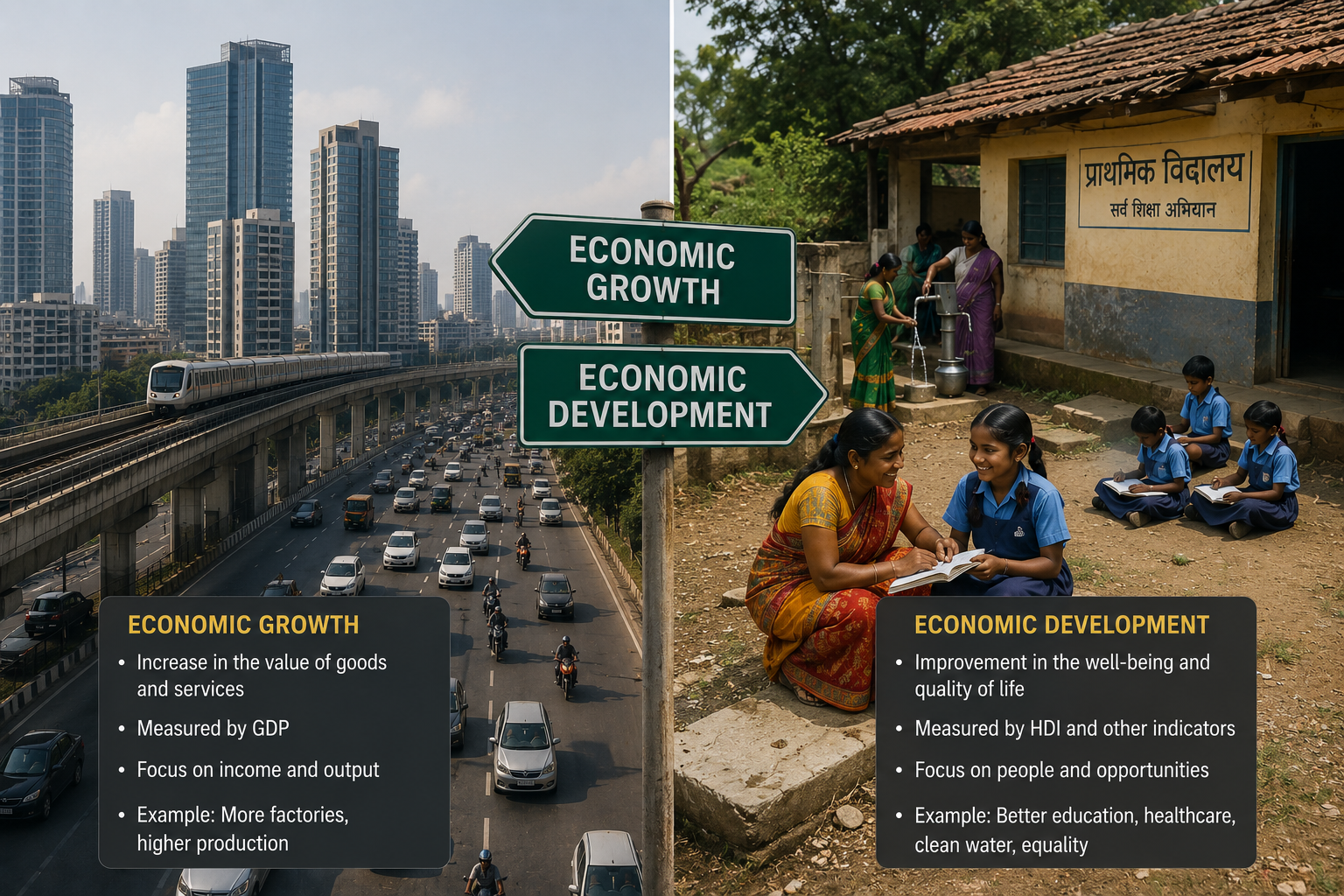
Economic growth and economic development are often used as if they mean the same thing. They do not. Growth is about expansion in output. Development is about improvement in human life. Growth asks whether the economy is producing more. Development asks whether people are living better. A country can grow without developing fully, and it can achieve some development gains even when growth is modest. The distinction is one of the most important ideas in economics and public policy.
This difference matters because societies often celebrate GDP growth as proof of national progress. Growth is important. Without it, jobs become scarce, tax revenue weakens, investment slows and poverty reduction becomes harder. But growth alone does not guarantee good schools, affordable healthcare, clean air, safe cities, gender equality, social mobility or dignity at work. Development requires growth to be converted into capability.
For a country like India, the distinction is especially significant. India needs high growth because its population is large, its employment needs are enormous and its infrastructure gaps remain serious. But India also needs development because millions of people still face unequal access to nutrition, education, healthcare, housing, formal jobs and justice. The real challenge is not choosing between growth and development. It is designing growth that produces development.
What Economic Growth Means
Economic growth refers to an increase in the value of goods and services produced by an economy over time. It is usually measured through GDP growth. If GDP rises from one year to the next after adjusting for inflation, the economy has grown in real terms. Growth can come from more workers, more capital, better technology, improved productivity, higher consumption, increased investment, stronger exports or government spending.
Growth is powerful because it expands the resource base of society. A growing economy can create jobs, increase incomes, attract investment and generate tax revenue. It gives governments more capacity to build roads, schools, hospitals and defence systems. It gives businesses more demand. It gives households more opportunity to move beyond subsistence.
But growth is a quantitative measure. It tells us that the economic pie has become larger. It does not automatically tell us who received the larger slices, whether the pie was made sustainably, or whether people gained real freedom in their lives.
What Economic Development Means
Economic development is broader. It includes rising income, but also improvements in health, education, nutrition, housing, sanitation, safety, gender equality, employment quality, institutional capacity and environmental sustainability. Development is not merely about producing more. It is about expanding what people are able to be and do.
This is why the Human Development Index became influential. It moved attention beyond GDP by combining indicators related to health, education and standard of living. The HDI is not perfect, but its message is important: a richer economy is not automatically a more developed society unless people live longer, learn better and enjoy a decent standard of living.
Development also includes structural transformation. An economy becomes more developed when labour moves from low-productivity activities to higher productivity work, when firms formalise, when women participate more fully in the workforce, when public services improve and when institutions become more predictable and accountable.
Why Growth Is Not Enough
Growth can fail to become development for several reasons. First, growth may be unequal. If gains go mainly to asset owners, monopolies or a small skilled class, average GDP rises but ordinary workers may see little improvement. Second, growth may be jobless. A capital-intensive sector can expand output without absorbing enough labour. Third, growth may be environmentally damaging. Pollution, water stress and climate vulnerability can impose hidden costs on health and future productivity.
Fourth, growth may depend on debt or speculative asset bubbles rather than real productivity. Such growth can collapse when financing conditions change. Fifth, growth may coexist with weak public goods. A city can have luxury malls and poor drainage, high-rise apartments and toxic air, digital payments and weak primary healthcare. In such cases, income rises but quality of life remains fragile.
This does not mean growth is bad. It means growth must be judged by its composition, distribution and consequences. A number alone cannot tell us whether progress is deep or shallow.
Why Development Without Growth Is Also Difficult
While growth is not sufficient, development without growth is also difficult to sustain. Public services require money. Better schools need teachers, buildings, training and technology. Healthcare needs doctors, nurses, equipment and supply chains. Infrastructure requires capital. Social protection requires revenue. A stagnant economy limits the resources available for these goals.
Redistribution can improve fairness, but redistribution alone cannot create prosperity if the economy does not produce enough value. A society can divide poverty more equally, but that is not development. Sustainable development requires expanding the productive base while ensuring that gains reach people broadly.
This is why good policy treats growth as the engine and development as the destination. An engine without a destination creates motion without purpose. A destination without an engine remains aspiration without capacity.
The India Context
India's development debate is shaped by scale. The country must generate growth fast enough to create jobs for a young population, finance infrastructure and increase household income. At the same time, it must improve learning outcomes, health systems, nutrition, urban governance, rural productivity and women's economic participation.
A high GDP growth rate can improve India's global standing, attract investment and strengthen fiscal capacity. But citizens experience development through daily life: whether children can read well, whether hospitals are affordable, whether public transport works, whether wages are stable, whether women can work safely, whether farmers have market access, whether small firms can obtain credit and whether cities remain livable.
India's challenge is therefore not only to grow, but to convert growth into broad capability. This means investing in human capital as seriously as physical capital. Roads and ports matter, but so do early childhood nutrition, school quality, primary healthcare and skills. Without human capability, infrastructure alone cannot generate inclusive prosperity.
Growth, Development and Inequality
Inequality is the bridge between growth and development. If growth reduces poverty and expands opportunity, it strengthens development. If growth increases wealth concentration while public services remain weak, development becomes uneven. The same GDP number can produce very different social outcomes depending on distribution.
This is why economists look beyond average income. Median income, wage growth, poverty rates, consumption distribution and access to services all matter. If the median household does not feel progress, the political legitimacy of growth weakens. People do not live in national averages. They live in wages, prices, commutes, school fees, hospital bills and local opportunities.
A country becomes genuinely developed when birth circumstances lose some of their power over destiny. If a child born in a poor village can access good nutrition, quality education, digital tools and decent jobs, development is real. If opportunity remains inherited, growth remains incomplete.
The Role of Institutions
Development depends heavily on institutions. Clear property rights, contract enforcement, regulatory predictability, low corruption, reliable public services and accountable governance all influence whether growth becomes broad progress. Weak institutions can turn growth into rent-seeking. Strong institutions turn economic expansion into trust, investment and social mobility.
Institutions also decide whether public money becomes public value. Two governments can spend the same amount on education and produce very different outcomes depending on teacher accountability, curriculum quality, monitoring, local governance and community participation. Development is therefore not only about spending more; it is about building systems that work.
For India, institutional quality is central to the next stage of development. Economic ambition must be matched by administrative capacity. Policy announcements matter, but delivery decides lived progress.
Environmental Sustainability
Traditional growth models often ignored environmental costs. Factories, highways, mining and urban expansion raised output but also polluted air, degraded land and stressed water systems. Today, development cannot be separated from sustainability. A country that grows by destroying its ecological base may become richer in the short term and poorer in the long term.
Climate change makes this even more urgent. Heat stress affects labour productivity. Floods damage infrastructure. Water scarcity affects agriculture and industry. Air pollution harms health and learning. Sustainable development asks whether today's growth protects tomorrow's capacity to live and produce.
This is not an argument against growth. It is an argument for better growth: cleaner energy, efficient cities, resilient agriculture, circular production, public transport and environmental regulation that protects health without killing opportunity.
How Readers Should Judge Progress
Readers should judge economic progress through a dashboard, not a single number. GDP growth is one indicator. Per capita income, inflation, employment, poverty, inequality, school learning, health outcomes, women's participation, environmental quality and institutional trust also matter. No single measure captures the whole development story.
A useful test is to ask: has growth increased the real choices available to ordinary people? Can they educate their children better? Can they access healthcare without financial ruin? Can they find productive work? Can they live in safer, cleaner communities? Can they participate in markets and public life with dignity? These questions move the discussion from abstract output to human freedom.
Final Takeaway
Economic growth is necessary because societies need expanding resources. Economic development is necessary because resources matter only when they improve human life. Growth without development can become unequal, fragile and politically hollow. Development without growth can become financially unsustainable. The real task is to align the two.
For India and other developing economies, the goal should not be to celebrate GDP alone or dismiss it as irrelevant. The goal should be to build an economy where growth creates jobs, public revenue, innovation and productivity - and where that growth is converted into health, education, dignity, opportunity and sustainability. That is when economic expansion becomes national progress.
Editorial Disclaimer
This article is for educational and editorial analysis only. Development indicators, poverty data, GDP estimates and HDI rankings are revised over time and should be verified from official sources before publication.