E-Waste Explained: Causes, Effects, Recycling and the Growing Global Electronics Problem
A discarded smartphone does not look like a major environmental problem.
It is small enough to fit in a pocket. It may weigh only a few hundred grams. Once it stops working, it can disappear into a drawer, a household bin or a box of forgotten chargers without attracting much attention.
But a phone is not simply plastic and glass.
Inside it are metals, electronic components, battery materials, circuit boards, adhesives and other substances that required mining, refining, manufacturing, energy, water, transport and highly specialised industrial processes to produce.
Now multiply that one device by televisions, refrigerators, laptops, routers, washing machines, air conditioners, toys, medical equipment, power tools, electronic cigarettes, solar equipment and an expanding range of products containing batteries, sensors or embedded electronics.
The result is one of the fastest-growing material challenges of the modern economy.
The latest Global E-waste Monitor, published by the International Telecommunication Union and UNITAR in 2024, estimated that the world generated a record 62 million tonnes of electronic waste in 2022, equivalent to about 7.8 kilograms for every person on Earth. Only 22.3% of that mass was documented as formally collected and recycled in an environmentally sound manner. Global e-waste generation is projected to reach about 82 million tonnes by 2030 if current trends continue.
Those figures reveal a problem larger than recycling.
Electronic products are entering the economy faster than systems can reliably collect, repair, reuse and recover them.
The central question is therefore not simply, “How do we recycle old electronics?”
It is:
“How can electronics be designed, used, repaired, collected and processed so that valuable materials remain in circulation without transferring environmental and health risks to workers and communities?”
That is the real e-waste challenge.
What Is E-Waste?
Electronic waste, commonly shortened to e-waste, generally refers to discarded electrical and electronic equipment.
The category is much wider than smartphones and computers.
It includes products that depend on electricity, electronic circuitry, plugs or batteries. Depending on the classification system, e-waste can include refrigerators, washing machines, televisions, lamps, air conditioners, laptops, printers, telecommunications equipment, toys, electric tools and many smaller household products.
The Global E-waste Monitor describes e-waste broadly as discarded products with a plug or battery.
Definitions can differ among countries because legal systems classify products differently, but the underlying trend is clear: more products are becoming electronic.
A mechanical household device that once contained only simple moving parts may now contain sensors, displays, electronic controls and wireless connectivity. Vehicles contain increasingly sophisticated electronics. Toys contain batteries and processors. Even products not traditionally thought of as technology can now enter electronic-waste streams.
This growing electronification of ordinary products is one reason e-waste is expanding so quickly.
Why Is E-Waste Growing So Fast?
Several trends are occurring at the same time.
First, more people own more electrical and electronic products. Rising incomes, urbanisation and expanding digital infrastructure have increased access to phones, appliances, computers and connected devices across much of the world.
Second, entirely new categories of electronic products continue to appear.
Third, products can become obsolete before their physical components have reached the end of their possible life. Software support may end. Batteries may deteriorate. Replacement parts may be unavailable. A device may become incompatible with newer services or standards.
Repair can also be difficult or uneconomic. Batteries may be glued into cases. Parts may be paired electronically. Proprietary components may be unavailable. Repair information may be restricted, while labour costs can make replacing a low-cost device cheaper than repairing it.
The Global E-waste Monitor identifies technological progress, increased consumption, limited repair options, shorter product lifecycles, design shortcomings and inadequate e-waste infrastructure among the forces driving the widening gap between e-waste generation and documented recycling.
This means the e-waste problem begins long before something reaches a recycling facility.
It begins with how products are designed and sold.
E-Waste Has Almost Doubled Since 2010
The scale of the increase is striking.
According to the Global E-waste Monitor, e-waste generation increased by about 82% between 2010 and 2022, reaching 62 million tonnes. The world is now adding approximately 2.6 million tonnes of e-waste every year, and global generation is projected to rise to 82 million tonnes by 2030.
Recycling systems have not expanded at the same pace.
If current trends continue, the Monitor projects that the documented formal collection and recycling rate could fall from 22.3% in 2022 to around 20% in 2030, even though the absolute quantity recycled may increase.
That is an important distinction.
A country can recycle more tonnes than before while still losing ground because waste generation rises even faster.
E-Waste Is Not Only Waste — It Is a Material Stock
One reason e-waste is unusual is that discarded electronics contain valuable materials.
The Global E-waste Monitor estimated that e-waste generated in 2022 contained about 31 million tonnes of metals, along with approximately 17 million tonnes of plastics and 14 million tonnes of other materials such as glass, minerals and composites. The metals embedded in that waste were estimated to have a value of about US$91 billion, including copper, gold and iron.
This creates the idea sometimes described as urban mining.
Traditional mining extracts materials from geological deposits.
Urban mining attempts to recover useful materials already embedded in products, buildings and waste streams.
An old computer or phone can therefore be viewed in two ways.
It is waste if it is dumped.
It is a secondary material resource if its components can be recovered safely and economically.
Documented recycling of e-waste in 2022 recovered roughly US$28 billion worth of secondary raw materials, according to the Global E-waste Monitor.
But the economic opportunity is only part of the story.
Why E-Waste Can Be Hazardous
Electronics are complicated products containing many different materials.
Some are valuable.
Some can become dangerous when electronics are dismantled, burned, crushed or chemically processed without appropriate controls.
WHO reports that more than 1,000 potentially harmful substances have been identified either in e-waste itself or as products of unsafe recycling activities. These include lead, cadmium, mercury, nickel, brominated flame retardants, dioxins and polycyclic aromatic hydrocarbons.
The presence of these substances does not mean that using every electronic product normally exposes consumers to dangerous quantities.
The risk changes when equipment is broken apart or processed.
A circuit board inside an intact device is different from a circuit board heated over an uncontrolled fire.
The environmental challenge is therefore partly about what happens after the product becomes waste.
Informal Recycling Is Not the Same as Informal Repair
This distinction matters.
Informal economies can perform valuable work.
A technician repairing a phone, replacing a screen or refurbishing a laptop may extend the useful life of a device and prevent it from becoming waste prematurely.
Second-hand electronics markets can also make technology more affordable.
Those activities should not automatically be described as environmentally harmful simply because they operate outside large industrial recycling systems.
The danger arises when material recovery uses unsafe methods.
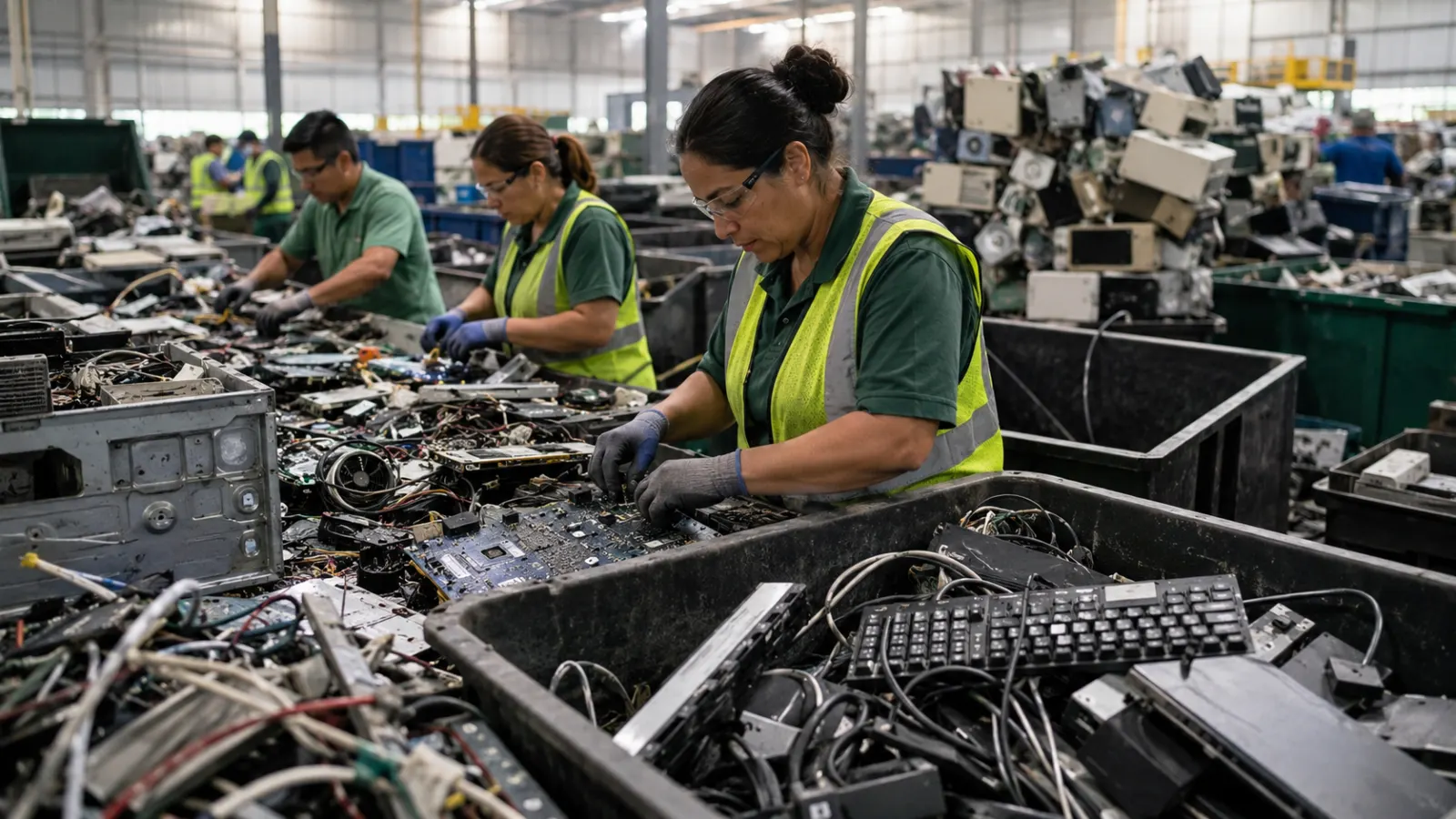
Examples include burning insulated wires to recover copper, heating components, breaking equipment without dust controls, using crude acids to extract metals or dumping unwanted residues after the most valuable components have been removed.
WHO warns that workers, families and communities can be exposed through inhalation of contaminated smoke and particles or through polluted soil, water, dust and food.
The policy challenge is therefore not to destroy repair and reuse economies.
It is to preserve their economic value while eliminating dangerous processing.
Children Face Particular Risks Around Unsafe E-Waste Recycling
The health dimension is especially serious where children live or work near uncontrolled recycling activities.
WHO notes that children can be exposed to toxicants from e-waste through contaminated air, soil, dust, food and water. Their developing respiratory, immune and nervous systems can make them particularly vulnerable, while hand-to-mouth behaviour can increase exposure to contaminated dust and soil. Some contaminants can also cross the placenta during pregnancy.
WHO reports associations between prenatal or childhood exposure to e-waste-related toxicants and adverse outcomes involving neurological development, birth outcomes, respiratory health and other systems.
This is one reason “recycling” cannot be evaluated only according to whether useful metals were recovered.
A process that recovers copper while exposing workers and nearby children to toxic fumes cannot reasonably be described as successful circularity.
How materials are recovered matters.
Batteries Create a Different Kind of Risk
Modern e-waste increasingly contains rechargeable lithium-ion batteries.
These batteries can retain substantial energy even when the device containing them appears broken.
If crushed, punctured, overheated or short-circuited, damaged lithium-ion batteries can enter thermal runaway and cause fires.
This creates problems throughout the waste chain.
A small battery discarded in ordinary household rubbish may enter a collection truck or mechanical sorting system that was never designed to handle stored electrical energy. Battery fires can occur at transfer stations and recycling facilities long after the consumer has thrown the product away.
The problem is expanding because batteries are appearing in more products, including phones, laptops, power tools, e-bikes, scooters, toys and disposable or semi-disposable electronic devices.
Proper collection therefore requires recognising batteries as a distinct risk rather than simply treating every electronic product as mixed scrap.
Refrigerators and Air Conditioners Require Special Handling
Cooling equipment creates another environmental challenge.
Refrigerators, freezers and air conditioners may contain refrigerants and insulating gases that can have significant climate effects if released.
Formal processing allows refrigerants to be recovered instead of simply vented during dismantling.
The Global E-waste Monitor estimated that formal e-waste management in 2022 avoided around 93 million tonnes of CO₂-equivalent emissions, including benefits from recovered refrigerants and avoided primary metal production.
This illustrates why different categories of e-waste need different treatment.
A refrigerator cannot be processed according to exactly the same method as a laptop.
A lithium battery requires different precautions from a television.
Good e-waste systems separate products according to their material and hazard profiles.
The Recycling Problem Starts With Collection
A sophisticated recycling plant has little value if discarded products never reach it.
This is one of the most important insights in e-waste management.
Consumers may keep old phones in drawers for years. Broken appliances may be discarded with household waste. Devices may be sold to informal collectors or exported through undocumented channels. Some areas may have no convenient collection point at all.
The famous 22.3% global figure therefore refers specifically to the share of e-waste mass that was documented as formally collected and recycled in an environmentally sound manner in 2022.
It does not prove that the remaining 77.7% was simply dumped into landfills.
Some products may have been reused.
Some may have been repaired.
Some may have entered informal recycling.
Some may have been exported.
Some may still be sitting unused in homes and businesses.
The larger problem is that much of this flow is not passing through transparent systems that can reliably document where products went and how they were processed.
The Drawer Full of Old Phones Is Part of the E-Waste System
Many households contain a hidden stock of electronics.
Old phones, cables, chargers, routers, headphones, remote controls and small devices accumulate because they are too valuable to feel like ordinary rubbish but not useful enough to remain in regular use.
Data security is another reason people hesitate to return devices.
A phone or computer may contain photographs, personal documents, passwords or business information. A consumer may prefer to keep it indefinitely rather than trust an unfamiliar collector.
This means successful collection systems need more than a bin.
People need confidence that devices will be handled responsibly and that personal information can be securely erased.
Convenient take-back systems, transparent downstream processing and clear data-erasure guidance can help move stored devices into legitimate reuse and recycling channels.
Reuse Usually Preserves More Value Than Recycling
Imagine two identical laptops.
One is refurbished, given a new battery and used for another three years.
The other is immediately shredded so that copper, aluminium and other recoverable materials can be separated.
Both outcomes may be preferable to landfill.
They are not equal.
The refurbished laptop retains far more of the economic and environmental value embedded in manufacturing the complete product.
Its processor still functions as a processor. Its display remains a display. Its case, battery connections, keyboard and memory continue doing the work for which they were manufactured.
Recycling breaks those complex structures back into lower-level material streams.
That is why circular-economy thinking generally places life extension, maintenance, repair, reuse and refurbishment ahead of material recycling whenever safe and practical.
Recycling is essential when useful product life genuinely ends.
It should not automatically be the first destination for functioning equipment.
Recycling Cannot Recover Everything
The phrase “100% recyclable” can create unrealistic expectations.
Modern electronics contain complex mixtures of materials, sometimes present in tiny quantities. Some are technically recoverable but not economically recoverable at current scale. Others become contaminated or mixed during processing.
Material value can also decline during recycling.
A high-performance engineered plastic may become a lower-grade recycled material. A complex component containing many metals may require substantial energy and specialised processes to separate them.
Recycling therefore does not reverse manufacturing perfectly.
Some value is inevitably lost.
This is another reason keeping an existing product functional can be preferable to destroying it merely because a newer model exists.
Product Design Determines Future Waste
Many e-waste problems are created years before disposal.
They are created on the drawing board.
If a battery is glued permanently into a product, replacement becomes harder.
If a screen, memory module or charging port cannot be replaced independently, failure of one part can render the entire device uneconomic to repair.
If manufacturers stop providing software security updates while hardware remains functional, digital obsolescence can become physical waste.
If specialised screws or software pairing prevent independent repairs, devices may be replaced instead.
Design therefore determines how easily a product can move through the circular economy.
Durable products, replaceable components, accessible repair information, spare parts and disassembly-friendly construction can extend useful life and simplify eventual recycling.
Circularity cannot be delegated entirely to recyclers after manufacturers have already fixed the product's physical architecture.
Software Support Has Become an Environmental Issue
A modern phone can become effectively obsolete without breaking.
The battery works.
The screen works.
The processor works.
But operating-system updates stop.
Security patches disappear.
Applications become incompatible.
The consumer then faces a practical replacement decision even though the hardware remains functional.
This means software policy increasingly affects physical resource consumption.
Longer software support can extend device life just as replaceable batteries can.
The environmental footprint of electronics therefore no longer belongs only to hardware engineers.
Software-development decisions can influence how quickly physical products become waste.
The Right to Repair Is Becoming Part of E-Waste Policy
Repairability has moved from consumer advocacy into regulation.
A major recent example is the European Union's right-to-repair framework. New EU rules applicable from 31 July 2026 strengthen consumers' ability to request repair for covered products that are technically repairable under EU law. They also require easier access to repair information and spare parts in relevant cases and extend the legal guarantee by at least 12 months when a consumer chooses repair rather than replacement during the liability period. Products covered include categories such as mobile phones, tablets, washing machines and vacuum cleaners.
The importance extends beyond Europe.
Large manufacturers often design products for international markets. Repairability standards in one major market can influence product design and service systems elsewhere.
Right-to-repair rules do not solve e-waste by themselves.
A consumer will not repair a product if repair remains prohibitively expensive.
But they address one of the structural causes of premature replacement.
Extended Producer Responsibility Changes Who Pays
Another important policy tool is extended producer responsibility, commonly abbreviated EPR.
The principle is simple: producers should carry some financial or operational responsibility for products after consumers finish using them.
Instead of municipalities and households bearing the full end-of-life cost, producers may finance or organise collection and treatment.
Well-designed EPR systems can also create design incentives.
If a manufacturer pays more to manage products that are difficult to recycle, repairability and material choice become business considerations rather than purely environmental concerns.
According to ITU data associated with the Global E-waste Monitor, 81 countries had an e-waste policy, legislation or regulation, and 67 of those applied the EPR principle. Countries with e-waste legislation had an average collection rate of around 25%, while most countries without such legislation had collection rates close to zero.
However, legislation alone does not guarantee results.
Targets require collection infrastructure, enforcement, reporting and financing.
A law that exists only on paper cannot collect a discarded refrigerator.
Why Cross-Border E-Waste Trade Is Complicated
Used electronics move internationally for legitimate reasons.
A functioning laptop may be sold into a second-hand market in another country.
Industrial equipment may be exported for refurbishment.
Components may be shipped to specialised repair facilities.
These flows can extend product life and make technology more affordable.
But the distinction between used equipment and waste can also be abused.
A shipment labelled as reusable electronics may contain large quantities of broken equipment whose real destination is dismantling or disposal.
When this happens, waste-management costs and environmental risks can be transferred from countries with stronger systems to communities with weaker recycling infrastructure.
International rules therefore need to distinguish legitimate reuse from disguised waste exports.
Basel Convention E-Waste Rules Became Stricter in 2025
This area changed materially in 2025.
Amendments to the Basel Convention adopted in 2022 took effect on 1 January 2025. The changes expanded controls over international movements of e-waste, bringing hazardous e-waste under a revised Annex VIII entry and other e-waste under Annex II. The objective was to make covered transboundary movements of both hazardous and other electrical and electronic waste subject to the Convention's prior informed consent, or PIC, procedure for participating Parties.
The practical principle is that one country should not simply send controlled e-waste to another without the required notification and consent process.
This does not prohibit legitimate international recycling or reuse.
It creates greater oversight around the movement of material classified as waste.
Used Electronics and E-Waste Are Not Automatically the Same Thing
This distinction needs careful wording.
A functioning second-hand computer is not automatically e-waste merely because somebody previously owned it.
Used products can have significant economic and social value.
The difficulty arises when supposedly reusable products are nonfunctional, incomplete or exported without a realistic prospect of legitimate reuse.
Condition, documentation, intended use and applicable legal definitions become important.
The right policy therefore should not obstruct legitimate second-hand markets unnecessarily while still preventing waste from being disguised as reusable goods.
Poorly designed regulation could unintentionally destroy repair and refurbishment markets that actually reduce waste.
The E-Waste Economy Has a Global Justice Dimension
E-waste illustrates an uncomfortable feature of global supply chains.
The environmental costs of electronics do not occur in one place.
Minerals may be mined in one country.
Components may be manufactured in several others.
Devices may be assembled somewhere else.
Consumers may use them thousands of kilometres away.
At the end of product life, equipment or material may move again.
The consumer who enjoyed years of convenient electronics can therefore be physically separated from both the mining impacts that created the device and the recycling impacts that occur after disposal.
This geographical separation can make environmental costs easier to ignore.
A circular electronics system needs to make those costs more visible and distribute responsibility more fairly.
Recycling E-Waste Can Reduce Demand for New Mining
Recovering metals from existing products cannot eliminate primary mining.
Demand for electronics and clean-energy technologies is too large and continues to grow.
But secondary materials can reduce some pressure on primary extraction.
The Global E-waste Monitor estimates that documented e-waste recycling in 2022 avoided around 900 million tonnes of primary ore extraction.
This is important because mining has its own environmental footprint, including land disturbance, energy use, water demand and waste production.
Recovering metals already circulating in society can therefore create benefits beyond the recycling facility itself.
The environmental advantage depends, however, on recycling being conducted safely and efficiently.
Replacing one form of pollution with another is not circularity.
Rare Earth Elements Reveal the Limits of Current Recycling
Electronics contain some materials that are strategically important but recovered poorly.
The Global E-waste Monitor reported that only about 1% of rare-earth-element demand was being met through e-waste recycling.
That low rate illustrates the technical and economic difficulty of recovering materials used in very small quantities or complex combinations.
A smartphone may contain tiny amounts of many elements.
Recovering the larger copper or aluminium fraction may be commercially attractive.
Recovering minute quantities of specialised materials can require complex processing.
Better product design, material tracking and recycling technology could improve recovery, but the challenge is fundamentally different from recycling relatively simple products such as aluminium cans.
E-Waste Is Also an Economic Loss
When electronics disappear into poorly managed waste streams, their material value does not simply vanish from an accounting table.
Society also bears environmental and health costs.
The Global E-waste Monitor estimated that the overall economic impact of e-waste management in 2022 represented a US$37 billion loss, incorporating externalised costs associated with factors such as lead and mercury emissions, plastic leakage and climate impacts, offset partly by benefits from recycling.
The report estimates that raising global e-waste collection and recycling rates to 60% by 2030 could produce benefits exceeding the associated costs by more than US$38 billion.
Those numbers demonstrate that environmental protection and material recovery are not necessarily opposing objectives.
Better e-waste management can create economic value.
Recycling Rates Need Careful Interpretation
A national recycling target can sound impressive.
But the word recycling hides several questions.
Was the material actually collected?
Was it exported?
Was processing environmentally sound?
Were hazardous fractions treated properly?
Were valuable components reused before being destroyed?
What materials were actually recovered?
Were residues safely managed?
A country reporting a high collection rate can still have downstream problems if treatment lacks transparency.
Likewise, a low documented formal recycling rate may coexist with substantial informal reuse or material recovery that national statistics fail to capture.
This is why data quality matters.
E-Waste Is Also a Data Problem
The lifecycle of electronics is difficult to track.
A device is sold through a formal retailer and enters a household.
Years later it moves to another family member.
Then it is resold.
A repair shop replaces parts.
The device enters a second-hand market.
Eventually it reaches a scrap dealer.
Some components are recovered and others discarded.
At which point did it become waste?
Which country should count it?
Was it reused, recycled or exported?
Without consistent definitions and data systems, countries cannot confidently measure flows.
The Global E-waste Statistics Partnership works to harmonise national e-waste data so governments can compare performance and track collection and recycling more consistently.
Data are therefore part of waste-management infrastructure.
A system cannot manage flows it cannot see.
Circular Electronics Requires More Than Recycling
A truly circular system would try to preserve product and material value for as long as practical.
That begins with durable design.
Products should remain functional for reasonable periods. Software support should not end unnecessarily early. Repair should be possible. Components that commonly fail should be replaceable. Refurbished products should have viable secondary markets.
When complete-product reuse is no longer appropriate, useful components may still have value.
Only after those higher-value options are exhausted should material recycling become the main strategy.
Eventually, some residues will still require controlled disposal.
Circularity therefore does not mean that nothing ever becomes waste.
It means avoiding unnecessary destruction of value at each stage.
Consumers Matter, but Consumers Cannot Solve E-Waste Alone
Individuals can make useful choices.
They can keep devices longer when practical, repair rather than replace, buy refurbished equipment, return old devices through legitimate collection channels and remove batteries from household waste where local rules require separate handling.
But framing e-waste primarily as a personal-behaviour problem misses the structure that shapes those decisions.
A consumer cannot replace a battery that the manufacturer permanently integrated into the product without specialised tools.
A consumer cannot install security updates that the manufacturer no longer provides.
A household cannot use a formal collection system that does not exist in its municipality.
An individual cannot determine whether a downstream exporter sends collected electronics to safe recycling facilities abroad.
The largest solutions therefore require manufacturers, governments, retailers, recyclers, municipalities and consumers to operate inside a coherent system.
Businesses Have an E-Waste Problem Too
Corporate e-waste is often less visible than household waste but can involve enormous equipment volumes.
Companies regularly replace laptops, monitors, servers, networking equipment, phones and specialised electronics.
Responsible asset retirement therefore involves more than arranging physical collection.
Data security matters.
Business devices may contain customer information, intellectual property, credentials and confidential documents.
Companies need processes that combine secure data destruction with refurbishment, resale or responsible recycling.
A working corporate laptop that has been securely erased may have substantial second-life value.
Destroying functioning assets simply to eliminate data risk can waste both equipment and materials when secure reuse alternatives exist.
Repair Markets Can Be Environmental Infrastructure
Repair shops are sometimes treated as informal commercial activities unrelated to environmental policy.
That is a mistake.
A technician who keeps a laptop functioning for another three years has effectively delayed the manufacture and disposal associated with a replacement device.
Repair infrastructure can therefore serve an environmental function even though the immediate transaction is commercial.
This is especially important in lower-income markets where second-hand electronics provide affordable access to technology.
The challenge is to support repair while ensuring that unusable residues eventually enter safe collection and recycling systems rather than unsafe recovery or dumping.
The Best E-Waste System Starts Before Waste Exists
The most effective e-waste strategy is not to wait until products are discarded.
It begins when products are designed.
Can the battery be replaced?
Can the device be opened without destroying it?
Will spare parts remain available?
How long will software be supported?
Can materials be identified and separated?
Can the product be refurbished?
Then comes the commercial model.
Does the manufacturer profit primarily from frequent replacement, or can repair and refurbishment remain viable?
Then comes use.
Can consumers maintain the product and keep it longer?
Finally comes end of life.
Is there a convenient route into a documented system capable of reuse, safe dismantling, material recovery and responsible disposal?
Every stage influences the next.
That is why e-waste is fundamentally a systems problem.
Common Myths About E-Waste
One common myth is that e-waste means only computers and mobile phones. In reality, the category includes a much wider range of electrical and electronic equipment.
Another is that all informal electronics activity is environmentally dangerous. Repair and reuse can extend device life considerably; the serious concern is unsafe dismantling and material recovery.
It is also misleading to assume that the 22.3% documented recycling rate means the remaining 77.7% was all dumped. The remainder includes a mixture of undocumented, stored, reused, traded, discarded and informally treated material.
Another misconception is that recycling solves the entire problem. Recycling recovers useful materials but usually destroys the value of the finished product. Extending product life, repair and reuse can often preserve more value.
Finally, e-waste should not be understood simply as the consequence of consumers wanting new gadgets. Product design, repair restrictions, software support, pricing, collection infrastructure and regulation all influence how quickly equipment becomes waste.
Frequently Asked Questions
What is e-waste?
E-waste is discarded electrical and electronic equipment, including products with plugs, batteries or electronic components. It includes far more than computers and phones.
How much e-waste does the world produce?
The latest Global E-waste Monitor estimates that 62 million tonnes were generated worldwide in 2022, or about 7.8 kilograms per person.
How much e-waste is recycled?
About 22.3% of global e-waste mass was documented as formally collected and recycled in an environmentally sound manner in 2022.
How much e-waste will the world produce by 2030?
The Global E-waste Monitor projects approximately 82 million tonnes annually by 2030 under current trends.
Why is e-waste increasing?
Important drivers include increasing electronics ownership, technological change, shorter replacement cycles, limited repair options, design shortcomings and inadequate collection and recycling infrastructure.
Is e-waste dangerous?
It can be when processed unsafely. Electronics can contain or generate hazardous substances during uncontrolled burning, dismantling and chemical recovery. WHO identifies lead, mercury, cadmium, dioxins and other toxicants among relevant hazards.
Why is informal e-waste recycling dangerous?
Unsafe practices such as open burning, uncontrolled heating, crude acid processing and unprotected dismantling can release hazardous substances into air, dust, soil and water.
Are repair shops part of the e-waste problem?
Repair itself can be part of the solution because it extends product life. Problems arise when unusable components are processed or discarded unsafely.
Are lithium batteries e-waste?
Used batteries can form part of electronic waste streams and require specialised collection because damaged batteries can create fire hazards.
Why should refrigerators be recycled separately?
Cooling equipment can contain refrigerants requiring controlled recovery. Improper dismantling can release gases with significant climate impacts.
Is recycling better than reuse?
For a functioning product, reuse or refurbishment often preserves more of the value already embedded in manufacturing. Recycling becomes essential when the product or its components can no longer provide useful service.
What is extended producer responsibility?
Extended producer responsibility is a policy approach that makes producers financially or operationally responsible for some aspects of collection and treatment after products become waste.
What is the right to repair?
Right-to-repair policies aim to make repairing products easier through measures such as access to parts, repair information and repair services. New EU repair rules became applicable on 31 July 2026 for covered product categories.
What changed under the Basel Convention in 2025?
Expanded e-waste amendments took effect on 1 January 2025, making covered international movements of hazardous and other e-waste subject to prior informed consent procedures for participating Parties.
Are used electronics the same as e-waste?
Not automatically. A functioning product genuinely intended for continued use can remain a used product rather than waste. Legal definitions depend on condition, intended use and applicable rules.
Why do people keep old phones at home?
Devices may retain perceived value, contain personal data, have sentimental significance or lack a convenient and trusted collection route.
Can e-waste reduce the need for mining?
Recycling can return metals to the economy and reduce some primary extraction. The Global E-waste Monitor estimates that documented recycling in 2022 avoided around 900 million tonnes of primary ore extraction.
Why aren't rare earth elements widely recovered from e-waste?
They can occur in small quantities and complex components, making economical recovery difficult. The Global E-waste Monitor reports that e-waste recycling currently supplies only about 1% of rare-earth-element demand.
What should I do with an old phone or laptop?
If the device still functions, consider continued use, repair, donation, resale or legitimate refurbishment. If it has reached the end of useful life, use a recognised electronics collection or recycling channel and follow appropriate procedures for protecting personal data.
The E-Waste Hierarchy Should Begin With Value Preservation
The fundamental mistake in many e-waste discussions is starting with the recycling bin.
By then, much of the product's original value may already have been lost.
The better sequence begins with creating durable equipment and keeping it functional. Repair comes next. Refurbishment and reuse can give products another life. Components can sometimes be recovered before the remaining device enters material recycling.
Only after those opportunities are exhausted should the product become a source of secondary raw materials.
This is a much more demanding model than recycling.
It requires cooperation across design, software, manufacturing, retail, repair, collection and regulation.
But it addresses the problem closer to its source.
The Central Idea
E-waste is not merely the rubbish left behind by the digital economy.
It is the physical footprint of that economy becoming visible.
Every phone, computer, refrigerator and connected device contains materials extracted from somewhere, processed somewhere, assembled somewhere and eventually discarded somewhere.
The latest global data show how quickly the system is growing. The world produced 62 million tonnes of e-waste in 2022, yet only 22.3% was documented as formally collected and recycled in an environmentally sound manner. On current trends, generation could reach 82 million tonnes by 2030.
But the recycling gap is only the visible end of the problem.
Products become waste partly because they cannot be repaired easily. Software support can end before hardware fails. Collection systems can be inconvenient. Valuable devices can remain forgotten in drawers. Unsafe recycling can transfer health risks to workers and communities. International trade can move waste across borders, while weak data can make those movements difficult to track.
The policy environment is beginning to respond. Basel Convention e-waste amendments effective since January 2025 expanded controls over international waste movements, while EU right-to-repair rules applicable since July 2026 strengthen repair rights for several product categories.
Those changes point toward a broader principle.
A sustainable electronics economy cannot depend on building better recycling plants while continuing to produce ever-larger quantities of difficult-to-repair products.
The more durable strategy is to preserve value for as long as possible.
Design electronics to last.
Support them with software.
Make repair realistic.
Reuse functioning products.
Collect equipment when its useful life genuinely ends.
Recover materials safely.
Control hazardous fractions.
Track cross-border movement.
And make the organisations placing electronics on the market responsible for what happens when those products eventually return.
The e-waste problem begins with discarded electronics.
The solution begins much earlier.