Why Protein Is Essential - and How Much Do Adults Need?
Protein has become associated so closely with gym culture that its ordinary biological importance can be obscured. Protein powders, high-protein snacks and muscle-building claims dominate marketing, yet protein is not a specialist nutrient for athletes.
It is basic human nutrition.
Proteins provide structural material for tissues and are used to make enzymes, hormones and many other molecules required for normal physiology. WHO’s 2026 healthy-diet guidance describes proteins as building blocks both for structural components such as muscle and for functional molecules including enzymes and hormones.
What protein becomes inside the body
Dietary proteins are broken down during digestion into amino acids and smaller peptides. Those amino acids enter the body’s metabolic pool and can be used to synthesise new proteins.
Human proteins are constantly being made and broken down. Muscle is part of that turnover, but so are enzymes, transport proteins and numerous structural and signalling molecules.
Some amino acids are classified as essential amino acids because the body cannot synthesise them in sufficient quantities and therefore has to obtain them through the diet.
This makes protein fundamentally different from a mere bodybuilding supplement: inadequate intake eventually limits the raw material available for essential biological work.
How much protein does an adult need?
There is no single gram value that applies perfectly to every person because requirement depends partly on body size and life stage.
The U.S. National Academies’ Dietary Reference Intake framework sets the adult Recommended Dietary Allowance at 0.8 grams of protein per kilogram of body weight per day. EFSA’s Population Reference Intake is very similar at 0.83 g/kg/day for adults of all ages.
For illustration, 0.8 g/kg corresponds to about:
48 g/day for a 60 kg adult.
56 g/day for a 70 kg adult.
64 g/day for an 80 kg adult.
These values are reference requirements for generally healthy adults, not universal prescriptions for every circumstance.
WHO’s 2026 public guidance offers another practical frame: protein providing roughly 10-15% of daily energy is generally sufficient to meet adult needs, or approximately 50-75 g in a healthy-weight adult consuming about 2,000 kcal per day.
Why requirements can be different
Pregnancy, lactation, growth, ageing, training, illness, injury and recovery can alter protein requirements or make distribution and food quality more important.
This is why the question “How much protein should I eat?” cannot always be answered by multiplying body weight by one number.
A sedentary healthy adult, a competitive athlete, a pregnant woman, an older adult losing muscle and a patient recovering from major illness do not necessarily have identical nutritional needs.
Reference intakes are therefore best understood as population-based benchmarks.
Does more protein always mean better health?
No.
Once nutritional requirements are being met, adding progressively larger quantities of any nutrient does not automatically produce progressively larger benefits.
Protein-rich diets can be convenient and satisfying for some people, and higher intakes are often studied in athletic and weight-management contexts. But the nutritional quality of a diet cannot be judged by its protein number alone.
A meal containing legumes, vegetables and whole grains is nutritionally different from an ultra-processed product that happens to advertise a large protein figure on its wrapper.
The surrounding food pattern remains important.
Animal protein versus plant protein
Both animal and plant foods can contribute meaningful protein.
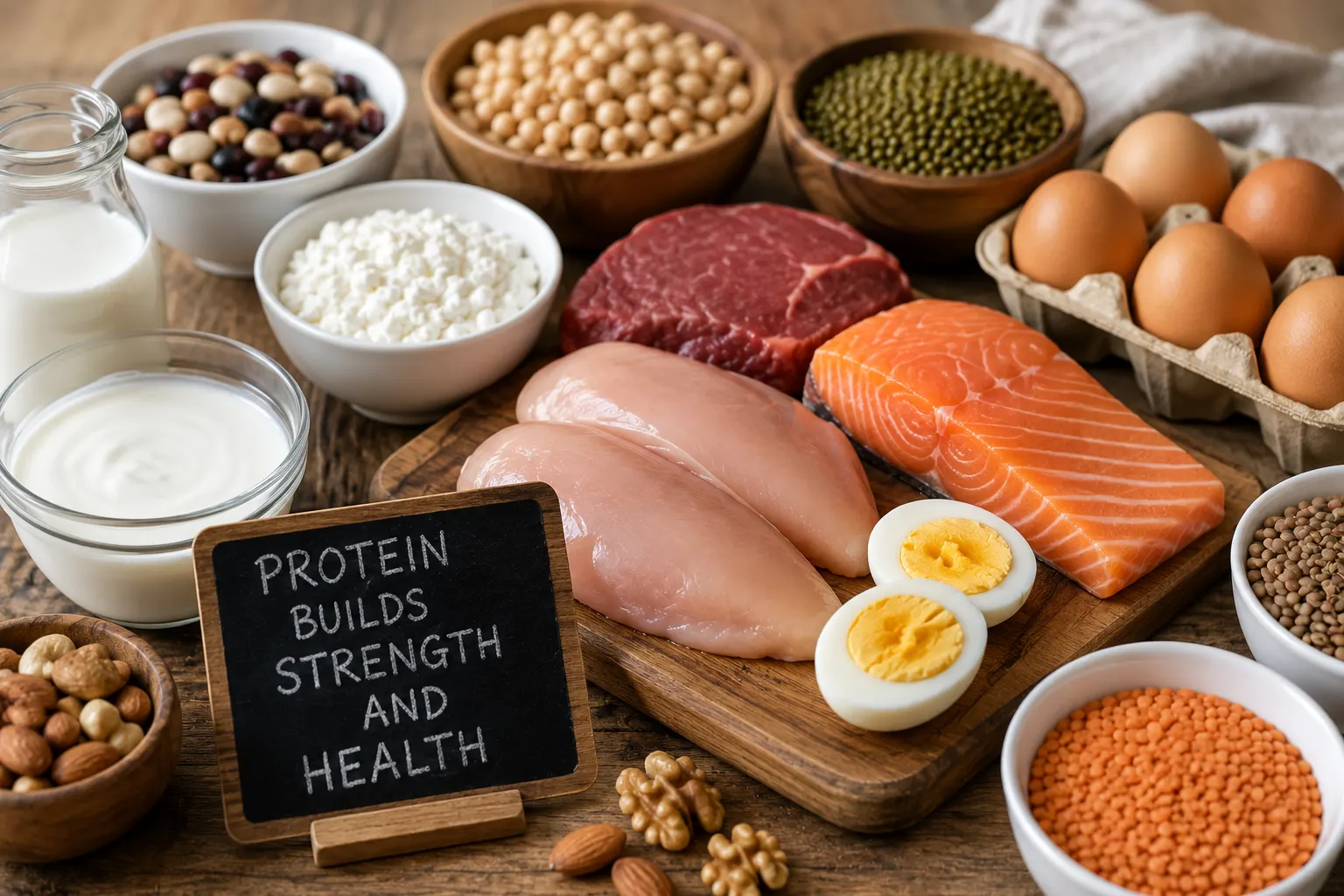
Common animal sources include eggs, milk and dairy foods, fish, poultry and meat. Plant sources include pulses such as beans, lentils and peas, soy foods, nuts, seeds and grains.
Different foods contain different amounts and proportions of amino acids and vary in digestibility. That does not mean a plant-based diet is incapable of supplying adequate protein. A varied diet containing sufficient energy and a range of protein-containing plant foods can meet requirements.
WHO’s healthy-diet guidance recommends obtaining nutritional requirements through a varied diet that is largely plant-based, while recognising that appropriate dietary patterns differ across cultures and individual circumstances.
What does “complete protein” mean?
The phrase usually describes a protein source that supplies all essential amino acids in adequate proportions.
Some people interpret this to mean every meal must contain one perfectly “complete” protein source. Human nutrition does not operate on such a narrow meal-by-meal accounting system.
What matters more for a generally healthy person is the overall dietary pattern and adequate intake across the day.
Traditional food combinations around the world - such as pulses with grains - also demonstrate how varied plant foods can complement one another.
Protein and muscle
Muscle contains protein, so dietary protein is obviously relevant to muscle maintenance and repair. But protein intake alone does not substitute for mechanical stimulus.
Resistance exercise provides a strong signal for the body to maintain and build muscle tissue. Adequate nutrition supplies the material needed to support that process.
This is why a broader strategy for maintaining muscle usually includes both appropriate protein intake and regular physical activity rather than treating a shake or bar as the central intervention.
Can protein deficiency occur?
Severe protein deficiency is uncommon in populations with secure access to sufficient varied food, but inadequate protein can occur in the context of general undernutrition, restrictive diets, certain illnesses, difficulties eating, or other circumstances.
Protein needs also deserve attention when appetite falls while nutritional demand remains significant - for example, in some older adults or during recovery from illness.
A clinician or registered dietitian can assess these cases more accurately than a generic online calculator.
Protein powders: useful, but not necessary for everyone
Protein powder is essentially a convenient concentrated source of protein. Convenience can be useful for someone who struggles to meet requirements through food or has a specific training or clinical reason for using it.
It is not biologically mandatory.
Most healthy adults can obtain adequate protein through ordinary foods. WHO likewise frames protein as part of an overall healthy diet rather than as a supplement requirement.
A more useful way to think about protein
Instead of asking whether every food is “high protein,” ask three questions:
Am I getting enough overall?
Are my protein sources part of a varied, nutritionally adequate diet?
Do my age, activity level or health circumstances give me needs that differ from the general population?
For most healthy adults, protein is essential but not mysterious. The body needs a reliable supply - not an endless one.
Medical note: People with kidney disease, significant liver disease, pregnancy-related nutritional concerns, eating disorders or medical conditions affecting nutrition should obtain individual advice before deliberately adopting a high-protein diet.