Coffee Culture: How a Global Drink Became a Social Ritual
Coffee culture is much older than the modern café, takeaway cup or language of single-origin beans and tasting notes. For centuries, coffee has been connected with hospitality, religious practice, conversation, commerce, intellectual life, work and migration. A cup of coffee can be a quick stimulant on the way to work, a formal welcome for a guest, an hours-long household ceremony, an excuse to meet friends or the centrepiece of a highly specialised tasting.
The drink became global because it proved extraordinarily adaptable. Coffee could move from Ethiopian and Yemeni cultural worlds into Ottoman coffeehouses, European commercial centres, colonial plantations, domestic kitchens and eventually multinational café chains without acquiring one universal meaning. Each society incorporated it into existing customs and created new ones around it.
Understanding coffee culture therefore requires looking beyond the beverage itself. The history includes farmers and traders as much as baristas, domestic rituals as much as famous cafés, and colonial labour systems as much as leisurely conversation. The social world surrounding coffee was built across the entire journey from plant to cup.
Coffee's Origins Are More Interesting Than the Famous Goat Story
Ethiopia occupies a central place in the biological and cultural history of coffee. UNESCO describes the Kafa region in southwestern Ethiopia as the birthplace of wild Arabica coffee, while coffee remains deeply embedded in Ethiopian daily and ceremonial life. The Kafa Biosphere Reserve contains wild genetic diversity that is still important to the future of the crop. (unesco.org)
The familiar story of coffee's discovery by a goatherd named Kaldi should be treated very differently. According to the legend, a shepherd noticed that his goats became unusually energetic after eating red berries and brought the discovery to a religious figure. The story is memorable, but it is not contemporary evidence for the discovery of coffee. UNESCO's historical discussion notes that versions of the energetic-goat story circulated in European writing centuries after the period in which coffee drinking had already become established. (courier.unesco.org)
A firmer historical path runs through Ethiopia and Yemen. UNESCO describes coffee from the forests of southern Ethiopia becoming popularised in Yemen by the fifteenth century, with Sufi communities among those associated with its early ritual use. Coffee's stimulating qualities were particularly suited to gatherings involving prolonged prayer and wakefulness. (courier.unesco.org)
From Yemen, coffee became part of the commercial world of the Red Sea and Indian Ocean. The Yemeni port of Mocha became so closely associated with the trade that its name entered the vocabulary of coffee itself. Smithsonian material on Mocha describes the port as a major commercial centre attracting merchants from Asian, African and European shores and linking Arabian coffee with textiles, spices and global flows of silver. (si.edu)
Coffee therefore did not move from a single moment of “discovery” directly into modern cafés. It passed through religious practice, domestic life, regional commerce and urban social institutions before becoming a worldwide commodity.
Coffee Became a Ritual of Hospitality
One reason coffee travelled so successfully is that it became more than something people consumed. In many societies, preparing and serving coffee became a social act.
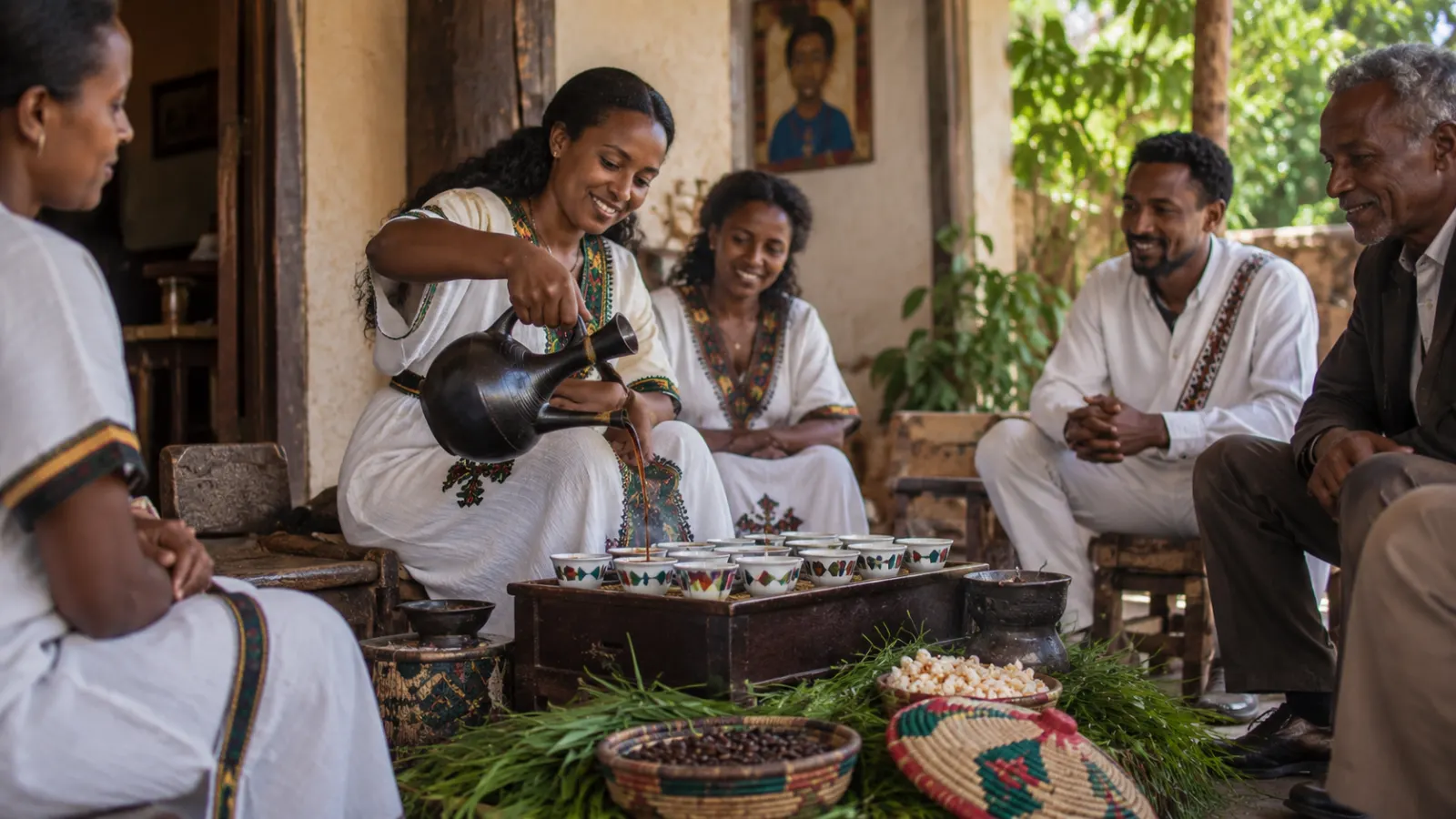
Ethiopia provides one of the clearest examples. A traditional coffee ceremony may involve roasting green beans, allowing guests to smell the aroma, grinding the beans, brewing them in a jebena and serving several rounds. UNESCO describes the ceremony as a practice that can extend over hours and bring together relatives, neighbours and guests. The order of serving and the time spent together are part of the social meaning. (courier.unesco.org)
The ritual remains sufficiently important that Ethiopia has been developing a nomination for its traditional coffee ceremony for UNESCO's Representative List of the Intangible Cultural Heritage of Humanity. UNESCO's work on that process emphasises hospitality, dialogue, community ties and the transmission of knowledge between generations. (unesco.org)
Arabic coffee provides another example. UNESCO's current inscription covers traditions in the United Arab Emirates, Oman, Qatar, Saudi Arabia and Jordan and describes Arabic coffee as a symbol of generosity and hospitality. The practice includes specific rules: older people and honoured guests are served first, coffee is poured with the right hand, and a guest can signal that they have had enough by shaking the cup. Coffee can accompany weddings, gatherings, reconciliation meetings, poetry and the exchange of memories. (ich.unesco.org)
Turkish coffee also demonstrates how preparation, equipment and sociability become culturally inseparable. UNESCO inscribed Turkish coffee culture and tradition in 2013, describing coffeehouses as places where people converse, exchange news and read, while coffee itself symbolises hospitality, friendship and refinement. It also appears in engagement ceremonies, holidays and fortune-telling practices using the grounds left in the cup. (ich.unesco.org)
In all these traditions, the cultural unit is larger than the liquid. The pot, cup, host, guest, sequence of actions and occasion matter together.
That is why two cups containing chemically similar coffee can have very different meanings.
The Coffeehouse Created a New Kind of Social Space
Coffee's move into public establishments changed its cultural history dramatically.
Early coffeehouses emerged in the Islamic world before becoming famous institutions in European cities. By the sixteenth and seventeenth centuries, coffeehouses in cities including Istanbul brought together merchants, craftsmen, officials, performers and other urban residents for conversation, games, storytelling, music and the exchange of information. Historical accounts also show why authorities sometimes viewed such spaces with suspicion: a room full of people talking for long periods could become a room full of people discussing politics. (folger.edu)
The political importance of coffeehouses should not be romanticised. They were not universally accessible democratic spaces. Participation could be shaped strongly by gender, class, occupation, religion and local custom. Owners still controlled commercial premises, and governments could monitor or suppress gatherings.
Yet the institutional innovation was significant. People could purchase a drink and, with it, temporary participation in an urban social environment.
As coffee spread farther into Europe, the institution changed again. Coffeehouses became associated at different times with commerce, journalism, literary life, finance and political discussion. Certain establishments acquired reputations because writers, artists, merchants or political groups gathered there.
The same pattern later appeared in South Asia in distinct local forms. Research on post-independence Delhi, for example, describes tea and coffeehouses as important spaces for networks of writers and intellectuals, debate, mentoring, journalism and political conversation. At the same time, those spaces could remain strongly gendered rather than functioning as universally accessible public forums. (sciencedirect.com)
This tension has followed the café throughout its history. It appears public because strangers can enter, yet it remains private property. It can encourage social mixing while excluding people through price, social convention or location.
The coffeehouse's cultural importance lies not in having created a perfectly democratic public sphere but in creating a durable commercial setting in which staying, talking and observing became part of what customers were effectively buying.
Global Coffee Culture Was Built on an Unequal Commodity System
The pleasant history of cafés has another side.
As coffee demand expanded, European colonial powers attempted to move cultivation beyond the regions that had previously controlled supply. Coffee spread into Java, the Caribbean and Latin America and became deeply entangled with imperial systems of land control, forced cultivation, slavery and unequal exchange.
In Java, Dutch colonial coffee production developed into systems in which cultivators were compelled to produce coffee for colonial authorities under highly unequal conditions. Historical research on the global coffee economy describes forced coffee cultivation as an important source of colonial revenue, while recent scholarship continues to examine the landscapes and institutions created by that extraction. (cambridge.org)
Coffee also became deeply connected with enslaved labour in parts of the Atlantic world, particularly as plantation production expanded in the Caribbean and Brazil. Brazil's rise as a dominant coffee producer during the nineteenth century was closely connected with slavery before abolition and later with new systems of migrant labour.
This history complicates the cultural image of the European coffeehouse. A beverage associated in consuming societies with conversation, leisure and intellectual freedom could simultaneously depend on coercive labour thousands of kilometres away.
That geographical separation remains important today even though the legal and economic structures have changed dramatically.
Coffee is still an agricultural livelihood on an enormous scale. In 2026, the International Coffee Organization estimated that coffee provides income for around 12.5 million farming families worldwide. Those households face risks including price fluctuations, climate change, pests, disease and unequal access to finance and markets. (ico.org)
The cultural history of coffee therefore cannot stop at the café door. Every coffee culture also rests on a production culture.
Coffee Farming Can Shape Entire Landscapes and Identities
Coffee does not only transform consumer behaviour. Where it is cultivated over generations, it can reorganise landscapes, architecture, settlement patterns and regional identities.
UNESCO's Coffee Cultural Landscape of Colombia, inscribed on the World Heritage List in 2011, makes this especially visible. The site encompasses six farming landscapes and eighteen urban centres in mountainous coffee-growing areas. UNESCO emphasises generations of small-plot cultivation adapted to steep terrain and the relationship between coffee production, settlement, architecture and the cultural identity of farming communities. (whc.unesco.org)
This provides an important correction to histories focused entirely on famous urban cafés.
Coffee culture begins long before roasting and brewing. It includes decisions about varieties, shade, soil, harvesting, processing and the timing of agricultural work. It includes seasonal labour, family knowledge, local architecture, transportation and the economic institutions that develop around cultivation.
A city consumer may understand “origin” as a word printed on a bag. For producing communities, origin is a lived landscape.
The specialty-coffee movement has made this agricultural side of coffee more visible to some consumers. Terms such as farm, altitude, variety, fermentation, processing method and harvest have entered ordinary café language in ways that were uncommon in mass-market coffee culture.
That greater attention can encourage appreciation for agricultural knowledge. It can also become another form of status consumption in which expertise itself becomes part of what is being purchased.
Both dynamics can occur at the same time.
Industrialisation Made Coffee Faster, Cheaper and More Ordinary
For much of coffee's history, preparation required substantial labour: roasting, grinding, heating water and brewing through locally specific methods. Industrialisation progressively changed this relationship.
Commercial roasting, packaged ground coffee, instant coffee, electric machines and eventually single-serve systems reduced the time and expertise required to make a cup. Coffee became easier to standardise and distribute across enormous markets.
Convenience helped turn coffee into an ordinary component of daily life.
Domestic rituals did not disappear. They became more diverse.
One household might still spend substantial time preparing coffee for guests while another uses instant coffee before work. An espresso can be consumed standing at a counter in a few minutes; an Ethiopian coffee ceremony can extend through several rounds; filter coffee may organise a family's morning routine.
Industrialisation therefore changed coffee ritual partly by changing time.
This relationship between coffee and time became increasingly important in industrial and office societies. Coffee was associated with wakefulness, schedules and the ability to sustain concentration. The “coffee break” embodied a useful contradiction: it was a pause from work built around a stimulant that could help work continue afterward.
That helps explain why coffee became so deeply embedded in factories, universities, transport hubs, offices and newsrooms.
It marks the beginning of work, a break within work and sometimes the extension of work beyond ordinary hours.
The Modern Café Sells Space as Well as Coffee
Contemporary café culture added another important function: the café became a place to work alone in public.
Wireless internet, laptops and flexible employment transformed many cafés into informal offices. A customer might spend an hour speaking with friends at one table while someone beside them works silently through headphones.
The economic transaction has therefore changed. Customers are not necessarily purchasing only a beverage. They may also be purchasing temporary access to seating, electricity, connectivity, toilets, climate control, music and a particular atmosphere.
This is a modern version of an older feature of coffeehouses: the value of the drink includes permission to remain.
Yet the shift creates new tensions. A café owner wants customers but also needs tables to circulate. Remote workers may occupy space for long periods after buying one drink. Social customers may dislike rooms dominated by laptops. Different cafés respond with different rules.
Coffee culture adapts because the social uses of public space keep changing.
The modern café can now function simultaneously as restaurant, meeting room, office, date venue, study space and refuge from the street.
Coffee Can Express Taste, Expertise and Social Status
Modern coffee has also developed increasingly specialised language. Consumers encounter terms describing origin, roast profile, extraction, fermentation, acidity, body and flavour.
Knowledge can deepen appreciation. Understanding why coffees from different regions or processing systems taste different can reconnect the consumer with agriculture and craft.
But expertise can also become a form of social distinction.
Knowing how to discuss extraction ratios or anaerobic fermentation may signal membership in a particular cultural world just as knowing how to order wine can. A person ordering sweet instant coffee may then be treated as unsophisticated by someone participating in specialty coffee culture.
There is no historical basis for assuming that one form represents the final or superior evolution of coffee.
Arabic coffee, Turkish coffee, Ethiopian ceremonies, espresso, South Indian filter coffee, instant coffee and contemporary specialty brewing represent different social histories and purposes. Some privilege speed, others hospitality; some foreground sweetness or spice, others acidity and origin.
Coffee's global success comes precisely from its capacity to support these differences.
Migration and Globalisation Keep Creating New Coffee Cultures
Coffee traditions rarely remain confined to the places where they developed.
Migration carries brewing methods, equipment, tastes and rituals across borders. A preparation associated with home may become a marker of cultural identity within a diaspora community. Children grow up seeing parents prepare coffee in one way while encountering entirely different café habits outside the home.
Over time, those worlds overlap.
A major city can contain Turkish coffee, espresso bars, Ethiopian ceremonies, Vietnamese coffee, South Indian filter coffee, Arabic coffee, chain cafés and experimental specialty shops within a few neighbourhoods.
Globalisation therefore does not simply replace local culture with one global coffee style. It can create several coffee cultures operating beside and inside one another.
The meanings also change as practices move.
A drink that feels ordinary to one community may be presented as exotic or fashionable by another. A traditional preparation may enter a specialty café and acquire new prices, terminology and audiences. Diaspora businesses may deliberately preserve ritual, while younger generations modify it.
Coffee follows people, and people keep rewriting coffee.
Why Coffee Culture Endures
Coffee has survived centuries of cultural change because it can occupy contradictory roles without losing its identity.
It can be ceremonial and convenient, agricultural and urban, cheap and expensive, solitary and communal. It can belong to a religious ritual, a family kitchen, a political conversation, a corporate meeting or a commuter's routine.
Its social history also contains contradictions that should not be hidden. The same commodity that supported hospitality and intellectual conversation was expanded through colonial systems of coercion and slavery. Modern consumers may celebrate farm identity while remaining economically distant from the farmers themselves. Specialty culture can increase appreciation while creating new forms of exclusivity.
Those contradictions are part of the history rather than exceptions to it.
Ultimately, coffee culture developed because the beverage repeatedly gave people a framework for doing something else: welcoming a guest, staying awake, meeting a friend, exchanging news, negotiating business, studying, debating politics or simply spending time together.
The technology changed from clay pots and hand grinders to espresso machines and automated brewers. Trade expanded from Red Sea ports to a global agricultural economy. Coffeehouses evolved into cafés, chains and laptop-filled workspaces.
But the most durable cultural achievement remained remarkably simple.
Coffee became more than a drink because people turned the act of drinking it into a social setting.