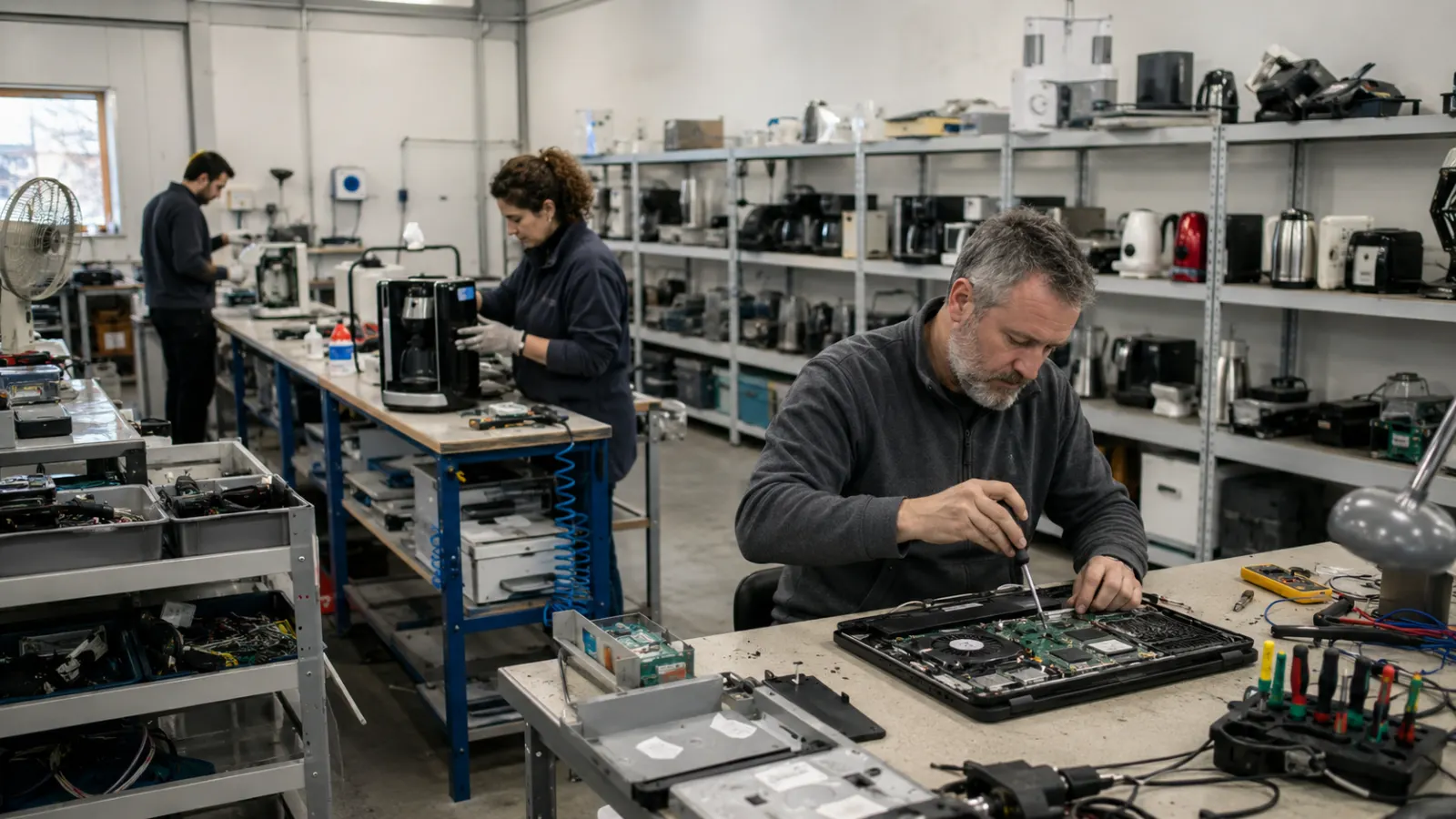
Circular Economy: Meaning, Principles, Examples and Why Recycling Is Not Enough
The circular economy is an economic model that aims to reduce waste and dependence on newly extracted resources by keeping products, components and materials useful for as long as practical. Instead of following the familiar linear sequence of extracting resources, manufacturing products, using them and discarding them, a circular system tries to prevent unnecessary material use, extend product life, enable reuse and repair, recover components and ultimately recycle materials when higher-value options are no longer practical.
That is why the circular economy should not be understood simply as better recycling.
Recycling remains important, but it occurs after much of a product's original value has already been lost. A functioning washing machine contains design, manufacturing, labour, components and materials. If one failed part is repaired, most of that value remains intact. If the entire machine is shredded and its steel recovered, the metal survives but much of the manufacturing value disappears.
Circular thinking therefore asks a different question from traditional waste management.
Instead of asking only, “What should we do with this product after it becomes waste?”, it asks:
“How can we design the product and the system around it so that it does not become waste so quickly in the first place?”
UNEP describes circularity as a systems approach built around reducing material use by design and retaining value through processes including reuse, repair, refurbishment, remanufacturing, repurposing and recycling. The Ellen MacArthur Foundation expresses the model through three broad principles: eliminate waste and pollution, circulate products and materials at their highest value, and regenerate nature.
Circular Economy at a Glance
| Question | Short answer |
|---|---|
| What is a circular economy? | A system designed to reduce waste and keep products, components and materials in use for longer |
| What is the opposite model? | The linear “take-make-waste” economy |
| Is circular economy the same as recycling? | No. Recycling is only one part of circularity |
| What usually comes before recycling? | Prevention, reduction, reuse, maintenance, repair, refurbishment and remanufacturing |
| What are the main principles? | Eliminate waste and pollution, circulate products and materials, regenerate nature |
| What is a technical cycle? | Keeping manufactured products and materials circulating through reuse, repair and recovery |
| What is a biological cycle? | Safely returning suitable organic materials and nutrients to natural systems |
| Does circular mean zero waste forever? | No. Energy use and material losses still occur |
| Why does design matter? | Product design determines whether repair, disassembly, reuse and recycling will be practical later |
| How should circularity be measured? | Through product life, virgin-material demand, reuse, repair, waste, emissions and other lifecycle outcomes—not recycling rates alone |
What Is a Linear Economy?
Most modern production still follows a largely linear pattern.
Raw materials are extracted from mines, forests, farms and fossil-fuel reserves. Manufacturers transform them into products. Consumers and businesses use those products, sometimes briefly, and much of the resulting material eventually becomes waste.
This is commonly described as:
take → make → use → dispose
The model is easy to operate when virgin resources are inexpensive and environmental costs are not fully reflected in prices.
But it creates several problems.
Resource extraction affects land, water, biodiversity and climate. Manufacturing consumes energy. Products may be discarded before their technical life is exhausted. Waste-management systems then have to collect, sort, recycle, burn or landfill enormous quantities of material.
UNEP's Global Resources Outlook 2024 reports that extraction of natural resources has tripled over the past five decades and warns that, without major change, global material extraction could increase by roughly 60% from 2020 levels by 2060.
The circular economy attempts to reduce that dependence on continuous throughput.
From a Line to a Loop
The phrase circular economy suggests that material moves in loops rather than along a one-way line.
In practice, several different strategies can create those loops.
A product can be designed to use less material. It can last longer. It can be maintained. It can move to a second owner. A failed component can be repaired. A used machine can be refurbished. Components can be remanufactured. Materials can eventually be recycled into another production process.
Circularity researchers often describe these strategies as slowing, narrowing and closing resource flows.
Slowing flows means extending the useful life of products and components.
Narrowing flows means using fewer resources to deliver the same function.
Closing flows means recovering material after use and feeding it back into production.
A strong circular system may do all three.
Circular Does Not Mean Materials Circulate Forever
The word “circular” can create an unrealistic image of a perfectly closed system in which nothing is ever lost.
Real industrial systems do not work that way.
Products wear out. Materials become contaminated. Recycling processes use energy. Some materials degrade in quality. Some components cannot economically or safely be separated. Collection itself consumes transport and infrastructure.
The circular economy should therefore be understood as a direction of improvement, not a claim that physical resources can circulate indefinitely without loss.
The useful benchmark is whether the economy is extracting less virgin material, retaining value for longer and producing less waste and pollution for the same or better level of service.
The Three Core Principles of the Circular Economy
A widely used framework identifies three core principles.
1. Eliminate Waste and Pollution
Waste should not simply be treated after it appears. Products and systems should be designed to prevent unnecessary waste and harmful pollution from being created.
A manufacturer might reduce packaging, eliminate toxic additives, design a modular device or replace disposable transport packaging with reusable containers.
2. Circulate Products and Materials
Products should remain useful for as long as possible.
That can happen through maintenance, sharing, reuse, repair, refurbishment, remanufacturing and eventually recycling.
The objective is to keep products and components circulating at the highest practical value.
3. Regenerate Nature
Circularity also considers biological systems.
Agriculture, food production and land management can be designed to maintain soils, return appropriate nutrients and reduce practices that degrade ecosystems.
These principles emphasise why circularity starts with system design rather than with the waste bin.
Why Recycling Alone Is Not Enough
Recycling converts discarded material into secondary raw material.
That can avoid some virgin extraction and reduce disposal, but it normally preserves less value than keeping the original product or component working.
Consider a steel office chair.
If another company buys and uses the chair, almost all its manufacturing value remains.
If the seat fabric is replaced and the chair repaired, most value still remains.
If the chair is dismantled and useful components reused, more processing is required but some product value survives.
If the entire chair is melted for scrap steel, only the material value remains.
EPA's current waste-management hierarchy places source reduction and reuse ahead of recycling and composting because preventing waste generally avoids more environmental impact than managing it after generation.
A high recycling rate can therefore coexist with a highly wasteful economy.
If a society sells twice as many disposable products and recycles half of them, it may report a respectable recycling rate while resource extraction and total waste continue rising.
The Value-Retention Hierarchy
Circular strategies can be arranged according to how much existing value they preserve.
A useful sequence is:
refuse → reduce → reuse → repair → refurbish → remanufacture → repurpose → recycle
UNEP explicitly uses these kinds of value-retention processes in its circularity framework.
The precise order can vary by product and context, but the underlying logic is stable:
keeping an existing product useful usually preserves more value than reducing it to raw material.
This is why repair and product-life extension are central to circularity rather than secondary lifestyle choices.
What Does “Refuse” Mean in Circularity?
Refuse means eliminating unnecessary products, materials or functions before they enter the system.
A retailer may remove redundant packaging.
A hotel may replace miniature toiletry bottles with refillable dispensers.
A company may decide that promotional merchandise is unnecessary.
The most circular product can sometimes be the product that does not need to be manufactured at all.
This is closely related to source reduction, which EPA identifies as the highest-priority waste-management strategy.
What Does “Reduce” Mean?
Reduction means delivering the same useful service with fewer resources.
Examples include lighter packaging, more efficient structural design, concentrated products and manufacturing processes that create less scrap.
But reduction should be judged carefully.
A package that uses 20% less material per unit may look circular, but if sales double, total material use still rises substantially.
This is why circularity has to consider absolute resource demand, not only efficiency per item.
Reuse Preserves Existing Value
Reuse means putting a product into another service cycle without major transformation.
Examples include second-hand furniture, reusable shipping crates, refillable beverage containers and reused building components.
Compared with recycling, reuse often requires relatively little processing.
The product does not have to return to raw material and then be manufactured again.
Reuse works especially well when products are durable, standardised and easy to collect.
Repair Extends Product Life
Repair restores a product that is no longer functioning properly.
A battery may be replaced, a screen repaired, a motor component changed or a broken furniture joint rebuilt.
Circular design makes repair easier by ensuring that:
-
products can be opened;
-
components can be removed;
-
spare parts exist;
-
repair information is available;
-
software does not unnecessarily prevent replacement components from functioning.
A product advertised as durable but impossible to repair can still become prematurely disposable.
Refurbishment vs Repair
Repair generally addresses a particular defect.
Refurbishment involves restoring a used product more comprehensively so that it can remain useful.
A refurbished laptop might receive a new battery, storage drive, cleaning, software reset and cosmetic repairs.
The product remains fundamentally the same product, but its useful life is extended through more extensive intervention.
Refurbishment can create important secondary markets because it allows products that are no longer desirable to one user to become functional assets for another.
What Is Remanufacturing?
Remanufacturing is a more industrial process.
Used products or components are recovered, inspected, disassembled, restored and rebuilt so they can meet defined performance requirements again.
It is common in some automotive components, heavy machinery, industrial equipment and printing systems.
UNEP's International Resource Panel has found substantial potential environmental savings from value-retention activities such as remanufacturing, refurbishment and repair in several industrial sectors because they can dramatically reduce the amount of new material required.
Remanufacturing demonstrates the central circular principle especially well:
the product's existing material and manufacturing value should not be destroyed merely because its first service cycle has ended.
Repurposing Gives Products Another Function
Repurposing means using a product or component for a different purpose.
A shipping container may become a storage structure. Construction timber may be used for furniture. Industrial by-products may become inputs for another process.
Repurposing can be useful, but it should not automatically be assumed to be environmentally superior.
The new use should genuinely replace another resource demand rather than merely creating an additional novelty product.
Recycling Is the Material Recovery Stage
Eventually, products and components may no longer be reusable or economically repairable.
At that point, recycling becomes important.
Metals, glass, paper and some plastics can be separated and processed into secondary materials.
But recycling quality matters.
If a high-quality material repeatedly becomes lower-quality material, the system is technically recycling while still moving toward eventual disposal.
Circularity therefore values high-quality material recovery that meaningfully displaces virgin inputs.
Technical and Biological Cycles
Circular-economy frameworks often distinguish between technical and biological materials.
Technical materials include metals, plastics, electronics and manufactured components that ideally remain circulating through maintenance, reuse, repair, refurbishment, remanufacturing and recycling.
Biological materials include suitable organic substances that can safely return to biological systems.
Food scraps, agricultural residues and some biodegradable materials may move through processes such as composting or anaerobic digestion.
The distinction matters because not every material should enter the same recovery process.
A circuit board does not belong in compost.
Food waste mixed with persistent chemicals or non-compostable packaging can also undermine biological recovery.
Circular systems depend on keeping material streams compatible and clean.
Why Product Design Determines Circularity
Much of a product's eventual environmental fate is determined before manufacturing begins.
Imagine two smartphones.
One has a glued-in battery, proprietary screws, limited software support and no spare parts.
The other can be opened, has replaceable modules and receives long software support.
Both may contain similar materials.
But their circular potential is very different.
Design determines whether maintenance, repair, component recovery and recycling are practical.
This is why circularity is fundamentally a design issue, not merely a disposal issue.
Durability Is a Circular Design Principle
Products that survive longer usually require fewer replacements.
But durability is not simply making something physically indestructible.
A product can become functionally obsolete because:
-
software support ends;
-
spare parts disappear;
-
a battery cannot be replaced;
-
standards change;
-
repair becomes too expensive;
-
fashion or marketing encourages premature replacement.
True durability therefore includes technical life, maintainability and continuing usability.
Modularity Can Make Repair Easier
Modular products allow important components to be replaced without discarding the entire product.
This can be especially valuable in electronics and machinery.
A worn battery, broken screen or failed motor should not necessarily require replacing everything around it.
However, modularity can also introduce additional material and design complexity.
Circular design still requires lifecycle assessment rather than assuming every modular product is automatically environmentally superior.
The Right to Repair and Circular Economy
Repair is strongly influenced by law and market structure.
A technically repairable device may remain effectively disposable if manufacturers restrict access to spare parts, diagnostics, tools or documentation.
This has made the right to repair an increasingly important policy issue.
Right-to-repair measures can require manufacturers to make parts and information available, improve access to independent repair and prevent unnecessary barriers to extending product life.
Such policies connect consumer rights directly with circular-economy goals.
A future Editors Outlook article on Understanding the Right to Repair Movement should link directly to this pillar page.
Circular Business Models
Circularity also changes the way firms earn revenue.
A conventional manufacturer earns more when it sells more products.
That can create weak incentives to make products last for decades.
Alternative models include:
-
leasing;
-
product-as-a-service;
-
repair services;
-
take-back programmes;
-
resale;
-
refurbishment;
-
sharing platforms;
-
deposit-return systems.
These models can align revenue with longer product life—but only if they genuinely reduce throughput.
A subscription model that replaces devices every twelve months can increase consumption rather than reduce it.
The business model should therefore be evaluated by material outcomes, not by the presence of circular terminology.
Product-as-a-Service
In a product-as-a-service model, the customer purchases access to a function rather than permanently owning the physical asset.
A company may retain ownership of industrial equipment and charge customers for its use.
Because the manufacturer expects the asset back, it may have stronger incentives to make the product durable, maintainable and valuable after one customer stops using it.
The model works best where the provider genuinely benefits from long asset life.
If contracts simply encourage constant upgrades, the environmental outcome can be very different.
Take-Back Systems
A take-back system creates a route for a product to return to a manufacturer or specialised operator.
Returned products can be inspected and directed toward:
reuse;
repair;
refurbishment;
remanufacturing;
parts harvesting;
recycling.
Without reverse logistics, even a theoretically reusable product may simply become waste because nobody has created a practical pathway back into the economy.
Circular systems therefore require logistics going both directions.
Deposit-Return Systems
Deposits give products or packaging financial value after use.
A consumer pays an additional amount when obtaining the item and receives it back when the item is returned.
This encourages collection and can support both recycling and reuse.
Deposit systems are particularly powerful when containers are standardised and can circulate through many service cycles.
They demonstrate a wider circular principle:
things are less likely to become waste when the system continues to treat them as valuable assets.
Sharing Can Increase Utilisation
Many products spend most of their lives unused.
Cars are parked. Tools sit in cupboards. Equipment waits in storage.
Sharing or rental can increase utilisation by allowing several users to obtain the same service from fewer physical assets.
This can reduce material demand if shared products replace individual ownership.
But rebound effects matter.
If sharing makes use so cheap and convenient that total consumption rises dramatically, some environmental savings can disappear.
Again, circularity should be measured by outcomes rather than intentions.
The Rebound Effect
Efficiency does not automatically reduce total resource use.
Suppose packaging becomes 30% lighter.
If the company then sells twice as many units, total packaging material may increase.
Similarly, someone who sells clothing through a resale platform may use the money to buy more new clothing.
This is called a rebound effect.
The circular economy therefore needs measures of absolute resource extraction, waste and emissions—not merely evidence that each individual product has become more efficient.
Circular Economy in Electronics
Electronics are a strong test of circularity because they contain valuable metals, complex components, plastics and sometimes hazardous substances.
Circular strategies can include:
longer software support;
replaceable batteries;
modular repair;
refurbishment;
second-hand sales;
secure data wiping;
manufacturer take-back;
parts harvesting;
specialised recycling.
The highest-value strategy is generally to keep a functioning device working longer before reducing it to materials.
A phone that receives another three years of useful life has retained more product value than one immediately shredded for metals.
Circular Economy in Buildings
Buildings contain enormous stocks of concrete, steel, timber, glass and fittings.
A circular construction strategy starts with the existing building.
Can it be maintained?
Can it be renovated?
Can it be adapted to another use?
Can components be replaced instead of demolishing the whole structure?
EPA explicitly identifies preserving existing buildings, designing for adaptability and facilitating disassembly and reuse as important source-reduction strategies in construction and demolition.
If demolition becomes necessary, deconstruction can preserve doors, beams, fixtures and structural components before remaining material is recycled.
This retains more value than crushing an entire building immediately into low-value aggregate.
Circular Economy in Textiles
Textiles illustrate several circular challenges simultaneously.
Cheap clothing can have short useful lives. Mixed fibres may be difficult to separate. Repair services may cost more than replacement. Fashion trends can create psychological obsolescence long before garments physically fail.
Circular textile strategies can include:
designing durable clothing;
repair;
resale;
rental where appropriate;
fibre-to-fibre recycling;
reduced overproduction;
producer take-back.
But collecting enormous amounts of low-quality clothing without reducing production does not automatically create circularity.
If the market continues producing disposable garments at ever-increasing scale, reuse systems may simply manage excess throughput rather than prevent it.
Circular Economy in Food
Food and agriculture involve biological rather than primarily technical cycles.
The first priority is often reducing food loss and waste.
Edible food should ideally remain food.
Surplus may be redirected to appropriate secondary uses. Suitable organic residuals can move toward animal feed, industrial processes, composting or anaerobic digestion depending on safety and local systems.
Returning nutrients to soil can help close biological loops.
But composting edible food that could have been prevented from becoming waste is not necessarily the highest-value strategy.
Circular thinking still begins with prevention.
Circular Economy and Plastics
Plastic illustrates why recycling alone is insufficient.
Many plastic products are short-lived, multilayered, contaminated or difficult to sort.
A circular plastics strategy therefore starts further upstream:
eliminate unnecessary products;
reduce packaging;
expand reuse;
design compatible materials;
improve collection;
use recycled content;
prevent leakage.
Only then does recycling play its role.
This should link directly to the Editors Outlook article How to Reduce Plastic Use: 25 Practical Ways That Make the Biggest Difference.
Circular Economy and Climate Change
The climate case for circularity begins with material production.
Mining, refining, agriculture, construction and industrial manufacturing all consume energy and produce greenhouse-gas emissions.
UNEP's Global Resources Outlook reports that extraction and processing of material resources account for a substantial share of global climate and environmental impacts. Resource extraction has already tripled over five decades, and continued growth could place further pressure on climate, biodiversity and pollution goals.
If existing products remain useful longer and fewer virgin materials are required, some upstream emissions can be avoided.
Circularity is therefore partly a climate strategy.
But it should not be treated as a substitute for decarbonising energy.
A circular economy powered entirely by high-emission energy would still face major climate problems.
Circular Economy and Biodiversity
Resource extraction transforms ecosystems.
Mining, forestry, agriculture and infrastructure can create habitat loss, water pressure and pollution.
UNEP's resource assessments connect material use with the wider triple planetary crisis of climate change, biodiversity loss and pollution.
Reducing virgin-material demand can therefore reduce some pressure on ecosystems.
Again, the actual effect depends on whether circular practices replace extraction rather than simply operating alongside ever-growing resource consumption.
Circularity Can Improve Resource Security
Circularity also has economic and strategic dimensions.
A company dependent entirely on newly extracted or imported materials may be vulnerable to shortages, geopolitical disruption and price volatility.
Repair, remanufacturing, secondary materials and local recovery networks can provide alternative supply.
This does not make an economy independent of primary resources.
But retaining material already circulating inside the economy can improve resilience.
Government Policy Shapes Circularity
Markets alone do not necessarily reward long product life.
A cheaper disposable product may outperform a durable repairable alternative if environmental costs are externalised.
Governments can change those incentives through:
product standards;
repair rules;
Extended Producer Responsibility;
landfill and disposal charges;
recycled-content requirements;
green public procurement;
deposit-return systems;
tax treatment;
eco-design requirements;
waste regulation;
consumer information.
Circular-economy policy therefore extends across industry, competition, trade, waste, consumer rights and environmental regulation.
It is not solely the responsibility of municipal recycling departments.
Extended Producer Responsibility
Extended Producer Responsibility, or EPR, makes producers financially or operationally responsible for some portion of a product's post-use management.
The basic logic is that manufacturers influence material choice and product design, so they should not transfer every downstream cost to households and municipalities.
EPR can support collection and recycling.
More ambitious systems can also reward products that are durable, repairable or easier to recover.
If the fee structure ignores design quality, however, EPR can become simply another waste-management charge.
Circular policy works best when it changes upstream incentives.
Public Procurement Can Shift Markets
Governments purchase enormous quantities of furniture, vehicles, electronics, construction materials and other goods.
Procurement rules can therefore create demand for:
repairable products;
remanufactured equipment;
recycled content;
long warranties;
take-back systems;
reusable packaging.
UNEP has explicitly connected sustainable procurement with longer product life, reuse, repair, refurbishment and remanufacturing.
A public authority can therefore influence circularity not only through regulation but also through what it buys.
Is the Circular Economy Good for Jobs?
Circular activities can create employment in repair, maintenance, refurbishment, remanufacturing, resale, recycling, reverse logistics and materials management.
Some of these activities are relatively labour-intensive.
But job creation alone does not prove environmental benefit.
A wasteful system can also employ many people.
The stronger question is whether circular employment helps deliver the same or better social value with less extraction and pollution.
Worker safety also matters.
Informal recycling operations that expose workers to toxic substances cannot be treated as complete circular-economy successes merely because materials are recovered.
Circularity and Social Justice
Material systems are also social systems.
Waste and hazardous recovery operations are often concentrated in poorer communities. Used goods may be exported to countries lacking safe recycling infrastructure. Informal workers may bear health risks while richer consumers receive the environmental credit.
A credible circular transition therefore asks:
Who performs the repair?
Who handles hazardous waste?
Who owns recovered materials?
Who receives the economic value?
Who carries the environmental risk?
Circularity that merely moves pollution somewhere less visible is not genuine system improvement.
Circular Economy vs Recycling
The distinction can be summarised simply.
| Circular economy | Recycling |
|---|---|
| Redesigns the whole material system | Manages material after use |
| Starts with prevention and design | Starts when waste or used material already exists |
| Prioritises product-life extension | Primarily recovers raw materials |
| Includes reuse, repair and remanufacturing | One specific recovery process |
| Can change business models | Usually operates within existing business models |
| Seeks lower virgin-resource dependence | Can reduce virgin demand but does not guarantee it |
| Includes biological and technical cycles | Primarily concerned with material recovery |
Recycling is part of a circular economy.
A circular economy is much larger than recycling.
Circular Economy vs the 3 Rs
The familiar reduce, reuse, recycle hierarchy is one of the foundations of circular thinking.
Circular-economy frameworks broaden that logic.
They add design, repair, refurbishment, remanufacturing, service models, reverse logistics and biological regeneration.
The 3 Rs are therefore best understood as an accessible starting point rather than the complete circular economy.
This article should internally link to Reduce, Reuse, Recycle: The 3 Rs of Sustainability Explained.
Circular Economy vs Zero Waste
The concepts overlap but are not identical.
Zero waste usually emphasises preventing material from becoming waste and improving reuse and recovery systems.
The circular economy additionally focuses on product design, economic incentives, ownership models, supply chains, industrial systems and the preservation of economic value.
Both reject unnecessary disposal.
But circularity is generally a broader economic-system framework.
Circular Economy vs Sustainable Materials Management
EPA uses the term Sustainable Materials Management, or SMM, for a lifecycle approach focused on using and reusing materials more productively while reducing environmental impacts and conserving resources.
SMM and circular-economy thinking overlap substantially.
Both shift attention from waste alone toward the entire material lifecycle.
Terminology differs among institutions, but the practical questions are similar:
How much material is required?
How long does it stay useful?
What environmental impacts occur throughout the lifecycle?
What happens when the product is no longer needed?
How Do We Measure a Circular Economy?
This is harder than calculating a recycling rate.
Useful indicators can include:
virgin-material consumption;
material footprint;
product lifetime;
repair rates;
reuse volumes;
remanufactured-product sales;
secondary-material share;
waste generation;
landfill disposal;
emissions;
water use;
biodiversity impacts.
EPA similarly emphasises lifecycle measurement because opportunities for material and environmental improvement occur across production, use and waste-management stages.
No single number captures circularity completely.
Why Recycling Rate Can Mislead
Suppose a country produces 100 units of waste and recycles 50.
Its recycling rate is 50%.
Ten years later, it generates 200 units and recycles 110.
The recycling rate has improved to 55%.
But total residual waste has risen from 50 to 90 units.
The country can truthfully report improved recycling performance while moving further away from the objective of reducing waste.
This is why absolute material and waste indicators matter.
Circularity should not reward the economy merely for processing a larger share of a rapidly expanding waste stream.
Material Footprint Matters
A country may appear resource-efficient domestically while importing large quantities of material-intensive goods.
A material footprint attempts to account for the upstream resources required to support consumption.
This matters because environmental burdens should not disappear statistically simply because extraction takes place in another country.
Global supply chains make circular-economy measurement inherently international.
Life-Cycle Assessment Can Help
Life-cycle assessment, or LCA, can compare environmental impacts across production, use and end-of-life stages.
It can help answer questions such as:
Is refurbishing an old appliance better than replacing it with a much more energy-efficient one?
How many times must reusable packaging circulate before it outperforms a disposable alternative?
Does lightweighting reduce overall impacts once transport and product loss are included?
But LCA depends on assumptions.
Results can change according to energy mix, transport distance, expected lifetime, recycling rates and what alternative product is assumed to be displaced.
Circular decisions still require judgment.
When Replacement Can Be Better Than Repair
Repair is usually associated with circularity, but extending product life is not automatically best in every case.
An extremely inefficient old appliance may consume so much energy that replacement with a substantially more efficient model produces lower lifecycle impact.
The answer depends on:
remaining product life;
energy consumption;
manufacturing impact of replacement;
repair requirements;
local electricity source;
expected use.
This is why circular economy thinking should not become another rigid slogan.
The objective is reducing lifecycle environmental impact and resource demand—not maximising repair at any cost.
Circular Economy Greenwashing
As circularity becomes popular, the word itself becomes a marketing asset.
A company may describe a package as circular because it contains some recycled material.
A clothing brand may operate a take-back scheme while continuously increasing production of short-lived garments.
A technology company may recycle devices while making repair unnecessarily difficult.
These activities can have some value.
But they do not prove that the underlying business is circular.
A stronger test asks whether the initiative reduces virgin-resource demand, increases product life, reduces total waste and lowers environmental pressure.
How to Test a Circular-Economy Claim
Ask seven questions.
Does the initiative prevent material use or merely manage waste?
Does the product last longer?
Can it be repaired or reused?
Does recovered material actually replace virgin material?
Is total waste falling?
Are emissions, toxicity and ecosystem impacts improving?
Are environmental burdens being shifted somewhere else?
If a company cannot answer these questions, the circular claim may be mostly branding.
Circularity Should Reduce Virgin Resource Demand
This is the practical benchmark that separates system change from cosmetic improvement.
A company can launch repair programmes, reuse packaging and increase recycling.
Those activities become most meaningful when they reduce the need for newly extracted material.
UNEP's Global Resources Outlook makes that upstream pressure especially important because global material extraction has already tripled over five decades and could continue rising sharply without major policy change.
Circular activity can grow while an economy remains fundamentally extractive.
The real test is whether extraction becomes less necessary.
Common Circular Economy Myths
Myth 1: Circular Economy Means Recycling More
Recycling is only one part of circularity. Prevention, durability, reuse and repair generally occur earlier.
Myth 2: Everything Can Be Recycled Forever
Materials degrade, become contaminated and require energy to process. Perfect closed loops are unrealistic.
Myth 3: A Recycled Product Is Automatically Sustainable
Environmental performance still depends on total material use, energy, transport, toxicity and lifespan.
Myth 4: Circularity Is Mainly a Consumer Responsibility
Manufacturers and governments determine design, repairability, infrastructure and incentives long before consumers make disposal choices.
Myth 5: Any Sharing Economy Business Is Circular
Sharing helps only if it reduces the number of assets and overall resource demand.
Myth 6: Repair Is Always Environmentally Better Than Replacement
Usually product-life extension is valuable, but very inefficient equipment can create cases where replacement performs better over the full lifecycle.
Myth 7: Waste-to-Energy Is the Same as Circularity
Energy recovery can play a role in waste management, but destroying material removes it from future product cycles.
Myth 8: Biodegradable Means Circular
A biological material is useful only if it can safely return to an appropriate biological cycle.
Myth 9: A High Recycling Rate Proves an Economy Is Circular
Recycling rates can rise while total material consumption and waste also rise.
Myth 10: Circular Economy Means Economic Activity Without Any Material Use
Every economy requires materials and energy. Circularity aims to reduce unnecessary extraction and preserve value more effectively.
What Can Individuals Do?
Individuals cannot redesign entire production systems, but they can influence material demand.
Useful actions include buying fewer short-lived products, choosing durable and repairable goods, maintaining products, repairing when practical, using second-hand markets, sharing rarely used equipment and recycling correctly after higher-value options are exhausted.
The most circular purchase is often no new purchase at all when the existing product still performs the required function.
Consumer demand can also support businesses that offer repair, refurbishment and take-back.
But individual choices work best when policy and product design make circular behaviour convenient.
What Can Businesses Do?
Businesses have much greater control over the system.
They can redesign products for durability and disassembly, eliminate unnecessary packaging, make spare parts available, adopt reusable transport systems and build reverse logistics.
They can also measure material use instead of focusing exclusively on waste.
A practical business hierarchy is:
Can we avoid this material?
Can we use less?
Can the product last longer?
Can we reuse it?
Can we repair or refurbish it?
Can components be remanufactured?
Can the remaining material be recycled effectively?
This turns waste management into resource management.
What Can Governments Do?
Governments can create conditions in which circular products compete more fairly with disposable ones.
Policy tools can include eco-design rules, Extended Producer Responsibility, right-to-repair measures, recycled-content standards, public procurement, landfill charges, deposit-return systems and better material information.
Governments also influence infrastructure.
Reuse systems fail when there is nowhere to return products. Recycling fails when collection and processing do not exist. Repair markets struggle when parts and documentation are inaccessible.
Circularity therefore depends on institutional design as much as product design.
Frequently Asked Questions About the Circular Economy
What is the circular economy?
The circular economy is an economic model designed to reduce waste and virgin-resource demand by keeping products, components and materials useful for longer through reduction, reuse, repair, refurbishment, remanufacturing and recycling.
What is the circular economy in simple words?
Instead of making products, using them and throwing them away, a circular economy tries to keep their value in use for as long as possible.
What are the three principles of the circular economy?
A widely used framework identifies three principles: eliminate waste and pollution, circulate products and materials at their highest value, and regenerate nature.
What is a linear economy?
A linear economy generally follows a take-make-use-dispose model in which resources are extracted, manufactured into products and eventually discarded.
What is an example of a circular economy?
Examples include refillable packaging systems, refurbished electronics, remanufactured automotive components, repairable appliances and construction projects that reuse existing buildings and components.
Is recycling part of the circular economy?
Yes, but it is only one stage. Circular systems generally prioritise preventing waste and extending product life before recycling.
Why is recycling not enough?
Recycling requires collection and processing and normally retains less value than keeping the original product or component functioning. Materials may also degrade or become contaminated.
What is the difference between reuse and recycling?
Reuse keeps the product or component largely intact for another service cycle. Recycling processes material into secondary raw material.
What is remanufacturing?
Remanufacturing is an industrial process that restores used products or components to defined performance standards so they can return to service.
What is refurbishment?
Refurbishment restores a used product through inspection, repair and replacement of worn components, usually without rebuilding it as extensively as remanufacturing.
What is a technical cycle?
A technical cycle keeps manufactured products, components and materials circulating through reuse, repair, refurbishment, remanufacturing and recycling.
What is a biological cycle?
A biological cycle returns suitable organic nutrients and materials safely to natural systems.
Does circular economy mean zero waste?
No. Some material loss and residual waste will remain. Circularity aims to minimise waste and preserve value rather than promise perfect physical loops.
How does the circular economy reduce climate change?
Using products longer and reducing virgin-material production can avoid some emissions from extraction and manufacturing. Circularity complements rather than replaces energy decarbonisation.
How does circular economy protect biodiversity?
Reduced resource extraction can lower pressure from mining, land conversion, forestry and other activities affecting ecosystems.
What is the right to repair?
The right to repair refers to policies and practices designed to make products practically repairable through access to parts, tools, information and compatible servicing.
What is Extended Producer Responsibility?
EPR makes producers financially or operationally responsible for part of the management of products or packaging after use.
Is a sharing economy circular?
It can be if sharing increases asset utilisation and genuinely reduces demand for new products. It is not automatically circular.
What are circular business models?
Examples include leasing, product-as-a-service, repair services, take-back programmes, refurbishment, resale and reuse systems.
What is circular design?
Circular design considers durability, repairability, modularity, disassembly, material safety and end-of-life recovery before the product is manufactured.
How do you measure circularity?
Useful measures include virgin-material consumption, material footprint, product lifetime, repair and reuse rates, secondary-material use, waste generation and environmental impacts.
Why is a recycling rate not enough?
A recycling rate can improve while total waste and material consumption continue increasing.
Can a company be 100% circular?
Claims of complete circularity should be treated cautiously because industrial systems require energy and experience material losses. The more useful question is how much virgin-resource demand and environmental impact are genuinely reduced.
What sectors have major circular-economy opportunities?
Construction, electronics, plastics, textiles, food systems, manufacturing and transport all have significant opportunities for resource reduction, product-life extension and material recovery.
Why is the circular economy important?
Resource extraction has tripled over the past five decades, and UNEP projects that it could rise another 60% from 2020 levels by 2060 without major change. Circularity offers one way to reduce dependence on continued extraction.
The Circular Economy Starts Before the Recycling Bin
The central lesson of the circular economy is that waste is often the result of decisions made long before anything is thrown away.
A designer decides whether a battery can be replaced.
A manufacturer decides whether spare parts will exist.
A retailer chooses between disposable and refillable packaging.
A building owner decides whether renovation is possible before demolition.
A government decides whether repair is encouraged, whether producers carry responsibility and whether reuse infrastructure exists.
By the time a product enters the recycling bin, many of those decisions have already been made.
Recycling therefore matters, but it cannot carry the entire transition.
A genuinely circular economy tries to preserve value earlier.
It avoids unnecessary material. It reduces the amount required. It keeps functioning products in use. It repairs what fails. It refurbishes and remanufactures when products need deeper intervention. It repurposes useful components and recycles material when higher-value options are exhausted.
And then it asks the hardest question:
Did these activities actually reduce the need for new resource extraction?
That question matters because the world can become more efficient, recycle more and create larger second-hand markets while still consuming ever-growing quantities of virgin material.
UNEP's resource data show why that distinction cannot be ignored. Natural-resource extraction has already tripled in fifty years, and without major changes it could continue rising sharply over coming decades.
Circularity therefore should not be judged by how often businesses use the word circular.
It should be judged by outcomes.
Are products lasting longer?
Is repair becoming easier?
Are components being reused?
Is residual waste falling?
Are secondary materials replacing virgin inputs?
Are emissions and ecosystem pressures declining rather than merely moving elsewhere?
Those are much harder questions than asking how much material entered a recycling plant.
But they are also the questions that reveal whether an economy is genuinely moving away from take-make-waste.
The circular economy is ultimately not an attempt to perfect the rubbish bin.
It is an attempt to design an economy in which far less value reaches the rubbish bin in the first place.