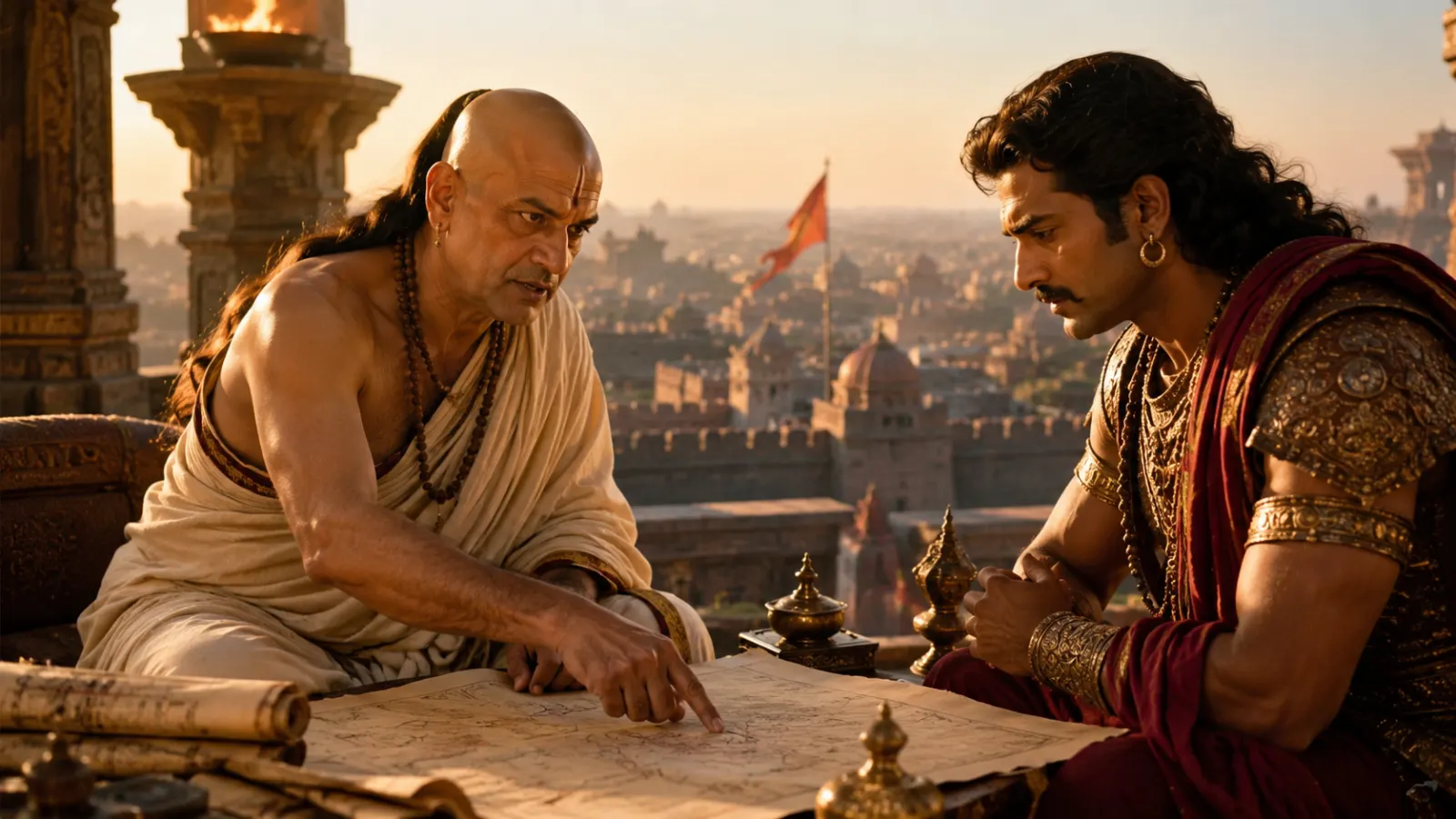
Chanakya: The Strategist Behind India’s Most Famous Tradition of Statecraft
Chanakya occupies an unusual place between history, political thought and legend.
In the familiar account, he is the brilliant scholar humiliated by the Nanda court, the teacher who recognises the potential of a young Chandragupta Maurya, the strategist who helps overthrow a dynasty and the chief adviser behind the creation of the Mauryan Empire.
He is also traditionally identified with Kautilya, the author associated with the Arthashastra—one of the most extensive surviving works of premodern statecraft, administration, political economy, intelligence and diplomacy.
It is an extraordinarily powerful story.
It is also considerably neater than the historical evidence.
The traditions concerning Chanakya survive in Brahmanical, Buddhist and Jain literature produced or redacted at different times. They disagree about important details and frequently contain literary motifs typical of royal foundation stories. The surviving Arthashastra, meanwhile, has its own complicated textual history.
Traditional scholarship identifies Chanakya, Kautilya and Vishnugupta as the same man.
Modern textual scholarship has made that identification much less straightforward.
The safest way to understand the subject is therefore to keep two related questions in view:
Who was the strategist remembered as Chanakya in traditions surrounding Chandragupta Maurya?
And:
How did the text known as the Arthashastra develop and become associated with Kautilya and Chanakya?
The two histories overlap.
They should not automatically be treated as identical.
Chanakya at a glance
| Detail | Information |
|---|---|
| Period traditionally associated with him | Late fourth to early third century BCE |
| Political setting | Rise of Chandragupta Maurya and fall of the Nandas |
| Traditional role | Teacher, strategist, minister and adviser to Chandragupta |
| Other names traditionally associated with him | Kautilya, Vishnugupta |
| Major text associated with him | Arthashastra |
| Core subjects of the Arthashastra | Kingship, administration, taxation, law, economy, intelligence, diplomacy and war |
| Historical problem | Chanakya's biography comes mainly from later literary traditions |
| Textual problem | The surviving Arthashastra appears to contain material produced and redacted across different periods |
| Modern importance | History of political thought, state capacity, strategic studies and political economy |
Who was Chanakya?
Chanakya is remembered primarily as the political adviser who helped Chandragupta Maurya rise to power.
Chandragupta established Mauryan rule in the late fourth century BCE after the decline of Nanda power in Magadha. His rise occurred during a period of considerable political change in northern India and the northwest following Alexander's campaigns and the fragmentation of his conquests after his death.
Later Indian traditions repeatedly insert Chanakya into this transformation.
The details vary.
In some versions, Chanakya is a learned Brahmin insulted by the Nanda king and determined to destroy the dynasty.
In others, the emphasis falls on his political intelligence, his discovery or training of Chandragupta, his organisation of alliances and his role as minister after the conquest.
The Sanskrit drama Mudrarakshasa, attributed to Vishakhadatta and composed long after the establishment of the Mauryan Empire, portrays Chanakya as a relentless political operator who uses strategy, deception and coalition-building to secure Chandragupta's rule.
Jain and Buddhist traditions preserve different versions of the same broader memory.
These accounts cannot be read as contemporary eyewitness reports.
Their importance lies partly in the persistence of the tradition: Indian literary memory repeatedly connected the foundation of Mauryan power with an unusually capable adviser.
That does not allow historians to reconstruct every dramatic episode.
But it does explain why Chanakya became the Indian archetype of political strategy.
Chanakya, Kautilya and Vishnugupta: one person or several traditions?
In popular usage, the matter appears simple.
Chanakya is Kautilya.
Kautilya is Vishnugupta.
And Kautilya wrote the Arthashastra while serving Chandragupta Maurya.
That remains the traditional identification and continues to appear in scholarship as well as popular histories.
The textual evidence, however, requires caution.
Modern scholars have studied the language, structure, chapter organisation, citations and intellectual layers of the Arthashastra. These studies have raised serious doubts that the complete surviving work was written in a single period by one fourth-century BCE minister.
That does not mean the entire Chanakya-Kautilya tradition must be discarded.
Ancient works can preserve much older material.
A political school can develop over generations.
A later compiler can organise inherited teachings.
A famous historical figure can become associated with a tradition that continues evolving after his lifetime.
The important correction is therefore not:
“Chanakya had nothing to do with the Arthashastra.”
The evidence does not justify such certainty.
The better formulation is:
The Arthashastra is traditionally attributed to Kautilya, identified with Chanakya and Vishnugupta, but the surviving text has a complex compositional history and should not automatically be treated as a verbatim Mauryan-era manual written entirely by Chandragupta’s minister.
That distinction makes the history more accurate without making it less interesting.
How old is the Arthashastra?
The dating of the Arthashastra has generated one of the longest debates surrounding the work.
Earlier scholars often defended a Mauryan date and treated the text as essentially the work of Chandragupta's minister.
Later research identified substantial evidence of textual layering.
Scholars have proposed different reconstructions, and there is no reason to pretend that the debate has been completely settled.
One influential modern approach, associated with Patrick Olivelle, distinguishes several stages of composition and redaction rather than assigning the entire text to one moment.
Another major study, by Mark McClish, similarly argues that the surviving Arthashastra cannot be explained as the work of a single author writing at one time.
McClish proposes an earlier work that was subsequently expanded and redacted, with the form familiar today emerging much later than the Mauryan foundation.
This means that statements such as:
“Chanakya wrote the Arthashastra in 300 BCE”
are too confident.
A more responsible account recognises both the ancient political tradition reflected in the work and the evidence that its present form developed over time.
The rediscovery that transformed Arthashastra studies
The modern scholarly history of the Arthashastra begins in Mysore in the early twentieth century.
A manuscript was handed to R. Shamasastry of the Mysore Government Oriental Library.
Shamasastry recognised its significance and began publishing portions of an English translation between 1905 and 1909.
The Sanskrit text was published in 1909.
His complete English translation appeared in book form in 1915.
The discovery was remarkable because the Arthashastra had been known through references in other Sanskrit literature but was no longer widely available as a complete work.
Later manuscripts and commentaries allowed scholars to produce improved editions.
R. P. Kangle's critical work in the twentieth century became especially important, and newer translations and textual studies have continued to revise how the book is understood.
The rediscovery revealed an extraordinarily detailed treatise.
Its subjects include:
-
taxation,
-
bureaucracy,
-
public finance,
-
law,
-
agriculture,
-
trade,
-
irrigation,
-
mines,
-
forests,
-
intelligence,
-
diplomacy,
-
military affairs,
-
corruption,
-
salaries,
-
markets,
-
punishment,
-
and the daily duties of the ruler.
Ancient Indian political thought could no longer be caricatured as consisting only of idealised discussions of righteous kingship.
The Arthashastra was intensely interested in the practical machinery of government.
What does “Arthashastra” mean?
The title itself requires explanation.
Artha has a wide range of meanings.
Depending on context, it can refer to material prosperity, advantage, purpose, interest, wealth or practical success.
Shastra refers to a systematic discipline or treatise.
Translations such as “science of politics,” “science of material gain,” “treatise on statecraft” or “science of political economy” each capture part of the meaning but not the whole.
The book is broader than modern political science.
Its central concern is with the acquisition, protection and expansion of political power, but political power is understood materially.
A kingdom needs revenue.
Revenue depends on economic production.
Production depends on agriculture, labour, infrastructure, trade and security.
Officials must be supervised.
Information must be collected.
Laws must be enforced.
Enemies must be understood.
Diplomacy must respond to relative power.
The Arthashastra therefore treats politics as an interconnected institutional system.
The king as a full-time administrator
One of the most striking features of the Arthashastra is its image of kingship.
The ruler is not merely a ceremonial monarch sitting above the machinery of government.
He is expected to work.
His schedule is divided around reports, consultations, administrative duties, intelligence and decision-making.
Government demands continuous attention because institutions can fail.
Officials can steal.
Revenue can disappear.
Enemies can infiltrate.
Markets can be manipulated.
Provincial authority can weaken.
Military preparation can deteriorate.
The ruler's power is therefore conditional.
A king may possess hereditary authority, but his kingdom can still collapse if he governs incompetently.
This is one of the reasons the Arthashastra remains interesting to historians of political thought.
It treats state capacity as a practical problem.
The problem of corrupt officials
The Arthashastra is famously suspicious of government employees.
It recognises that officials responsible for collecting or managing resources may exploit their positions for personal gain.
The text discusses numerous possible methods through which public revenue can be misappropriated and proposes mechanisms involving accounting, inspection, testing and punishment.
Modern writers occasionally describe these passages as though Kautilya invented contemporary forensic auditing.
That is unnecessary.
The deeper insight is institutional.
A ruler cannot assume that an official automatically acts in the ruler's interest.
Delegating authority creates opportunities for hidden behaviour.
Modern economics might describe this in terms of a principal-agent problem.
The terminology is modern.
The governance problem is ancient.
The Arthashastra's proposed solutions belong to a hierarchical and often harsh monarchical state, but its recognition of the problem is remarkably clear.
An economy the state wants to understand
The Arthashastra gives extensive attention to economic life because political power requires resources.
Agriculture occupies a particularly important place.
But the text also addresses:
-
irrigation,
-
mines,
-
forests,
-
livestock,
-
customs,
-
trade routes,
-
craft production,
-
markets,
-
warehouses,
-
weights and measures,
-
state enterprises,
-
and taxation.
This has made the work important in histories of economic thought.
It has also encouraged anachronism.
Kautilya is sometimes called capitalist.
Elsewhere he is described as socialist.
Some writers portray him as an advocate of a command economy, while others turn him into a champion of markets.
None of these modern ideological labels fits comfortably.
The political economy of the text belongs to an agrarian monarchy.
Private property and commerce exist.
The state also regulates, taxes and sometimes directly controls important economic activities.
The organising principle is not commitment to a modern economic ideology.
It is the strength, revenue and stability of the kingdom.
Taxation: revenue without destroying the source
No government operates without resources.
The Arthashastra treats taxation accordingly.
Yet extraction has limits.
A kingdom that impoverishes cultivators, destroys production or makes commerce impossible ultimately weakens its own revenue base.
That creates a practical reason for moderation.
The ruler benefits when land is cultivated.
He benefits when trade functions.
He benefits when settlements prosper.
He benefits when producers have enough stability to continue producing.
This reasoning can sound surprisingly modern.
But its historical basis must remain clear.
The restraint is often prudential rather than constitutional.
Subjects are not imagined as modern taxpayers possessing democratic control over government.
The ruler avoids destructive extraction because destroying the productive base damages the kingdom.
That distinction matters.
Good administration is not automatically liberal democracy.
Law, danda and political order
The Arthashastra contains extensive legal material.
It discusses disputes involving matters such as:
-
contracts,
-
debts,
-
property,
-
inheritance,
-
family relations,
-
theft,
-
assault,
-
commercial conduct,
-
and official wrongdoing.
At the centre of political authority stands the concept of danda—punishment or coercive authority.
The basic logic is straightforward.
A government unable to punish serious wrongdoing cannot maintain order.
But punishment used without discipline can also produce instability.
The text therefore attempts to systematise coercion.
Modern readers should not romanticise this system.
Its penalties can be severe.
Its society is hierarchical.
Its assumptions concerning gender, social status and authority differ profoundly from contemporary constitutional equality.
The king does not operate under a modern regime of fundamental rights and judicial review.
Yet the effort to transform punishment from completely personal whim into a field of administration remains historically important.
The intelligence state
No part of the Arthashastra has attracted more attention than espionage.
Its world contains secret agents, informants, disguises, covert tests and attempts to manipulate hostile actors.
Agents may be used to:
-
monitor officials,
-
investigate disloyalty,
-
measure public sentiment,
-
identify conspiracies,
-
obtain foreign intelligence,
-
and destabilise enemies.
Some recommendations are ruthless.
This is one reason Chanakya is often described as an Indian Machiavelli.
The comparison is tempting but limited.
Machiavelli and the Arthashastra belong to very different political worlds, write within different intellectual traditions and address different institutional settings.
The spy system is more interesting when understood through the problem it attempts to solve.
A ruler cannot directly observe a large kingdom.
He depends on information.
But informants can lie.
Officials can manipulate reports.
Spies themselves can become unreliable.
The text therefore sometimes requires information to be independently confirmed.
That is an important insight.
Collecting information is not the same as possessing reliable knowledge.
Strategy begins with uncertainty
The Arthashastra assumes that political actors operate under incomplete information.
A ruler rarely knows with certainty:
-
what another king intends,
-
whether an ally will remain loyal,
-
whether an official is corrupt,
-
whether a population will rebel,
-
whether an army is stronger than reported,
-
or whether peace will remain advantageous.
Statecraft therefore involves reducing uncertainty.
Intelligence is one tool.
Diplomacy is another.
Economic preparation is another.
Military readiness is another.
This helps explain why the text can appear extraordinarily calculating.
Politics is treated less as a sequence of moral declarations than as a continuing problem of imperfect information and changing capability.
The mandala and the “circle of kings”
One of the most famous ideas associated with Kautilya is the mandala, usually translated as a circle of states or circle of kings.
Popular summaries often reduce it to a slogan:
“Your neighbour is your enemy; your neighbour's neighbour is your friend.”
That is too simple.
The Arthashastra analyses relations among rulers whose strategic positions depend on geography, relative strength, alliances, interests and circumstances.
The framework is dynamic.
An ally under one set of conditions may not remain an ally forever.
A hostile ruler may become useful.
A weaker ruler may seek protection.
Two rulers may cooperate against a third.
A king may choose peace, war, neutrality, preparation or other combinations depending on relative position.
The analysis resembles later traditions of political realism because it emphasises capability and interest.
But it is not a timeless mathematical law of foreign relations.
The political environment imagined in the text consists of monarchies and would-be conquerors, not modern sovereign states operating within international institutions and international law.
Foreign policy is more than war versus peace
The Arthashastra does not view diplomacy as a binary choice between fighting and doing nothing.
Peace itself can be strategic.
So can neutrality.
An alliance can buy time.
Negotiation can divide enemies.
A weaker king may cooperate today while preparing for a different balance of power tomorrow.
War may become rational under one set of circumstances and unnecessarily expensive under another.
This flexibility is among the work's most enduring analytical qualities.
The central question is rarely:
Is war morally admirable?
It is:
Which available policy is most advantageous under present conditions?
Modern governments operate under very different legal and ethical constraints.
Yet the analytical habit remains recognisable: strategy must account for geography, resources, timing, capability and the likely reactions of other actors.
War is expensive
The Arthashastra is sometimes portrayed as a celebration of conquest.
It certainly accepts conquest as a legitimate objective within its political world.
But it does not assume open warfare is always the best instrument.
Armies consume revenue.
Campaigns carry risk.
Fortifications are difficult to overcome.
Allies can defect.
Victory may produce administrative burdens.
For these reasons, diplomacy, deception, negotiation, alliances and covert action can sometimes be preferable to direct conflict.
This is strategic rationality rather than pacifism.
The goal is not avoidance of violence as a moral principle.
The goal is to achieve political objectives efficiently.
That difference is essential when evaluating the text ethically.
Welfare and state interest can coexist
One of the more complicated aspects of the Arthashastra is the relationship between the ruler and the welfare of his subjects.
The text contains ideas suggesting that the ruler's success is connected with the prosperity and security of the population.
This has encouraged interpretations of Kautilya as an ancient theorist of the welfare state.
That goes too far.
Public welfare and ruler interest need not be opposites.
Healthy agriculture strengthens revenue.
Security encourages economic activity.
Infrastructure can increase production.
Protection from disorder helps both subjects and the treasury.
A ruler can therefore promote welfare for reasons that are simultaneously practical and political.
The presence of such reasoning does not turn the monarchy into a modern social democracy.
Nor does its authoritarian character mean every concern for subjects must be dismissed as insincere.
Premodern political thought can contain coercion and welfare at the same time.
Political philosophy without constitutional democracy
The Arthashastra is sometimes celebrated as though it were an ancient democratic constitution.
It is not.
Its political centre is the king.
It does not begin with:
-
popular sovereignty,
-
universal adult franchise,
-
equal democratic citizenship,
-
constitutional separation of powers,
-
or enforceable fundamental rights in the modern sense.
Its primary concern is effective rule.
Yet that does not make its political thought primitive.
The work repeatedly shows that authority depends on functioning institutions.
A ruler who cannot collect revenue cannot maintain an army.
A ruler with unreliable officials cannot administer territory.
A ruler without intelligence cannot identify danger.
A ruler who destroys economic productivity damages his own power.
A ruler who misunderstands neighbouring states can lose strategic advantage.
In that sense, the Arthashastra treats political power as something produced by institutions rather than simply possessed by the king.
Chanakya and Machiavelli
Comparisons between Chanakya and Niccolò Machiavelli are almost inevitable.
Both names have become shorthand for political calculation.
Both are associated with unsentimental discussions of power.
Both are frequently reduced to the idea that rulers should do whatever is necessary to win.
But the comparison has limits.
Machiavelli wrote in Renaissance Italy amid republics, principalities and intense interstate conflict.
The Arthashastra emerged from ancient South Asian traditions of artha, kingship, punishment, political economy and interstate relations.
Its scope is also considerably wider than The Prince.
It addresses bureaucratic organisation, market regulation, law, taxation, agricultural administration, intelligence and other subjects in extensive detail.
Calling Chanakya the "Indian Machiavelli" may help a reader orient quickly.
It can also make the older and structurally different South Asian tradition appear to be merely a local version of a European thinker who lived many centuries later.
Chanakya is more usefully studied on his own terms.
The ethics problem
The Arthashastra is uncomfortable reading in places.
It discusses deception.
It allows covert manipulation.
It contemplates forms of violence that contemporary constitutional and human-rights frameworks would reject.
Does that make the text immoral?
The answer depends partly on the question being asked.
The Arthashastra is not primarily a modern ethics manual.
It is concerned with preserving and expanding political order.
That does not excuse everything it recommends.
Historical explanation is not moral approval.
But simply condemning the work also avoids the more difficult question it poses:
How far may political authority go in the name of security and survival?
That problem has not disappeared.
Modern constitutional states attempt to limit government through:
-
rights,
-
law,
-
courts,
-
elections,
-
oversight,
-
accountability,
-
and restrictions on executive power.
The Arthashastra emerges from a world in which these restraints were structured very differently.
Its relevance is therefore analytical rather than prescriptive.
The quote problem: did Chanakya really say it?
Modern Chanakya has become a quotation industry.
Social media is filled with statements attributed to him about:
-
friendship,
-
revenge,
-
women,
-
money,
-
enemies,
-
leadership,
-
success,
-
secrecy,
-
and ambition.
Many appear on motivational graphics without a book, chapter, verse or reliable edition.
This creates a serious problem.
Some sayings may derive from later collections known as Chanakya Niti.
Some may be paraphrases.
Some may reflect broader Indian proverbial traditions.
Others appear to be modern inventions.
A quotation should therefore not be treated as authentic merely because Chanakya's photograph or name appears beside it online.
Responsible use requires a traceable source.
Ideally, the quotation should identify:
-
the text,
-
chapter or verse,
-
edition or translation,
-
and enough context to establish its meaning.
The historical Chanakya is difficult enough to reconstruct without adding thousands of unsourced internet aphorisms.
Chanakya Niti is not simply the Arthashastra
Another source of confusion is the tendency to treat Chanakya Niti and the Arthashastra as interchangeable.
They are not the same work.
Texts circulating under titles such as Chanakya Niti or Chanakya Niti Shastra belong to traditions of aphoristic instruction associated with Chanakya's name.
The Arthashastra, by contrast, is a large systematic treatise dealing with government, law, economy, diplomacy and political strategy.
The association of both with Chanakya reflects the enormous authority his name acquired.
But a quotation from a niti collection should not automatically be presented as a passage from the Arthashastra.
Source precision matters.
Why “corporate Chanakya” is a poor historical shortcut
Modern management culture frequently turns Chanakya into a corporate strategist.
Passages are extracted to offer advice on:
-
defeating competitors,
-
managing employees,
-
hiding intentions,
-
building teams,
-
negotiating contracts,
-
or surviving office politics.
Some analogies can be intellectually useful.
But the historical context cannot simply be discarded.
The Arthashastra addresses kings who control armies, taxation, coercive punishment, fortresses, secret agents and territorial expansion.
A strategy designed for a monarch confronting rebellion is not automatically ethical advice for a sales manager.
An intelligence technique devised for state security is not a model for monitoring employees.
An argument about conquering a hostile kingdom is not automatically a principle of commercial competition.
The text becomes more valuable, not less, when modern readers resist converting it into motivational slogans.
It enables comparison between political systems.
It does not provide ready-made permission to import ancient monarchical techniques into every modern institution.
Chanakya and Chandragupta: how much can one adviser explain?
The traditional partnership between Chanakya and Chandragupta has extraordinary narrative power.
One becomes the strategist.
The other becomes the ruler.
Thought and action appear to combine perfectly.
Historical change is rarely that simple.
The collapse of Nanda authority and emergence of Mauryan power must have depended on many forces:
-
armies,
-
commanders,
-
elites,
-
local alliances,
-
economic resources,
-
political dissatisfaction,
-
geography,
-
and the changing balance of power in northern India.
No single adviser could replace all of these conditions.
The story of Chanakya should therefore not become a "great strategist did everything" explanation of Mauryan state formation.
Yet the persistent tradition remains meaningful.
Political organisation matters.
Advice matters.
Institutional design matters.
Coalition-building matters.
A ruler needs more than battlefield courage.
The Chanakya tradition may be remembered so strongly precisely because it personifies those less visible elements of state formation.
The Arthashastra as a theory of state capacity
The most productive modern way to read the Arthashastra may be to see how consistently it links power to capacity.
A state needs the capacity to:
-
gather information,
-
collect revenue,
-
supervise officials,
-
administer justice,
-
protect economic production,
-
enforce decisions,
-
defend territory,
-
build alliances,
-
and respond to crisis.
Failure in one area affects the others.
Corruption weakens revenue.
Weak revenue limits military capability.
Poor intelligence increases strategic risk.
Economic collapse undermines taxation.
Arbitrary government can create instability.
Insecure borders interfere with trade.
Statecraft therefore becomes systemic.
This is far more interesting than reducing the work to a collection of "tricks."
The Arthashastra and political realism
The term political realism is modern and should not simply be projected backward.
Yet aspects of the Arthashastra clearly resonate with ideas associated with realist traditions.
It assumes that political actors have competing interests.
It places considerable weight on relative power.
It treats alliances as contingent.
It distinguishes what rulers might wish to do from what their capabilities allow.
It takes information, geography and strategic position seriously.
And it assumes that moral intention alone cannot preserve a state.
At the same time, the text is not simply a doctrine of unlimited power.
Administration, law, prosperity, discipline and order all matter because political power cannot survive through violence alone.
Its realism is institutional as well as strategic.
What Chanakya did not invent
Modern admiration often becomes exaggerated priority claiming.
Chanakya is credited online with inventing:
-
economics,
-
political science,
-
intelligence agencies,
-
auditing,
-
diplomacy,
-
taxation,
-
management,
-
game theory,
-
behavioural psychology,
-
welfare economics,
-
and sometimes nearly every concept associated with government.
Such claims weaken rather than strengthen the historical case.
Ancient societies across the world developed taxation, administration, espionage, diplomacy and political strategy.
The significance of the Arthashastra is not that no human being had considered these subjects before.
Its significance lies in the breadth and systematic character with which it brings them together.
That achievement needs no exaggeration.
Why the authorship debate makes the Arthashastra more interesting
At first glance, uncertainty about authorship may appear disappointing.
A simple biography is easier:
Chanakya lived.
Chanakya wrote the book.
Chanakya advised Chandragupta.
Everything fits.
But a layered text offers a more revealing history.
It suggests a continuing tradition of political reasoning.
Ideas were inherited.
Older material was reorganised.
Different views were debated.
The text grew.
Editors and redactors participated in preserving and reshaping political knowledge.
The name Kautilya acquired authority within that tradition.
Later historical memory connected it powerfully with Chanakya.
Instead of one isolated genius inventing an entire science, we see a long intellectual process.
That is often how important bodies of knowledge actually develop.
Why Chanakya still matters
Chanakya matters because Indian historical memory made him the archetype of strategic intelligence.
The Arthashastra matters because it preserves one of the world's richest premodern bodies of writing on practical government.
Its range is remarkable.
It connects:
revenue to military power,
production to taxation,
information to security,
official supervision to administrative capacity,
diplomacy to relative strength,
and political survival to the competence of institutions.
Modern readers do not need to adopt its monarchy, punishments, espionage methods or ethics to recognise the sophistication of those connections.
Nor is it necessary to pretend that every modern field of government was invented by one ancient Indian thinker.
The more credible conclusion is stronger.
Ancient South Asian political thought contained an extensive tradition of systematic reflection on the practical machinery of power.
Chanakya became the most famous human symbol of that tradition.
Frequently Asked Questions
Who was Chanakya?
Chanakya is traditionally remembered as a scholar, strategist and political adviser who helped Chandragupta Maurya overthrow the Nandas and establish Mauryan power in the late fourth century BCE. Most detailed stories about his life survive in later literary traditions rather than contemporary biographical records.
Was Chanakya a real historical person?
A political figure behind the Chanakya tradition may well have been historical, and traditions connecting a powerful adviser with Chandragupta are widespread. However, the detailed biography familiar today comes largely from later Brahmanical, Buddhist and Jain narratives and cannot be reconstructed with certainty.
Are Chanakya and Kautilya the same person?
Traditional accounts identify Chanakya, Kautilya and Vishnugupta as the same person. Modern textual scholarship is more cautious, particularly because the surviving Arthashastra shows evidence of composition and redaction across different periods.
Did Chanakya write the Arthashastra?
The Arthashastra is traditionally attributed to Kautilya, identified with Chanakya. However, modern scholarship indicates that the surviving text has a complex compositional history and should not automatically be regarded as a single work written entirely by one fourth-century BCE minister.
What is the Arthashastra about?
The Arthashastra is a Sanskrit treatise dealing with kingship, administration, taxation, public finance, law, agriculture, commerce, intelligence, diplomacy, warfare and the organisation of political power.
When was the Arthashastra written?
There is no single uncontested date for every part of the surviving text. Some material may preserve relatively early traditions, while major modern studies argue that its composition and redaction extended into the early centuries CE.
Who rediscovered the Arthashastra?
R. Shamasastry brought the text into modern scholarship after receiving and studying a manuscript at the Mysore Government Oriental Library. He published portions of his translation from 1905 onward, the Sanskrit text in 1909 and a complete English translation in 1915.
What is Kautilya's mandala theory?
The mandala framework analyses relations among kings according to geography, interests, relative power and alliances. It is often simplified to "the neighbour is an enemy and the neighbour's neighbour is a friend," but the actual framework is considerably more flexible.
Was Chanakya like Machiavelli?
The comparison reflects their shared reputation for political realism and strategic calculation, but it can be misleading. They lived in very different periods and intellectual traditions, and the Arthashastra covers many administrative and economic subjects beyond those normally associated with Machiavelli.
Is Chanakya Niti the same as the Arthashastra?
No. Chanakya Niti refers to aphoristic traditions associated with Chanakya's name, while the Arthashastra is a large systematic treatise on government and statecraft.
Are all famous Chanakya quotes authentic?
No. Many quotations circulated online under Chanakya's name lack reliable textual references. Quotations should be checked against identifiable editions of the Arthashastra, Chanakya Niti or another traceable source before being attributed to him.
Is the Arthashastra still relevant today?
It remains highly valuable for studying the history of political thought, administration, intelligence, political economy and strategy. Its recommendations should be read historically rather than treated as instructions that can automatically be transferred to modern democratic governments or businesses.
Conclusion
The easiest Chanakya to understand is the legendary one.
He is the solitary genius who finds Chandragupta, destroys the Nandas, designs an empire and writes the definitive manual of political strategy.
The historical picture is less cinematic and more significant.
Traditions about Chandragupta preserve the memory of an extraordinary political adviser.
The name Chanakya became inseparable from strategic intelligence.
The Arthashastra became associated with Kautilya and, through tradition, with Chanakya.
But modern textual research shows that the work as it survives today has a history more complicated than the biography of one man.
That complexity should not be treated as a problem to hide.
It reveals something important about intellectual history.
Political knowledge develops through traditions.
Texts accumulate layers.
Ideas are preserved, revised and reorganised.
Later generations attach authority to influential names.
The Arthashastra survived because generations considered its analysis of political power worth transmitting.
And the core questions it examines remain recognisable more than two millennia later:
How does a state obtain reliable information?
How can officials be controlled?
How much revenue can government extract without damaging production?
When should rulers negotiate rather than fight?
How does relative power shape diplomacy?
How can political authority survive corruption, uncertainty and institutional weakness?
Those questions explain why Chanakya remains more than a legendary minister.
He stands at the centre of one of the most important traditions of political thought produced in ancient South Asia.