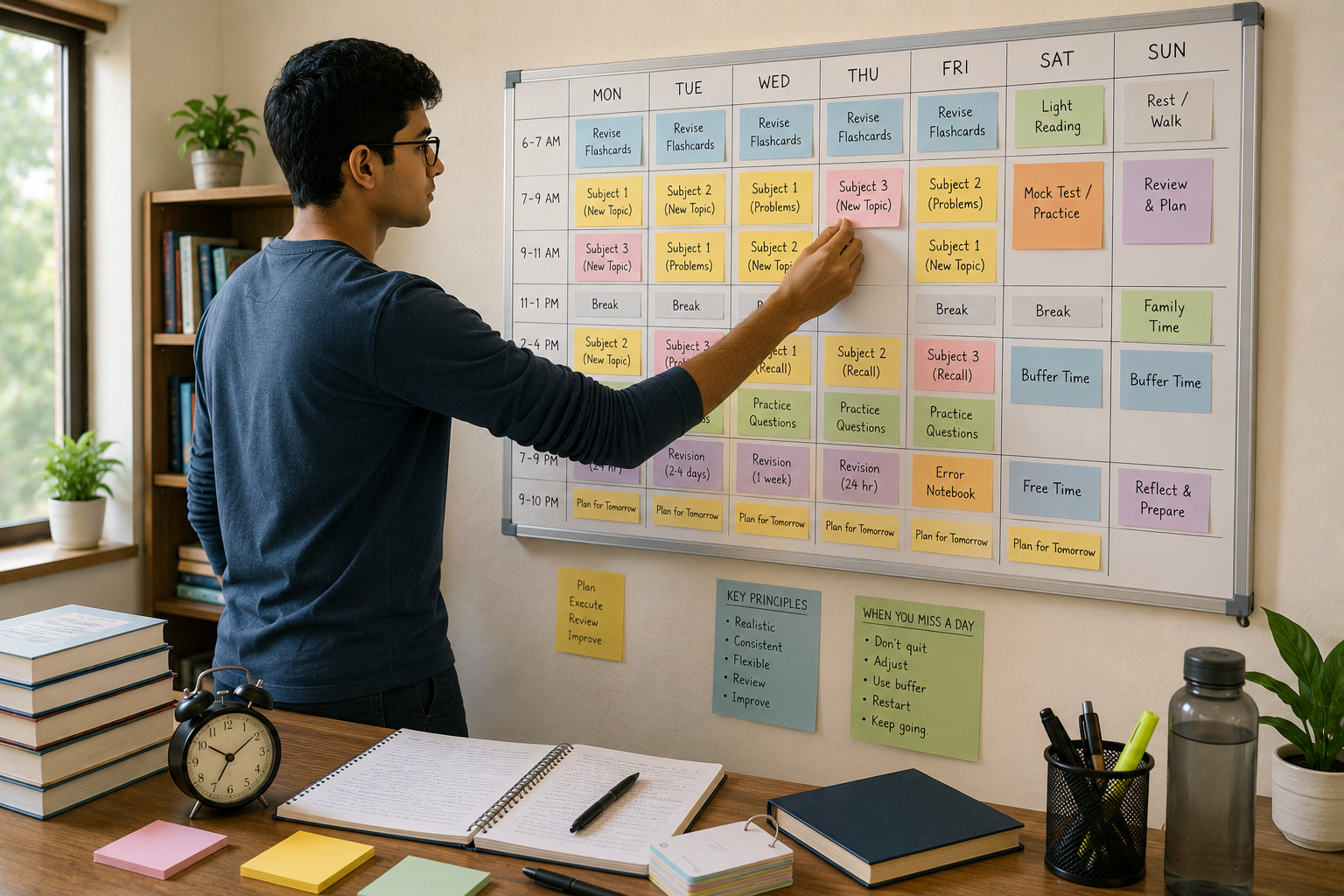
Most study schedules fail because they are written for an imaginary version of the student. The imaginary student wakes up early, never gets tired, never receives phone calls, never wastes time, understands every topic quickly and follows the timetable perfectly. The real student has classes, work, travel, family responsibilities, mood swings, distractions, weak subjects, unexpected delays and days when the mind simply does not cooperate. A schedule that ignores real life becomes decoration. It looks impressive on paper and collapses by Wednesday.
A study schedule that sticks is not the one with the most colourful boxes. It is the one that survives contact with reality. It should tell the student what to study, when to study, how deeply to study, when to revise, how to handle backlog and when to stop. It should reduce decision fatigue. It should make progress visible. Most importantly, it should be flexible enough to recover after failure. The aim is not to create a perfect timetable. The aim is to create a repeatable system.
Step One: Start With the Exam or Learning Goal
A schedule must begin with the destination. Are you preparing for a school exam, a college semester, a competitive exam, a professional certification, an interview, a skill course or a language test? Each goal demands a different rhythm. A board exam may require chapter coverage and writing practice. A competitive exam may require conceptual depth, revision cycles and mock tests. A skill course may require practice projects. A career exam may require current affairs, aptitude, domain knowledge and interview preparation.
Write the goal in concrete terms. Not “study more” but “complete the first revision of economics by 30 June.” Not “improve English” but “write three essays per week and review grammar errors every Sunday.” Not “prepare for interviews” but “practice ten HR answers, five technical explanations and two mock interviews this month.” A vague goal produces a vague schedule.
Once the goal is clear, list the subjects, units or skills required. Then mark their weight and difficulty. High-weight and high-difficulty topics deserve priority. Low-weight and easy topics can be scheduled later or revised in shorter blocks. This prevents the common mistake of spending too much time on comfortable subjects while avoiding the ones that matter.
Step Two: Audit Your Real Time
Before making a timetable, measure available time. Students often overestimate what they can do in a day. They forget travel, meals, chores, fatigue, phone use, classes, office work and sleep. A schedule built on fantasy time will fail even if motivation is high.
Make a seven-day time audit. Write fixed commitments first: school, college, job, coaching, commute, family duties and sleep. Then mark personal routines: meals, exercise, prayer, rest, calls and unavoidable errands. The remaining time is your study window. This may look smaller than expected, but that is useful. A realistic schedule beats an ambitious lie.
The audit should also identify energy levels. Some students focus best in the morning. Some study better at night. Some can solve mathematics after lunch; others become sleepy. Place difficult tasks in high-energy slots. Use low-energy slots for review, flashcards, light reading, note organisation or planning. A good schedule respects attention, not just the clock.
Step Three: Use Study Blocks, Not Endless Hours
A study schedule should be built in blocks. A block is a focused unit of time with one clear purpose. For example: “Polity: Fundamental Rights, Article 14 to 18, active recall and short notes, 7:00 to 8:30 p.m.” This is better than writing “Polity, 7 to 10.” The more specific the block, the easier it is to start and evaluate.
Most students should use blocks of 45 to 90 minutes for deep study. Shorter blocks can be useful for revision. Longer blocks can work for mock tests, writing practice or project work. Each block should include a task and an output. The task is what you do. The output is what proves the block worked. Reading a chapter is a task. Producing a one-page summary from memory is an output. Watching a lecture is a task. Solving ten questions is an output.
Output-based scheduling prevents fake productivity. A student who writes “study history for two hours” may spend half the time rereading. A student who writes “explain causes of the Revolt of 1857 without notes and answer five questions” knows exactly what success means.
Step Four: Build Revision Into the Schedule
Many timetables fail because they schedule only new learning. The student completes topics, feels progress and then forgets them. A schedule without revision is a leaking bucket. Every plan should include review slots from the beginning.
Use a simple revision rhythm: first review within twenty-four hours, second review after three to four days, third review after one week, and later reviews according to difficulty. The exact interval can change, but the principle matters. Old topics must return. If they do not return, they will fade.
Revision should not mean rereading everything. Use active recall, practice questions, blank-page summaries, flashcards, diagrams, formula sheets and error notebooks. The goal is to retrieve and repair. A thirty-minute recall session may be more valuable than two hours of passive reading.
Step Five: Keep Buffer Time
A schedule that fills every hour is fragile. One delay destroys the chain. Real life needs buffer. Keep at least one buffer block daily or several buffer blocks weekly. This time is not wasted. It is insurance. It absorbs spillover, unexpected work and weak topics.
Buffer time also reduces guilt. Without buffer, any missed task becomes backlog. With buffer, the student has a planned recovery space. This makes the schedule psychologically easier to maintain. The student does not need to abandon the entire timetable because one day went wrong.
A useful rule is to plan only 70 to 80 percent of available study time. Leave the rest for revision, backlog, rest or unexpected difficulty. Ambitious students may resist this because they want maximum output. But a plan that is slightly underloaded and consistently followed usually beats an overloaded plan that collapses.
Step Six: Design for Your Weakest Moment
Do not design the schedule for the day you feel motivated. Design it for the day you feel average. Motivation changes. A timetable should rely on structure more than emotion. This means making the starting point easy.
Use entry tasks. If a subject feels difficult, begin with ten minutes of review or two solved examples before entering the deeper block. Keep materials ready before the session. Decide the first task in advance. Remove the phone or use an app blocker if distraction is predictable. Study in the same place if possible. These small design choices reduce friction.
Also prepare a minimum version of the day. On a bad day, what is the smallest acceptable study output? It may be one recall session, ten questions or thirty minutes of reading. This prevents all-or-nothing failure. A reduced day keeps the chain alive. The next day can return to full intensity.
Step Seven: Use Weekly Reviews
A study schedule should be reviewed weekly. Without review, the plan becomes outdated. Every Sunday or any fixed day, ask five questions. What was completed? What was missed? Which topics took longer than expected? Which method worked? What needs to change next week?
This review should be honest but not emotional. The purpose is not self-blame. It is system correction. If mathematics always takes twice the planned time, the schedule must change. If late-night study keeps failing, move difficult work earlier. If phone distraction destroys evening blocks, change the environment. A schedule is a living document.
Weekly review also gives a sense of progress. Students often feel they are not moving because the syllabus is large. A review shows completed chapters, solved questions, revised topics and improved weak areas. Visible progress protects motivation.
Sample Schedule Structure
A full-time student might use the morning for the hardest subject, late morning for the second subject, afternoon for practice questions, evening for revision and night for light review. A working professional might use early morning for deep study, commute time for audio revision, evening for practice and weekend for long sessions. A school student might use weekdays for homework and concept review, then weekends for tests and revision.
The exact timetable depends on life. The structure should include five elements: deep learning, active recall, practice, revision and rest. For example, a weekday evening plan could be: 7:00 to 8:15, new topic; 8:15 to 8:30, break; 8:30 to 9:15, practice questions; 9:15 to 9:30, error notes; 9:30 to 9:45, plan tomorrow. This is more effective than a vague three-hour block.
For competitive exams, the weekly plan should mix static subjects, current affairs, answer writing or mock tests. For skill learning, it should mix concept study, project work and feedback. For language learning, it should mix reading, speaking, vocabulary recall and writing. The schedule must serve the goal.
Common Mistakes to Avoid
The first mistake is copying someone else’s timetable. A topper’s schedule may inspire you, but it was built for their life, energy and preparation stage. Use principles, not imitation.
The second mistake is planning too much new material. New topics feel productive, but exams reward retention. Include revision from day one.
The third mistake is ignoring sleep and health. A tired learner becomes slower. A schedule that destroys the body will eventually destroy consistency.
The fourth mistake is changing the plan every day. Adjustment is good; constant redesign is avoidance. Follow one weekly plan, review it, then improve it.
The fifth mistake is measuring only hours. Hours matter, but outputs matter more. Track chapters revised, questions solved, answers written, mistakes corrected and concepts explained.
Final Checklist
Define the goal clearly. List subjects and topics. Rank them by importance and difficulty. Audit real available time. Place difficult work in high-energy slots. Use focused blocks with specific outputs. Add revision cycles. Keep buffer time. Protect sleep. Review weekly. Build a minimum plan for bad days. Track outputs, not just hours.
Final Takeaway
A study schedule that sticks is realistic, flexible and evidence-based. It does not demand perfection. It creates direction. It reduces daily confusion and turns preparation into a series of manageable decisions. The best schedule is not the most intense one. It is the one you can return to after interruption, boredom, failure and fatigue.
When the schedule reflects real life, study becomes less dependent on mood. The student no longer asks every day, “What should I do now?” The plan answers. And when the plan is followed, reviewed and improved, consistency becomes less like discipline forced from outside and more like a system quietly carrying the learner forward.
How to Recover After Breaking the Schedule
A schedule becomes useful only when it includes recovery. Many students miss one day and then abandon the plan completely. This is unnecessary. The correct response is to restart from the next available block, not to rewrite life from zero. Keep a backlog list, but do not let it become a punishment list. Move only the most important missed tasks into buffer time. Delete or postpone low-value tasks.
Use the two-day rule: try not to miss the same core habit two days in a row. If Monday collapses, Tuesday should include at least the minimum version of study. This protects identity. The student still sees themselves as someone who returns. Long-term consistency is not built by never falling; it is built by making return easier than giving up.
Tools That Can Help
A schedule can be made on paper, a wall calendar, a spreadsheet, Google Calendar, Notion, a planner app or a simple notebook. The tool matters less than the review habit. Use digital calendars for fixed time blocks, paper planners for daily focus and spreadsheets for long syllabus tracking. For revision, use spaced repetition apps, flashcards or a manual review table. For distraction control, use website blockers or keep the phone outside the room.
Do not spend more time decorating the system than using it. A plain timetable followed for four weeks is more valuable than a beautiful dashboard abandoned after two days. The best tool is the one that makes the next action obvious.