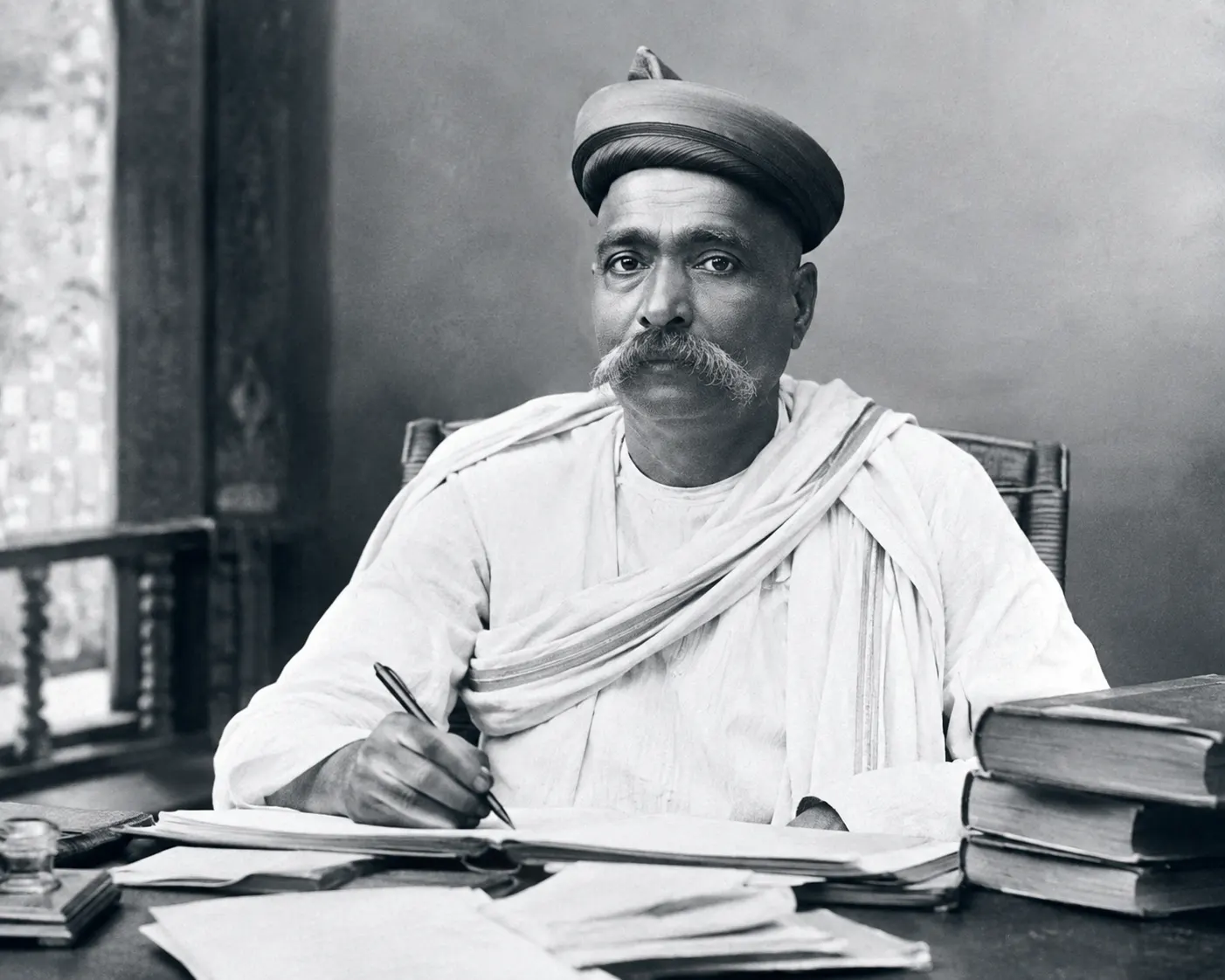
Bal Gangadhar Tilak is remembered through one sentence more than any other: the declaration that swaraj was his birthright and that he would have it.
The phrase captures the political force of his public life. It also risks turning a complicated thinker into a slogan.
Tilak was a teacher, journalist, Sanskrit scholar, political organiser and defendant in some of the most consequential sedition cases of British India. He helped make nationalist politics more confrontational and more public. He used newspapers, festivals, courtrooms, associations and political tours to expand the audience for self-government.
At the same time, he frequently disagreed with social reformers who wanted the colonial state to legislate changes inside Hindu society. His opposition to the Age of Consent legislation and his wider social conservatism have made him a contested figure in histories of gender and reform.
Tilak therefore embodies one of the defining tensions of early Indian nationalism: could political freedom be pursued independently of social reform, or were the two inseparable?
Education before agitation
Tilak was born on 23 July 1856 in Ratnagiri in the Bombay Presidency. His family later moved to Pune. He studied mathematics and law, acquiring the formal education that placed him within the emerging English-educated Indian middle class.
But Tilak quickly became dissatisfied with education designed primarily to produce clerks and professionals for the colonial system.
Along with colleagues including Gopal Ganesh Agarkar and Vishnushastri Chiplunkar, he helped establish the New English School in Pune in 1880. The group later helped create the Deccan Education Society, and Fergusson College was established in 1885.
Fergusson College’s institutional history remembers Tilak among the founders associated with the educational movement.
The project was nationalist before Tilak became a full-time political agitator. Education, in this vision, would produce Indians capable of intellectual independence and civic leadership rather than merely success within colonial bureaucracy.
The journalist as political organiser
Tilak’s most effective early political instruments were newspapers.
He became associated with Kesari in Marathi and The Mahratta in English. The choice of languages mattered.
English could address administrators and educated elites. Marathi could reach a wider regional public and help create a more direct political relationship with readers.
Tilak’s journalism was argumentative, combative and often personal. He did not treat newspapers as neutral observers of politics. They were instruments of mobilisation.
This style helped expand nationalist communication beyond annual Congress sessions and formal petitions.
It also repeatedly brought him into conflict with colonial law.
Politics enters public culture
Tilak is closely associated with the public celebration of Ganapati and with Shivaji festivals in Maharashtra.
Popular nationalist narratives sometimes say he “created” these festivals. That is imprecise. Ganesh worship obviously long predated Tilak, and public religious culture had many precedents.
His political innovation was to support and popularise forms of public celebration that could assemble communities, generate speeches, create associational networks and bring nationalist ideas into spaces outside elite political meetings.
The Shivaji festival similarly used memory of the seventeenth-century Maratha ruler as a language of public identity.
This strategy was effective because culture could perform political work where direct political organisation faced restrictions.
But it also introduced a lasting ambiguity.
When nationalism mobilises through symbols drawn from a majority religious tradition, does it create broad collective identity or narrow the terms on which minorities belong?
Historians continue to debate how Tilak’s use of Hindu symbols should be situated within the later history of Hindu nationalism. It is safest to avoid reading twentieth- and twenty-first-century political categories backward in a simplistic way while still recognising that his political symbolism had communal implications.
Plague, violence and the first sedition prosecution
The late 1890s brought famine, plague and intense conflict in western India.
British plague measures in Pune involved intrusive interventions in homes and communities. Resentment grew. In 1897, W. C. Rand, the plague commissioner, was assassinated by the Chapekar brothers.
Tilak did not carry out the assassination. The colonial government nevertheless treated writings in Kesari as politically inflammatory and prosecuted him for sedition.
The case became a landmark in the history of Section 124A of the Indian Penal Code.
Tilak was convicted and sentenced to imprisonment.
The importance of the trial extended far beyond one defendant. It showed how the colonial state interpreted “disaffection” broadly enough to criminalise forceful political criticism even where direct incitement to a particular violent act was disputed.
Tilak’s trials later became reference points in arguments over free political speech in India.
Congress and the split over method
The Indian National Congress of the late nineteenth century was dominated by leaders who hoped to secure political reform through petitions, legislative advocacy, public reason and gradual constitutional change.
Tilak regarded that approach as inadequate.
The disagreement was not simply between people who wanted freedom and people who did not. Both Tilak and leaders such as Gopal Krishna Gokhale sought greater Indian political power.
Their dispute concerned political method, pace and the relationship between public mobilisation and constitutional negotiation.
Tilak supported boycott, swadeshi and more assertive agitation. The partition of Bengal in 1905 intensified these debates.
By the Surat session of the Congress in 1907, conflict between the so-called Moderates and Extremists produced an organisational split.
The labels are crude but historically influential.
Gokhale represented disciplined constitutional reform; Tilak represented a politics willing to use broader agitation and confrontation.
Their rivalry shaped a generation of nationalism before Gandhi reorganised the political field.
Social reform: the harder side of Tilak’s legacy
Tilak’s political radicalism did not always translate into social radicalism.
He opposed the Age of Consent Bill that became law in 1891, which raised the age below which sexual intercourse with a wife constituted rape under colonial criminal law.
Tilak’s objection was partly political. He argued that a foreign government should not legislate Hindu social custom from above and that reform should arise within society.
But the practical effect of this position placed him against reformers campaigning for legal protection of girls.
This controversy is essential to understanding Tilak.
A leader can be radical on sovereignty and conservative on family or gender. Political nationalism does not automatically produce social equality.
Tilak’s position also reveals the strategic problem colonialism created for Indian reformers. British officials could portray intervention in Indian society as a civilising mission, while Indians who opposed colonial rule could treat even humanitarian legislation as illegitimate interference.
The result was a conflict in which the question “Who has the right to reform society?” could overshadow “What reform is just?”
The 1908 sedition case and Mandalay
Tilak faced sedition charges again in 1908 after articles published amid a period of revolutionary violence.
The Bombay trial ended in conviction and a sentence of transportation. He was sent to Mandalay in Burma, where he spent roughly six years before his release in 1914.
Bombay High Court’s historical archive preserves materials relating to Tilak’s legal cases, including later proceedings over his Home Rule speeches.
The Mandalay imprisonment became central to his nationalist image.
It also became a period of intellectual work.
Tilak wrote his major philosophical interpretation of the Bhagavad Gita, generally known as Gita Rahasya.
Gita Rahasya: action rather than withdrawal
Tilak’s reading of the Bhagavad Gita emphasised karma-yoga—disciplined action—over interpretations that placed primary emphasis on renunciation.
This philosophical argument was also politically suggestive.
If moral life required performance of duty in the world, then public action could become a spiritual obligation rather than a distraction from spirituality.
Tilak did not write Gita Rahasya merely as a nationalist pamphlet. It was a serious engagement with Sanskritic philosophical traditions.
But its political resonance is difficult to miss.
In a colonial setting, a philosophy of action could legitimate civic struggle.
This relationship between scripture and politics distinguishes Tilak from secular nationalist thinkers who sought to keep religious texts outside political argument.
Return from Mandalay
Tilak returned to India in 1914 to a political environment that had changed significantly.
The First World War transformed imperial politics. The Congress split required repair. Annie Besant’s activism was creating new organisational possibilities. A younger generation was impatient with slow constitutional progress.
Tilak now pursued a more flexible strategy than the caricature of permanent extremism suggests.
He worked toward reunification within the Congress and became a major force in the Home Rule movement.
Home Rule
In 1916, Tilak developed a Home Rule League operating particularly in parts of western and central India, while Annie Besant organised a parallel league with a broader regional reach.
Home Rule did not yet mean immediate complete independence in the later sense of purna swaraj. It demanded substantial self-government within the imperial framework.
Tilak toured, lectured and organised extensively.
His collected writings and speeches show how insistently he turned self-government into a public political demand.
The significance of the Home Rule campaign was organisational as much as ideological.
It created political networks, expanded discussion beyond annual Congress gatherings and trained activists in sustained campaigning.
This was one of the bridges between pre-war nationalism and the mass politics of the Gandhian era.
The 1916 sedition proceedings and the meaning of Swaraj
Tilak’s Home Rule speeches again attracted colonial scrutiny.
The government initiated proceedings under laws dealing with seditious speech. This time, the Bombay High Court ultimately ruled in a way that recognised the importance of reading speeches as a whole and distinguished advocacy of Home Rule from sedition.
The Bombay High Court’s archival presentation of Tilak-related cases is especially valuable because it shows how the meaning of political speech was being fought over inside colonial law.
The legal conflict illustrates a broader shift.
By the 1910s, demanding self-government was becoming increasingly difficult to treat as inherently criminal without exposing the authoritarian character of imperial rule.
What did Tilak mean by Swaraj?
The word swaraj became the organising concept of Tilak’s later politics, but its meaning changed with context. It could refer to self-government, political autonomy, control over administration and, more broadly, the moral claim that a people should not be permanently governed without their consent.
This elasticity helped make the word powerful. A constitutional reformer could hear in swaraj a demand for responsible government; a more radical nationalist could hear a claim to political independence. Tilak could therefore push public expectations forward without always committing himself to one fixed institutional blueprint.
His Home Rule speeches are particularly revealing. They framed self-government not as a reward to be granted after Indians satisfied an imperial test of political maturity, but as a right whose exercise would itself develop political capacity. This reversed a common colonial argument. British officials frequently suggested India required more preparation before receiving substantial self-rule. Tilak answered, in effect, that a people learn government by governing.
That disagreement remains central to the history of decolonisation. Empire often justified postponement through claims of tutelage. Anti-colonial leaders had to challenge not only foreign control but also the assumption that the ruler alone could decide when the ruled were ready to be free.
Tilak, Lucknow and political coalition
The year 1916 also saw the Lucknow session of the Congress, which brought major factions of the nationalist movement back together and coincided with the Congress-League agreement commonly known as the Lucknow Pact.
Tilak’s return to Congress politics helped end the isolation created by the Surat split.
This period complicates attempts to present him as incapable of political compromise.
He could be tactically flexible when he believed compromise advanced self-government.
Gandhi and the transition to a new era
Mahatma Gandhi’s emergence after 1915 gradually transformed Indian nationalism.
Gandhi inherited a political landscape already changed by Tilak and Gokhale.
From Tilak came proof that nationalist politics could mobilise a public far beyond elite petitioning.
From Gokhale came the discipline of policy analysis, constitutional argument and political training.
Gandhi developed something different from either.
Tilak did not live long enough to see the full consequences. He died in Bombay on 1 August 1920, just as the Non-Cooperation movement was about to transform Congress politics.
His funeral drew enormous public attention and confirmed the scale of his popular reputation.
Was Tilak the “father of Indian unrest”?
The famous phrase is associated with British journalist Valentine Chirol, who described Tilak as the “father of Indian unrest.”
Tilak later pursued a libel action in Britain over Chirol’s allegations.
The phrase survived because it unintentionally captured what admirers valued: Tilak made political quiet more difficult.
Yet it is analytically limited.
Indian “unrest” had structural causes—economic grievances, racial discrimination, political exclusion and colonial coercion. No single journalist or agitator manufactured them.
Tilak’s importance lay in giving existing dissatisfaction a political language and organisational form.
A divided legacy
Tilak remains difficult to categorise because the parts of his legacy pull in different directions.
He helped democratise nationalist politics while drawing heavily on Hindu cultural symbolism.
He defended political liberty while opposing some state-led social reforms.
He was prosecuted under sedition law and became a symbol of free political expression, yet his own social vision was not consistently liberal in the modern sense.
He criticised constitutional gradualism but later worked through legal and organisational mechanisms when useful.
These are not contradictions to be erased. They are the substance of the biography.
Why Bal Gangadhar Tilak still matters
Tilak’s enduring importance lies less in one slogan than in the political technologies he helped normalise.
A newspaper could become an organising institution.
A cultural festival could become a political gathering.
A courtroom could become a theatre of colonial legitimacy.
A religious text could be interpreted as a philosophy of civic action.
A demand for self-government could be repeated until it moved from radical speech toward mainstream politics.
Modern India remembers Tilak as Lokmanya—one accepted by the people.
A serious history should neither discard that popular memory nor let it end the inquiry.
His life is most valuable when it forces us to examine a question that still matters: what happens when the struggle for national freedom advances faster than the struggle to reform society within the nation?
Tilak never resolved that tension. His political power came partly from inhabiting it.