Periyar E. V. Ramasamy: Self-Respect, Caste and the Dravidian Movement
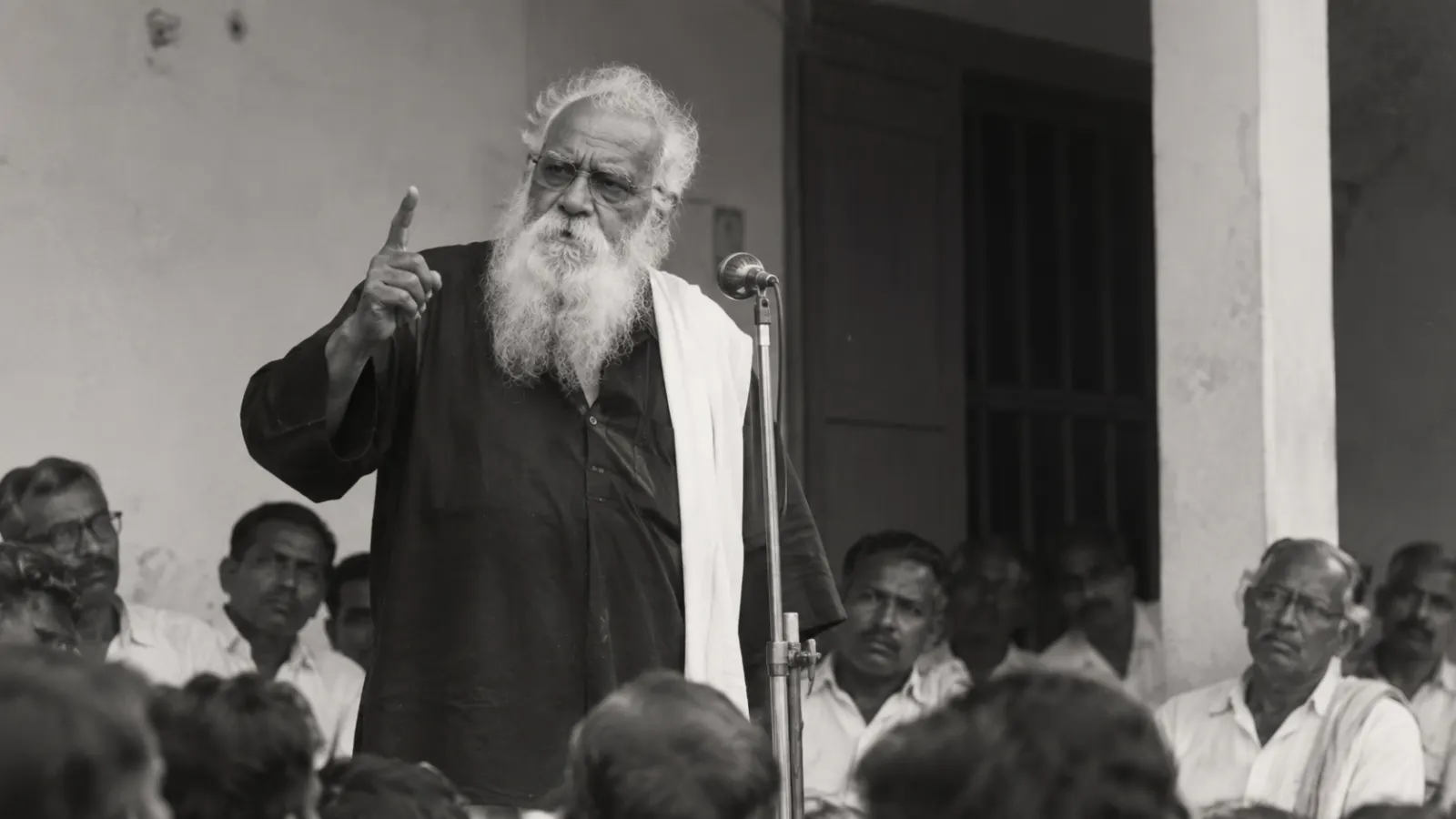
E. V. Ramasamy, widely known as Periyar, became one of the most consequential and controversial social reformers in twentieth-century India because he refused to treat caste hierarchy as a problem that political independence would automatically solve. Across more than five decades of public activity, he attacked hereditary status, untouchability, priestly authority, patriarchy and religious ideas that he believed legitimised inequality. He moved through the Indian National Congress, the Self-Respect Movement, the Justice Party and Dravidar Kazhagam, but remained primarily a movement leader rather than a politician seeking elected office. His influence extended into debates over caste representation, women's rights, language, marriage, rationalism, federalism and the political culture that later developed in Tamil Nadu.
That influence remains contested. Supporters have emphasised his role in making social equality and dignity central to public politics, while critics have challenged his attacks on religion, his sweeping rhetoric about Brahmins and Brahminism, and some of the political categories through which he described Aryan and Dravidian identities. The original draft correctly identifies this tension as essential to understanding him: Periyar's historical significance cannot be reduced either to admiration or rejection. A useful account instead asks what social structures he challenged, what methods he used, what changed as a result, and where his own political framework had limits.
From Erode to Congress and the Vaikom Satyagraha
Periyar was born on 17 September 1879 in Erode, then part of the Madras Presidency, into a prosperous trading family. Before becoming a full-time political organiser, he worked in the family business and participated in municipal and civic affairs. Unlike many nationally prominent political figures of his generation, his public formation did not principally come through an elite university education. Commerce, local administration, travel, religious encounters and direct observation of caste relations shaped his political development.
He entered Congress politics during the era of Gandhian mass mobilisation and participated in campaigns associated with non-cooperation, khadi and prohibition. His differences with the Congress increasingly centred on caste and political representation. Periyar argued that formal political equality could coexist with entrenched caste privilege if access to education, public employment and political institutions remained uneven. Recent scholarship places his dissatisfaction with Congress responses to non-Brahmin representation, the Cheranmadevi Gurukulam controversy and the experience of Vaikom among the important developments preceding his eventual break with the party in late 1925.
The Vaikom Satyagraha of 1924–25 became particularly important in his public career. The agitation challenged caste restrictions that prevented subordinated communities from using roads surrounding the Vaikom Mahadeva Temple in Travancore. Periyar arrived at Vaikom in April 1924, participated actively in the campaign and was imprisoned. Kerala government material and recent scholarship describe him as an important figure in the struggle, while also making clear that Vaikom was a broad collective mobilisation involving local leaders and organisations, including T. K. Madhavan, K. P. Kesava Menon, K. Kelappan and others.
That distinction matters because later political memory sometimes turns collective movements into biographies of a single leader. Periyar's role at Vaikom was substantial, but the campaign preceded his arrival and depended on a wider network of activists. Its importance for his own political development lies partly in how forcefully it demonstrated that caste was maintained not only through private prejudice but through control over public space, religious authority and everyday rights.
The Self-Respect Movement and a different idea of freedom
Periyar left the Congress in late 1925 after repeated conflicts over proportional representation and caste inequality, and the Self-Respect Movement emerged as the principal vehicle for his politics. A recent Cambridge account summarises three central goals of the movement as equality, the annihilation of caste and the liberation of women. Periyar used his weekly newspaper Kudi Arasu, public conferences and an expanding organisational network to carry those ideas beyond elite political institutions.
The term self-respect expressed a political claim as much as a personal one. Human dignity, in this framework, should not depend on birth, caste status, priestly approval or ritual rank. The movement challenged caste names, untouchability, hereditary hierarchy and the authority claimed for religious texts and intermediaries. It also attempted to reshape everyday institutions—particularly marriage and family life—where caste and gender were reproduced from one generation to the next.
Print was crucial to that project. Newspapers and pamphlets circulated speeches, arguments about caste and gender, reports from conferences and attacks on established religious and social authority. The direct and deliberately irreverent style associated with Periyar was not incidental. It was a political method intended to strip institutions of the reverence that, in his view, protected them from scrutiny.
The movement also developed through local organisers rather than Periyar alone. Activists conducted meetings, circulated publications, organised marriages and participated in anti-caste and language campaigns. Women including Nagammai, Periyar's first wife, took part in movement activity, while later Maniammai became an important organisational figure. Treating the Self-Respect Movement merely as an extension of one individual's personality therefore understates the infrastructure that allowed its ideas to spread.
Women, marriage and freedom inside the family
Gender was not a secondary issue in Periyar's politics. Scholarship on his writings shows that he treated women's freedom as central to his broader conception of liberty, challenging not only legal inequality but also marriage, chastity, compulsory motherhood, economic dependence and the social regulation of female sexuality.
At the Self-Respect conference in Chengalpattu in 1929, resolutions included demands concerning women's property rights, widow remarriage, opposition to child marriage, freedom in choosing spouses and greater access to education and occupations. Periyar argued that social reform would remain incomplete if women were economically dependent and family institutions continued to reproduce male authority. His writings went considerably further than conventional arguments for female education: he questioned whether marriage should be treated as sacred, argued for the ability to leave incompatible relationships and linked reproductive autonomy to women's freedom.
Self-Respect marriages gave these arguments an institutional form. Such ceremonies rejected the necessity of Brahmin priests and conventional Sanskritic rituals and instead emphasised consent between the partners. Their significance was not merely ceremonial. By questioning priestly authority and the sacramental character of marriage, the movement also challenged the mechanisms through which caste boundaries and patriarchal authority were maintained.
The practice eventually received statutory recognition in Tamil Nadu. Section 7-A of the Hindu Marriage Act, as applicable in the state, recognised Self-Respect and reformist marriages in 1967; subsequent court decisions have affirmed that these marriages do not require the conventional religious rites demanded under other forms of Hindu marriage.
Periyar's views should not simply be projected onto twenty-first-century feminism. His language emerged from a different intellectual and political setting, and scholars have examined tensions and limitations within both his ideas and the movement that followed him. But the historical record makes clear that women's emancipation was unusually central to his conception of self-respect. The original draft's emphasis on economic independence, marriage and control over women's lives reflects a substantial body of scholarship rather than a later attempt to add gender to his politics.
Rationalism, religion and the politics of provocation
Periyar's rationalism distinguished him from reformers who sought primarily to reinterpret religious tradition. He frequently challenged the authority of gods, scriptures, epics, priesthood and ritual itself when he believed they provided ideological support for caste or gender hierarchy. His atheism therefore operated politically as well as philosophically: denying divine sanction was a way of denying that inherited inequality was natural or sacred.
His methods were intentionally confrontational. He used satire, provocative speeches, iconoclastic demonstrations and attacks on revered religious narratives. For supporters, this language broke taboos that had shielded caste hierarchy from criticism. For many religious believers and political critics, the same rhetoric was insulting, unnecessarily antagonistic or directed too broadly at communities rather than institutions.
The distinction between Brahmins and Brahminism is especially important but not always easy to preserve in Periyar's polemical language. Much of his political argument was aimed at what he described as Brahminism: a system of ritual hierarchy and social authority. Yet particular speeches and formulations could generalise about Brahmins collectively. A historical account should therefore avoid both sanitising his rhetoric and treating every polemical statement as a complete description of his political theory.
The problem is intensified by quotation culture. Periyar spoke and wrote across decades, often using exaggeration and confrontation as political techniques. Statements circulating today are frequently detached from date, venue and surrounding argument, sometimes passing through translations before reaching contemporary debate. Evaluating his ideas therefore requires attention to complete texts and historical context rather than isolated quotations. The draft itself correctly identifies this methodological problem.
Justice Party, Dravidar Kazhagam and the anti-Hindi movement
By the late 1930s, the Self-Respect Movement became increasingly intertwined with the Justice Party, the major political organisation of the earlier non-Brahmin movement in the Madras Presidency. Periyar assumed leadership of the Justice Party, and in 1944 it was reorganised as Dravidar Kazhagam, or DK. Academic accounts describe this transition as a movement away from the Justice Party's earlier electoral form toward Periyar's model of extra-parliamentary social mobilisation.
Language politics helped turn that mobilisation into a mass movement. During the late 1930s, Periyar and his associates opposed the introduction of compulsory Hindi in schools under the Congress government of the Madras Presidency. The campaign connected language to broader concerns about education, employment, political power and the relationship between southern India and the emerging national state. Recent scholarship describes the 1938–39 anti-Hindi agitation as an important moment in the consolidation of the Dravidian movement and Tamil political assertion.
Periyar's opposition to Hindi did not mean that he treated Tamil tradition as beyond criticism. He could invoke Tamil or Dravidian identity against perceived northern domination while simultaneously attacking Tamil literature, religious traditions and customs that he regarded as irrational or hierarchical. His politics therefore differed from a straightforward cultural nationalism built around glorification of an ancient past.
His use of Aryan and Dravidian also requires historical care. The categories had intellectual histories predating Periyar and were shaped by nineteenth-century linguistic scholarship and later cultural and political arguments. Periyar deployed them as categories of power, domination and resistance, but modern scholarship does not treat a simple Aryan-versus-Dravidian racial binary as established biological fact. The distinction is important because explaining the political vocabulary of the period is different from endorsing its racial assumptions.
Dravida Nadu, nationalism and the split with Annadurai
Periyar's disagreements with mainstream Indian nationalism intensified as independence approached. He argued at different stages for a separate Dravidian political unit, generally described as Dravida Nadu, and portrayed centralisation, Hindi promotion and caste hierarchy as connected forms of domination. The demand was advanced particularly by Dravidar Kazhagam in the 1940s, although its geographical meaning and political feasibility changed over time.
The proposal placed Periyar outside the dominant nationalist consensus. For him, the transfer of power from Britain to an Indian government did not settle the prior question of who would exercise social and political authority inside that nation. Critics regarded separatism as divisive, while supporters understood the demand through the politics of regional autonomy and opposition to perceived northern and upper-caste dominance. The later Dravidian electoral parties abandoned the secessionist demand and increasingly pursued state autonomy within the Indian constitutional system.
A decisive organisational change occurred in 1949 when C. N. Annadurai and his supporters broke from Dravidar Kazhagam and established the Dravida Munnetra Kazhagam, or DMK. Periyar's marriage to Maniammai, who was substantially younger than him, became an immediate source of controversy, but historians also identify a deeper strategic conflict over political succession and electoral participation. Periyar remained sceptical that pursuing office would preserve the radical objectives of social reform, while Annadurai and his associates saw elections and popular mass communication as routes to political power.
The distinction matters because DK and the later electoral Dravidian parties were not interchangeable. The DMK eventually defeated Congress in Tamil Nadu in 1967, but it modified important aspects of Periyar's programme and operated within parliamentary institutions he had viewed with suspicion. Contemporary scholarship cautions against retrospectively collapsing Periyar's movement and its electoral successors into a single unified politics.
Periyar, Gandhi and Ambedkar: different approaches to caste
Placing Periyar alongside Gandhi and B. R. Ambedkar helps clarify the distinctive features of his politics, but the three should not be turned into a simplistic hierarchy. All confronted caste, yet they differed substantially over religion, political representation, social reform and the institutions through which change should occur.
Periyar had worked inside the Gandhian Congress movement and participated in Vaikom, but increasingly rejected attempts to preserve or reinterpret inherited systems such as varna. He came to believe that caste could not be dismantled while the religious and social authority supporting it remained intact. Gandhi's approaches to religious reform and national mobilisation therefore diverged sharply from Periyar's increasingly iconoclastic rationalism.
Periyar and Ambedkar shared stronger points of convergence in treating caste as a structural political problem, defending representation for subordinated communities and criticising inherited religious authority. Their politics nevertheless remained distinct. Ambedkar developed an extensive programme of constitutional and legal intervention, participated directly in state institutions and eventually embraced Buddhism. Periyar remained committed to a movement based on rationalism, Self-Respect politics and Dravidian mobilisation, with deep suspicion of conventional electoral office.
Their relationship also included specific political intersections. Recent scholarship on Periyar and the Poona Pact examines the Self-Respect Movement's response to Ambedkar's struggle over political representation for the Depressed Classes, demonstrating that the connection was more substantive than retrospective comparisons alone suggest. At the same time, Dalit political traditions developed their own analyses of caste that cannot simply be subsumed within Dravidian politics.
Caste, class and the material meaning of self-respect
Periyar is frequently remembered through symbolic controversies over gods, language and ritual, but his critique also concerned access to material resources. Education, government employment, representation, property and occupational mobility were central to the politics of the non-Brahmin and Self-Respect movements. Scholarship on Tamil Nadu's later political development traces a broader connection between demands for self-respect and social justice and attempts to expand equality of opportunity beyond caste-based divisions of labour.
This helps explain why the question of representation mattered so much to Periyar. If particular communities had disproportionately little access to administrative posts, higher education or political institutions, formal equality alone would not correct the imbalance. His defence of proportional representation and later reservations emerged from this structural interpretation of caste.
His engagement with socialist ideas added an economic dimension to this politics, although he never produced a single comprehensive economic programme comparable to that of a disciplined socialist party. He criticised concentrations of wealth and linked social dignity to economic independence, particularly in relation to women. Yet his distinctive argument was that economic redistribution by itself would not necessarily eliminate caste because caste also governed marriage, status, ritual relations and social reproduction.
That position made caste more than an adjunct to class politics. For Periyar, hierarchy operated simultaneously through culture, material resources and intimate social relations. It was one reason his movement directed attention not only toward government policy but also toward marriage ceremonies, family authority, language and everyday practices.
A legacy that remains politically contested
Periyar died on 24 December 1973, nearly half a century after establishing the Self-Respect Movement. By then the political landscape around him had changed dramatically: Congress dominance in Tamil Nadu had ended, the DMK had governed the state, Self-Respect marriage had received legal recognition and the language of social justice had become deeply embedded in Tamil politics. Government of India material identifies him as a major social reformer and rationalist associated with equality, Self-Respect, Vaikom and the transformation of the Justice Party into Dravidar Kazhagam.
His impact, however, cannot be measured simply by attributing every later Tamil Nadu policy to him. Reservations predated and exceeded his personal political activity; anti-caste traditions had multiple intellectual lineages; Dalit movements followed independent trajectories; and electoral Dravidian parties changed many parts of his programme. The political order that developed after the 1960s was influenced by Periyar but was not a direct implementation of a single Periyarist blueprint.
His own positions also resist easy canonisation. His critiques of caste and patriarchy could be radical, while his polemical generalisations and attacks on religious traditions remain deeply contested. His language of Dravidian identity opened a powerful challenge to hierarchy but also relied at times on categories that require qualification in light of later historical and linguistic scholarship. His hostility to electoral politics differed sharply from the political strategy eventually adopted by the parties that claimed part of his legacy.
That complexity is precisely why Periyar remains historically significant. Recent scholarship continues to examine his ideas across caste, gender, religion, nationalism, regionalism and social justice rather than treating him only as a symbol in contemporary political disputes.
The most useful historical question is therefore not whether Periyar should be remembered simply as a hero or a villain. It is how his insistence on self-respect altered the terms of political debate. He argued that independence without social equality could leave inherited domination intact; that democracy had to address the power exercised through caste and family as well as elections; and that customs claiming sacred authority could still be subjected to criticism.
His methods produced both lasting reform movements and lasting controversy. The same confrontational politics that enabled him to force caste, gender and religious authority into public debate also generated rhetoric that opponents experienced as hostile or reductive. Reading both sides of that history is more informative than removing either one.
Periyar's legacy is therefore best understood not as a settled doctrine but as an enduring argument about the meaning of social freedom: whether dignity can coexist with inherited hierarchy, how far political equality can reach without social transformation, and what methods are legitimate when challenging institutions protected by tradition. Those questions outlived both Periyar and the organisations he led, which is one reason debates about him remain active more than half a century after his death.