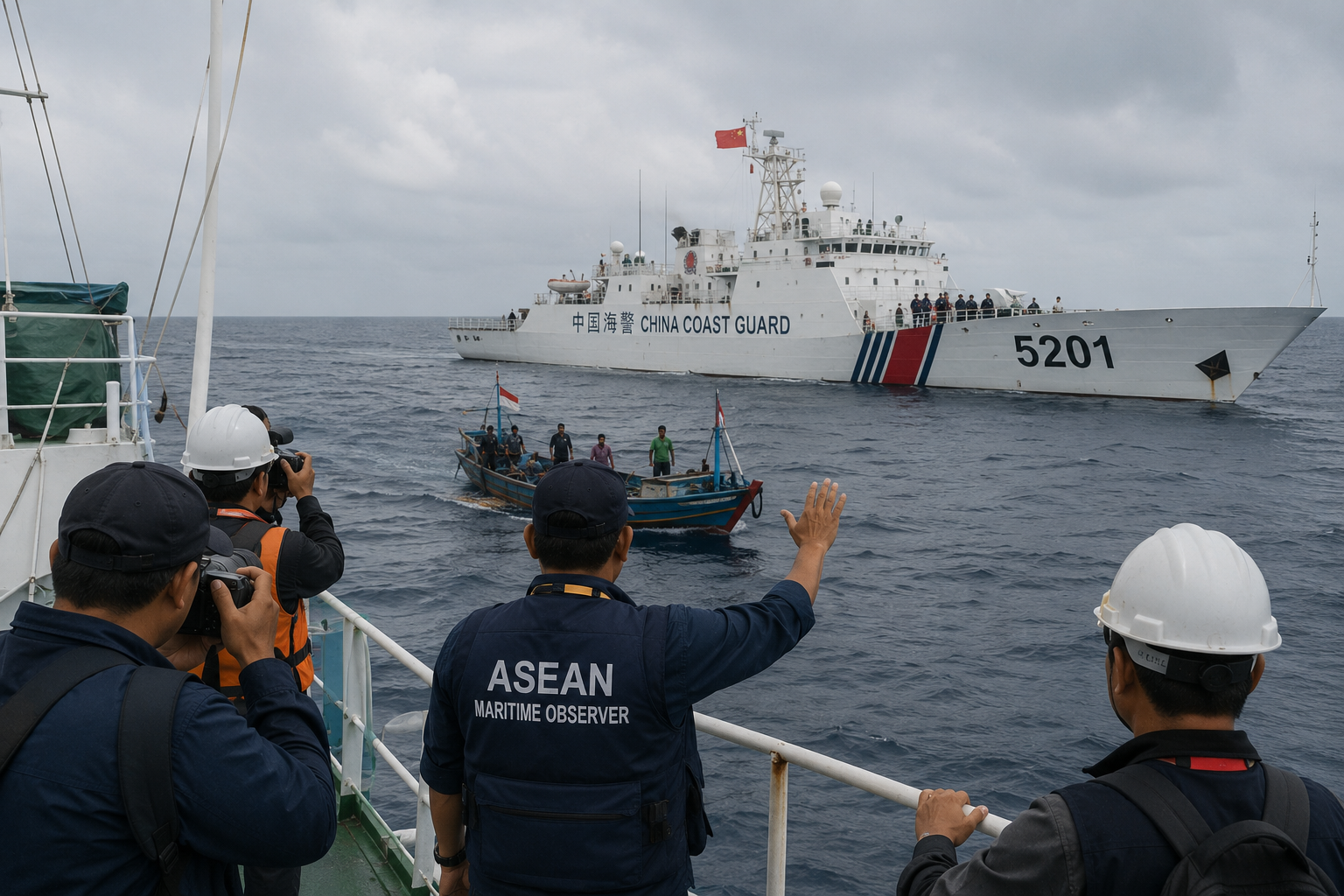
ASEAN centrality is one of the most repeated phrases in Indo-Pacific diplomacy, but repetition is not the same as security. Southeast Asia sits at the crossroads of trade, technology, energy, maritime routes and great-power rivalry. Every major power says it supports ASEAN centrality. The harder question is whether their behaviour actually leaves ASEAN at the centre.
China's rise has made this question urgent. Beijing is Southeast Asia's largest economic partner, a major infrastructure financier and an unavoidable strategic neighbour. It is also a claimant and military actor in the South China Sea, where several ASEAN members have direct disputes with China. This duality makes ASEAN's position difficult: it must engage China, benefit from China and manage China at the same time.
ASEAN centrality is being tested not because ASEAN is irrelevant, but because the pressures around it have become stronger than its internal consensus. A central institution can still be constrained if its members disagree, if external powers bypass it, or if economic dependence weakens strategic autonomy.
Why the Issue Matters Now
The Indo-Pacific is no longer a distant strategic concept. It is the arena in which the United States, China, India, Japan, Australia, the EU and others are designing policies on supply chains, maritime security, digital standards, infrastructure and defence partnerships. Southeast Asia lies at the centre of this geography.
ASEAN's own Outlook on the Indo-Pacific emphasises inclusivity, openness, respect for international law and ASEAN-led mechanisms. The document reflects a desire to prevent the region from being divided into hostile blocs. But the regional environment has become more competitive. Maritime incidents, military modernisation, economic coercion fears and infrastructure competition all test ASEAN's ability to remain an honest broker.
The central issue is whether ASEAN can shape the regional order or merely host conversations about an order shaped elsewhere.
Historical Context
ASEAN was created in 1967 in a Cold War context, but its long-term success came from building habits of consultation among diverse states. Its members differ in political systems, economic models, threat perceptions and external alignments. The ASEAN way - consensus, non-interference and gradualism - helped keep the grouping together.
That same method now faces strain. Consensus is useful for unity, but it can become paralysis when members have sharply different views on China, Myanmar, the South China Sea or great-power alignments. ASEAN centrality depends on unity, but unity becomes harder when external pressure works differently on each member.
Analytical Dimension 1: Economic Dependence and Strategic Caution
China's economic weight in Southeast Asia is immense. Trade, investment, tourism, infrastructure finance and supply-chain links create incentives for cooperation. For many ASEAN states, China is not an abstract threat. It is a daily economic reality.
This economic dependence encourages caution. States may resist language that appears confrontational even when they are worried about Chinese behaviour. ASEAN's collective statements often reflect the lowest common denominator because members calculate risks differently. The result is centrality with restraint.
Analytical Dimension 2: The South China Sea Test
The South China Sea is the hardest test of ASEAN centrality. Vietnam, the Philippines, Malaysia and Brunei have varying stakes in maritime disputes, while other ASEAN members have indirect interests in freedom of navigation and regional stability. China prefers bilateral handling of disputes, while ASEAN seeks collective relevance.
A Code of Conduct has been discussed for years, but the underlying power asymmetry remains. If ASEAN cannot influence behaviour in its own maritime neighbourhood, the credibility of centrality suffers. The challenge is not producing another document. It is ensuring that rules change conduct.
Analytical Dimension 3: ASEAN-led Forums and Their Limits
ASEAN-led mechanisms such as the East Asia Summit, ASEAN Regional Forum and ASEAN Defence Ministers Meeting-Plus give ASEAN convening power. This is real power. It allows Southeast Asian states to place themselves at the diplomatic centre of the region.
But convening power is not the same as enforcement power. ASEAN can host, frame and moderate. It cannot easily compel major powers to act against their interests. Its centrality is therefore strongest when major powers accept ASEAN-led rules voluntarily, and weakest when competition becomes coercive.
Analytical Dimension 4: Myanmar and Internal Credibility
ASEAN's crisis over Myanmar shows that centrality is tested from within as well as outside. The grouping's difficulty in enforcing its own consensus on Myanmar weakens claims that ASEAN can manage regional security challenges. If internal crises remain unresolved, external powers question ASEAN's effectiveness.
This does not mean ASEAN has failed. It means its principles are colliding: non-interference, consensus, human security and regional stability. The Myanmar crisis exposes the cost of a method designed for caution in a time that demands sharper action.
Analytical Dimension 5: Hedging as Strategy
Most ASEAN states do not want to choose between China and the United States. They hedge. They deepen economic ties with China while maintaining security links with the U.S. and other partners. They welcome Japanese, Indian, Australian, European and Korean engagement to diversify options.
Hedging is sometimes criticised as indecision. In reality, it is a rational strategy for medium and small states in a competitive environment. The question is whether hedging can remain sustainable if rivalry hardens into sharper blocs.
India Angle
India has a strong interest in ASEAN centrality because its Act East policy and Indo-Pacific strategy depend on Southeast Asia. India does not want a region dominated by any single power, nor does it want ASEAN weakened by great-power rivalry. A stable, autonomous ASEAN gives India strategic space.
For New Delhi, ASEAN is also a bridge to trade, connectivity, maritime cooperation and cultural diplomacy. India's challenge is to move from rhetorical support to stronger delivery: better connectivity projects, faster economic engagement, defence cooperation, digital partnerships and people-to-people links.
Global Implications
ASEAN's success or failure will shape the Indo-Pacific order. If ASEAN remains central, the region may preserve a degree of inclusivity and diplomatic balance. If ASEAN is bypassed, the Indo-Pacific could become more openly divided among competing coalitions.
The issue matters beyond Southeast Asia. ASEAN is a model of how smaller and middle powers can create diplomatic space amid great-power rivalry. If that model weakens, the lesson for the world will be harsh: institutions without unity can be honoured in speeches but ignored in strategy.
Counter-view and Complexity
A counter-view argues that ASEAN centrality is overstated. Major powers already shape the region through alliances, military deployments, trade policy and technology controls. ASEAN, from this perspective, is central mainly because diplomats politely say it is.
This criticism captures part of the truth but misses ASEAN's quiet strength. Centrality is not domination. It is agenda-setting, convening and preventing total polarisation. ASEAN may not control the Indo-Pacific, but without ASEAN the region would have fewer buffers against bloc politics.
What Happens Next
The future of ASEAN centrality will depend on three questions: whether ASEAN can maintain unity on the South China Sea, whether it can manage internal crises such as Myanmar, and whether it can turn the ASEAN Outlook on the Indo-Pacific into practical cooperation rather than diplomatic language.
China's rise is not a temporary test. It is the structural condition of Southeast Asian geopolitics. ASEAN's challenge is to engage a powerful neighbour without becoming subordinate to it, and to welcome other powers without becoming an arena for their rivalry. That balance is the real meaning of centrality.
Deeper Editorial Lens: Why This Is Not a Single-Issue Story
The first mistake in reading ASEAN centrality is to treat it as a narrow file. It is not. It is a pressure point where economics, security, legitimacy and institutional design meet. The central tension is collective regional leadership under conditions of internal diversity and external pressure. That tension makes the subject larger than a headline and more durable than a news cycle.
Every serious assessment has to follow at least five moving parts: consensus diplomacy, ASEAN-led forums, Code of Conduct talks, economic dependence and strategic hedging. None of these works in isolation. A change in one can alter the political meaning of another. This is why simple explanations often fail; they describe the event but miss the operating system underneath it.
The deeper story is about confidence. Citizens need confidence that national leaders have not lost control. Markets need confidence that rules are predictable. Partners need confidence that commitments will be honoured. Rivals watch for loss of confidence because it creates strategic openings. In that sense, ASEAN centrality is a test of authority as much as policy.
Domestic Political Economy
International issues become decisive when they enter domestic life. In this case, the pressure can be felt through elite bargaining, trade dependence, fisheries livelihoods, nationalism and regime security. These are not abstract variables. They affect household budgets, political narratives, elite bargaining and the credibility of governments.
Domestic politics also determines how much room leaders have to compromise. A technically rational agreement can become politically impossible if citizens see it as surrender, elites see it as a loss of privilege, or opposition forces convert it into a symbol of weakness. Good statecraft is therefore not only about choosing the correct policy; it is about creating the consent required to sustain it.
This is why the public language around ASEAN centrality matters. Governments often prefer strategic ambiguity, but citizens tend to demand clarity. The gap between what diplomacy requires and what domestic politics rewards can become the space in which miscalculation grows.
Institutional Choices and the Credibility Gap
The relevant institutions - ASEAN Summit, East Asia Summit, ARF, ADMM-Plus and ASEAN Secretariat - can reduce uncertainty, but only if they are seen as legitimate. Institutions do not work merely because charters exist. They work when powerful actors accept restraint and weaker actors believe the process is not rigged.
A credibility gap emerges when rules are invoked selectively. States then comply when convenient, delay when costly, and reinterpret obligations when power allows. This is not always dramatic. Often it appears as procedural delay, vague communiques, underfunded commitments or carefully worded statements that preserve unity while avoiding difficult choices.
For ASEAN centrality, institutional credibility will depend on whether rules produce behaviour change. Declarations, scorecards and summits are useful only if they alter incentives. Otherwise, the process becomes performative governance: visible enough to claim action, weak enough to avoid transformation.
India's Strategic Calculation
India cannot look at ASEAN centrality only as a distant global issue. It connects with Act East policy, maritime cooperation, connectivity and Indo-Pacific diplomacy. These are central to India's foreign policy because New Delhi is trying to expand influence without losing autonomy, deepen partnerships without entering rigid blocs, and defend development space while accepting global responsibilities.
India's approach therefore tends to combine principle with prudence. It supports rules, but resists rules written without developing-country participation. It supports stability, but does not want stability to become a code word for preserving old hierarchies. It supports reform, but prefers reform that expands strategic options rather than replacing one dependency with another.
The Indian lens also brings a neighbourhood test. If ASEAN centrality produces instability around India, the cost will not remain diplomatic. It can affect trade, technology flows, migration, energy prices, security planning and domestic political debate. For a rising power, external shocks increasingly become internal governance questions.
Risk Map for 2026 and Beyond
The immediate risk map includes South China Sea escalation, Myanmar paralysis, great-power bypassing and loss of unity. These risks are not equal in probability, but they are connected. A small procedural failure can produce political mistrust; mistrust can produce harder bargaining; harder bargaining can make a crisis more likely.
The medium-term risk is normalisation. The world can become used to dysfunction. Repeated crises, repeated warnings and repeated emergency meetings can create fatigue. Once fatigue sets in, even serious risks begin to look routine until a shock proves they were not routine at all.
The long-term question is whether ASEAN centrality becomes a case study in adaptation or drift. Adaptation would mean clearer rules, better financing, stronger deterrence, more credible institutions and wider participation. Drift would mean symbolic language, selective enforcement and rising costs postponed to the next crisis. The choice between these paths will define the strategic value of the issue.
What Serious Readers Should Track
First, track the financial base behind every promise linked to ASEAN centrality. Announcements are easy; budget lines, lending windows, enforceable timelines and operational capacity reveal seriousness. A policy without resources is often a press release disguised as strategy.
Second, track who controls information. In ASEAN centrality, data, inspections, disclosures, intelligence, market signals and official statements can all become instruments of power. The actor that defines the facts often shapes the political choices available to everyone else.
Third, track the behaviour of middle powers. Great powers dominate headlines, but middle powers often determine whether ASEAN centrality becomes polarised or manageable. Their hedging, coalition-building and refusal to accept binary choices can slow escalation and preserve diplomatic space.
Fourth, track the cost distribution. Every settlement around ASEAN centrality creates winners and losers. If costs fall mainly on weaker states, poorer citizens, smaller firms or politically excluded groups, the settlement may appear stable in documents but unstable in society.
Fifth, track whether crisis language becomes permanent. Emergency logic can justify extraordinary policies, but when emergency tools become routine, accountability weakens. The line between necessary urgency and institutional overreach must remain visible.
Sixth, track the India connection. Even when ASEAN centrality appears geographically distant, it can affect Indian trade, technology, energy, diplomacy, security planning and the larger debate over strategic autonomy. India's rise makes external shocks harder to treat as external.
Seventh, track narrative competition. Countries do not only fight over territory, money or rules; they fight over interpretation. Whoever frames ASEAN centrality as fairness, sovereignty, security, development or coercion gains political advantage.
Finally, track implementation after public attention shifts elsewhere. Many international issues look dramatic during summits and silent between them. The real story often happens in the quiet phase: regulations written, budgets released, inspections scheduled, projects delayed, ships deployed, or creditors called back to the table.
Publishing Angle for Editors Outlook
For an Editors Outlook audience, the value of this article lies in making ASEAN centrality understandable without making it simplistic. The article should not read like a policy brief alone. It should read like a map of power: who has leverage, who is exposed, who pays, who delays and who benefits from ambiguity.
The strongest headline treatment should connect ASEAN centrality with a wider question of sovereignty, security, development or institutional fairness. This helps the reader see why the subject belongs in a serious international section rather than a narrow explainer box.
The article should use facts carefully but not drown the reader in numbers. Figures are useful when they prove scale, reveal imbalance or challenge a popular assumption. A number without interpretation is decoration; interpretation without evidence is opinion. The article needs both.
The best visual treatment would avoid literal cliches. For ASEAN centrality, the image should show pressure, networks, institutions and strategic geography rather than a simple flag collage. Editorial visuals should help readers feel the structure of the issue before they read the full argument.
The concluding social-media caption should be framed around a question: what does ASEAN centrality reveal about the world we are entering? This encourages engagement without reducing the subject to outrage or slogan.
Editorial Conclusion
The most important conclusion is that ASEAN centrality cannot be solved by one speech, one summit or one technical adjustment. It requires political patience and institutional seriousness. Leaders must stop treating structural problems as temporary disturbances.
For readers, the key is to watch implementation rather than announcement. Who funds the promise? Who changes behaviour? Who bears the cost? Who gains leverage? Who remains excluded? These questions reveal more than diplomatic language ever will.
In the end, the story of ASEAN centrality is the story of a world struggling to update its rules under pressure. The old order is not fully gone, and the new order is not fully born. That unstable middle is where the most important strategic stories now unfold.
Internal Links to Add
• Quad Evolves From Security Dialogue to Strategic Partnership
• SCO Reveals Both the Promise and Limits of Eurasian Cooperation
• WHO Reform Remains Critical After the Pandemic Shock
• The United Nations Faces a Crisis of Authority and Reform
Premium editorial feature image for ASEAN centrality: geopolitical map, diplomatic table, flags, corridors and strategic pressure lines. Dark navy, muted gold and deep red palette, realistic magazine style, no text, no cartoon.
Source Notes / Fact-checking References
Use these sources to verify figures, institutional positions and latest developments before publishing:
• ASEAN Outlook on the Indo-Pacific: https://asean.org/wp-content/uploads/2021/01/ASEAN-Outlook-on-the-Indo-Pacific_FINAL_22062019.pdf
• ASEAN official documents and summit statements: https://asean.org
• UNCLOS official materials: https://www.un.org/depts/los
• Excel source priority: https://www.un.org; https://www.imf.org; https://www.wto.org