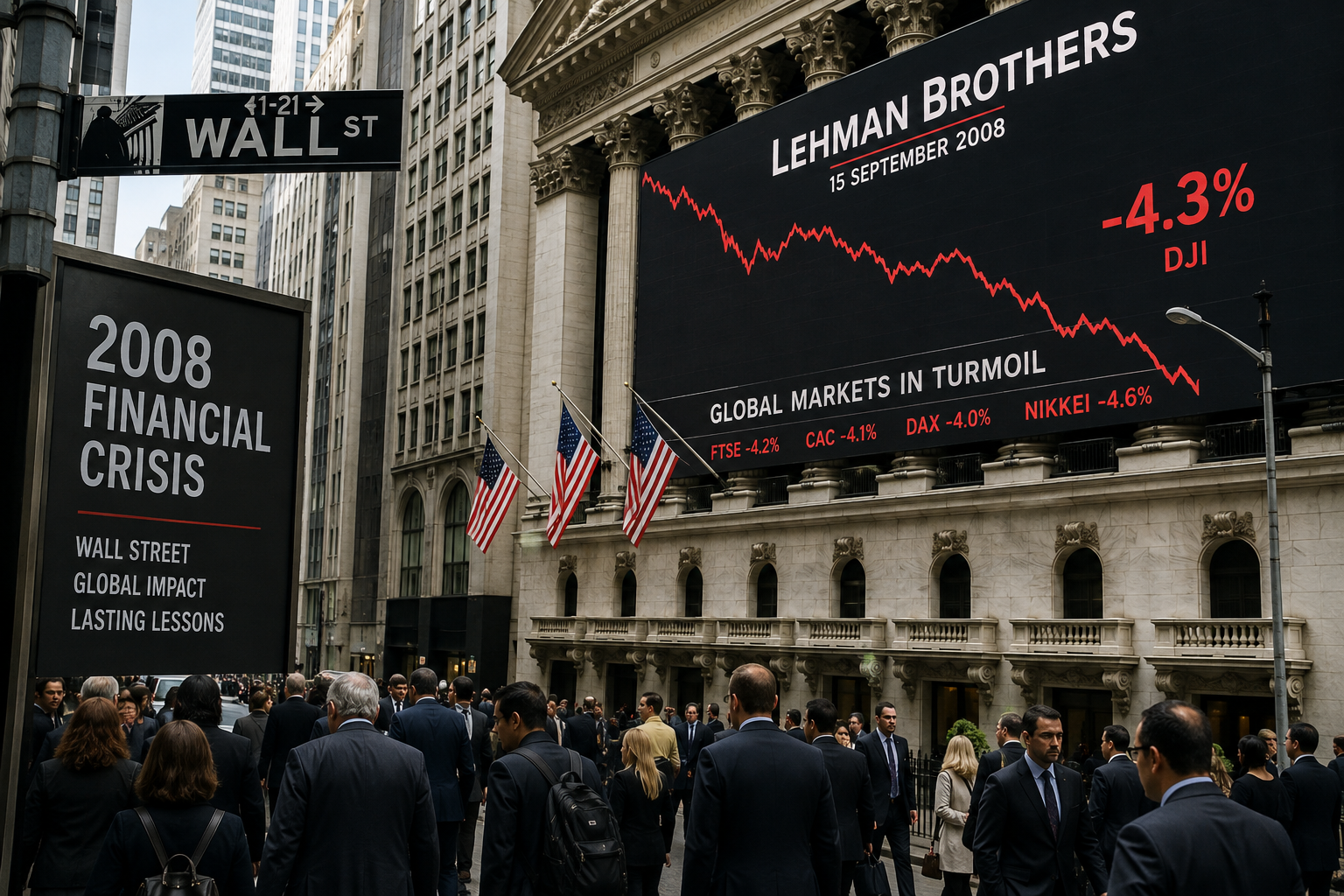
The 2008 financial crisis is often described as a housing crash, but that is only the surface. Houses were the visible asset. Mortgages were the fuel. Wall Street was the amplifier. Global finance was the transmission system. What made 2008 historic was not simply that many American homeowners could not repay loans. It was that those loans had been converted into complex financial products, distributed across the global system and financed with extraordinary leverage.
The crisis was really about the failure of trust in modern finance. Banks stopped trusting borrowers. Investors stopped trusting securities. Lenders stopped trusting banks. Markets stopped trusting prices. Governments stopped trusting that private institutions could save themselves. Once trust broke, liquidity disappeared, credit froze and a housing problem became a global economic crisis.
The story begins with the US housing boom. For years before the crisis, home prices rose strongly. Low interest rates, abundant global savings, aggressive mortgage lending and widespread belief in ever-rising house prices created a powerful feedback loop. Rising prices made lenders feel safe. Easy loans allowed more buyers to enter the market. More buyers pushed prices higher. Higher prices appeared to justify still more lending.
A major part of that lending went to subprime borrowers - borrowers with weaker credit histories, lower incomes or higher repayment risk. Not every subprime loan was irresponsible. But many loans were structured on the assumption that house prices would continue rising. Adjustable-rate mortgages, low initial payments, weak documentation and poor underwriting allowed people to buy homes they could not sustainably afford.
In an older banking model, a lender making a bad mortgage would suffer directly if the borrower defaulted. In the pre-2008 system, many mortgages were quickly sold, pooled and transformed into mortgage-backed securities. This process is called securitisation. In theory, securitisation spreads risk. In practice, it can also weaken discipline if the loan originator no longer cares enough about repayment quality because the loan will be sold to someone else.
Financial engineering took the process further. Mortgage-backed securities were repackaged into collateralised debt obligations, or CDOs. Different slices, or tranches, carried different levels of risk. Some senior tranches received high credit ratings even though their safety ultimately depended on the performance of underlying mortgages. Many investors trusted ratings and models without fully understanding the embedded risk.
Credit rating agencies played a controversial role. Their ratings were used by investors, banks and regulators as signals of safety. But the crisis exposed deep weaknesses in rating models, assumptions and incentives. Securities backed by risky mortgages could appear safer than they really were because models underestimated nationwide house-price declines and correlation among defaults.
Leverage made the system fragile. Investment banks, structured investment vehicles and other financial entities funded long-term or risky assets with short-term borrowing. As long as markets were calm, this looked profitable. But when doubts emerged, short-term lenders pulled back. Institutions that depended on rolling over funding suddenly faced liquidity stress. They did not merely have bad assets. They had no time.
Shadow banking was central to the crisis. Much credit creation had moved outside traditional deposit-funded banks into investment banks, money market funds, securitisation vehicles and repo markets. These entities performed bank-like functions but did not always have bank-like safety nets, deposit insurance or regulation. When confidence weakened, shadow banking experienced something similar to a bank run - but through wholesale funding markets rather than ordinary deposit queues.
Derivatives added another layer. Credit default swaps allowed investors to insure against, or speculate on, the default of mortgage-related securities. These instruments were not inherently bad, but they created hidden interconnections. A firm selling large amounts of protection could become a systemic threat if it lacked capital to honour those promises. AIG became the most famous example of this danger.
The turning point came when housing prices stopped rising and defaults increased. Once the underlying mortgages began to weaken, the value of mortgage-related securities became uncertain. Because these securities were complex and widely held, no one knew exactly who was exposed or how badly. Uncertainty became contagious. Institutions hoarded cash. Lending markets tightened. Asset prices fell. Losses spread.
The failure of Lehman Brothers in September 2008 became the symbol of the crisis. Lehman's bankruptcy did not cause every underlying problem, but it shattered confidence at a critical moment. Investors realised that a major financial institution could fail disorderly. Funding markets panicked. Money market funds came under pressure. Credit markets froze. The crisis moved from severe stress to global emergency.
Policy responses were massive because the alternative looked catastrophic. Central banks cut interest rates, provided emergency liquidity, opened special lending facilities and coordinated internationally. Governments guaranteed bank liabilities, injected capital, rescued or resolved major institutions and introduced fiscal stimulus. In the United States, the Troubled Asset Relief Program, or TARP, was created to stabilise the financial system.
These interventions remain politically debated. Supporters argue that they prevented a second Great Depression. Critics argue that they rescued institutions that had taken reckless risks while ordinary households suffered foreclosures and unemployment. Both concerns matter. In a systemic crisis, authorities may need to act quickly to prevent collapse, but rescue without accountability creates moral hazard.
The real economy suffered deeply. The crisis led to the Great Recession. Businesses cut investment. Consumers reduced spending. Unemployment rose. International trade collapsed. Governments faced weaker revenues and higher deficits. The effects lasted for years, especially for households that lost homes, jobs or savings. The crisis was financial in origin but social in consequence.
The 2008 crisis also changed regulation. Banks were required to hold more and better capital. Liquidity rules became stricter. Stress testing became more important. Derivatives markets received more oversight. Systemically important institutions faced additional scrutiny. Resolution planning became a priority. Regulators began paying more attention to macroprudential risk - not only whether each firm looked safe, but whether the system was becoming fragile.
One lesson is that risk can hide in complexity. Financial products may be mathematically sophisticated but economically fragile. If investors do not understand the underlying assets, if ratings substitute for due diligence and if models assume away extreme events, complexity becomes a risk multiplier.
A second lesson is that incentives matter. If lenders earn fees for originating loans but do not bear long-term credit risk, underwriting can weaken. If executives are rewarded for short-term profits, leverage can rise. If investors believe major firms will be rescued, market discipline can decline. Bad incentives can turn ordinary risk-taking into systemic danger.
A third lesson is that liquidity is not the same as solvency. A market can look liquid until everyone wants to sell. An institution can appear healthy until short-term funding disappears. A security can appear safe until buyers vanish. Modern finance depends not only on asset values but on continuous market functioning. When liquidity disappears, prices can collapse faster than fundamentals alone would suggest.
A fourth lesson is that housing finance is politically sensitive because it touches families directly. Encouraging home ownership is a legitimate policy goal, but when credit expansion outruns income, repayment capacity and underwriting discipline, housing becomes a bubble. A society cannot build durable prosperity by lending people more money than they can repay.
For India and other emerging markets, the 2008 crisis offers a wider warning. Financial innovation is useful, but it must be matched by regulation, transparency and consumer protection. Credit growth is good when it is supported by income growth and sound underwriting. It is dangerous when it is supported by asset-price optimism, weak supervision and hidden leverage.
The crisis was not caused by one villain or one mistake. It was caused by an ecosystem: cheap credit, housing optimism, weak lending, securitisation, flawed ratings, leverage, shadow banking, derivatives, poor supervision and misplaced confidence. Each part alone may have been manageable. Together, they created a machine that converted mortgage defaults into global panic.
The simplest summary is this: 2008 was a crisis of promises. Borrowers promised to repay loans they often could not sustain. Lenders promised that risky mortgages were manageable. Banks promised that complex securities were safe. Rating agencies promised that models captured risk. Markets promised liquidity. Governments promised stability after panic had already begun. When those promises were tested together, many failed.
The lasting lesson is not that finance is bad. It is that finance must remain connected to reality. Loans must be tied to repayment capacity. Securities must be tied to transparent assets. Ratings must be questioned. Capital must be real. Liquidity must be planned. Incentives must be aligned. And regulators must look beyond individual firms to the system they create together.
Disclaimer
This article is for general educational and editorial use. It is not investment, legal, lending, banking or regulatory advice. Historical facts, crisis timelines and policy figures should be verified from official records before publication.