Wolfgang Amadeus Mozart: Genius, Work and the Man Behind the Myth
Wolfgang Amadeus Mozart has been made to carry one of cultural history’s most persistent myths: the effortless genius. In the familiar version, music simply poured from him fully formed, childhood brilliance made training almost irrelevant, masterpieces appeared without meaningful revision, money disappeared through irresponsibility, and the mysterious Requiem seemed to announce his approaching death. The story survives because the documented talent was genuinely extraordinary. Mozart was composing as a child, performing before European courts and producing music at a level that astonished experienced musicians, but extraordinary ability does not require a supernatural explanation.
The historical Mozart was shaped by work, education and opportunity. His abilities developed within a highly organised family project led by his father, Leopold Mozart, a professional musician, teacher and manager who understood how talent could be cultivated and presented. Mozart’s sister Maria Anna, known as Nannerl, was also an accomplished keyboard performer and initially participated in the same touring enterprise. Years of travel exposed Wolfgang to composers, instruments, theatres, musical styles and audiences across Europe, giving him an unusually broad professional education before adulthood.
His life becomes more interesting when viewed as professional history rather than miracle. Mozart moved from being a court-dependent child prodigy to attempting a comparatively independent career in Vienna, where he earned money through composing, performing, teaching, publishing and patronage. He worked for courts, theatres, churches, private households and public audiences while managing reputation, family responsibilities and unstable finances. His death at thirty-five froze that career into legend, but manuscripts, correspondence and surviving performance records reveal a working composer whose apparent ease rested on deep training and extraordinary command of his craft.
Salzburg: A Musical Household
Mozart was born in Salzburg on 27 January 1756 and baptised Johannes Chrysostomus Wolfgangus Theophilus Mozart, although he later used several forms of his name, including Wolfgang Amadé. He was the seventh child of Leopold Mozart and Anna Maria Pertl, but only Wolfgang and his older sister Maria Anna survived infancy. Their household was unusually well suited to musical development because Leopold served as a musician at the Salzburg court and published an important violin treatise in the same year Wolfgang was born.
Nannerl received keyboard instruction from their father, and Wolfgang learned within that environment. Family documents and early manuscripts show striking musical precocity, but the label “child prodigy” can obscure as much as it explains. Precocity accelerated Mozart’s education; it did not eliminate the need for one. He learned keyboard technique, violin playing, composition and the social discipline of performance, while Leopold corrected manuscripts, supervised practice and guided his development.
Scholars have continued to examine Mozart’s earliest works partly to distinguish his own contributions from his father’s assistance. That does not diminish the child’s ability. It places that ability inside the educational process through which professional skill developed. Genius did not make instruction irrelevant; Mozart’s family recognised unusual talent early enough to build an intensive programme around it.
Nannerl’s role makes the social dimension of musical careers even clearer. She toured as a performer and received significant praise, yet the possibilities available to her narrowed sharply as she approached adulthood and marriageable age. Wolfgang’s sex, family strategy and professional environment allowed his musical ability to be converted into a sustained public career in ways that Nannerl’s could not. The contrast is a reminder that talent is never recognised or developed in a social vacuum.
Touring Europe: Education Through Performance
The Mozart family undertook extensive journeys through major European courts and cities while Wolfgang and Nannerl were still young. Munich, Vienna, Paris, London, the Netherlands and major Italian centres became part of Wolfgang’s practical education. These journeys should not be imagined as comfortable modern concert tours. Eighteenth-century travel involved poor roads, illness, delays, expensive logistics and substantial financial uncertainty.
The performances served several purposes at once. They demonstrated the children’s virtuosity, strengthened Leopold’s social connections and created opportunities for patronage. Wolfgang performed prepared works, improvised and participated in displays designed to prove the unusual extent of his abilities. European aristocratic culture had a strong appetite for prodigies, and the Mozart family understood how to operate within that market.
The tours were also musical education on an extraordinary scale. In London, Mozart encountered the influence of Johann Christian Bach; in Italy he absorbed the conventions of opera seria, met professional musicians and pursued commissions. Musical culture was still strongly regional, and travel gave Mozart access to styles and practices that were not available instantly through recordings or digital scores. By adolescence, he had experienced courts, theatres, churches and professional networks across Europe.
The myth of the child who simply “knew music” therefore hides an unusually intense apprenticeship. Mozart was gifted, but he was also exposed to more professional musical environments at a younger age than most musicians would encounter in decades. His later ability to move fluently among genres and styles was partly built during these years of constant observation and performance.
Italy, Opera and the Young Professional
Opera soon became central to Mozart’s ambitions because it brought together composition, theatre, singers, orchestras, patronage and public reputation. His Italian journeys allowed him to study operatic conventions at close range and produce stage and sacred works, but they also revealed that extraordinary talent did not guarantee permanent employment.
Leopold repeatedly sought favourable positions for his son, yet Mozart’s early successes did not automatically produce the major European appointment the family hoped for. Courts were institutions with budgets, hierarchies and immediate practical needs. Modern audiences know Mozart became canonical; eighteenth-century patrons had to evaluate a young composer within contemporary professional circumstances without knowing what later history would make of him.
Back in Salzburg, Mozart served under the prince-archbishop and received income and performance opportunities through court employment. He increasingly experienced that system as restrictive, while the court expected him to fulfil the obligations of an employee. The conflict is often simplified into a story of misunderstood genius battling philistine authority, but the tension was also structural: Mozart increasingly saw himself as an artist with a reputation extending beyond Salzburg, while his employer saw a musician whose duties were defined by court service.
Breaking With Salzburg
The conflict reached a decisive point in 1781 during Mozart’s service under Archbishop Hieronymus Colloredo. The relationship deteriorated and Mozart chose to establish himself in Vienna. The decision is often romanticised as an artistic declaration of independence, but its practical meaning was more complicated: he exchanged the security of regular court employment for an uncertain combination of teaching, performing, composing, publishing and private patronage.
Vienna offered enormous opportunity because it was an imperial capital with aristocratic households, public concerts, active musical circles and a strong operatic culture. It also brought competition and unstable demand. Mozart’s success would now depend on sustaining several income streams and a network of patrons rather than relying primarily on one institutional salary.
His move therefore belongs to a broader shift in European cultural life. Court patronage remained powerful, but commercial publishing, ticketed concerts and other forms of public musical consumption were expanding. Mozart did not become a modern freelancer in the full contemporary sense, yet his Vienna career required a degree of professional independence that differed significantly from traditional household service.
Constanze Weber and Mozart’s Household
Mozart married Constanze Weber in 1782. Leopold worried about or opposed the relationship, and the marriage complicated relations between father and son. Later biographical traditions sometimes reduced Constanze either to an irresponsible wife who failed the genius or to a heroic guardian of his legacy, but both versions flatten a more complicated historical figure.
The couple had six children, only two of whom survived infancy. Repeated child loss belonged tragically to ordinary eighteenth-century family life and formed part of the domestic circumstances within which Mozart worked. Constanze managed aspects of household life during periods of unstable income and, after Mozart’s death, became important in preserving, publishing and promoting his music.
Her later role also affects how Mozart’s final years are remembered. Widows, family members and later biographers had emotional and financial reasons to preserve and shape the composer’s reputation. Stories concerning the Requiem and Mozart’s final illness therefore need to be read as remembered narratives rather than as automatic verbatim documentation. That does not make the memories worthless; it means they require historical evaluation.
Mozart as Performer-Composer
During his early Vienna years, Mozart enjoyed considerable success as both pianist and composer, particularly through the piano concertos associated with his public appearances and subscription concerts. These works show how closely composition and performance were connected within his career. The concerto could display his abilities as a pianist while also functioning as a complex conversation between soloist and orchestra.
The piano in these works could dominate, answer, withdraw, interrupt and re-enter. Audiences who knew Mozart as a performer encountered a composition partly through his physical presence at the keyboard. The concertos therefore belonged simultaneously to his artistic output and his professional strategy.
This period also complicates the stereotype of Mozart as permanently impoverished. He could earn substantial sums and maintained a lifestyle reflecting social aspirations in Vienna. The central problem was not continuous destitution but volatility. Concert income, commissions, pupils and patronage changed over time, while household expenses and debt placed pressure on unstable revenue.
Letters asking his friend and fellow Freemason Michael Puchberg for loans reveal genuine financial distress during the late 1780s. Yet the common claim that Mozart simply squandered everything and died penniless is too crude. His finances varied across his Vienna career, and his final year included significant new professional activity and commissions.
Haydn and Musical Dialogue
Mozart admired Joseph Haydn and famously dedicated six string quartets to him. The personal relationship has often been sentimentalised, but the compositional exchange is more revealing. Haydn’s quartet writing represented a major artistic challenge, and Mozart answered with works demanding unusually close interaction among the instruments.
These quartets demonstrate Mozart’s ability to absorb another composer’s achievements without simply copying them. Counterpoint, thematic development and conversational textures become part of his own musical language. The apparent naturalness of the finished result can hide how technically sophisticated that synthesis is.
This is one reason the idea of completely isolated genius is misleading. Mozart’s music was relational. He learned from Johann Christian Bach, Handel, Haydn, Italian opera, Salzburg sacred traditions and the performers around him. Originality emerged through selection, recombination, judgment and craft rather than through total independence from earlier musical culture.
The Marriage of Figaro
The Marriage of Figaro premiered in Vienna in 1786 with a libretto by Lorenzo Da Ponte based on Beaumarchais. The original play had attracted political controversy because of its treatment of aristocratic privilege, and the operatic adaptation had to fit imperial censorship and theatrical expectations.
The opera is sometimes treated as a straightforward musical declaration of revolution, but that interpretation is too simple. Mozart was not producing a party manifesto. Yet hierarchy is fundamental to the drama: masters and servants, sexual privilege, gender, household authority and the vulnerability of people lower in the social order all shape the action.
Mozart’s ensemble writing gives these conflicts musical form. Several characters can pursue different intentions simultaneously, and the music creates coherence without eliminating confusion or contradiction. Characters across social ranks receive emotional and musical depth, making the opera’s social world more complicated than a simple hierarchy of important and unimportant people.
Its initial reception in Vienna was respectable rather than the overwhelming triumph later memory might suggest. Stronger enthusiasm in Prague helped establish an important connection between Mozart and that city.
Don Giovanni and the Instability of Genre
Don Giovanni premiered in Prague in 1787, again with a libretto by Da Ponte. The opera combines comic, serious and supernatural elements around the Don Juan story, resisting easy classification as either comedy or tragedy. That instability is part of its power.
The protagonist’s charisma exists beside violence, exploitation and refusal of repentance. Modern productions continue to debate how the opera should represent sexual coercion and social power without romanticising them. These debates belong to the work’s continuing performance history, although contemporary interpretations should not automatically be projected backwards onto eighteenth-century audiences.
Musically, the opera moves rapidly among different social worlds and emotional registers. The supernatural confrontation with the stone guest became one of Mozart’s most famous theatrical moments, but the work depends just as strongly on the differentiated musical identities of the surrounding characters. Don Giovanni demonstrates Mozart’s theatrical intelligence: he used music not only to decorate drama but to make relationships and conflicts audible.
Freemasonry and Mozart’s Later Vienna Years
Mozart joined the Freemasons in Vienna in 1784. Freemasonry provided social connections and exposed him to Enlightenment-associated ideas concerning fraternity, morality and ritual. Masonic themes are frequently discussed in relation to works such as The Magic Flute, although symbolic interpretation can become speculative when every musical feature is treated as coded Masonic meaning.
The later 1780s brought changing professional conditions. Public concert opportunities became less favourable, Austria’s war with the Ottoman Empire affected aristocratic life and spending, and Mozart changed residences and borrowed money. Yet these difficulties did not produce artistic collapse; he continued composing at a high level throughout the period.
Così fan tutte premiered in 1790. Its story of fidelity, disguise, manipulation and gender continues to create interpretive difficulty because the extraordinary beauty of the music coexists with a plot that can appear emotionally cruel. Rather than resolving that tension by deciding the work must be either harmless comedy or moral condemnation, its continuing power may lie partly in the discomfort between elegance and instability.
That combination appears repeatedly in Mozart’s mature music. Comic surfaces can contain cruelty, apparently simple musical ideas can support elaborate structures, and works created for entertainment can reveal complicated psychological relationships.
The Extraordinary Final Year
Mozart’s final year, 1791, was exceptionally productive. The Magic Flute, written for Emanuel Schikaneder’s popular theatre, combined spoken dialogue, comedy, fantasy, Masonic associations and serious moral aspiration. Its mixture of popular accessibility and ambitious musical construction contributed to its enduring success.
Mozart also composed La clemenza di Tito in connection with the coronation festivities of Leopold II as King of Bohemia. Working on music for court ceremony while simultaneously contributing to popular theatre demonstrates the flexibility required of an eighteenth-century professional composer.
The famous Requiem commission also arrived during this period. It was conveyed anonymously through an intermediary acting for Count Franz von Walsegg, who commissioned music privately. The unusual circumstances later generated stories of a mysterious messenger and Mozart becoming convinced that he was composing his own funeral mass.
The most secure facts are less supernatural but no less dramatic. Mozart accepted the commission, worked on the Requiem alongside other obligations, became seriously ill and died before completing it. Constanze needed the commissioned work completed and payment secured, so she arranged for other composers to finish the score, most importantly Franz Xaver Süssmayr. The Requiem familiar to audiences today is therefore both Mozart’s work and a posthumously completed composition.
Mozart’s Death and the Poisoning Myth
Mozart died in Vienna on 5 December 1791 at the age of thirty-five. The exact cause of death remains uncertain, and retrospective attempts to diagnose him from incomplete eighteenth-century descriptions have generated numerous competing theories.
The most famous legend claims that Antonio Salieri poisoned Mozart. There is no credible evidence that Salieri murdered him. Competition existed within Vienna’s musical world, but rivalry is not evidence of homicide. The poisoning story became culturally powerful because later rumours and artistic treatments transformed professional competition into dramatic tragedy.
The burial story has also been exaggerated. Mozart was not simply dumped into an anonymous pauper’s grave because Vienna had rejected him. His burial followed contemporary practices appropriate to his social category, involving a common grave rather than an individually marked elite tomb, and its precise location was subsequently lost.
Later generations expected a canonical genius to receive a monumental funeral. The difference between those expectations and eighteenth-century burial practice helped turn an ordinary historical circumstance into another element of Mozart mythology.
Constanze and the Construction of Mozart’s Legacy
Mozart’s reputation after death did not preserve itself automatically. Constanze organised memorial concerts, managed manuscripts and worked with publishers while caring for family responsibilities. Later biographers, collectors, performers, publishers and Mozart’s surviving sons continued shaping the archive around him.
This process matters because artistic canons are built through institutions. Music survives when it is performed, published, collected, catalogued, taught and preserved. The later work of the International Mozarteum Foundation and critical editions expanded this process on a scholarly scale.
The Köchel catalogue, first created in the nineteenth century and subsequently revised, attempted to arrange Mozart’s works chronologically. The familiar “K” numbers attached to compositions demonstrate how scholarship creates organisational systems around prolific historical figures, allowing later researchers and performers to navigate a large and complex body of work.
What Mozart’s Genius Actually Consisted Of
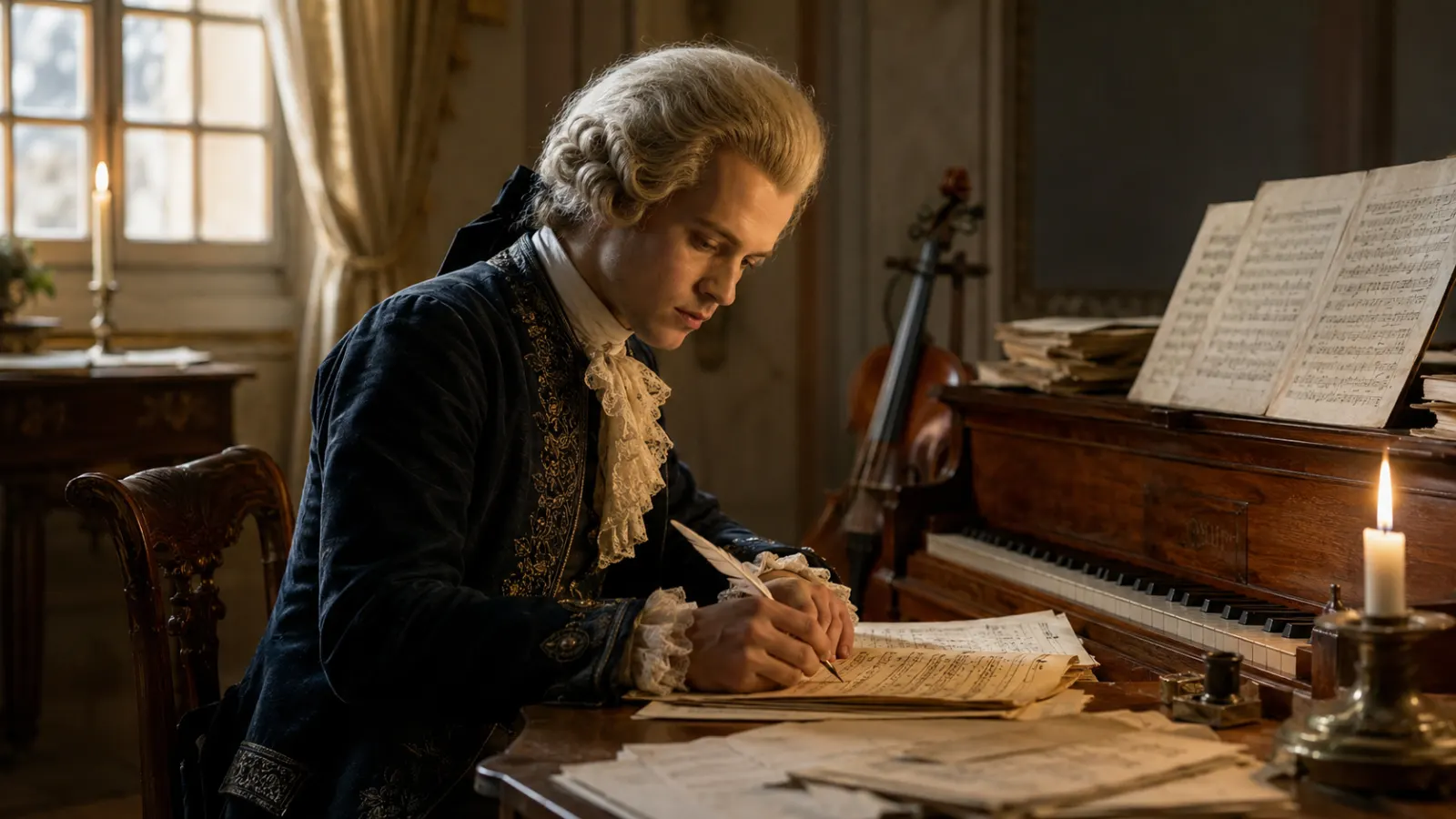
Mozart’s genius is often reduced to compositional speed. He could work rapidly, and some surviving manuscripts appear much cleaner than Beethoven’s famous heavily revised pages. Yet a neat manuscript does not demonstrate that music entered Mozart’s mind in complete form without revision. Compositional decisions can occur mentally before they ever appear on paper.
His deeper achievement was fluency across an extraordinary range of genres. Opera, symphony, concerto, chamber music, sacred music, dances and songs all belonged to his working world. He adapted to different performers, patrons and institutions while maintaining a distinctive compositional intelligence.
His operatic ability is especially striking because characters rarely become musically interchangeable. Aristocrats, servants, comic personalities and serious figures can appear within the same ensemble while retaining individual emotional presence. In instrumental music, contrasting ideas can coexist inside structures that sound balanced without becoming static.
The word genius remains useful only if it does not erase the infrastructure that made the achievement possible: Leopold’s training, Nannerl’s shared musical childhood, European travel, patronage networks, instruments, theatres, performers, librettists, copyists and publishers. Mozart’s exceptional ability operated through those systems rather than outside them.
The Myth of Music Without Revision
One of the most attractive legends surrounding Mozart is that he simply heard complete works internally and wrote them down without meaningful revision. The story converts compositional mastery into something almost supernatural.
Surviving manuscripts do sometimes show unusual fluency, but the absence of extensive visible correction is not the same thing as the absence of intellectual labour. A composer with deep technical knowledge can solve many problems before writing the final notation. Years of experience can also make decisions that once required conscious effort increasingly automatic.
This is precisely why expertise can look effortless to observers. The finished performance conceals the thousands of earlier decisions that made such fluency possible.
Mozart’s music may often sound inevitable, but inevitability in finished art can be the product of mastery rather than evidence that no work occurred.
Why the Child-Prodigy Story Survives
The idea of the miraculous child remains powerful because Mozart really was precocious. Removing exaggeration should not require pretending that his early ability was ordinary.
The distortion begins when precocity becomes a complete explanation of adult achievement. Mozart’s childhood travels exposed him to an enormous range of music, and his adolescence involved continual composition and professional work. Adult mastery emerged from the interaction between unusual aptitude and unusually intensive experience.
The child-prodigy story becomes more historically useful when it prompts a different question: what happens when extraordinary early ability is identified by a family with the knowledge, resources and determination to develop it professionally?
In Mozart’s case, the result was a childhood that functioned simultaneously as family life, public spectacle and professional apprenticeship.
Nannerl and the Limits of the Genius Narrative
Nannerl complicates the Mozart legend because she demonstrates how talent and opportunity can diverge. She was highly accomplished, toured publicly and belonged to the same musical household, yet eighteenth-century gender expectations sharply constrained her adult professional possibilities.
This does not prove that she would necessarily have become a composer equal to Wolfgang under different conditions. History cannot answer that counterfactual. It does demonstrate that recognition depends partly on social structures determining who is permitted to continue developing and displaying talent.
The history of genius therefore involves more than identifying exceptional individuals. It also requires asking which people received training, travel, instruments, patronage, professional independence and permission to remain visible.
Mozart and the Economics of Artistic Independence
Mozart’s Vienna career also challenges modern assumptions about artistic independence. Leaving Salzburg gave him greater control, but freedom did not eliminate dependence. He still needed pupils, subscribers, commissions, patrons, publishers and audiences.
The difference was that dependence became distributed across several sources instead of concentrated primarily in one court employer. This arrangement created opportunity because success in one area could compensate for weakness in another, but it also produced financial volatility.
Mozart’s career therefore sits within a transitional cultural economy. Court patronage remained powerful, while ticketed public performance, private teaching and commercial publishing were expanding. His life illustrates both the possibilities and insecurity created when artistic labour becomes less institutionally fixed.
Mozart’s Operas and Social Intelligence
Mozart’s operatic achievement cannot be explained by melody alone. His theatrical works show a remarkable ability to distinguish character through music and to allow several psychological intentions to exist simultaneously.
In Figaro, social hierarchy becomes part of musical organisation. In Don Giovanni, comedy and threat coexist. In Così fan tutte, elegance does not remove emotional manipulation, while The Magic Flute combines popular theatre with moral and symbolic ambition.
This suggests that Mozart’s artistic intelligence was partly social. He understood how characters respond, interrupt, conceal and reveal themselves within shared musical time. Opera allowed him to transform interpersonal conflict into musical structure.
Why Mozart Still Sounds Effortless
Mozart’s continuing reputation for effortlessness comes partly from the extraordinary clarity of his musical surfaces. Complex counterpoint can sound natural, formal balance can conceal instability, and technically difficult passages can appear inevitable when performed well.
That clarity should not be confused with simplicity in the weak sense. The listener can follow the music while still discovering additional relationships through repeated listening. Mozart’s works often create tension without losing proportion and complexity without sounding overloaded.
This combination makes the myth of natural genius especially tempting. The labour disappears inside the result.
Yet making labour invisible is itself evidence of mastery.
Frequently Asked Questions
When was Wolfgang Amadeus Mozart born?
Mozart was born in Salzburg on 27 January 1756.
Was Mozart really a child prodigy?
Yes. He displayed exceptional musical ability at a very young age, but his development also depended on intensive training, extensive travel and professional experience.
Who taught Mozart?
His father, Leopold Mozart, played a central role in his early musical education and professional development.
Was Mozart’s sister also musical?
Yes. Maria Anna “Nannerl” Mozart was an accomplished keyboard performer and toured publicly with Wolfgang during their childhood.
Why did Mozart travel so much as a child?
The family tours displayed Wolfgang and Nannerl’s abilities, created patronage connections and exposed Wolfgang to different European musical styles and institutions.
Why did Mozart leave Salzburg?
His relationship with the Salzburg court deteriorated, and in 1781 he chose to pursue a more independent professional career in Vienna.
How did Mozart earn money in Vienna?
His income came from several sources, including composing, performing, teaching, publishing, commissions and private patronage.
Was Mozart always poor?
No. He experienced periods of significant professional success as well as serious financial difficulty. His finances changed over time and should not be reduced to permanent poverty.
Did Mozart know Joseph Haydn?
Yes. Mozart admired Haydn and dedicated six string quartets to him. Their musical relationship is particularly important for understanding Mozart’s chamber music.
Who wrote the librettos for Mozart’s major Da Ponte operas?
Lorenzo Da Ponte wrote the librettos for The Marriage of Figaro, Don Giovanni and Così fan tutte.
Was The Marriage of Figaro revolutionary?
Its drama deals significantly with social hierarchy and privilege, but describing it as a direct political manifesto oversimplifies both Mozart’s intentions and the theatrical context.
Was Mozart a Freemason?
Yes. He joined the Freemasons in Vienna in 1784, and Masonic themes are often discussed in connection with some of his later works.
Did Mozart finish the Requiem?
No. Mozart died before completing it. Other composers subsequently worked on the score, most importantly Franz Xaver Süssmayr.
Did Mozart think he was writing his own Requiem?
Stories making that claim circulated later, but the dramatic legend developed through recollection and embellishment. What is securely known is that he received an anonymous commission and died before finishing it.
Did Salieri poison Mozart?
There is no credible evidence that Antonio Salieri murdered Mozart.
Why is Mozart’s exact grave unknown?
He was buried according to contemporary Viennese practices in a common grave rather than an individually marked elite tomb, and the precise location was later lost.
Did Mozart write music without revising it?
His manuscripts can show remarkable fluency, but clean notation does not prove that composition required no revision or intellectual labour. Many decisions could have been made before the music was written down.
What are Köchel numbers?
The Köchel catalogue organises Mozart’s works and assigns the familiar “K” numbers used to identify individual compositions.
Why is Mozart considered a genius?
His reputation rests on exceptional fluency across genres, extraordinary musical memory and technique, sophisticated formal control, theatrical intelligence and a body of influential work produced during a relatively short life.
The Mozart Myth Is Less Interesting Than Mozart Himself
The effortless-genius story appears flattering, but it reduces Mozart’s achievement. If the music simply arrived complete through supernatural inspiration, then training, judgment, collaboration and professional experience become almost irrelevant. The historical record shows something richer: an exceptionally gifted child whose talent was recognised early, trained intensively, displayed across Europe and continually expanded through contact with different musical traditions.
His adult life was equally grounded in practical realities. Mozart negotiated employment, patronage, publishing, teaching, performance, marriage, debt and changing public demand. He competed for opportunities, collaborated with librettists and performers, borrowed money when finances deteriorated and continued producing work under professional pressure.
The extraordinary part of the story is therefore not that Mozart escaped labour. It is how completely mastery could conceal that labour inside the finished music.
The Central Idea
Mozart’s biography becomes stronger when separated from the mythology built around him. The child prodigy was real, but so were Leopold’s teaching, Nannerl’s shared musical environment, exhausting European tours and decades of concentrated professional experience. The successful Vienna performer was real, but so were fluctuating income and debt. The unfinished Requiem was real, but the supernatural messenger and poisoning stories accumulated through later storytelling.
The same correction applies to the idea of effortless composition. Mozart’s ability to write rapidly should not be confused with an absence of work. Fluency is what deep expertise often looks like after years of practice. The clean surface of a manuscript may conceal decisions already made through memory, experience and internal composition.
His greatness also depended on artistic relationships. Bach, Handel, Haydn, Italian opera, Salzburg sacred music, singers, instrumentalists and librettists all formed part of the environment from which Mozart developed his own musical language. Originality did not require isolation from influence.
His death at thirty-five made legend almost inevitable because an unfinished life invites speculation. Later generations imagined what he might have written, dramatists turned rivalry into murder, and Romantic culture transformed precocity into a mythology of pure inspiration.
The documented life does not need those embellishments. Mozart was a highly trained child taken through Europe, a professional musician seeking independence, a composer working across courts and commercial culture, a husband and father living with financial instability and family loss, and an artist capable of making extremely complicated musical decisions sound natural.
That is a more convincing explanation of genius than miracle.
Mozart’s achievement was not that he escaped labour. It was that the labour became almost invisible inside the music.