Winston Churchill Biography: War Leadership, Empire and a Contested Legacy
A serious Winston Churchill biography has to explain why one political decision made during a few extraordinary weeks in 1940 became powerful enough to shape the memory of a career lasting more than six decades.
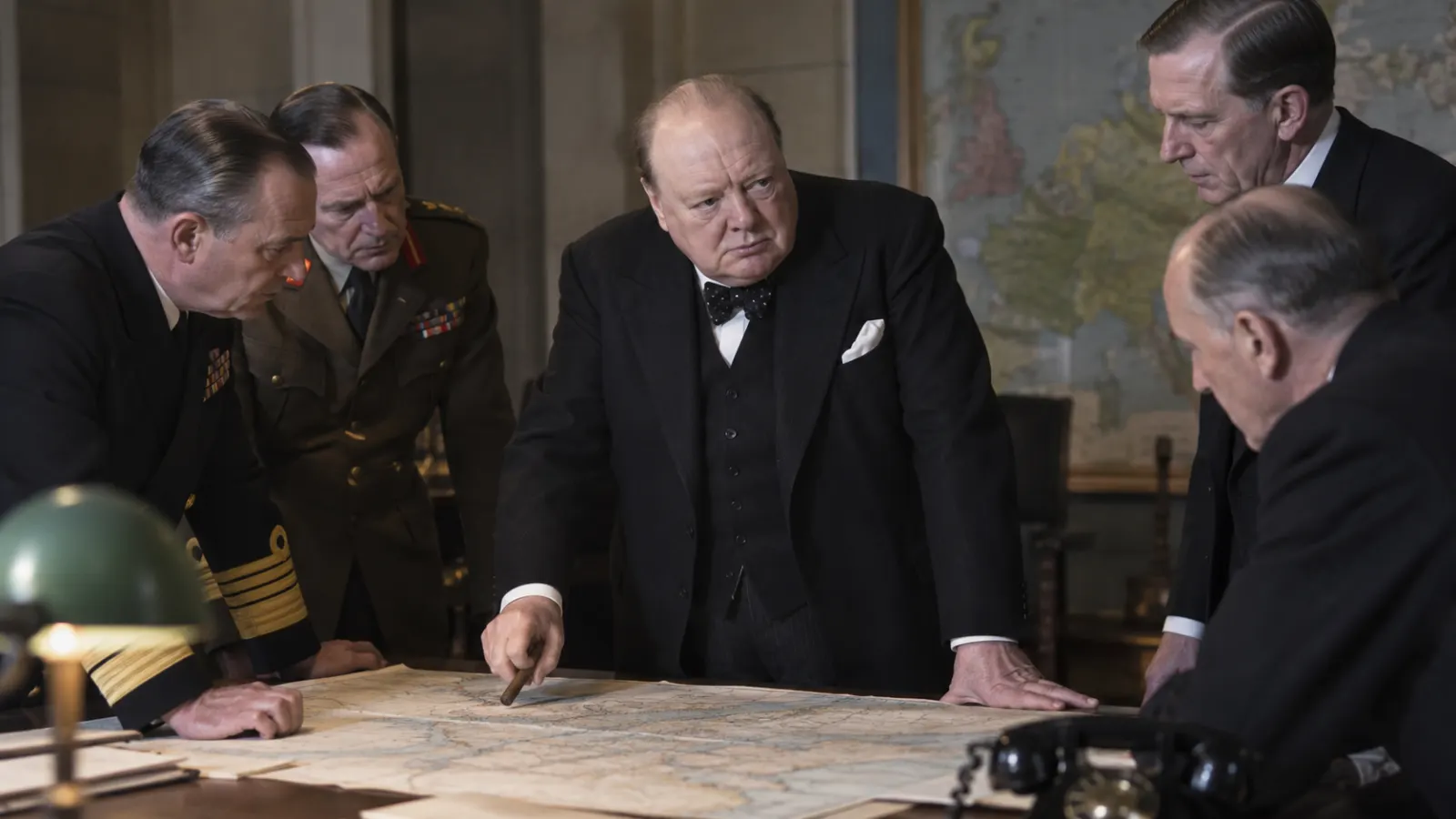
Churchill became prime minister on 10 May 1940, the same day Germany invaded Belgium, the Netherlands and Luxembourg. Within weeks, France was collapsing, the British Expeditionary Force was retreating toward Dunkirk and Britain faced the possibility of continuing the war without its principal continental ally. Churchill’s government was not simply Conservative: he formed a five-member War Cabinet that included Neville Chamberlain, Clement Attlee, Lord Halifax and Arthur Greenwood as part of a broader coalition. Hansard records Churchill telling Parliament on 13 May that the new administration represented a united determination to prosecute the war.
During the crisis that followed, Foreign Secretary Lord Halifax favoured examining whether Benito Mussolini might provide a route to negotiated terms before Britain’s position deteriorated further. Churchill resisted moving toward negotiation while Britain still possessed the means to continue fighting. That decision did not defeat Nazi Germany, and Britain’s eventual victory depended on armed forces, industry, empire and Commonwealth resources, intelligence, the United States, the Soviet Union and millions of people far removed from Downing Street. But Churchill’s political role was nevertheless consequential: he helped make continued resistance the policy of a coalition government at a moment when another path was being seriously discussed.
That achievement explains much of his reputation. It does not explain his whole life.
Churchill had already been a soldier, journalist, Conservative MP, Liberal reformer, Home Secretary, First Lord of the Admiralty, architect and casualty of the Dardanelles strategy, Colonial Secretary and Chancellor of the Exchequer. He had crossed political parties twice, campaigned fiercely against Indian self-government and made racial and imperial statements that remain central to modern arguments about him. During the Second World War he led Britain against Hitler while maintaining a British Empire in which many of the democratic rights invoked in wartime rhetoric were not equally available. After victory he lost the 1945 election, became an early public voice of the Cold War, returned as prime minister in 1951 and won the Nobel Prize in Literature in 1953.
The historical Churchill therefore contains qualities that do not fit comfortably together. He could be strategically imaginative and strategically reckless, politically resilient and stubbornly attached to assumptions whose time was disappearing. He understood the threat posed by Hitler better than many political rivals while misunderstanding the force of anticolonial nationalism. He could describe freedom in language that inspired democratic resistance in Europe while defending imperial hierarchy elsewhere.
Complexity does not diminish him. It makes him historically legible.
From aristocratic soldier to senior politician
Winston Leonard Spencer Churchill was born on 30 November 1874 at Blenheim Palace into one of Britain’s most prominent aristocratic political families. His father, Lord Randolph Churchill, was a Conservative politician, while his American mother, Jennie Jerome, came from a wealthy New York family. Churchill later portrayed his relationship with his parents as emotionally distant, but the social position into which he was born provided access to institutions and networks unavailable to most contemporaries. After schooling that did not initially suggest an exceptional academic future, he entered the Royal Military College at Sandhurst and joined the cavalry. The British government’s historical biography records his military and journalistic travels through Cuba, India, Sudan and South Africa before his parliamentary career began.
Churchill quickly learned that military adventure and journalism could reinforce one another. He reported on campaigns, wrote books and turned personal experience into public reputation. During the South African War he was captured while accompanying an armoured train, escaped from captivity in Pretoria and became something of a celebrity in Britain. The episode revealed a characteristic that would remain with him: Churchill did not merely experience events; he understood the political power of narrating them.
His imperial worldview was developing at the same time. Churchill largely assumed the legitimacy of British global dominance and frequently described colonised societies through racial and civilisational hierarchies. These attitudes were not incidental youthful language that disappeared when he matured. They remained visible much later, particularly in his resistance to Indian self-government, and scholarship on Churchill, India and race places imperial permanence near the centre of his political outlook.
He entered the House of Commons as a Conservative in 1900 but crossed to the Liberal Party in 1904, partly over the Conservatives’ movement toward tariff protection. As a Liberal minister, Churchill participated in the era’s social reforms, including work at the Board of Trade associated with labour exchanges and unemployment insurance. He later served as Home Secretary before becoming First Lord of the Admiralty in 1911, bringing him directly into naval strategy as Britain moved toward the First World War.
Churchill energetically supported naval modernisation, including the transition from coal toward oil, and took an unusually interventionist interest in military planning. That combination of political energy and strategic imagination could be an asset. It also contributed to the crisis that nearly ended his career.
The Dardanelles operation sought a route through the straits toward Constantinople, partly to relieve pressure on Russia and potentially remove the Ottoman Empire from the war. Churchill became one of the strongest advocates of a naval attempt to force the passage. After several Allied warships were lost to mines in March 1915, the campaign evolved into the disastrous Gallipoli land operation. Imperial War Museums’ historical material identifies Churchill, then First Lord, as the principal political advocate for sending a naval force through the Dardanelles.
Churchill was not personally responsible for every operational decision made at Gallipoli, and failures were distributed across political, naval and military command structures. But he had attached his authority to a bold strategic concept that failed at enormous human cost. He left the Admiralty in 1915, later resigned from government and served on the Western Front.
Gallipoli is important because it exposes a recurring feature of Churchill’s political imagination. He liked strategic moves that promised to break deadlock through audacity rather than gradual pressure. Sometimes that willingness to reject conventional thinking was valuable. At other times, ambition moved faster than logistics, consensus or operational reality.
The interwar politician who looked backward and forward at the same time
Churchill eventually returned to government and occupied several senior offices after the First World War, including Secretary of State for War and Air, Colonial Secretary and, from 1924 to 1929, Chancellor of the Exchequer. As Chancellor he returned sterling to the gold standard at its prewar parity, a policy that later attracted substantial criticism for its deflationary effects and pressure on British industry and exports. Government records confirm his chancellorship from 1924 to 1929.
By the 1930s Churchill was largely outside ministerial office. The famous description of this period as his “wilderness years” can make him sound politically invisible, but he remained an MP, author, newspaper contributor and major public figure. What changed was his relationship with the political mainstream.
On India, he appeared increasingly attached to an imperial order that nationalist politics was making unsustainable. Churchill opposed constitutional concessions and campaigned fiercely against the Government of India Act of 1935. His rhetoric toward Indian political leaders, including Gandhi, could be contemptuous, and modern scholarship treats his views on India as inseparable from his racial and imperial assumptions.
At almost the same time, Churchill was becoming increasingly important as a critic of British weakness toward Nazi Germany. He warned about German rearmament, pressed for stronger British military preparation and later attacked the Munich settlement. His eventual reputation as the politician who “saw Hitler coming” contains genuine substance but has often been simplified.
Churchill was not literally the only British politician worried about Hitler. Clement Attlee, for example, also opposed the Munich Agreement, and others inside government and the armed services recognised the threat. Nor were the governments pursuing appeasement merely foolish men incapable of understanding dictatorship. Their decisions operated inside the trauma of the First World War, public resistance to another conflict, financial constraints, uncertain alliances and doubts about British military readiness.
What distinguished Churchill was the strength and persistence of his argument that repeated concessions unsupported by credible force could worsen the strategic position rather than secure lasting peace. When Germany invaded Poland in September 1939, Neville Chamberlain brought him back into government as First Lord of the Admiralty.
The collapse of confidence in Chamberlain after the failed Norwegian campaign then created Churchill’s opportunity. On 10 May 1940, Churchill formed a new government. Parliamentary records confirm both the date and the cross-party structure of his War Cabinet.
1940, wartime leadership and the limits of the lone-saviour story
Churchill’s position in May 1940 was far less secure than later mythology suggests. Many Conservative MPs remained personally loyal to Chamberlain, while Halifax had been a serious alternative candidate for prime minister. Churchill’s ability to lead therefore depended partly on coalition politics. Labour participation was indispensable, and figures such as Clement Attlee and Ernest Bevin would carry substantial responsibility for domestic mobilisation throughout the war.
The military situation deteriorated immediately. German forces broke through in France, the Allied armies retreated and the evacuation from Dunkirk rescued large numbers of troops without changing the strategic fact that France was approaching defeat. The War Cabinet debate over possible mediation through Mussolini occurred against this background.
Churchill’s great political achievement was not that he possessed secret knowledge that victory was guaranteed. He did not. It was that he resisted beginning a negotiation process that he believed would weaken Britain’s willingness and ability to continue the war before the likely German terms were even known. Continuing to fight was a gamble whose favourable outcome depended on future developments that remained uncertain in May 1940.
His rhetoric helped turn that policy into a public political position. Speeches associated with phrases such as “blood, toil, tears and sweat,” fighting on the beaches and Britain’s “finest hour” became part of national memory because they acknowledged the scale of danger while presenting endurance as possible. The speeches did not create aircraft, train pilots, escort convoys, manufacture weapons or decode German communications, but rhetoric can still perform real political work. Churchill gave a coalition government and a frightened population a language in which continuing the war could be imagined as a coherent national purpose.
The danger is allowing that rhetorical achievement to absorb the entire war effort. Britain’s survival in 1940 depended on the Royal Air Force, Royal Navy, industrial workers, scientists, intelligence services, civil defence, empire and Commonwealth resources and the geography of the English Channel. The Soviet Union later absorbed and inflicted enormous losses on Nazi Germany after Hitler invaded in 1941, while American industrial and military power increasingly transformed the balance after the United States entered the war.
Churchill understood alliances pragmatically. He had spent years attacking communism, yet after Germany invaded the Soviet Union in June 1941 he immediately supported assistance to Stalin because defeating Hitler took precedence. After Pearl Harbor and Germany’s declaration of war on the United States, the alliance Churchill had long hoped for became a military reality. His personal relationship with Franklin Roosevelt mattered, but the relationship also charted Britain’s changing position: as the war continued, the United States increasingly possessed greater industrial, financial and military power.
Strategic disagreements persisted among the Allies. Churchill often preferred operations in the Mediterranean and at Europe’s periphery, while American planners pushed more strongly toward a cross-Channel assault. The eventual Normandy invasion in June 1944 emerged from coalition planning rather than from one national strategy.
The same need for complexity applies to Allied bombing. Britain’s bombing campaign increasingly attacked German urban and industrial areas, causing enormous civilian casualties. Churchill supported the bombing offensive through much of the war. Near its end he questioned the destruction of German cities, especially after Dresden, but RAF historical analysis notes his own substantial responsibility in the policy environment that produced that attack.
Britain was fighting a regime responsible for aggressive war, occupation, genocide and mass murder. That context is indispensable to evaluating Allied decisions. It does not make every method used by the Allies immune from moral or strategic scrutiny.
Churchill’s wartime leadership therefore deserves neither trivialisation nor sainthood. His role in 1940 was genuinely consequential. But Britain’s war was institutional, imperial and international, not the accomplishment of a single heroic personality.
India and the Bengal famine expose the deepest contradiction in Churchill’s reputation
The most difficult modern debate over Churchill concerns India, particularly the Bengal famine of 1943.
Churchill was openly hostile to Indian nationalism and strongly committed to preserving British imperial authority. His racialised remarks about Indians are extensively documented and cannot be dismissed as irrelevant simply because he was simultaneously leading the struggle against Nazi Germany. The contradiction is historically important: Churchill could invoke democracy and freedom as principles worth defending in Europe while resisting their full extension within the empire.
The Bengal famine killed millions through starvation and disease. Attempts to explain it through one cause are misleading. Wartime economic disruption, the Japanese conquest of Burma, inflation, food distribution failures, market behaviour, crop conditions, military priorities, transport pressure, provincial governance and British imperial policy all interacted. Oxford scholarship has argued strongly that British wartime policies were directly implicated in creating the conditions of famine, while other historical work emphasises how wartime mobilisation destabilised the Bengal economy and contributed to catastrophic price increases and food insecurity.
The historiographical disagreement is not over whether the famine was catastrophic or whether colonial governance bears responsibility. The sharper dispute concerns how responsibility should be distributed and how directly Churchill himself should be held responsible for particular decisions involving shipping, grain imports and relief.
The strongest evidence does not require claiming that Churchill deliberately designed a plan to starve millions of Bengalis. Such a claim demands evidence of intention that is different from evidence of prejudice, policy failure or imperial prioritisation. At the same time, reducing the famine to unavoidable wartime scarcity ignores serious scholarship showing that government policy, allocation priorities and administrative decisions materially affected the crisis. Modern Cambridge scholarship also places Churchill’s response to Bengal within the context of his attitudes toward India and race.
The responsible historical position therefore avoids two convenient extremes. Churchill’s documented racist attitudes are not by themselves proof of an intentional extermination policy. But the absence of such a policy does not absolve the government he led from responsibility for what happened inside an empire it governed.
This is where the heroic wartime narrative becomes most difficult. In Britain, Churchill’s speeches framed the conflict against Hitler in terms of freedom, resistance and national survival. In India, millions lived under colonial rule without equal political sovereignty, while wartime priorities made in imperial structures helped determine access to food and shipping.
One Churchill does not cancel the other.
The contradiction is part of the history.
Victory did not give Churchill a permanent democratic mandate
Germany surrendered in May 1945, and Churchill reached the peak of his international prestige. British voters removed him from office only weeks later.
The result can look paradoxical only if wartime popularity and peacetime political preference are assumed to be the same thing. The 1945 general election asked voters who should govern reconstruction: who would build homes, create employment, organise social security and reshape healthcare after six years of war. Labour under Clement Attlee offered a programme explicitly designed for that domestic future and won its first Commons majority. Parliamentary records show Labour winning a majority of 147 seats, with Attlee becoming prime minister and Churchill leader of the opposition.
Attlee had also served inside Churchill’s wartime coalition, eventually as Deputy Prime Minister, which made it easier for voters to separate approval of the war effort from support for the Conservative Party. The election was therefore not necessarily a rejection of Churchill’s wartime leadership. It was a democratic judgment that another party offered the stronger programme for peace.
Churchill’s own campaign helped Labour. His warning that a socialist government could require something resembling a political police was widely regarded as excessive, particularly after years of cooperation with Labour ministers. The episode exposed a limitation of charismatic leadership: success at one national task does not automatically establish authority over the next.
Churchill remained Conservative leader and became one of the most prominent Western critics of Soviet expansion. His 1946 Fulton speech popularised the phrase “iron curtain” as a description of the emerging division of Europe. He did not invent the phrase, but his international stature helped make it one of the defining expressions of the early Cold War.
He returned to power after the 1951 general election and served as prime minister until 1955. Parliamentary records confirm that second premiership, while the government’s official biography describes a leader increasingly limited by age and ill health.
His second government did not attempt to dismantle wholesale the welfare-state settlement created under Attlee. Britain was operating in a new world of Cold War rivalry, declining imperial power, nuclear weapons and economic constraints. Churchill increasingly hoped that personal summit diplomacy might reduce tensions between the Soviet Union and the West, although those ambitions produced limited results.
His health became increasingly serious. He suffered a major stroke in 1953 that was initially concealed from much of the public and resigned as prime minister in April 1955. He nevertheless remained an MP until 1964.
The writer who helped construct the Churchill remembered today
Churchill’s political power cannot be separated from his extraordinary relationship with language.
Writing was not a hobby attached to his political career. It was a profession. He wrote journalism, biography, history, memoir and multivolume narratives of war and empire, earning substantial income from publication over decades.
In 1953, he received the Nobel Prize in Literature, not the Nobel Peace Prize. The Nobel Committee cited his historical and biographical writing as well as his oratory.
That literary career matters to historical memory because Churchill became one of the principal authors of the story in which later generations encountered Churchill.
His multivolume history of the Second World War contained indispensable observations from one of the central political participants. It was also self-presentation. Churchill selected events, framed responsibility and placed decisions within a narrative that naturally gave unusual prominence to his own perspective.
This does not make his writing unreliable or useless.
It makes it a primary source that requires comparison.
Historians can read Churchill beside Cabinet minutes, military records, American and Soviet archives, memoirs of political colleagues and records from the colonies over which Britain ruled. The National Archives identifies the wartime Cabinet series, including CAB 65 minutes and CAB 66 memoranda, as central records for reconstructing wartime decision-making.
Churchill understood that political action and historical narration reinforce one another. He did not merely leave behind decisions.
He helped provide later generations with the vocabulary for interpreting those decisions.
That is one reason controversies over his reputation remain unusually intense.
Churchill matters most when neither admiration nor condemnation is allowed to simplify him
Winston Churchill died on 24 January 1965, aged ninety, and received a state funeral. Official government records identify his two premierships as 1940–45 and 1951–55 and confirm the extraordinary span of the career that preceded them.
Public memory tends to produce two Churchills.
The first is Churchill in 1940: the prime minister who refused to begin a slide toward negotiation with Hitler, led a coalition through military catastrophe and gave political language to resistance at a moment when Britain’s position was extraordinarily dangerous.
That Churchill is real.
The second is Churchill the imperialist: hostile to Indian nationalism, committed to racial and civilisational hierarchies, involved in imperial governments and associated with decisions whose consequences were experienced very differently in colonised societies.
That Churchill is real too.
The mistake is treating history as though establishing one version invalidates the other.
Gallipoli does not make May 1940 irrelevant.
May 1940 does not make Bengal irrelevant.
Churchill’s opposition to Hitler does not retroactively make his imperial politics liberal.
His imperial prejudices do not change the strategic significance of Britain’s refusal to leave the war in 1940.
A more mature assessment asks narrower questions. Where was Churchill’s judgment unusually strong? Where did his appetite for bold strategy produce avoidable risk? Which outcomes depended materially on his presence, and which later myths assign him achievements that actually belonged to institutions, allies or entire populations? How should his defence of British democratic independence be understood beside his commitment to an empire that denied equal political power elsewhere?
Those questions produce a more difficult figure than either the national saviour or the villain constructed in response to him.
They also produce better history.
Churchill’s defining political strength was his ability to connect strategic choice with language. He could absorb terrible news, frame a decision inside a larger historical story and persuade others that endurance remained meaningful even when success was uncertain.
Some of his weaknesses emerged from the same temperament. Confidence could become overconfidence. Strategic imagination could become adventurism. Historical romanticism could reinforce an imperial order whose decline he struggled to accept. Rhetorical brilliance could express prejudice as forcefully as courage.
The result is not a contradiction that needs to be solved by choosing whether Churchill was “good” or “bad.”
It is the actual subject of the biography.
Churchill was one of the most consequential democratic war leaders of the twentieth century and one of the most consequential defenders of British imperial power. Understanding why both descriptions can be accurate is more useful than trying to erase either one.