William Shakespeare: The Working Playwright Behind the Global Literary Monument
William Shakespeare is simultaneously one of the most documented writers of the English Renaissance and one of the least documented by the standards of modern celebrity. Parish registers, property transactions, legal records, title pages, company documents and references by contemporaries provide a substantial outline of his life. Yet there are no surviving diaries explaining what he thought while writing Hamlet, no reliable record of his private conversations and no personal archive comparable to the correspondence left by many later writers. That imbalance between strong public documentation and limited private evidence has encouraged generations of speculation.
Shakespeare has consequently been imagined as a secret Catholic, political radical, government propagandist, disguised autobiographer, aristocratic front man and almost everything in between. Some hypotheses arise from serious historical questions, while others survive largely because mystery is culturally attractive. The strongest biography begins by accepting the limits of the documentary record rather than treating every gap as permission to invent.
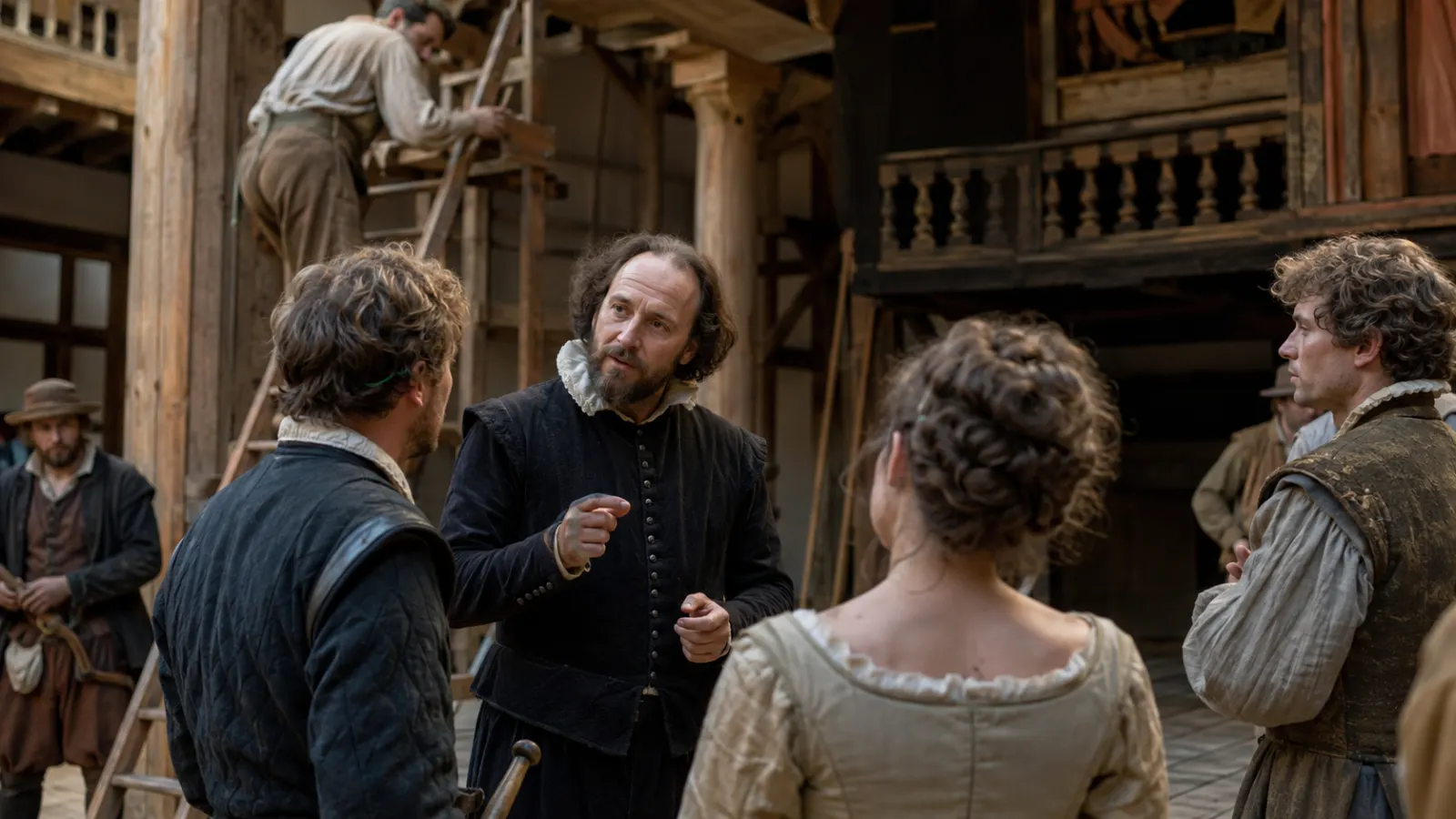
His achievement also becomes easier to understand once he is removed from the image of a solitary literary genius writing masterpieces primarily for silent readers. Shakespeare was an actor, playwright, company sharer and theatre professional working inside a commercial entertainment industry. His plays were written for particular actors, performed before paying audiences, shaped by censorship, competition and theatre architecture, and sometimes revised or collaboratively written. After his death, fellow actors helped preserve much of the dramatic canon in the First Folio. The works eventually became literature of extraordinary prestige, but they began as theatre made for performance.
Stratford-upon-Avon and What the Evidence Actually Establishes
William Shakespeare was baptised at Holy Trinity Church in Stratford-upon-Avon on 26 April 1564. His exact birth date is not recorded. The traditional date of 23 April is plausible because baptism commonly followed birth within several days, but it remains a tradition rather than a documented fact.
This distinction is small but important because Shakespeare biography is filled with claims that gradually hardened from probability into apparent certainty.
He was the son of John Shakespeare, a glover and civic officeholder, and Mary Arden, who came from an established Warwickshire family. John Shakespeare rose within Stratford's municipal government before encountering financial and legal difficulties. Those changing family circumstances have encouraged theories about William's later interest in money, status, debt and ambition, but direct psychological connections cannot be established from the surviving evidence.
Shakespeare probably attended the King's New School in Stratford, where the sons of families in his social position could receive intensive instruction in Latin grammar, rhetoric and classical literature. No surviving school register confirms that he attended. The inference is nevertheless strong because of his father's civic position and the educational knowledge evident in Shakespeare's writing.
The important principle is methodological: probable should not silently become documented. The absence of a school register does not mean Shakespeare lacked education, just as the strength of the inference does not turn an inference into a surviving record.
Marriage, Children and the So-Called Lost Years
In late 1582, Shakespeare married Anne Hathaway. He was eighteen, while she was older. Their daughter Susanna was baptised in May 1583, and twins Hamnet and Judith were baptised in 1585.
After those records, the documentary trail becomes comparatively thin until Shakespeare appears within London theatrical culture in 1592. This period has become famous as the “lost years.”
The phrase makes the gap sound more mysterious than it necessarily was. Documentary silence is common for people who had not yet become nationally prominent. Nevertheless, the gap has encouraged theories that Shakespeare worked as a schoolmaster, lawyer's clerk, actor, traveller or even poacher. Some suggestions possess more historical plausibility than others, but none provides a fully documented narrative of how he moved from Stratford into the London theatre world.
The important fact is where the gap ends.
By 1592, Shakespeare was sufficiently established in London theatre to become the target of the famous “upstart crow” attack associated with Robert Greene's Groats-Worth of Wit. The insult matters because it suggests that Shakespeare was no anonymous beginner. He had already become visible enough within the professional theatre world to provoke resentment.
Exactly how he reached that position remains unknown.
That uncertainty is not a failure of biography. It is part of the evidence.
Plague Closures and Shakespeare's Entry Into the Print World
London's theatres were periodically closed during plague outbreaks, interrupting performances and reducing opportunities for theatrical companies. During the early 1590s, Shakespeare published the narrative poems Venus and Adonis and The Rape of Lucrece, dedicating them to Henry Wriothesley, Earl of Southampton.
These publications complicate any simple division between Shakespeare the playwright and Shakespeare the poet. His dramatic work belonged primarily to a theatrical economy, while the narrative poems gave him a more conventional literary identity within print culture.
The sonnets, published as a collection in 1609, created an even larger field of biographical speculation. Their first-person voices speak about desire, betrayal, rivalry, beauty, ageing and emotional conflict, tempting readers to identify their speakers and addressees with real people in Shakespeare's life.
That temptation should be resisted unless evidence supports it.
Lyric voice is not automatically autobiography. A poem written in the first person does not function as a sworn statement about the author's private life. The sonnets undoubtedly contain extraordinary emotional intensity, but attempts to identify every figure within them with a specific historical person often move beyond what the surviving record can justify.
Shakespeare Inside the Lord Chamberlain's Men
By 1594, Shakespeare was associated with the Lord Chamberlain's Men, one of London's most successful theatrical companies. This relationship became central to his professional life.
He was not merely a freelance writer delivering scripts to actors. Shakespeare became a sharer in the company and later acquired financial interests connected with theatrical property. That position connected his artistic success directly to the commercial success of the troupe.
Theatre companies required more than writers. They needed actors, costumes, rehearsal, repertory, venues, patronage and an audience willing to pay repeatedly. New plays had to attract attention, while older works needed to remain performable as part of a continuing repertory.
Shakespeare worked within a company containing major performers such as Richard Burbage, who became famous for leading tragic roles. Writing for known performers may have affected character construction, while changes among the company's comic actors may have influenced the development of clown roles.
This reminds us that theatre is embodied collaboration. The script is only one element.
In 1603, after James VI of Scotland became James I of England, the company received royal patronage and became the King's Men. The change increased prestige and court access while placing the troupe more visibly within the political culture of the monarchy.
“Shakespeare's plays” remains an accurate phrase, but it should never erase the actors, companies and performance conditions that made those plays possible.
The Globe Was Part of Shakespeare's Business
The Globe Theatre, built in 1599, became the playhouse most strongly associated with Shakespeare. Importantly, he was not simply a playwright whose works happened to be staged there. Evidence indicates that he was among the shareholders with a financial stake in the enterprise.
That helps explain how Shakespeare became sufficiently prosperous to invest in property in Stratford, including New Place. His economic success came not only from writing but from participating more broadly in the theatrical business.
The architecture of the Globe also influenced dramatic form. Its projecting stage, galleries, standing audience and limited reliance on elaborate scenery meant that language could create locations rapidly. Several lines could move the audience from palace to battlefield, from England to Rome or from daylight to darkness without requiring realistic sets.
The audience was socially mixed. Cheap standing admission brought one group close to the stage, while more expensive seating accommodated wealthier spectators. Shakespeare therefore wrote for people with different educational backgrounds and expectations.
Philosophical reflection, bawdy humour, political history, swordplay, lyric poetry and clowning could all appear within the same performance.
The later transformation of Shakespeare into exclusively elite “high culture” obscures the commercial popular theatre in which the plays originated.
The History Plays Made National Memory Into Theatre
Shakespeare's English history plays helped establish his reputation. Works involving Henry VI, Richard III, Richard II, Henry IV and Henry V transformed dynastic conflict and political succession into popular drama.
They should not be read as neutral historical accounts. Shakespeare used chronicles, compressed events, rearranged chronology and shaped historical personalities for dramatic purposes.
Richard III offers an obvious example. Shakespeare created one of literature's most memorable villains, but the play's Richard belongs partly to Tudor political memory and theatrical convention rather than to modern historical scholarship.
The history plays repeatedly examine legitimacy, rebellion, succession, war and the performance of public authority. Kings must not merely possess power; they must appear kingly before subjects, soldiers and rivals.
Political authority therefore becomes theatrical within theatre.
That insight helps explain why the histories remain adaptable. Modern productions can use them to explore nationalism, propaganda, leadership and civil conflict. But modern political interpretations should not automatically be converted into claims about Shakespeare's personal ideology.
The plays support political argument more confidently than the surviving biography allows us to reconstruct Shakespeare's private politics.
Comedy: Weddings Built on Instability
Shakespearean comedy is often associated with marriages and reconciliations. Many comedies move toward weddings that appear to restore social order.
The route to those endings, however, is frequently unstable.
A Midsummer Night's Dream mixes desire, hierarchy, humiliation and supernatural intervention. Much Ado About Nothing brings gendered accusation and damaged reputation close to tragedy before reconciliation. Twelfth Night uses disguise to unsettle gender, desire and social status.
The Merchant of Venice combines romantic comedy with the treatment of Shylock, whose representation has become inseparable from the history of antisemitism and the play's later performance tradition.
Shakespeare's comedies are not modern manifestos about identity, but they repeatedly demonstrate how identity depends upon clothing, language, recognition and social position.
Early modern stage conventions intensified that instability because female roles were played by boys or young men. A male performer could therefore play a woman disguising herself as a man, creating multiple layers of performed gender.
Modern productions continue to find interpretive possibilities inside those structures.
Comedy in Shakespeare is rarely only cheerful. Festivity and cruelty frequently exist beside one another.
Hamlet and Thought as Theatrical Action
Hamlet became the Shakespearean play most strongly associated with interiority. Hamlet thinks aloud, questions his motives, tests the difference between appearance and truth and repeatedly analyses his own hesitation.
It is sometimes claimed that Shakespeare invented the modern self through Hamlet. That is much too sweeping. Complex interiority existed in earlier literature, and no single writer invented human self-consciousness.
Shakespeare's achievement was more specifically theatrical.
The soliloquy makes thought itself into an event. An audience watches a character reconsider himself in real time.
Hamlet is also important because it survives in significantly different early printed forms, including an early quarto, a later quarto and the First Folio. Those textual differences challenge the assumption that every Shakespeare play exists as one perfectly stable original text waiting to be recovered.
Editors have to decide how different versions relate and whether they should be combined. Theatre companies make similar decisions when preparing performances.
The canonical work is therefore partly a history of textual transmission.
Othello, King Lear and Macbeth: Plays That Refuse One Interpretation
In Othello, Shakespeare builds tragedy through trust, jealousy, manipulation, race and military identity. The play's long performance history includes racist stereotyping as well as major reinterpretations by Black actors and directors.
Modern productions do not encounter a neutral text untouched by history. They inherit centuries of performance choices.
King Lear examines authority, family obligation, ageing, homelessness and political collapse. Its ending proved so difficult for later audiences that eighteenth-century adaptations famously gave the story a more consoling conclusion. The eventual restoration of Shakespeare's tragic ending demonstrates again that “Shakespeare” has always been mediated through changing theatrical preferences.
Macbeth compresses prophecy, political murder, guilt and fear into unusually concentrated dramatic form. Its witches can be interpreted through early modern beliefs about witchcraft, psychological readings or modern political frameworks.
No single interpretation exhausts these plays.
Their durability comes partly from their ability to organise powerful conflicts without resolving every moral question for the audience.
Shakespeare Was Not Always Writing Alone
Modern scholarship has strengthened the evidence that Shakespeare collaborated with other playwrights on some works.
John Fletcher is associated with late plays including Henry VIII and The Two Noble Kinsmen. Other plays, particularly around the beginning and end of Shakespeare's career, have been studied through documentary, stylistic and linguistic methods for evidence of multiple authorship.
Collaboration was normal in early modern theatre. Companies needed new scripts, and playwrights often worked together.
Recognising collaboration does not diminish Shakespeare's achievement. It corrects a later cultural model in which artistic greatness is assumed to require complete isolation.
The solitary-genius idea fits printed literary culture more comfortably than collaborative theatre.
A play could pass through playwrights, actors, company bookkeepers, censors, printers and later editors.
Authorship remains meaningful without requiring artistic solitude.
The Late Plays and a Changing Theatre
Works often grouped as Shakespeare's late romances—including Cymbeline, The Winter's Tale and The Tempest—combine themes of separation, apparent death, loss, recognition and reconciliation.
They differ significantly in tone from the concentrated tragedies, although chronology and genre categories are themselves scholarly constructions rather than rules Shakespeare formally announced.
The King's Men also gained access to the indoor Blackfriars Theatre. Its acoustics, lighting, ticket prices and audience environment differed from those of the Globe, creating different possibilities for performance.
Shakespeare's late work therefore belongs partly to an evolving theatrical system.
The Tempest demonstrates the interpretive richness of this period. Modern readers frequently approach Prospero and Caliban through colonial history. That framework can be highly illuminating, but reducing the entire play to one colonial allegory would ignore its other concerns: magic, theatre, authority, travel, dynastic marriage and control.
The play continues to generate interpretation because no single framework consumes the whole work.
Hamnet, Hamlet and the Risks of Biographical Desire
Shakespeare's only son, Hamnet, died in 1596 at the age of eleven. Because Hamlet was written several years later and the names are closely related, readers have understandably wondered whether the child's death directly influenced the tragedy.
The possibility is emotionally compelling.
Direct documentary evidence establishing such a causal connection does not survive.
That does not mean grief was irrelevant to Shakespeare's later writing. It means biography cannot confidently transform emotional plausibility into documented authorship history.
This example captures one of the recurring problems in Shakespeare studies. Because the private record is thin, readers naturally want the plays themselves to explain the missing life.
Sometimes they may preserve traces of experience.
But literature cannot simply be reverse-engineered into biography.
Stratford, Property and the Gradual End of Shakespeare's Career
Shakespeare maintained strong financial and family relationships with Stratford while working in London. He bought property and eventually spent increasing amounts of time in his home town.
The term “retirement” is convenient but somewhat modern. There is no surviving retirement announcement in which Shakespeare formally declared his theatrical career finished. The movement away from regular theatrical activity appears gradual.
His surviving will and legal records reveal a man deeply embedded in family, property and local economic affairs.
The famous bequest of the “second best bed” to Anne Hathaway has inspired countless interpretations. Some readers imagine deliberate insult, others marital affection, and still others point to inheritance practices and the possibility that the phrase carried household meanings difficult to reconstruct centuries later.
The responsible answer is that the document survives while the emotional interpretation remains uncertain.
Shakespeare died in Stratford on 23 April 1616 and was buried at Holy Trinity Church on 25 April.
The coincidence with his traditional birthday helped create the familiar claim that Shakespeare was born and died on 23 April.
Only half of that claim is documented.
His death date is recorded. His birth date is inferred.
The First Folio Preserved the Theatre After Shakespeare's Death
Seven years after Shakespeare's death, fellow actors John Heminge and Henry Condell helped publish Mr. William Shakespeare's Comedies, Histories, & Tragedies, now universally known as the First Folio.
Published in 1623, it preserved eighteen plays that had not previously appeared in print and that would otherwise have faced a much greater risk of disappearance.
This makes the First Folio central to Shakespeare's survival.
Yet the Folio is not simply a transparent container containing perfect authorial originals. Manuscript sources, printers, compositors and editorial decisions shaped what appeared on the page. Individual surviving copies can also contain printing variations.
The volume transformed theatrical repertory into monumental authorial literature. Its division of the plays into comedies, histories and tragedies profoundly shaped later understanding of the canon.
The cultural entity now called “Shakespeare” is therefore partly a posthumous achievement of colleagues who decided that the plays deserved preservation.
The author created the work, but institutions preserved the author.
The Authorship Question: What the Evidence Supports
Claims that William Shakespeare of Stratford did not write the works associated with his name became prominent long after his death. Alternative candidates have included Francis Bacon, Edward de Vere, Earl of Oxford, and numerous others.
These theories often begin with assumptions about the educational or social background a writer of Shakespeare's achievement supposedly must have possessed.
Mainstream Shakespeare scholarship does not treat attribution to William Shakespeare of Stratford as an open contest among equally supported candidates.
Contemporary references identify Shakespeare as an actor and playwright. Printed title pages associate his name with works. His company relationships align closely with the dramatic career. His fellow actors presented the First Folio under his name. No comparable contemporary documentary trail establishes a hidden aristocratic writer responsible for the entire canon.
Legitimate questions remain concerning collaboration, revision, chronology and attribution of particular passages or plays.
Those are different scholarly questions from the claim that Shakespeare was merely a front.
The authorship controversy is therefore culturally interesting partly because it reveals later beliefs about class, genius and what kind of person people imagine could have produced extraordinary literature.
Did Shakespeare Really Invent Thousands of Words?
Popular accounts frequently state that Shakespeare invented thousands of English words.
The historical reality is more complicated.
Earlier dictionaries often identified Shakespeare as the first known printed source for many words because his texts had been extensively indexed. As larger digital corpora make earlier texts searchable, some supposed Shakespearean inventions have turned out to have older surviving examples.
“First surviving written use” is also not equivalent to “invented.” Spoken language leaves an incomplete record.
None of this means Shakespeare lacked linguistic inventiveness.
He used compounds, converted words between grammatical categories, exploited rhetorical figures and created memorable combinations of existing language.
His influence can be understood more accurately through circulation and memorability. Because the plays and poems became widely performed, published and taught, expressions associated with Shakespeare remained unusually visible in later English.
Influence does not require him to have personally invented every word later linked to his name.
Global Shakespeare Was Shaped by Power as Well as Art
Shakespeare eventually became a global cultural figure, but the international canon did not spread solely because literary merit naturally conquered the world.
British imperial education, publishing systems and cultural institutions played an important role in placing Shakespeare within curricula across numerous territories.
That history matters because canons are produced through institutions as well as through aesthetic judgment.
Yet the global Shakespeare story cannot be reduced to imperial export.
Theatre-makers across India, Africa, Japan, the Caribbean, the Americas and elsewhere have translated, transformed and localised the plays. Shakespeare has sometimes been used to criticise colonial authority and political power rather than simply reproduce them.
Macbeth can become the story of a modern dictatorship. Romeo and Juliet can be reworked through local forms of social conflict. The Tempest can become a vehicle for confronting colonial memory.
Adaptation is therefore not secondary to Shakespeare's survival.
Adaptation is part of the survival mechanism.
Why the Plays Continue to Travel
Shakespeare's works combine strong dramatic structures with remarkable interpretive openness.
The plays contain power struggles, family conflicts, political ambition, desire, betrayal, grief and uncertainty—experiences that can be recognised across very different cultural settings. At the same time, their language and historical contexts remain specific enough to resist becoming generic stories.
That balance allows directors and performers to relocate them without completely exhausting them.
Every new production is partly an interpretation. Casting, costume, setting, cutting and performance emphasis can transform how a familiar line or character appears.
Shakespeare therefore persists not because the plays remain unchanged, but because theatrical culture keeps changing them.
Shakespeare's Biography Matters Because It Makes the Achievement Less Magical
The mythology surrounding Shakespeare sometimes makes his writing seem inexplicable: a provincial man somehow appears and produces extraordinary literature without sufficient background.
The surviving historical outline produces a much less mysterious and more interesting explanation.
He came from a Stratford family with municipal status, probably received substantial grammar-school education, entered a thriving commercial theatre industry, worked with experienced actors, became a company shareholder, responded to audiences, participated in print culture, collaborated with other writers and invested his earnings in property.
His achievement remains exceptional.
It simply does not require magic.
Genius and professional environment are not opposites.
Shakespeare's career shows what extraordinary talent can do inside a functioning cultural institution.
Shakespeare's Plays Were Changed From the Beginning
Modern readers sometimes imagine an original Shakespeare text existing in perfect form before later editors began altering it.
The surviving evidence is less tidy.
Different quartos preserve different versions. The First Folio occasionally differs substantially from earlier printings. Plays may have been revised. Performance necessarily involved cuts or changes. Collaborators contributed to some texts.
Later centuries modified Shakespeare even more dramatically. Productions cut scenes, rewrote endings, adapted language and altered characters according to theatrical taste.
The Shakespeare canon has therefore never been completely static.
This does not make the text meaningless. It means textual history is part of the work's history.
Frequently Asked Questions
Who was William Shakespeare?
William Shakespeare was an English playwright, poet, actor and shareholder in a professional theatrical company whose major works include Hamlet, Macbeth, King Lear, Othello, Romeo and Juliet and numerous comedies and history plays.
When was Shakespeare born?
His precise birth date is unknown. He was baptised on 26 April 1564, while 23 April is the traditional birth date.
Where was Shakespeare born?
He was born in Stratford-upon-Avon in Warwickshire, England.
Who were Shakespeare's parents?
His parents were John Shakespeare, a glover and civic officeholder, and Mary Arden.
Did Shakespeare attend school?
He probably attended the King's New School in Stratford, but no surviving school register directly confirms his attendance.
Did Shakespeare attend university?
There is no evidence that Shakespeare attended a university.
Who did Shakespeare marry?
He married Anne Hathaway in 1582.
How many children did Shakespeare have?
William and Anne Shakespeare had three children: Susanna and the twins Hamnet and Judith.
What are Shakespeare's “lost years”?
The term usually refers to the period between the baptism of his twins in 1585 and his appearance in London theatrical commentary by 1592.
What did Shakespeare do during the lost years?
The evidence does not establish one definitive answer. Numerous occupations and experiences have been proposed, but much remains speculative.
Was Shakespeare an actor?
Yes. Contemporary evidence connects him with acting as well as playwriting.
What was the Lord Chamberlain's Men?
It was the theatrical company with which Shakespeare became closely associated from the 1590s. After James I came to the throne, it became the King's Men.
Did Shakespeare own the Globe Theatre?
He was one of the shareholders with a financial interest in the Globe rather than its sole owner.
Were Shakespeare's plays written for reading or performance?
They were created primarily within a commercial theatrical environment for performance, although some also circulated in print during his lifetime.
Did Shakespeare write all his plays alone?
Not necessarily. Modern scholarship supports collaboration on several works, particularly with playwrights such as John Fletcher.
Did Shakespeare invent thousands of English words?
The popular claim is overstated. Shakespeare was linguistically inventive, but the earliest surviving printed use of a word does not necessarily prove that he invented it.
Did Shakespeare write his own works?
The mainstream scholarly attribution is to William Shakespeare of Stratford. Contemporary documentary and publishing evidence connects him directly with the theatrical works bearing his name.
Why do some people doubt Shakespeare's authorship?
Alternative-authorship theories often rely on assumptions about Shakespeare's education, class or biography, but they do not possess a comparable contemporary documentary record supporting another writer as author of the canon.
What is the First Folio?
The First Folio is the 1623 collection of Shakespeare's plays published after his death with the involvement of fellow actors John Heminge and Henry Condell.
Why is the First Folio important?
It preserved eighteen plays that had not previously appeared in print and helped establish the structure of the Shakespeare canon.
Did Shakespeare write Hamlet because his son Hamnet died?
The connection has often been suggested, but no surviving evidence proves that Hamnet's death directly caused or inspired Hamlet.
When did Shakespeare die?
Shakespeare died on 23 April 1616 in Stratford-upon-Avon.
Was Shakespeare born and died on the same date?
His death on 23 April is documented, but 23 April as his birth date is traditional rather than recorded.
Why is Shakespeare still important?
His plays combine extraordinary language, theatrical construction, memorable characters and interpretive openness. Their preservation, performance and adaptation across four centuries have made them central to global theatre and literary culture.
The Biography Should Not Become Another Shakespeare Play
The gaps in Shakespeare's private record have made invention irresistible. Because readers want to know what he believed, whom he loved, how he mourned and what political opinions he held, the plays are repeatedly used as substitutes for missing diaries.
That approach can generate interesting interpretations, but it can also produce circular biography: first assume a play describes Shakespeare's life, then use that assumed biography to interpret the play.
A stronger method separates several levels of certainty.
Some facts are documented. Others are strongly inferred. Others remain plausible. Others are speculative.
Keeping those categories separate does not make Shakespeare less interesting.
It makes the extraordinary historical evidence we actually possess more meaningful.
The Central Idea
William Shakespeare's achievement becomes clearer rather than smaller when the mythology surrounding him is removed. He was not an inexplicable literary apparition writing alone for posterity. He was a working theatre professional operating within one of the most dynamic commercial entertainment industries of early modern England.
He acted, wrote, invested, collaborated and worked within a company whose actors and economic structure shaped what could be staged. The Globe and later Blackfriars provided different theatrical environments. Plague closures affected performance. Censorship and patronage formed part of the professional system. Audiences needed to be entertained repeatedly.
The plays themselves bear traces of that collaborative history. Some survive in multiple early versions. Some involve other writers. Performance introduced another layer of interpretation long before modern editors began constructing authoritative editions.
After Shakespeare's death, fellow actors Heminge and Condell helped preserve a major part of the repertory in the First Folio. Without that intervention, many plays now treated as indispensable literary monuments might have disappeared.
The Shakespeare known today is therefore the product of both extraordinary authorship and extraordinary transmission.
That history also makes the authorship controversy less mysterious. The documentary record identifies Shakespeare within precisely the theatrical networks in which the works emerged. The legitimate scholarly complexities concern collaboration, textual versions, dating and revision—not the absence of a playwright behind the name.
His global afterlife adds another layer. Imperial education helped spread Shakespeare, but later cultures did not merely receive the plays passively. They translated, adapted, contested and reinvented them.
The works remain alive because they never became completely fixed.
Shakespeare's greatest achievement may therefore be not that he created texts capable of escaping history, but that he created theatre strong enough to survive continuous historical reinterpretation.
The plays endure as literature.
But their history repeatedly returns us to the same fact:
they were born on a stage.