Why Museums Matter: Meaning, Purpose, Functions and Their Role in Society
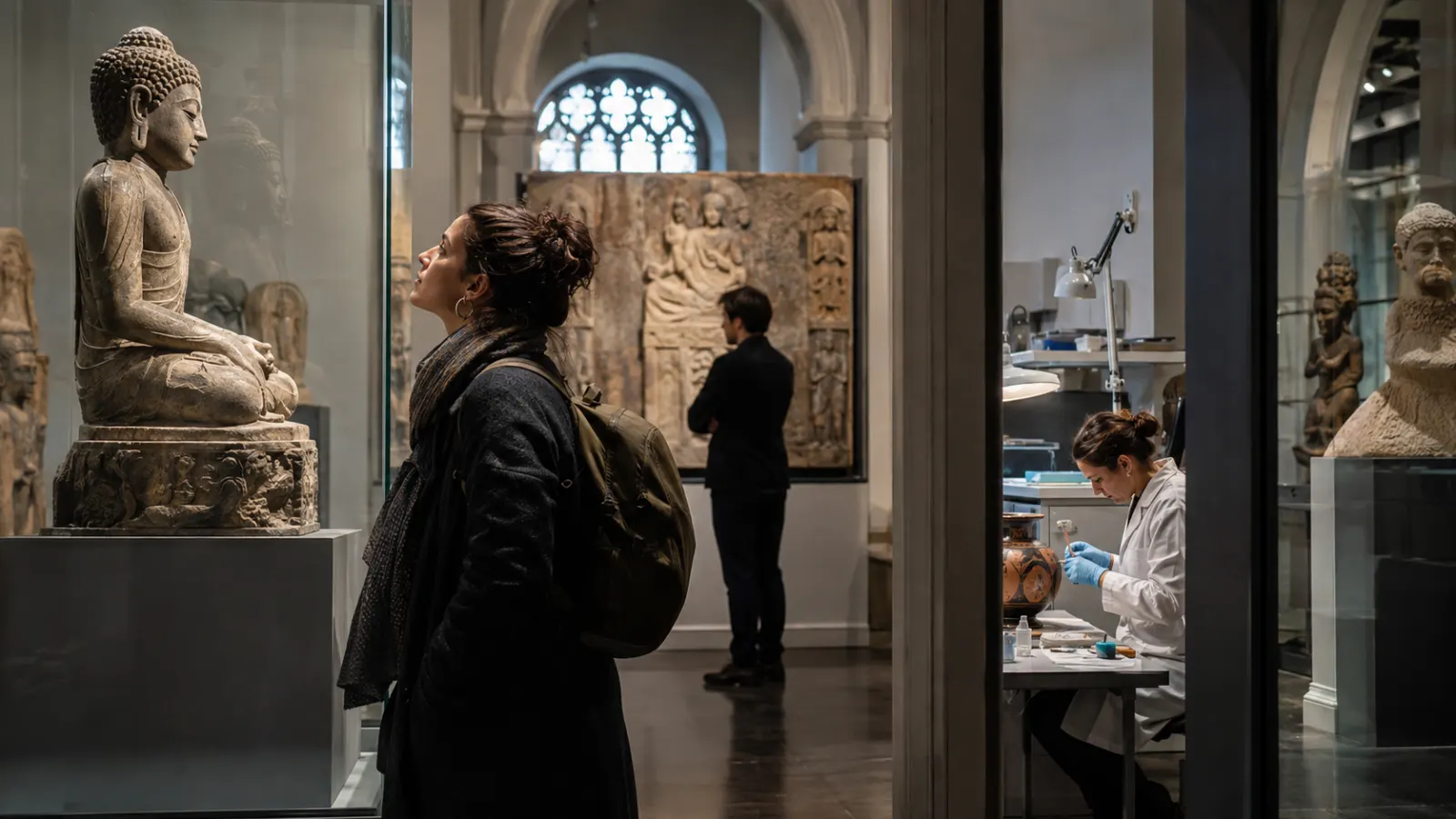
A visitor enters a museum.
They see:
paintings;
fossils;
historic clothing;
machines;
archaeological objects;
photographs;
specimens;
or objects from everyday life.
The obvious conclusion is that museums exist to display things.
That is only the visible part.
Before an object reaches a gallery, someone may have to determine:
where it came from;
whether the museum can legally and ethically acquire it;
what materials it contains;
whether it is deteriorating;
how it should be stored;
what its catalogue record should say;
who has authority to interpret it;
whether culturally sensitive access restrictions apply;
whether another community or country has a legitimate claim to it;
and whether displaying it could damage the object itself.
A museum therefore is not simply a place where objects are kept.
It is an institution built around stewardship, evidence, interpretation and public access.
The International Council of Museums adopted a new international museum definition in 2022. It describes museums as permanent, not-for-profit institutions in the service of society that:
research, collect, conserve, interpret and exhibit tangible and intangible heritage.
The definition also emphasises:
accessibility, inclusion, diversity, sustainability, ethical and professional practice, community participation, education, enjoyment, reflection and knowledge sharing.
That tells us something important.
A modern museum is not defined by having glass cases.
It is defined by what it does with heritage and for society.
Museums at a Glance
| Question | Short answer |
|---|---|
| What is a museum? | A permanent, not-for-profit institution that researches, collects, conserves, interprets and exhibits tangible and intangible heritage in the service of society. |
| Why are museums important? | They preserve evidence, support research and education, provide public access to heritage and create spaces for reflection and cultural dialogue. |
| Do museums only display objects? | No. Much museum work happens in storage, conservation laboratories, archives, research departments and collection-management systems. |
| What do museums collect? | Depending on the institution: artworks, archaeological objects, specimens, photographs, manuscripts, technology, oral histories, digital heritage and other cultural or natural evidence. |
| Why do museums preserve objects? | So evidence can survive for future research, education and public interpretation. |
| Why is museum documentation important? | An object without context may lose much of its historical or scientific meaning. |
| Are museums research institutions? | Many are. Collections support research in history, archaeology, art history, biology, geology, conservation and other fields. |
| What is provenance? | The documented history of an object's ownership, custody, excavation, collection or transfer. |
| Why is restitution important? | Some museum objects were obtained through theft, illicit excavation, colonial coercion or other questionable circumstances. |
| What does decolonising a museum mean? | It can include reviewing collecting histories, catalogue language, authority, interpretation, restitution and whose knowledge is recognised. |
| Do museums contribute to education? | Yes. UNESCO identifies museums as spaces for formal, informal and lifelong learning. |
| Do museums contribute to the economy? | Yes, including tourism and creative industries, but UNESCO warns their public value cannot be reduced only to revenue. |
| What is the ICOM Code of Ethics? | An international professional framework for ethical museum practice, revised and formally adopted in June 2026. |
| Are digital museums replacing physical museums? | No. Digital access expands reach but does not fully reproduce physical encounters with original collections. |
| Are museums using AI? | Increasingly, which is why UNESCO and ICOM launched a global survey in 2026 to examine uses, opportunities and ethical challenges. |
What Is a Museum?
The word museum covers many different institutions.
An art museum may preserve paintings and sculpture.
A natural-history museum may hold millions of:
plants;
insects;
fossils;
rocks;
animal specimens;
and environmental samples.
A science museum may preserve:
instruments;
machines;
industrial technology;
and experimental apparatus.
A local history museum may contain:
family photographs;
trade tools;
shop signs;
letters;
school records;
and ordinary household objects.
A memorial museum may focus less on valuable objects and more on:
testimony;
trauma;
identity;
human rights;
and difficult memory.
What connects these institutions is not the type of object.
It is the institutional process of stewardship and interpretation.
ICOM's 2022 definition deliberately includes both:
tangible heritage
and
intangible heritage.
That matters because heritage is not limited to physical things.
It can also include:
knowledge;
practices;
traditions;
oral histories;
performance;
skills;
and cultural meanings connected with objects and communities.
A Museum Is Not a Warehouse
A warehouse can store objects.
A museum must do more.
Imagine two identical archaeological vessels.
Vessel A
Stored on a shelf with no record.
Nobody knows:
where it was found;
when it was excavated;
what archaeological layer it came from;
who owned it;
or how it reached storage.
Vessel B
Documented with:
excavation location;
archaeological context;
date;
material;
dimensions;
condition;
photographs;
ownership history;
and related finds.
The physical objects may look almost identical.
Their research value is not.
Museum work creates the connection between:
object
and
context.
That is why documentation is not bureaucracy added after “real” museum work.
It is part of what makes a collection intellectually usable.
What Do Museums Actually Do?
The public may see only the gallery.
Behind it sits a much larger system.
Typical museum functions can include:
collecting
accessioning
cataloguing
provenance research
conservation
storage
scientific analysis
historical research
photography
digitisation
education
exhibition design
community consultation
loans
security
rights management
repatriation or restitution
publication
and
public programming.
ICOM's definition captures the core sequence through the verbs:
research, collect, conserve, interpret and exhibit.
The exhibition is therefore only one function among several.
Museums Preserve Evidence
One of the oldest and most important museum functions is preservation.
An object may outlive:
the person who made it;
the society that used it;
the institution that commissioned it;
or even the ecosystem from which it came.
Preserving it creates the possibility that future generations can ask questions that nobody thought to ask when the object was collected.
Consider an old biological specimen.
The original collector might have wanted only to classify the species.
A century later, researchers might investigate:
environmental contaminants;
DNA;
historical distribution;
diet;
climate;
disease;
or evolutionary change.
The object remained the same.
The questions changed.
That is one of the deepest reasons museums preserve collections.
Future knowledge cannot always be predicted in advance.
Natural-History Collections Are Scientific Time Capsules
Natural-history museums illustrate this particularly well.
A bird skin collected in 1890 can preserve evidence from:
a specific species;
location;
ecosystem;
and historical moment.
A preserved plant may document where a species once grew before:
urbanisation;
climate change;
pollution;
or habitat loss altered the landscape.
A geological specimen can provide physical reference material for later analytical techniques.
This means natural-history collections are not merely displays of:
stuffed animals;
shells;
bones;
or minerals.
They can function as long-term scientific datasets made from physical objects.
ICOM even maintains specific ethical guidance for natural-history museums because their work raises specialised issues involving:
scientific data;
human remains;
fossils;
minerals;
and biological material.
Museums Preserve Things That Once Looked Ordinary
Not everything in a museum began as treasure.
A factory worker's badge.
A ration book.
A bus ticket.
A child's school notebook.
A supermarket package.
A protest leaflet.
A telephone.
A miner's helmet.
A local club photograph.
At the moment of use, these may have looked ordinary.
Later they become evidence.
This is why museum collecting cannot focus only on:
royalty;
elite art;
wars;
monuments;
and famous leaders.
Everyday objects can reveal:
labour;
migration;
consumption;
gender;
technology;
social class;
family;
and local life
in ways official records do not.
Documentation Gives Objects Meaning
A museum catalogue record can contain information such as:
object name;
maker;
date;
materials;
dimensions;
place of origin;
provenance;
condition;
acquisition method;
current location;
copyright;
cultural restrictions;
related people;
and bibliographic references.
This may sound administrative.
But consider the difference between:
“wooden chair”
and
“chair used in a textile-workers' union hall during a documented 1934 strike.”
The documentation transforms interpretation.
Without context, objects can become visually interesting but historically weak.
Museums Are Research Institutions
The museum gallery is a public interface.
The collection behind it may be research infrastructure.
Researchers use museum collections to investigate:
history;
archaeology;
art;
biodiversity;
climate;
materials;
technology;
trade;
disease;
migration;
and cultural practice.
UNESCO's 2015 Recommendation explicitly identifies museums as institutions involved in:
heritage preservation;
scientific knowledge transmission;
education;
lifelong learning;
social cohesion;
and sustainable development.
This is why some museum collections contain enormous quantities of material that are rarely exhibited.
Their value may be primarily:
scientific;
comparative;
archival;
or documentary.
Why Museums Keep More Than They Display
Visitors sometimes ask:
“Why do museums keep so many objects in storage instead of putting everything on display?”
Several reasons exist.
Space
A museum may own millions of objects but have room to display only a small fraction.
Conservation
Light can damage:
textiles;
paper;
photographs;
pigments;
and biological material.
Continuous display may shorten an object's life.
Research
Some material is retained primarily for scholarly comparison rather than exhibition.
Rotation
Collections can support changing exhibitions.
Cultural sensitivity
Some objects should not be publicly displayed.
Fragility
Certain objects cannot safely withstand prolonged exhibition or transport.
Storage is therefore not necessarily evidence that a collection is “unused.”
Research access, conservation and future reinterpretation are also forms of use.
Conservation Is Not the Same as Making Something Look New
Museum conservation is often misunderstood as restoration.
The goal is not necessarily to make an old object appear freshly manufactured.
A conservator might instead try to:
slow deterioration;
stabilise fragile material;
remove harmful deposits;
support weak structures;
control temperature or humidity;
or document change.
Sometimes damage itself is historically significant.
A repaired ceramic vessel may reveal ancient use.
A damaged banner may carry evidence of protest.
A faded textile may tell researchers about:
materials;
light exposure;
or previous display.
Over-restoration can erase evidence.
Good conservation therefore asks:
What should be preserved?
not simply:
How can we make this look new?
Museums Control Environments Because Objects Age
Material deteriorates.
Paper can become brittle.
Metals corrode.
Textiles fade.
Wood expands and contracts.
Organic specimens can be attacked by insects.
Photographs chemically degrade.
Museums therefore manage factors such as:
light;
temperature;
relative humidity;
pests;
pollution;
handling;
and physical support.
Conservation is partly the science of slowing time.
Nothing lasts forever.
The objective is to extend survival while preserving as much information as possible.
Museums Make Heritage Public
Preservation alone is not enough.
A collection permanently hidden from everyone except its owner has limited public function.
Museums make heritage accessible through:
galleries;
study rooms;
online catalogues;
publications;
loans;
school programmes;
lectures;
research appointments;
and digital images.
ICOM's definition explicitly describes museums as:
open to the public, accessible and inclusive.
UNESCO likewise describes museums as public spaces for:
learning;
discussion;
cultural transmission;
and intercultural dialogue.
Access and Conservation Can Conflict
Public access is important.
So is preservation.
These aims can pull in opposite directions.
Imagine a fragile medieval manuscript.
Visitors understandably want to see the original.
But continuous light exposure can damage:
ink;
pigment;
and paper.
A museum might therefore:
display it temporarily;
rotate pages;
use low lighting;
provide a high-resolution digital facsimile;
or show a reproduction alongside limited original access.
This is not necessarily withholding heritage.
It can be an attempt to ensure the heritage still exists decades later.
Museums Teach Differently From Classrooms
A classroom can explain that:
a dinosaur was enormous;
an industrial loom was mechanically complex;
or an oil painting has visible layers of paint.
A museum can place the visitor in front of:
the fossil;
the loom;
or the painting.
Original objects provide:
scale;
material;
texture;
spatial presence;
and evidence.
The visitor can ask:
How was this made?
Why was it saved?
Who used it?
What is missing?
How do we know its date?
Could the interpretation be wrong?
This is object-based learning.
Museums Support Lifelong Learning
UNESCO describes education as a primary museum function and explicitly includes:
formal;
non-formal;
and lifelong learning.
That matters because museums are not organised only around:
school age;
degrees;
or formal qualifications.
The same institution may serve:
a six-year-old;
a university researcher;
a tourist;
a local resident;
a teacher;
a specialist conservator;
and a retired visitor.
Museums therefore occupy an unusual educational space.
They can support learning without requiring enrolment.
Museums Should Not Simply Tell Children Facts
A weak children's programme says:
“Here are five facts about this object.”
A stronger one asks:
What do you notice?
What material is it made from?
What evidence tells us how it was used?
What do we not know?
Why might someone preserve it?
Can two interpretations be possible?
This teaches something deeper than memorisation.
It teaches children how evidence becomes knowledge.
Museums Create Public Memory
Museums do not only preserve the past.
They help decide which past becomes visible.
Every exhibition involves selection.
A museum has limited:
space;
money;
staff;
collections;
and attention.
Choosing one object means not choosing another.
Choosing one narrative foregrounds one interpretation.
This means curation is not neutral.
Consider a national-history gallery.
Does it emphasise:
political leaders?
workers?
women?
colonised populations?
migration?
military victory?
social conflict?
environmental change?
industrialisation?
The selection affects how visitors imagine national history.
Museums Do Not Simply Reflect Memory—They Help Construct It
Public memory is shaped by:
monuments;
textbooks;
anniversaries;
archives;
films;
family stories;
and museums.
A museum display can give institutional authority to a particular interpretation.
That creates responsibility.
Museums need to ask:
Whose voices are included?
Who is missing?
Who wrote the catalogue?
Who collected the object?
Was the original label offensive or inaccurate?
Could a community connected to the object understand it differently?
The question is not whether museums should avoid interpretation.
Interpretation is unavoidable.
The responsibility is to make it:
evidence-based;
transparent;
and open to revision.
Small Museums Can Preserve Histories Nobody Else Holds
Visitor numbers can distort how museums are valued.
A famous national museum may attract millions.
A local museum may attract only thousands.
That does not mean its collections are unimportant.
A small museum may preserve:
the only photographs of a demolished factory;
oral histories from a local migration community;
records of a regional industry;
objects from a disappearing craft tradition;
or evidence of a local environmental disaster.
Scale and significance are not identical.
A small institution can hold material unavailable anywhere else.
Museums Can Preserve Marginalised Histories
Traditional national collections often concentrated on:
elite art;
imperial expansion;
military history;
political rulers;
and wealthy collectors.
Other experiences were under-collected.
Community and specialist museums have helped preserve histories relating to:
labour;
migration;
race;
gender;
sexuality;
disability;
industrial communities;
and local social movements.
This does not automatically make newer interpretation correct.
It changes the evidence base by asking:
What was previously absent?
Museums Are Places for Reflection, Not Only Celebration
Museums often contain difficult subjects.
War.
Slavery.
Colonialism.
Genocide.
Extinction.
Racism.
Displacement.
Disease.
Death.
Human remains.
Political violence.
The 2022 ICOM definition explicitly includes reflection among museum experiences.
That matters.
A museum does not always exist to make visitors feel proud.
Sometimes its role is to create conditions in which people encounter evidence they would rather avoid.
Museums Can Support Social Cohesion—but Not Automatically
UNESCO identifies museums as institutions capable of contributing to:
social cohesion;
intercultural dialogue;
citizenship;
and cultural understanding.
In 2026, ICOM chose “Museums Uniting a Divided World” as the theme of International Museum Day, explicitly presenting museums as potential spaces for listening, connection and dialogue.
But this potential is not automatic.
A museum that consistently excludes or stereotypes a community may create alienation rather than cohesion.
Social value depends on practice.
Community Participation Changes Museum Authority
Older museum practice often assumed:
museum expert interprets
and
public receives.
Contemporary practice increasingly includes:
consultation;
co-curation;
community advisory groups;
source-community collaboration;
and shared interpretation.
ICOM's current definition specifically includes participation of communities.
This does not mean professional expertise disappears.
A conservator still needs conservation expertise.
An archaeologist still needs archaeological expertise.
But communities may hold:
language knowledge;
oral history;
ritual knowledge;
family history;
cultural restrictions;
and interpretive context
that museum records lack.
The museum's knowledge can become stronger when different forms of expertise are combined.
Museum Authority Should Be Strong Enough to Explain and Humble Enough to Revise
Museums need expertise.
Visitors reasonably expect institutions to:
research;
verify;
date;
identify;
and interpret collections carefully.
But expertise should not become:
“The museum can never be wrong.”
Catalogues change.
Attributions change.
Scientific classifications change.
Provenance information changes.
New documents appear.
Communities correct names.
Previously ignored histories are investigated.
A trustworthy museum should therefore be able to say:
This is what the current evidence supports.
not:
This interpretation can never change.
Provenance Has Become Central to Museum Ethics
One of the most important questions in museum work today is:
How did this object get here?
That is the question of provenance.
Provenance may include:
ownership history;
collection history;
excavation history;
sale records;
export records;
donations;
war transfers;
colonial acquisition;
and custody.
An object can be authentic and valuable while still having an ethically or legally problematic collection history.
ICOM's Code of Ethics explicitly identifies:
due diligence;
provenance;
acquisition procedures;
returns;
restitutions;
and the fight against illicit trafficking
as major professional concerns.
Why Provenance Research Is Growing
Many museums were built during periods when collecting standards differed radically from today's expectations.
Objects may have entered collections through:
colonial administration;
military expeditions;
archaeological excavation;
private collectors;
art markets;
missionary activity;
scientific collecting;
or unequal transactions.
Some records are incomplete.
Some collecting practices were legal under the rules of the time but ethically controversial today.
Others may have involved:
theft;
looting;
illegal export;
or coercion.
ICOM devoted two 2026 issues of Museum International specifically to provenance research, noting that many objects, collections and ancestral remains still have incomplete ownership or custody histories.
That indicates how central provenance has become.
Provenance Is Not Just About Finding a Previous Owner
Strong provenance research can ask:
Who removed the object?
From where?
Under what political conditions?
Was consent possible?
Was payment meaningful?
Was the object excavated legally?
Did colonial law itself enable unequal transfer?
How did later dealers describe it?
Were ownership gaps deliberately hidden?
Did a source community understand the transaction differently?
The chain of custody may therefore become a history of:
power;
law;
trade;
violence;
or inequality.
What Is Restitution?
Restitution generally refers to returning cultural objects or heritage to a party with a legitimate claim.
Related terms can include:
return;
repatriation;
and restoration of ownership.
The exact legal and ethical meanings can differ by case.
A return may involve:
stolen art;
illicitly excavated antiquities;
ancestral remains;
sacred objects;
objects seized during war;
or colonial-era acquisitions.
The important principle is that museum possession is not automatically the end of the ethical question.
Restitution Does Not Mean Museums Are Failing
A common argument says:
“If a museum returns objects, it is destroying its own collection.”
That is too narrow.
Museums claim public trust partly because they apply:
research;
law;
professional standards;
and ethical scrutiny
to their collections.
If careful research demonstrates that an object should be returned, acting on that evidence can strengthen institutional credibility.
ICOM's current ethics framework explicitly includes returns and restitutions among museum responsibilities.
A museum should not preserve an object at the cost of refusing to investigate how it obtained it.
What Does “Decolonising Museums” Mean?
The term decolonisation is widely used and widely debated.
It does not describe one universal procedure.
In museum practice it can involve:
reviewing colonial acquisition histories;
revising catalogue terminology;
questioning older racial or ethnographic classifications;
including source-community expertise;
changing interpretation;
returning cultural objects or ancestral remains;
reconsidering whose scholarship is treated as authoritative;
and examining how institutional power was historically constructed.
ICOM's Working Group on Decolonisation published its report in June 2026 after work conducted from 2023–2025. ICOM itself describes the field as containing diverse approaches and acknowledges that the meaning and application of decolonisation remain debated.
That is important.
There is no single checklist that makes a museum “decolonised.”
Decolonisation Should Not Mean Deleting History
A museum should not solve a problematic historical display by pretending the problem never existed.
Older labels and classifications can themselves become evidence of:
colonial thinking;
racial theory;
scientific assumptions;
or institutional bias.
Sometimes the better approach is to explain:
what the older museum believed;
why it believed it;
who was affected;
and what later evidence changed.
Critical reinterpretation is often more educational than erasure.
Museums Need Public Trust
Museums often hold objects that are:
valuable;
rare;
sacred;
scientifically important;
or culturally sensitive.
Society grants institutions enormous responsibility.
The public therefore has reason to ask:
How was this acquired?
Who owns it?
Is it insured?
Can staff sell it?
Can donors control interpretation?
Are records accurate?
Are conflicts of interest disclosed?
Are human remains handled appropriately?
Are cultural restrictions respected?
Trust depends on procedures.
The Revised ICOM Code of Ethics 2026
ICOM's ethical framework has existed for decades.
The Code was:
first adopted in 1986;
revised in 2004;
and comprehensively revised again through a multi-year process culminating in formal adoption during the 41st ICOM Ordinary General Assembly in June 2026.
ICOM reports that the revised Code was approved by 85.90% of voting members.
The Code addresses professional responsibilities including:
collection management;
acquisition;
legal compliance;
security;
resources;
provenance;
due diligence;
returns;
restitution;
and protection against illicit trafficking.
This matters because museum ethics are not decorative ideals.
They shape what institutions are allowed—or expected—to do with collections.
Museum Ethics Are Hard Because Legitimate Values Can Conflict
Consider a sacred object.
A museum may believe:
public access supports education.
A source community may believe:
public display violates cultural restrictions.
Both positions involve important values.
Or consider human remains.
Researchers may see scientific potential.
Descendant communities may see:
ancestors;
identity;
and dignity.
Ethical museum practice cannot always reduce these conflicts to one universal technical answer.
It requires:
consultation;
law;
evidence;
professional judgment;
and respect for affected communities.
Museums and Human Remains
Human remains raise particularly difficult ethical questions.
Collections may contain:
skeletons;
mummies;
tissue samples;
medical specimens;
or ancestral remains.
Historically, some were collected under conditions that would now be regarded as deeply unethical.
Questions can include:
Was consent obtained?
Are descendants identifiable?
Does scientific value justify retention?
Should remains be displayed?
Are religious or cultural obligations relevant?
Who has decision-making authority?
This is one of the areas where the older idea that museums simply “own objects” becomes inadequate.
Human beings are not ordinary collection material.
Museums Can Support Scientific Knowledge
UNESCO explicitly includes the transmission of scientific knowledge among museums' social roles.
Museums can do this through:
science exhibitions;
natural-history collections;
demonstrations;
research;
public lectures;
citizen-science programmes;
and specimen databases.
But science museums have an additional responsibility:
they must communicate uncertainty honestly.
A good science exhibition should distinguish:
established evidence;
active research;
historical theory;
and scientific controversy.
Museums Can Help People Understand How Knowledge Changes
One of the best things a museum can show is:
knowledge has a history.
An old scientific instrument reveals how measurement was once performed.
A historical medical display shows how disease was once understood.
A taxonomy collection shows how species classification changed.
An astronomical model shows how humans once imagined the cosmos.
This does not mean:
“people in the past were stupid.”
It shows that knowledge develops through:
evidence;
tools;
institutions;
argument;
and revision.
Museums Can Test Claims Against Physical Evidence
Digital information can circulate extraordinarily quickly.
Photographs can be edited.
Context can disappear.
AI can generate convincing synthetic material.
A museum object with documented provenance provides a different kind of evidence.
It has:
material composition;
physical dimensions;
a catalogue history;
a storage location;
and often a documented chain of custody.
Museums are not automatically correct because they possess originals.
But collections create an environment where claims can be tested against preserved evidence.
That can be especially valuable in an information environment where images and claims detach easily from their source.
Digital Museums Expand Access
Digitisation has transformed museum access.
Someone thousands of kilometres away may be able to:
search a collection;
view high-resolution images;
read catalogue records;
compare objects;
download research data;
or explore a 3D model.
This can dramatically expand access for:
researchers;
students;
teachers;
people with disabilities;
and audiences unable to travel.
Digital collections also make material searchable in ways physical galleries cannot.
Digital Access Is Not the Same as Physical Access
A high-resolution image can reveal enormous detail.
But it does not fully reproduce:
scale;
weight;
material presence;
three-dimensional form;
surface;
or spatial context.
Likewise, some objects cannot or should not be digitised without restrictions.
Issues may include:
copyright;
sacred knowledge;
privacy;
human remains;
community rights;
and sensitive cultural information.
Digital access therefore creates new museum responsibilities rather than replacing old ones.
Museums Now Have to Preserve Digital Heritage Too
What should a museum do with:
a video game;
a website;
a digital artwork;
a social-media archive;
a software-dependent installation;
or a file format that may become unreadable in 30 years?
Digital heritage can deteriorate differently from physical objects.
A bronze sculpture may corrode slowly.
A digital artwork may become inaccessible because:
software disappears;
hardware fails;
licensing expires;
or operating systems change.
Digital preservation therefore involves:
migration;
emulation;
metadata;
storage redundancy;
and technical documentation.
The museum of the future must preserve both:
things
and
systems required to understand those things.
Artificial Intelligence Is Becoming a Museum Issue
In May 2026, UNESCO and ICOM launched a global survey specifically examining how museums are using artificial intelligence.
The initiative is collecting examples involving areas such as:
collection management;
research;
accessibility;
education;
and visitor engagement,
while examining ethical challenges under UNESCO and ICOM frameworks.
This is significant.
AI could potentially help museums:
search poorly catalogued archives;
translate collections;
improve accessibility;
identify visual patterns;
generate visitor interfaces;
or assist with metadata.
But it also creates risks.
AI Can Introduce New Museum Errors
Imagine an AI system generating catalogue descriptions.
If its training data contains:
historical bias;
incorrect attribution;
racist terminology;
or invented information,
the system can reproduce those errors at scale.
Likewise, AI-generated reconstruction might make a damaged historical site look convincingly complete even where the evidence is uncertain.
Museums therefore need to distinguish:
evidence
from
algorithmic reconstruction.
A realistic image is not necessarily a historically accurate image.
AI makes transparency more important, not less.
Accessibility Is Part of the Museum's Public Function
A museum cannot seriously claim to serve society if major groups cannot use it.
Accessibility may involve:
step-free physical access;
seating;
sign-language interpretation;
captioning;
audio description;
tactile material;
sensory-friendly sessions;
accessible websites;
clear language;
affordable admission;
multilingual interpretation;
and transport considerations.
ICOM's 2022 definition explicitly uses the words:
accessible
and
inclusive.
This turns accessibility from a secondary customer-service concern into part of the museum's institutional purpose.
Accessibility Is More Than Installing a Ramp
Physical access matters.
But accessibility can fail in other ways.
A visitor may enter the building but be unable to:
read labels;
hear audio;
understand specialist language;
afford admission;
navigate the website;
or tolerate the sensory environment.
A museum can therefore be technically open while remaining practically inaccessible.
The better question is:
Who can meaningfully use this institution?
Museums and Sustainability
The ICOM definition also includes sustainability.
Museums face environmental questions because they operate:
large buildings;
climate-control systems;
storage facilities;
international loans;
visitor transport;
exhibitions;
shops;
and construction projects.
At the same time, museums can educate audiences about:
climate change;
biodiversity;
environmental history;
and sustainable development.
Sustainability therefore involves both:
what museums communicate
and
how museums themselves operate.
Conservation Requirements Can Conflict With Sustainability
Museums often use environmental control to protect collections.
Historically, some institutions maintained extremely narrow temperature and humidity standards requiring large amounts of energy.
Modern conservation debates increasingly ask whether environmental standards can be:
evidence-based;
collection-specific;
and more energy efficient.
The challenge is genuine.
Reducing energy should not destroy collections.
Preserving collections should not automatically justify wasteful systems.
Sustainability requires trade-offs to be assessed scientifically rather than symbolically.
Museums Have Economic Effects
Museums can attract visitors.
Visitors spend money on:
hotels;
restaurants;
transport;
shopping;
and cultural activities.
Museums also directly employ:
curators;
conservators;
educators;
designers;
security staff;
technicians;
administrators;
researchers;
and visitor-service workers.
UNESCO recognises museums as economic actors that can contribute to:
tourism;
creative industries;
and local development.
But UNESCO also makes an important qualification.
Museums' primary public functions should not be reduced to revenue generation alone.
Visitor Numbers Are Not the Same as Public Value
Imagine:
Museum A
Receives two million tourists annually.
Museum B
Receives 20,000 visitors but preserves the only surviving archive of a regional mining community.
Which museum is more valuable?
The question has no simple numerical answer.
Attendance is one measure.
Others include:
research use;
educational impact;
collection significance;
community importance;
preservation;
access;
and cultural meaning.
A museum can matter even when it never becomes a major tourist attraction.
Museums Can Help Communities After Crisis
War, natural disaster and political violence can damage:
museums;
libraries;
archives;
monuments;
and collections.
Cultural recovery cannot replace:
housing;
food;
safety;
or healthcare.
People come first.
But after immediate survival, heritage may help communities reconnect with:
identity;
memory;
place;
and continuity.
UNESCO and ICOM both work on museum and cultural-heritage protection in crisis contexts.
Objects can become especially meaningful when the world around them has been destroyed.
Emergency Planning Is Part of Museum Work
Museums therefore need plans for:
fire;
flood;
earthquake;
war;
civil disorder;
cyberattack;
power failure;
water leaks;
and pest infestation.
Emergency preparedness may involve:
priority salvage lists;
backup catalogues;
safe storage;
fire suppression;
staff training;
digital backups;
and disaster-response partnerships.
Preservation is partly about preparing for events everyone hopes never happen.
Museums Do Not Own Complete History
Every museum is selective.
Storage is finite.
Budgets are finite.
Collections reflect:
past collecting priorities;
donor interests;
historical prejudice;
accidents;
geography;
and institutional missions.
This means:
absence from a museum is not proof that something was historically unimportant.
Sometimes it means nobody preserved it.
A museum should therefore be honest about collection gaps.
Collection Gaps Can Reveal Historical Power
Why do museums sometimes hold thousands of objects from:
royal courts
but relatively little from:
domestic workers?
Why might a colonial museum have detailed collections from communities abroad but weak documentation of how those people understood the objects?
Why might industrial history preserve machines better than the experiences of workers?
These gaps are themselves evidence.
They tell us what previous institutions considered worth collecting.
Museums Should Explain How Knowledge Was Produced
A label saying:
“This object dates to 1200 CE.”
can sound authoritative.
A more educational museum can also explain:
How do we know?
Was it:
radiocarbon dating?
inscription?
archaeological layer?
style?
documentary evidence?
scientific analysis?
The visitor then learns not only the conclusion.
They learn the method.
That turns a museum from a place dispensing facts into a place showing how evidence becomes knowledge.
Museums Need to Admit Uncertainty
Some museum labels should say:
possibly
probably
attributed to
date uncertain
or
maker unknown.
This is not institutional weakness.
It is intellectual accuracy.
An object can be meaningful even when parts of its history remain unresolved.
False certainty creates more damage than acknowledged uncertainty.
There Is No Single Type of Museum
Museums include:
art museums;
natural-history museums;
archaeological museums;
science museums;
technology museums;
children's museums;
industrial museums;
community museums;
military museums;
maritime museums;
medical museums;
memorial museums;
open-air museums;
historic-house museums;
and highly specialised collections.
Their methods and priorities differ.
A natural-history research collection and a community oral-history museum may both fulfil the broad museum mission while working in completely different ways.
Science Centres and Museums Are Related but Not Identical
Some science centres use:
interactive exhibits;
demonstrations;
and experiments
without maintaining large historical collections.
Traditional museum definitions often placed more emphasis on permanent collections.
Contemporary institutional boundaries can be more complicated.
The useful question is less:
“Does it look like an old museum?”
and more:
What functions does this institution perform?
Museums Are Not Neutral Storage Systems
Every museum makes decisions.
What to collect.
What to refuse.
What to conserve.
What to deaccession.
What to display.
How to label.
Whose language to use.
Which interpretation to foreground.
Who is consulted.
What should be returned.
These are not reasons to distrust museums automatically.
They are reasons museum procedures should be:
professional;
documented;
transparent;
and open to scrutiny.
Deaccessioning Is Not Simply “Selling the Collection”
Museums sometimes formally remove objects from their collections.
This process is called deaccessioning.
Reasons may include:
duplication;
irreparable deterioration;
lack of relevance to the collection mission;
legal problems;
or responsible transfer to another institution.
Ethical rules are important because collections are held in trust.
Deaccessioning should not become an easy way to sell heritage whenever an institution needs cash.
ICOM maintains dedicated professional guidance on deaccessioning.
Museums Need Clear Acquisition Policies
A museum should not accept every object offered to it.
Taking an object creates obligations.
The museum may need to:
store it;
insure it;
catalogue it;
conserve it;
research it;
and protect it indefinitely.
Before acquisition, institutions may ask:
Does it fit our collecting mission?
Do we have legal title?
Is provenance adequate?
Can we preserve it?
Are there cultural restrictions?
Could another institution care for it better?
Collection growth without planning can become a preservation problem.
Donations Are Not Always Free
A donor gives a museum 500 objects.
The purchase price is zero.
The real cost is not.
The museum may need:
storage space;
cataloguing hours;
conservation;
photography;
insurance;
research;
and environmental control
for decades.
Responsible collecting therefore considers long-term stewardship costs.
Museums Depend on Invisible Labour
The gallery experience depends on many people visitors may never meet.
Curators.
Collections managers.
Registrars.
Conservators.
Archivists.
Librarians.
Researchers.
Preparators.
Photographers.
Educators.
Designers.
Security staff.
Technicians.
Cleaners.
Digital teams.
Front-of-house workers.
Museum work is an institutional collaboration.
The famous curator or exhibition designer represents only part of it.
Museum Work Also Has Labour Problems
Museums can present progressive public values while relying on:
temporary contracts;
low-paid entry-level roles;
unpaid internships;
and insecure cultural labour.
This is increasingly being discussed within the profession.
ICOM itself published a 2026 discussion of casualisation and the sustainability of museum careers.
That raises an uncomfortable but necessary question:
Can an institution claim social responsibility while its own workforce is unsustainably structured?
Museum ethics apply inward as well as outward.
Common Myths About Museums
Myth 1: Museums are places where old things are stored
Too narrow.
Museums research, document, conserve, interpret, educate and provide public access.
Myth 2: Everything in a museum is on display
False.
Many institutions display only a small fraction of their collections.
Myth 3: Objects in storage have no value
False.
Stored collections may support research, conservation, future exhibitions and scientific comparison.
Myth 4: Museums simply tell objective history
False.
Museums interpret evidence and make choices about what to collect and display.
Myth 5: Museum experts should be the only people deciding meaning
Too simple.
Professional expertise matters, but community knowledge can be essential, especially for culturally specific collections.
Myth 6: Restitution destroys museums
False.
Responsible returns can be part of ethical stewardship.
Myth 7: Digitising an object means the original is no longer needed
False.
A digital image cannot preserve every material property of the physical object.
Myth 8: Museums are only for tourists
False.
They also serve:
researchers;
schools;
local communities;
specialists;
and lifelong learners.
Myth 9: Visitor numbers are the best measure of museum value
False.
Research, preservation, education and community significance may be equally important.
Myth 10: Museums preserve the complete past
Impossible.
Collections are selective and contain gaps.
Myth 11: Museum interpretation should never change
False.
New research, evidence and community knowledge can justify revision.
Myth 12: AI can automatically solve museum cataloguing
No.
AI may assist some tasks, but errors, bias, provenance and cultural context still require expert oversight.
What Makes a Good Museum?
A good museum should not be judged only by architecture or expensive exhibitions.
A stronger test asks:
Does it preserve collections responsibly?
Are records accurate?
Is provenance researched?
Are acquisitions ethical?
Can researchers access the collections?
Are exhibitions evidence-based?
Is uncertainty acknowledged?
Can different audiences use the institution?
Are communities meaningfully consulted where appropriate?
Are culturally sensitive collections handled responsibly?
Are interpretation and terminology reviewed?
Are workers supported professionally?
Are digital records preserved?
Is the museum transparent when evidence changes?
Does public programming encourage understanding rather than merely spectacle?
These questions evaluate the institution beneath the gallery.
What Should Visitors Ask Inside a Museum?
Visitors can engage more deeply by asking:
Why was this object collected?
Who collected it?
When did it enter the museum?
What evidence supports the label?
Who wrote the interpretation?
Is another interpretation possible?
What is missing from this gallery?
Does the source community have a voice here?
Is this original, reconstructed or reproduced?
How much of the collection is not on display?
These questions do not undermine museums.
They make museum visiting more intellectually useful.
Frequently Asked Questions
What is a museum?
ICOM defines a museum as a permanent, not-for-profit institution in the service of society that researches, collects, conserves, interprets and exhibits tangible and intangible heritage.
What is the main purpose of a museum?
Museums have several major purposes:
preservation;
research;
education;
interpretation;
public access;
and stewardship of cultural or natural heritage.
Why are museums important?
They preserve evidence that might otherwise disappear, support research and learning, make heritage accessible and help societies reflect on history, identity, science and culture.
What are the main functions of a museum?
Typical functions include:
collecting;
documenting;
conserving;
researching;
interpreting;
exhibiting;
educating;
and providing public access.
What does ICOM stand for?
ICOM stands for the International Council of Museums.
What is the current ICOM museum definition?
The current definition was adopted in Prague on 24 August 2022 and emphasises research, collecting, conservation, interpretation, exhibition, accessibility, inclusion, sustainability, community participation and knowledge sharing.
What is museum conservation?
Museum conservation involves protecting and stabilising objects so that physical deterioration is slowed while preserving historical and scientific evidence.
Why are only some museum objects displayed?
Because of:
limited gallery space;
fragility;
light sensitivity;
research use;
storage rotation;
and cultural restrictions.
What is museum provenance?
Provenance is the documented history of an object's:
ownership;
collection;
custody;
excavation;
sale;
or transfer.
Why is provenance important?
It helps establish:
authenticity;
historical context;
legal ownership;
and whether acquisition was ethical.
What is restitution in museums?
Restitution generally involves returning cultural property or heritage where research, law or ethical considerations support a legitimate claim.
What does decolonising a museum mean?
It can involve examining colonial collecting histories, interpretation, terminology, authority, community relationships and restitution. ICOM's 2026 report emphasises that approaches vary and the term remains actively debated.
Are museums educational institutions?
Yes.
UNESCO explicitly recognises museums as spaces for:
formal;
informal;
and lifelong learning.
Are museums research institutions?
Many are.
Collections can support research in:
history;
art;
archaeology;
biology;
geology;
conservation;
and related disciplines.
Why are museum collections useful to science?
Because preserved specimens and objects allow researchers to revisit physical evidence with new methods and new questions.
Do museums contribute to tourism?
Yes.
UNESCO recognises museums' contributions to tourism and creative industries while also stressing that their public functions cannot be measured only financially.
Are museums neutral?
No institution is completely neutral.
Collection and exhibition decisions involve selection and interpretation.
Professional museum practice aims to make those decisions:
evidence-based;
ethical;
and transparent.
Why do museums return objects?
Objects may be returned after provenance research identifies:
theft;
illegal export;
war seizure;
colonial acquisition issues;
or other legitimate claims.
What is the ICOM Code of Ethics?
It is an international professional reference framework establishing standards for museum practice.
When was the new ICOM Code of Ethics adopted?
ICOM formally adopted the revised Code during its 41st Ordinary General Assembly in June 2026.
Are museums becoming more digital?
Yes.
Many institutions now provide:
online catalogues;
high-resolution images;
3D models;
digital exhibitions;
and research databases.
Will digital museums replace physical museums?
Unlikely.
Digital access can expand reach, but physical collections remain important for:
material evidence;
research;
conservation;
and experiences that cannot be fully reproduced on a screen.
Are museums using artificial intelligence?
Yes, increasingly.
UNESCO and ICOM launched a global survey in 2026 specifically to document museum AI use and associated ethical challenges.
Why is accessibility important in museums?
Because museums claim a public role. Physical, financial, sensory, linguistic and digital barriers can prevent parts of society from participating.
Are small museums important?
Yes.
A small local or specialist museum may preserve unique evidence even if it receives relatively few visitors.
Museums Matter Because They Preserve the Possibility of Reinterpretation
A museum collection is valuable partly because its meaning is not exhausted by today's exhibition.
A textile can be:
an artwork;
evidence of labour;
evidence of trade;
evidence of gender;
evidence of technology;
and evidence of colonial exchange
depending on the question being asked.
A biological specimen can move from:
classification
to
DNA research.
A political poster can move from:
ephemeral propaganda
to
evidence of social history.
Preservation keeps these future interpretations possible.
The Best Museums Do Not Pretend to Have the Final Word
Museum authority can easily become too rigid.
A label looks official.
A display case looks permanent.
A building can make interpretation feel unquestionable.
But historical and scientific knowledge changes.
A strong museum therefore does something paradoxical.
It preserves objects for the long term while keeping interpretation revisable.
Objects may remain.
Meanings can change.
That is not institutional instability.
It is one of the purposes of keeping the evidence.
The Central Idea
Museums matter because societies need institutions that can keep evidence longer than individual memory lasts.
People die.
Buildings disappear.
Technology becomes obsolete.
Languages change.
Species decline.
Industries close.
Governments fall.
Communities move.
Digital platforms vanish.
Without organised preservation, enormous amounts of evidence disappear with them.
Museums intervene in that loss.
They preserve selected parts of:
nature;
culture;
technology;
art;
science;
and ordinary life.
But preservation alone is not enough.
Objects have to be:
documented;
researched;
conserved;
interpreted;
and made accessible.
Institutions also need to explain:
how collections were acquired;
whose knowledge was used;
what remains uncertain;
what should be returned;
and why one version of the past was presented rather than another.
That is why the modern museum is not simply a treasure house.
Nor should it be understood as an unquestionable authority.
Its strongest role is more demanding.
A museum should be a durable institution in which:
evidence is preserved,
knowledge is produced,
interpretations are tested,
communities can participate,
ethical claims can be challenged,
and
future generations remain able to ask different questions.
The museum's greatest achievement is therefore not filling a gallery.
It is keeping the relationship between:
objects, evidence, expertise and public memory
alive long enough to be reconsidered.