What Is the Good Life
The question of the good life is one of the oldest and most practical questions in philosophy. It does not ask merely how to stay alive, how to earn more, how to become famous, or how to avoid pain. It asks something deeper: what kind of life is truly worth living?
Every society gives ready-made answers. Some say the good life is wealth. Some say it is pleasure. Some say it is respectability, achievement, family, power, spirituality, freedom, comfort, service, knowledge, or peace. Modern culture often mixes these answers into one restless dream: earn well, look successful, stay entertained, become admired, remain comfortable, and call that happiness. But philosophy refuses to accept such formulas too quickly. It asks whether a life can look successful from outside and still be poor from within.
The good life is not simply a life that feels good in every moment. It is a life that is good in a fuller sense: meaningful, morally coherent, inwardly stable, and worthy of respect. It includes happiness, but it is not reducible to happiness if happiness means only pleasure. It includes success, but it is not reducible to success if success means only status. It includes freedom, but it is not reducible to doing whatever one wants. The good life is the life in which human capacities, relationships, values, and actions are brought into a wise order.
Why the Question Matters
The question matters because every person lives by some hidden answer to it. A person who believes the good life is comfort will avoid difficulty even when difficulty is necessary for growth. A person who believes the good life is victory will treat others as competitors. A person who believes the good life is service may accept sacrifice that others cannot understand. A person who believes the good life is inner peace may reject ambitions that society celebrates.
We may not state our philosophy clearly, but our choices reveal it. How we spend time, what we envy, what we fear, what we admire, what we sacrifice, and what we refuse to sacrifice all show our working definition of the good life.
This is why the question cannot remain abstract. It affects career, marriage, friendship, education, politics, consumption, spirituality, parenting, health, and death. A confused idea of the good life produces confused living. A clearer idea does not remove all struggle, but it gives direction to struggle.
The Good Life Is Not Mere Pleasure
The most immediate answer is that the good life is a pleasurable life. If life contains more enjoyment than pain, one might say it is good. Food, rest, entertainment, romance, travel, praise, luxury, and sensory delight seem to make life attractive.
Pleasure has a real place in human life. A philosophy that treats all pleasure as corrupt becomes unnecessarily harsh. Friendship, beauty, music, food, laughter, and rest are not enemies of wisdom. They can be part of a humane and balanced life.
The problem is not pleasure itself but the worship of pleasure. Pleasure is unstable. It fades after repetition. What excites today becomes ordinary tomorrow. Pleasure also depends heavily on conditions we cannot fully control: health, money, mood, environment, and other people. If the good life requires constant pleasure, then the good life becomes impossible.
More importantly, many things that make life truly good are not pleasurable in the short term. Discipline, study, care for the sick, moral courage, parenting, public service, and honest self-correction may involve effort and discomfort. Yet people often recognise these as among the most meaningful parts of life.
A life of pleasure without character can become shallow. A life of comfort without purpose can become empty. The good life must include joy, but it must also include depth.
The Good Life and Virtue
One of the strongest philosophical answers comes from the tradition of virtue ethics. In this view, the good life is the life of excellent character. A human being lives well not merely by feeling good but by becoming good.
Virtues such as courage, honesty, justice, temperance, generosity, patience, wisdom, and compassion shape the soul. They determine how a person responds to desire, fear, power, anger, success, and suffering. Without virtue, external success becomes dangerous. Wealth without generosity becomes greed. Intelligence without humility becomes arrogance. Courage without justice becomes aggression. Freedom without self-control becomes slavery to impulse.
The virtue view asks a powerful question: what kind of person am I becoming through my choices? This question changes the meaning of daily life. Every action is not just an isolated event; it is character formation. Each lie makes lying easier. Each act of courage strengthens courage. Each surrender to envy deepens envy. Each act of generosity expands the self beyond selfishness.
The good life, then, is not achieved only at the end. It is practiced repeatedly. It is built through habits.
Indian Reflections on the Good Life
The good life has also been explored deeply in Indian philosophical traditions. The idea of purusharthas, or aims of human life, offers a balanced framework: dharma, artha, kama, and moksha. Dharma refers to duty, moral order, and right conduct. Artha refers to material prosperity and practical power. Kama refers to desire, pleasure, and aesthetic enjoyment. Moksha refers to liberation from bondage, ignorance, and ultimate suffering.
This framework is important because it does not reduce life to one aim. It recognises that human beings need material stability, emotional fulfilment, moral responsibility, and spiritual depth. But it also insists on order. Artha and kama become dangerous when separated from dharma. Wealth and pleasure require ethical discipline. Moksha reminds human beings that worldly success does not exhaust the meaning of existence.
Buddhist thought approaches the good life through the problem of suffering. A life governed by craving, attachment, and ignorance remains restless, even if externally successful. The good life requires insight into impermanence, compassion, mindfulness, and freedom from destructive desire.
Jain thought places emphasis on non-violence, self-restraint, and respect for many-sided truth. A good life is not simply one that benefits the self but one that reduces harm and disciplines appetite.
These traditions show that the good life is not merely personal satisfaction. It is moral, social, and spiritual.
The Modern Confusion: Success as Goodness
Modern society often equates the good life with success. A good life is imagined as a high income, attractive lifestyle, professional status, visible confidence, and social recognition. This view is powerful because it is measurable. Money can be counted. Titles can be displayed. Houses, cars, degrees, followers, and awards can be shown.
But measurable success does not always measure a good life. A person may be wealthy but anxious, famous but lonely, powerful but morally degraded, productive but spiritually exhausted. External success can decorate a life without healing its inner disorder.
This does not mean success is bad. Achievement can be meaningful when connected to skill, contribution, and responsibility. The problem is when success becomes the only measure. Then life becomes a performance before others instead of an honest relationship with truth.
A good life may include ambition, but ambition must be governed by wisdom. The question is not only “How far can I go?” but “What will I become while going there?”
Relationships and the Good Life
No life can be called good if it is completely cut off from love, friendship, and human connection. Human beings are relational creatures. We are born dependent, grow through care, and flourish through recognition.
Good relationships give life warmth, accountability, memory, and belonging. They teach patience, forgiveness, loyalty, generosity, and humility. A person who cannot love or be loved may have pleasure and success, but something central remains wounded.
However, relationships contribute to the good life only when they respect dignity. Possession is not love. Control is not care. Dependency is not intimacy. A relationship that destroys freedom, truth, or self-respect cannot be the foundation of a good life.
The good life requires relationships in which persons help each other become more fully human. This includes family, friendship, mentorship, community, and compassionate concern for strangers. A life turned entirely inward becomes small. A life connected rightly to others becomes richer.
Work, Contribution, and Purpose
Work is another major part of the good life because it consumes much of human time and energy. Work can be merely a means of survival, but it can also become a field of contribution, discipline, creativity, and identity.
Good work does not necessarily mean glamorous work. A teacher, nurse, farmer, accountant, artisan, entrepreneur, civil servant, researcher, or parent doing unpaid care may all live meaningfully through work if their labour serves real value. The dignity of work comes not only from status but from contribution and integrity.
The good life requires that work not completely swallow the person. If work produces income while destroying health, family, character, and peace, it must be questioned. At the same time, a life without disciplined effort can become passive and empty.
The ideal is not laziness and not burnout. The ideal is purposeful effort: work that develops capacity, serves others, and remains aligned with moral limits.
Freedom and Self-Mastery
Many define the good life as freedom. This is partly true. Without basic freedom, human flourishing is severely damaged. Political oppression, poverty, violence, and social humiliation restrict the possibilities of life.
But freedom has an inner dimension as well. A person may be externally free but inwardly ruled by addiction, fear, envy, anger, vanity, or compulsive comparison. Such a person can choose many options but may not be truly self-directed.
The good life requires self-mastery. This does not mean cold suppression of emotion. It means the capacity to govern desires through reason, value, and discipline. A free person is not one who obeys every impulse but one who can choose what is worthy.
Inner freedom becomes especially important in a consumer age. The market constantly manufactures desire. Social media constantly manufactures comparison. Public culture constantly manufactures anxiety about status. A person who cannot govern attention and desire becomes easily manipulated.
The good life therefore requires not only rights but also inner independence.
Suffering and the Good Life
A realistic idea of the good life must include suffering. No one avoids loss, ageing, uncertainty, illness, failure, or death. If the good life means a life without pain, then no human life qualifies.
The wiser question is not how to avoid all suffering, but how to suffer without losing meaning, dignity, or compassion. Some suffering must be resisted because it is unjust or preventable. Poverty, abuse, discrimination, and violence should not be romanticised. But some suffering is inseparable from love, responsibility, and mortality.
A parent worries because they love. A citizen may suffer for justice. A student struggles to grow. A person grieves because someone mattered. These forms of suffering do not make life bad by themselves. They may reveal the depth of what is good.
The good life is not painless. It is a life in which suffering is met with courage, support, interpretation, and moral seriousness.
The Ordinary Good Life
One misconception is that the good life must be extraordinary. People imagine it as a life of fame, adventure, wealth, genius, or historical importance. But much of the good life is ordinary.
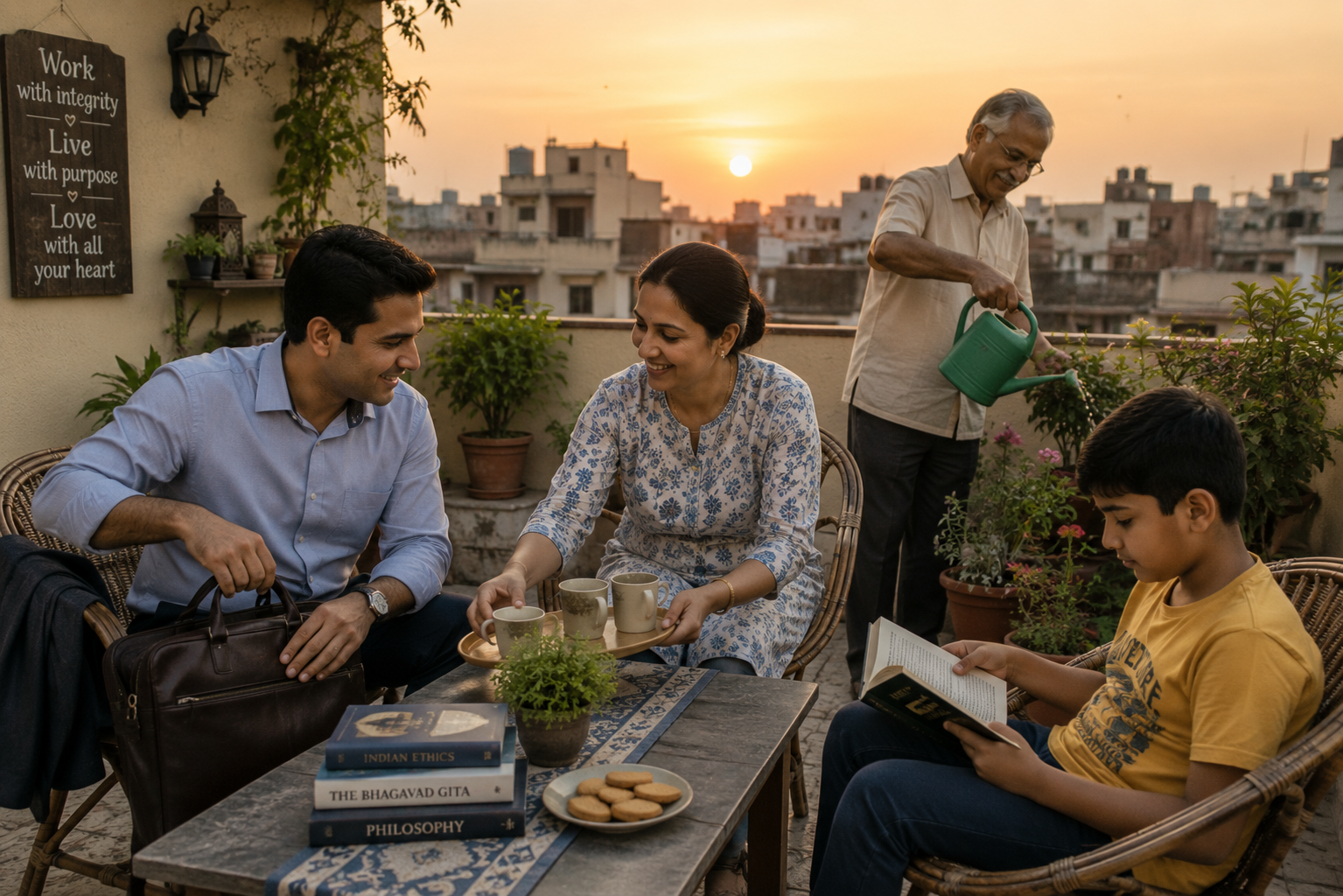
Cooking honestly for a family, keeping promises, learning patiently, helping neighbours, doing fair business, caring for parents, raising children, praying, reading, exercising restraint, paying debts, forgiving, creating beauty in a small home, and refusing corruption can all be parts of a good life.
The good life does not require applause. It requires alignment. The question is whether one’s actions, values, relationships, and inner life form a coherent whole.
Modern culture often makes invisible goodness seem insignificant. But philosophy reminds us that visibility is not value. A quietly truthful life may be better than a loudly celebrated one.
A Practical Framework for the Good Life
A practical definition of the good life can include five dimensions.
First, moral coherence: the person tries to live according to values that can be honestly defended. Second, meaningful contribution: the person’s life benefits others or serves something beyond ego. Third, wise enjoyment: pleasure and comfort are welcomed but not allowed to rule. Fourth, loving relationship: the person gives and receives care without destroying freedom or dignity. Fifth, inner growth: the person continues to refine desire, judgment, character, and understanding.
This framework is not perfect, but it avoids narrowness. It refuses to reduce the good life to money, mood, fame, or renunciation alone. It sees the human being as moral, social, emotional, rational, and spiritual.
The good life is not a fixed recipe. It will look different for different people. But it cannot be whatever anyone happens to prefer. A life devoted to cruelty, deception, greed, or emptiness cannot become good merely because someone chooses it.
The good life is the life in which a human being becomes more truthful, more capable of love, more inwardly free, more useful to others, and more aligned with what is worthy.
In the end, the good life is not found by asking only, “What do I want?” It is found by asking, “What is worth wanting, and what kind of person must I become to live for it?”