What Is an Ecosystem? How Living and Non-Living Parts Work Together
What is an ecosystem? An ecosystem is a system formed by living organisms and the non-living environment interacting with one another. A forest is therefore not an ecosystem simply because trees, birds, insects and mammals occupy the same place. It becomes meaningful as an ecosystem when those organisms are considered together with sunlight, water, soil, temperature, nutrients and the processes connecting them.
The Convention on Biological Diversity defines an ecosystem as a “dynamic complex” of plant, animal and microorganism communities and their non-living environment interacting as a functional unit. The most important part of that definition is interaction. Plants alter soils, animals disperse seeds, microorganisms decompose dead material, rainfall changes nutrient availability and temperature influences which organisms can survive. Ecosystems are therefore networks of relationships and processes rather than merely collections of species.
This also explains why an ecosystem is different from a habitat. A habitat is the place or type of site where an organism or population naturally occurs. An ecosystem includes the organisms, their physical surroundings and the interactions that connect them. A pond may be habitat for a frog, for example, while the pond ecosystem includes the frog, algae, insects, microbes, water chemistry, sunlight, sediment, temperature and all the processes occurring among them.
The Living and Non-Living Parts of an Ecosystem
Ecologists commonly divide ecosystem components into biotic and abiotic factors. Biotic factors are the living components: plants, animals, fungi, bacteria and other organisms. Abiotic factors are the physical and chemical conditions around them, including sunlight, temperature, rainfall, water availability, soil, salinity, nutrients, pH and atmospheric conditions.
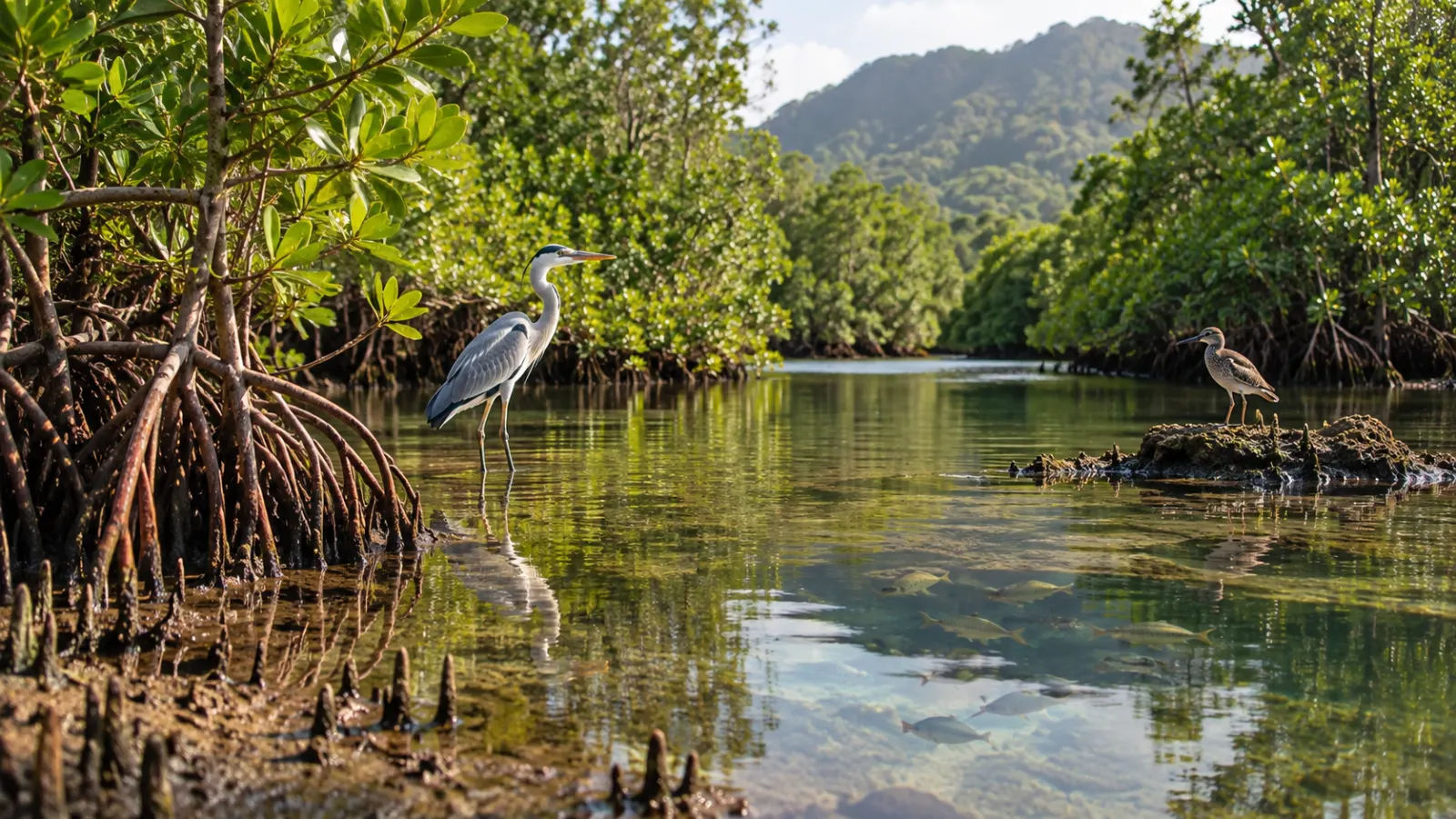
Neither group can be understood properly in isolation. A mangrove tree, for example, survives where salt concentration, tidal flooding, temperature and sediment conditions fall within ranges it can tolerate. In turn, mangrove roots trap sediment, slow water movement and create habitat used by numerous other organisms. The environment shapes organisms, but organisms also reshape their environment.
The biotic part of an ecosystem is equally interconnected. Organisms compete for resources, consume one another, pollinate flowers, disperse seeds, parasitise hosts, form mutualistic relationships and decompose dead material. The U.S. National Park Service notes that ecological communities contain relationships including predation, competition, mutualism, parasitism and commensalism, demonstrating that feeding is only one part of ecosystem organisation.
A useful way of organising some of those living components is by their functional role:
| Group | Main ecological role | Common examples |
|---|---|---|
| Producers | Build organic matter, usually by capturing sunlight through photosynthesis | Plants, algae, some microorganisms |
| Consumers | Obtain energy and matter by eating other organisms | Herbivores, carnivores, omnivores |
| Decomposers | Break down dead organic material and help return nutrients to the environment | Fungi, bacteria |
| Detritivores | Consume dead organic matter and waste physically | Earthworms, many insects and crustaceans |
These categories are helpful but simplified. Many organisms occupy several roles. An omnivore may eat both plants and animals, fungi can form mutualistic relationships as well as participate in decomposition, and microorganisms perform chemical transformations that cannot be represented neatly in a simple food-chain diagram.
The important point is that organisms do not merely live beside one another. Their survival and abundance depend on relationships extending through the whole system.
Energy Flows Through Ecosystems, While Matter Is Recycled
Two processes are fundamental to understanding how ecosystems work: energy flow and the cycling of matter. They are related, but they do not operate in the same way.
In most ecosystems, energy initially enters as sunlight. Plants, algae and other photosynthetic organisms capture some of that solar energy and convert it into chemical energy stored in organic molecules. Herbivores obtain some of this energy by eating producers. Predators acquire energy by consuming other animals, while decomposers use organic material from dead organisms and waste.
Energy is transferred through these relationships, but each organism also uses energy for movement, growth, reproduction, cellular processes and maintaining its body. During metabolism, substantial energy is eventually dissipated as heat. Ecosystems therefore require a continuing energy input; energy moves through the system rather than being endlessly recycled. Khan Academy summarises this distinction as energy generally flowing from light toward heat.
Matter behaves differently.
The carbon, nitrogen, phosphorus, water and other substances making up organisms can be used repeatedly. A plant takes carbon dioxide from the atmosphere and nutrients from soil or water. An herbivore incorporates some of those atoms into its own tissues by eating the plant. A predator may later consume the herbivore. When organisms produce waste or die, decomposers and other ecological processes return materials to soil, water and atmosphere, where they can enter living organisms again.
This is why nutrient cycles are so important. Carbon cycles through organisms, the atmosphere, soils and water. Nitrogen is transformed by microorganisms into chemical forms that organisms can use. Phosphorus moves among rocks, soils, water and living tissues. Water continually moves through evaporation, precipitation, organisms, groundwater, rivers and oceans.
The distinction can be summarised simply: energy flows; matter cycles.
These cycles can also be disrupted. Excessive nutrients from fertiliser or sewage entering lakes and coastal waters, for example, can stimulate large algal blooms. When organisms die and decomposition consumes dissolved oxygen, aquatic animals can experience severe oxygen stress. A change in one part of the nutrient system can therefore produce effects throughout the ecosystem.
Food Chains Are Useful, but Ecosystems Are Really Food Webs
A food chain shows one possible pathway of energy transfer: grass may be eaten by an herbivore, which is then eaten by a predator. Such diagrams are useful for introducing trophic relationships, but real ecosystems rarely operate as simple straight lines.
Most organisms consume or are consumed by multiple species. Those overlapping feeding relationships form food webs. The National Park Service groups organisms into trophic roles such as producers, consumers and decomposers while emphasising that ecosystems are highly interconnected.
Even a food web captures only part of the system. Bees interact with flowering plants through pollination. Birds and mammals disperse seeds. Corals create three-dimensional habitat for other organisms. Beavers alter water flow by building dams. Fungi can exchange nutrients with plant roots. Competition influences which species occupy particular areas.
Some organisms have effects disproportionate to their abundance because they strongly influence habitat or ecological relationships. Removing a major predator, pollinator, ecosystem engineer or other influential species can generate indirect effects far beyond the species immediately interacting with it.
That is why ecologists increasingly focus on networks, feedbacks and processes rather than treating species as independent pieces that can always be removed without consequences.
Ecosystems Can Be Tiny or Enormous
There is no universal minimum or maximum size for an ecosystem. The Convention on Biological Diversity specifically notes that its definition does not prescribe a particular spatial scale. Depending on the ecological question, an ecosystem could be considered at the scale of a small patch of soil, a pond, a forest, a biome or even the entire biosphere.
This sometimes creates confusion between ecosystems and biomes. A biome is a broad ecological region usually characterised by large-scale climate and vegetation patterns, such as tropical rainforest, tundra, desert or savanna. Many individual ecosystems can exist within the same biome.
Ecosystems are also commonly described according to their broader environment:
-
Terrestrial ecosystems occur primarily on land and include forests, grasslands, deserts and tundra.
-
Freshwater ecosystems include rivers, lakes, ponds, streams and wetlands with relatively low salt concentrations.
-
Marine ecosystems include oceans, coral reefs, coastal waters, seagrass beds and other saltwater environments.
These categories help organise ecological knowledge but should not suggest completely sealed systems. A river carries nutrients from land into an estuary. Migratory birds link wetlands separated by thousands of kilometres. Forest insects may depend on nearby streams. Coastal ecosystems receive sediment and nutrients transported from entire watersheds.
Ecosystems are therefore open systems.
Energy, organisms and material cross whatever boundaries researchers draw around them. Wind transports pollen and dust. Rivers move sediment and dissolved nutrients. Animals migrate between habitats. Seeds travel with animals or air currents. Human transport can unintentionally move species across oceans.
This openness has practical consequences for conservation. Protecting one small patch of habitat may not be sufficient if pollution, water extraction, invasive species, climate change or other pressures outside its boundary continue altering the processes required inside it.
Ecosystems Are Dynamic: Disturbance, Feedbacks and Resilience Matter
Healthy ecosystems are not necessarily environments in which nothing ever changes.
Fire, flooding, drought, storms, grazing, disease, falling trees and population fluctuations are part of the ecological histories of many environments. Some plants require periodic fire to reproduce successfully. Floodplains depend on changing water levels and sediment movement. Tree falls can create openings that allow light-dependent plants to establish.
The ecological question is therefore not simply whether disturbance occurs. What matters is its frequency, intensity, timing, scale and interaction with other pressures.
Human activity can change disturbance regimes dramatically. Fire may be suppressed for decades in ecosystems adapted to periodic burning, allowing fuel to accumulate. Elsewhere, land clearing and climate change may make fires more frequent or severe. Dams can prevent natural flood cycles, while water extraction can intensify drought conditions.
Ecosystems also contain feedback loops. Increased vegetation can improve soil stability and water retention, which may favour additional plant growth. Heavy grazing can reduce vegetation, expose soil and increase erosion, making plant recovery more difficult. Predator decline can change herbivore numbers, which can alter vegetation and eventually habitat available to other species.
These feedbacks help explain why ecosystem change is not always gradual. A system may absorb pressure for years and then change rapidly after important thresholds are crossed.
This leads to the concept of ecological resilience: broadly, the capacity of an ecosystem to absorb disturbance while retaining important structures, functions or feedbacks. Resilience should not always be imagined as a system returning perfectly to an earlier snapshot. Ecosystems are dynamic, and climate change can make previous conditions difficult or impossible to reproduce exactly.
The Convention on Biological Diversity consequently emphasises adaptive management because ecosystems are complex, processes may be nonlinear, consequences can appear after delays and ecological knowledge is always incomplete.
For restoration, this means that appearance alone can be misleading. Planting trees may quickly make a degraded site look greener, but true ecological recovery may also require restoring soils, water movement, decomposition, nutrient cycling, pollination, food webs and other processes.
Ecologists therefore measure both who is present and what the system is doing.
Biodiversity and Ecosystem Function Are Connected but Not Identical
Biodiversity refers to variation in living organisms, including diversity within species, between species and among ecosystems. Ecosystem function refers to processes such as primary production, decomposition, nutrient cycling and water movement.
The concepts overlap but should not be treated as synonyms.
Two forests might contain a similar number of species yet differ greatly in their species composition, biomass, soil processes, water retention or carbon storage. Conversely, an ecosystem undergoing species loss may initially appear to continue functioning normally if remaining species perform similar roles.
Over longer periods, however, biodiversity can influence stability and the capacity of ecosystems to respond to change. IPBES assessments identify biodiversity and ecosystem functions—including carbon, water and nutrient cycling—as closely linked foundations of nature's contributions to people.
This is one reason ecological monitoring cannot rely only on counting species. Scientists may measure vegetation growth, decomposition rates, soil nutrients, water chemistry, respiration, pollination, stream flow or other processes depending on the ecosystem and research question.
An ecosystem is not functioning well merely because it still looks green.
Humans Are Part of Ecosystems, Not Outside Them
Environmental discussions sometimes divide the world into “nature” and “people,” but the ecosystem concept does not require humans to be treated as external observers.
The Convention on Biological Diversity's ecosystem approach explicitly recognises humans, including their cultural diversity, as an integral component of many ecosystems.
Cities, farms, fisheries, reservoirs, managed forests and agricultural landscapes contain ecological processes even though human decisions strongly shape them. Urban trees influence temperature and water movement. Agricultural soils contain enormous communities of microorganisms. Fisheries alter predator-prey relationships. Dams reshape sediment transport, migration and river flow.
Human activities can degrade ecological systems, but people also actively manage, restore and maintain ecosystems. Indigenous Peoples and local communities in many regions have developed ecological knowledge and management practices through generations of interaction with particular landscapes.
Recognising humans as part of ecosystems changes environmental policy. Conservation is not always a matter of removing people from nature. Frequently, the challenge is to manage interactions among livelihoods, infrastructure, resource use and ecological processes so that the system can continue functioning.
Ecosystem Services Explain Why Ecosystem Function Matters to People
People depend on ecosystems for food, freshwater, materials, pollination, soil formation, flood regulation, water purification, recreation, cultural identity and many other benefits. These relationships are commonly described as ecosystem services.
The idea is useful because it makes visible the connection between ecological processes and human well-being. A wetland can slow floodwater and filter pollutants. Forest vegetation can influence water and climate regulation. Pollinating animals contribute to reproduction in many wild plants and agricultural crops. Healthy coastal ecosystems can support fisheries and reduce certain forms of shoreline exposure.
Modern assessments increasingly broaden this idea through the concept of nature's contributions to people. IPBES uses the framework to include material, regulating and non-material relationships between nature and quality of life, while recognising that cultural values influence how different societies understand and value those relationships.
But ecosystems should not be treated as factories producing isolated services.
Flood moderation depends on vegetation, soils, topography and water movement. Pollination depends on organisms and suitable habitat. Fisheries depend on food webs, reproduction, water conditions and habitat. These benefits arise from ecological structure and processes.
Nor does assigning a monetary value capture every reason an ecosystem matters. A forest may possess cultural, spiritual, historical, intrinsic or relational significance that cannot be reduced meaningfully to its market price.
Understanding the ecosystem itself therefore comes before calculating its services.
Why the Ecosystem Concept Changes Environmental Thinking
The ecosystem perspective forces us to look beyond individual environmental objects.
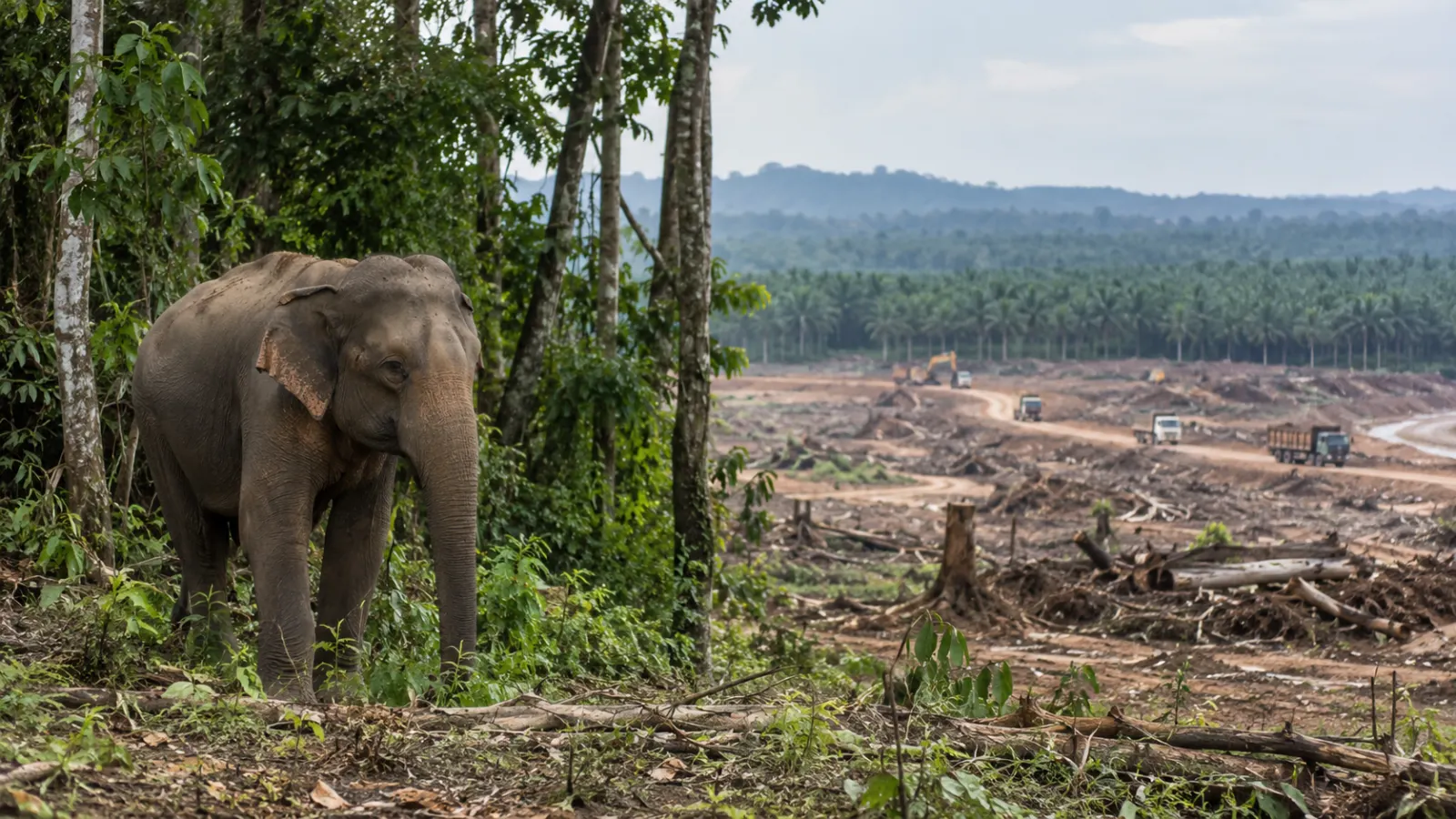
Deforestation is not simply the removal of trees. It can alter soils, evaporation, rainfall patterns, erosion, habitat, carbon storage, nutrient cycles and food webs. Pollution in a river is not merely a change in water chemistry; it can affect microbes, aquatic plants, invertebrates, fish, oxygen levels and organisms farther downstream.
Draining a wetland can change water storage, plant communities, bird habitat, sediment behaviour and nutrient processing simultaneously. Removing a predator may alter prey populations and vegetation. Introducing a new species can reorganise competition and feeding relationships.
This makes environmental management harder because ecological effects can spread through indirect pathways. It also makes the analysis more realistic.
The ecosystem concept tells us that environmental problems rarely concern one isolated species, chemical or landscape feature. They involve networks of relationships.
A forest is therefore more than its trees. A coral reef is more than its corals. A lake is more than a body of water.
Each is a continuing interaction among organisms, energy, matter and physical conditions.
Frequently Asked Questions
What is an ecosystem in simple words?
An ecosystem is a community of living organisms and the non-living environment around them interacting as a system. It includes organisms such as plants, animals and microorganisms together with factors such as water, soil, sunlight, temperature and nutrients.
What are the two main components of an ecosystem?
The two main components are biotic factors, meaning living organisms, and abiotic factors, meaning the non-living physical and chemical environment. Ecosystem processes emerge from interactions between these two components.
What is the difference between an ecosystem and a habitat?
A habitat is the place or type of site where an organism or population naturally occurs. An ecosystem includes the organisms, their physical environment and the interactions among them.
What are producers, consumers and decomposers?
Producers build organic matter, usually using photosynthesis. Consumers obtain energy and matter by eating other organisms. Decomposers such as fungi and bacteria break down dead organic material and help return nutrients to the environment.
Does energy cycle through an ecosystem?
No. Energy generally enters ecosystems from an external source such as sunlight, moves between organisms and is eventually dissipated as heat. Matter such as carbon, nitrogen and phosphorus, by contrast, can be recycled repeatedly through organisms and the physical environment.
Can a small pond be an ecosystem?
Yes. Ecosystems have no universally fixed size. Depending on the question being studied, an ecosystem can be defined at the scale of a tiny patch of soil, a pond, a forest, a biome or even the entire biosphere.
Are humans part of ecosystems?
Yes. Humans interact continuously with ecological systems through farming, fishing, cities, resource use, restoration and many other activities. The Convention on Biological Diversity explicitly recognises humans as an integral component of many ecosystems.
An Ecosystem Is a System of Relationships
The most useful answer to what is an ecosystem is not “a forest,” “a pond” or “a coral reef.” Those are places in which ecosystems can be studied. The ecosystem itself is the system of interactions connecting organisms with one another and with their physical environment.
Energy flows through that system. Matter is recycled. Organisms compete, cooperate, consume and decompose. Water and nutrients move across boundaries. Disturbances alter relationships, while feedbacks can either support recovery or push the system toward a different state.
Humans participate in those processes as well.
Thinking in terms of ecosystems therefore changes how environmental problems are understood. Instead of asking only what has happened to a particular tree, fish, river or patch of soil, ecology asks how changes to one component alter the relationships that allow the larger system to function.
An ecosystem is ultimately the functional conversation between life and its physical environment—and every environmental change has the potential to rewrite more than one part of that conversation.