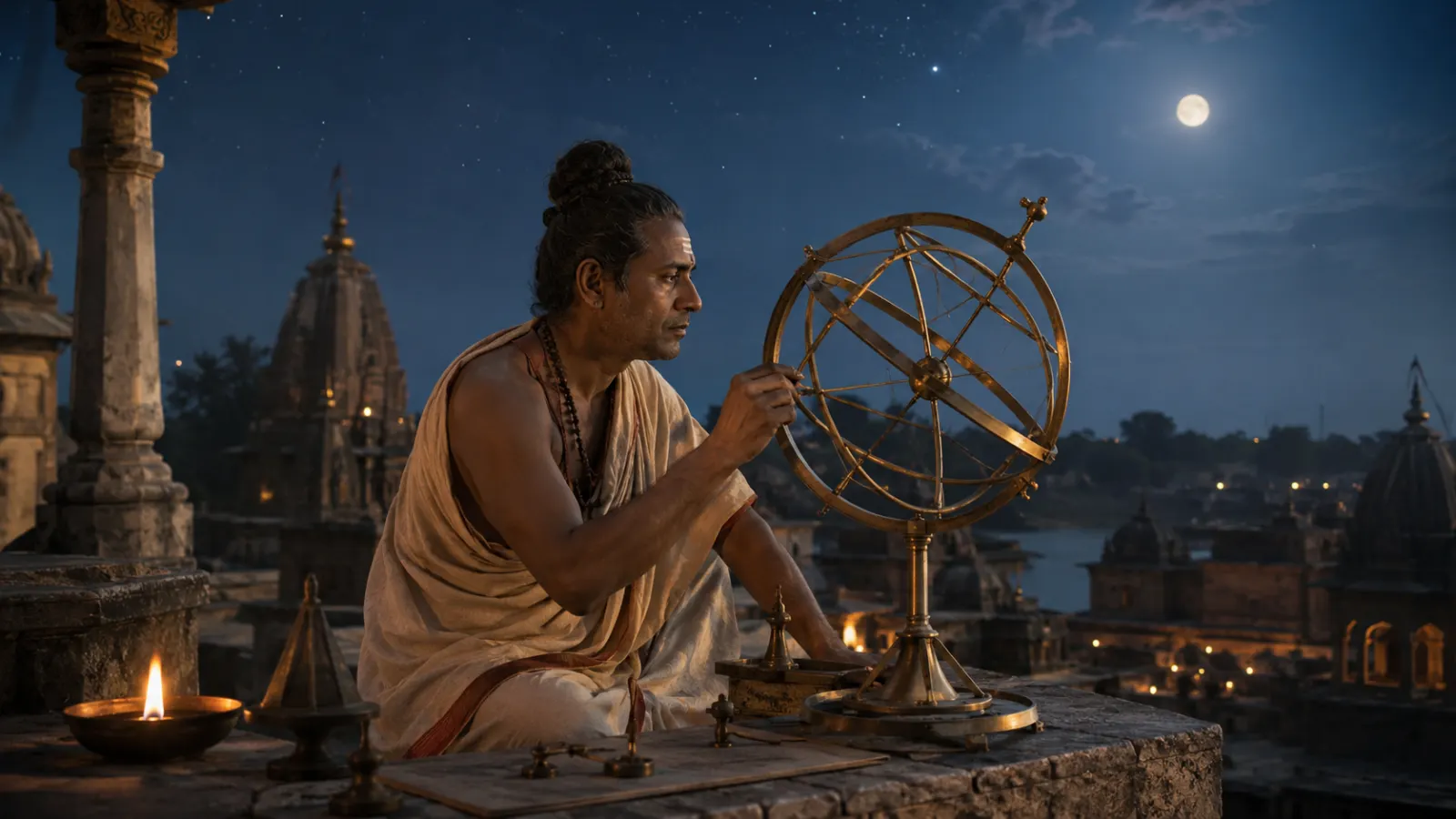
Varahamihira: The Scholar Who Preserved Ancient India’s Astronomical Traditions
Varahamihira was a sixth-century Indian astronomer, mathematician, astrologer and encyclopaedic scholar associated with Ujjain, one of the most important centres of mathematical astronomy in classical India. His best-known works, the Pancha-Siddhantika and the Brihat Samhita, preserve an extraordinary record of Indian astronomical calculation, environmental observation, calendrical knowledge and the wider intellectual culture of his age.
Calling Varahamihira simply an astronomer is accurate but incomplete. Calling him an astrologer is historically defensible but equally incomplete.
His surviving works belong to the Sanskrit jyotisha tradition, a field that brought together mathematical astronomy, calendrical calculation, predictive techniques and interpretations of celestial phenomena. His writings also range across rainfall, architecture, agriculture, water sources, plants, gemstones, perfumes, rituals and many other subjects.
That breadth may appear miscellaneous to a modern reader because contemporary knowledge is divided into specialised academic disciplines. In Varahamihira's world, however, the boundaries between astronomy, mathematics, natural observation, cosmology and practical knowledge were organised very differently.
His importance therefore lies not only in what he calculated or believed, but also in the remarkable body of earlier knowledge that his works preserved.
Varahamihira at a glance
| Detail | Information |
|---|---|
| Period | Sixth century CE |
| Region | Classical India |
| Associated centre | Ujjain |
| Fields | Mathematical astronomy, jyotisha, calendrical studies and encyclopaedic scholarship |
| Major works | Pancha-Siddhantika, Brihat Samhita and Brihat Jataka |
| Known for | Comparing and preserving earlier astronomical systems |
| Historical importance | Major source for the history of Indian astronomy and the transmission of astronomical knowledge |
| Legacy | Part of a long mathematical-astronomical tradition that continued through later Indian scholars |
Who was Varahamihira?
Varahamihira belonged to a highly developed astronomical culture in India during the fifth and sixth centuries CE.
He is particularly associated with Ujjain, a major intellectual and astronomical centre. Indian astronomers used mathematical procedures to calculate planetary positions, eclipses, solar and lunar cycles and calendrical quantities long before the invention of the telescope.
Varahamihira inherited this technical tradition while also encountering multiple schools of astronomical thought. His work is especially valuable because he did not preserve only one system. He compared different astronomical traditions and recorded their methods.
This makes him an important figure not just in the history of Indian astronomy but in the broader history of scientific transmission.
Ancient scientific knowledge rarely developed inside completely isolated civilisations. Ideas travelled through trade, political expansion, translation, migration and scholarly exchange. Varahamihira's writings provide important evidence of precisely this interconnected intellectual world.
Ujjain and the geography of ancient astronomy
Astronomy in the ancient and early medieval world was closely connected with geography.
Astronomers required reference locations, calendrical conventions and established centres from which observations and calculations could be organised. Ujjain became particularly important in the Indian astronomical tradition and was later associated with a conventional reference meridian used in astronomical computation.
Varahamihira's association with Ujjain placed him within an intellectual environment already transformed by earlier mathematical astronomy.
Aryabhata, born in 476 CE according to information contained in his own work, belonged to the generation immediately preceding Varahamihira. The two scholars should not simply be merged into a vague story of an Indian scientific "golden age," but their work illustrates the sophistication mathematical astronomy had achieved by the fifth and sixth centuries.
Varahamihira's writings also demonstrate familiarity with astronomical systems whose names indicate contact with knowledge originating beyond India.
This is important because it challenges the popular idea that ancient scientific traditions can be understood as completely self-contained civilisations competing over who "discovered" something first.
Knowledge moved.
Astronomers compared it, translated it, corrected it and adapted it to their own computational traditions.
The Pancha-Siddhantika and five astronomical systems
The Pancha-Siddhantika, or compendium of five astronomical systems, is the work most directly associated with Varahamihira's importance as a mathematical astronomer.
It discusses five siddhantas conventionally identified as:
-
Surya Siddhanta
-
Romaka Siddhanta
-
Paulisa Siddhanta
-
Vasishtha Siddhanta
-
Paitamaha Siddhanta
These systems were not identical.
They represented different astronomical traditions, assumptions, constants and computational procedures. The names Romaka and Paulisa have attracted particular scholarly attention because they indicate connections with astronomical knowledge associated with the western or Greco-Roman world.
The significance of this material should not be reduced to a simple question of whether Indian astronomy "borrowed" from somewhere else.
Scientific traditions have always developed through exchange.
Varahamihira was working in an intellectual culture capable of receiving, comparing, adapting and recombining different systems of astronomical knowledge.
The Pancha-Siddhantika therefore performs two functions.
It is a work of mathematical astronomy in its own right.
It is also an archive of earlier traditions.
Some of the astronomical texts Varahamihira knew no longer survive independently in the form available to him. Without his summaries, historians would know considerably less about them.
That makes preservation one of his most important contributions.
Tables, parameters and the craft of prediction
Premodern mathematical astronomy was fundamentally computational.
An astronomer needed procedures capable of transforming a date into an expected position of the Sun, Moon or planets. Calculations could also help determine the timing and circumstances of eclipses.
Such systems depended on numerical parameters, cycles and correction rules inherited from earlier astronomers and adjusted over time.
The Pancha-Siddhantika is particularly important because several computational traditions appear side by side.
This reveals something crucial about the history of science: astronomy was not a single frozen doctrine.
Different schools could use different constants or procedures while attempting to describe the same observable sky.
A learned astronomer therefore had to understand competing systems, determine how inherited tables were to be interpreted and decide where correction or adaptation was necessary.
Varahamihira's work gives historians evidence of this culture of technical comparison.
Scientific knowledge progresses not merely when one individual suddenly announces a discovery, but also when methods can be compared, tested, revised and transmitted across generations.
Astronomy before the telescope
Varahamihira lived roughly a thousand years before telescopic astronomy transformed humanity's view of the heavens.
Yet sophisticated astronomical knowledge does not require a telescope to begin developing.
Astronomers across India, China, the Mediterranean, the Middle East and other regions relied on naked-eye observations, arithmetic, geometry, angular measurements, shadows, gnomons, timekeeping devices and accumulated numerical tables.
Repeated observation allowed increasingly refined predictions of celestial cycles.
Much of mathematical astronomy was practical.
Calendars required knowledge of solar and lunar motion.
Eclipse prediction required numerical computation.
Planetary positions were important to astronomical calculation as well as to astrology.
This overlap is essential to understanding Varahamihira.
A modern reader may want to divide astronomy and astrology sharply, accepting mathematical eclipse calculations while rejecting astrological prediction. Contemporary science has good reasons for doing so.
But Varahamihira did not inhabit a modern university divided into departments of physics, meteorology, geology and religious studies.
For him, these forms of celestial knowledge could belong to the broader field of jyotisha.
Astronomy and astrology: avoiding an anachronistic divide
Modern astronomy studies celestial objects using mathematics, physics, observation and experimentally testable models.
Astrology, by contrast, is not supported by contemporary scientific evidence as a system capable of establishing reliable causal relationships between planetary configurations and individual or social events.
Both facts should be stated clearly.
At the same time, historians should not impose modern disciplinary divisions backward onto sixth-century scholars.
In Varahamihira's intellectual environment, mathematical prediction of planetary positions could provide the astronomical information on which astrological interpretations were subsequently based.
Precise calculation and divination could therefore appear in the work of the same scholar.
Recognising that historical relationship does not validate astrology scientifically.
It simply allows Varahamihira to be understood accurately in the intellectual context in which he lived.
The strongest historical assessment is therefore balanced: he participated in a sophisticated mathematical astronomical tradition while also practising forms of celestial interpretation that modern evidence does not support.
Both statements can be true simultaneously.
The Brihat Samhita: an encyclopaedia of a learned world
If the Pancha-Siddhantika reveals Varahamihira the mathematical astronomer, the Brihat Samhita demonstrates the extraordinary range of his scholarship.
The work moves across subjects that a modern library would separate into astronomy, meteorology, architecture, agriculture, botany, gemology, water management, ritual studies and divination.
This breadth has produced two recurring errors in modern discussions of Varahamihira.
The first is dismissal.
Because portions of the work contain astrology, omens and cosmological interpretations, the entire text is sometimes treated as scientifically meaningless.
The second is exaggeration.
Isolated passages are sometimes presented online as proof that Varahamihira had already developed essentially modern geology, hydrology, ecology, climatology or other contemporary scientific disciplines.
Neither approach is historically convincing.
The more useful question is how Varahamihira organised knowledge.
What observations did he consider significant?
How did practical experience interact with inherited textual traditions?
Where can empirical observation be distinguished from symbolic or astrological interpretation?
Those questions reveal far more about the history of knowledge than attempts either to ridicule him or to transform him into a twenty-first-century scientist.
Rainfall, clouds and natural observation
The Brihat Samhita contains extensive discussion of weather and rainfall.
Varahamihira considered clouds, winds, seasonal conditions and various celestial signs that were believed to help predict precipitation.
Some passages reflect close attention to recurring natural patterns.
Others connect rainfall with astrological correlations for which modern meteorology provides no scientific basis.
This distinction matters.
Observation and explanation are not the same thing.
A scholar may recognise a recurring environmental pattern without possessing an accurate modern explanation of the physical mechanisms producing it.
This has occurred repeatedly throughout the global history of science.
The historical importance of Varahamihira's weather discussions therefore lies in the effort to organise and systematise environmental observations, not in claiming that sixth-century meteorology was equivalent to modern atmospheric science.
Water, vegetation and signs beneath the ground
Varahamihira is frequently described in popular accounts as an early hydrologist because the Brihat Samhita contains discussions of locating underground water through signs visible at the surface.
These include features involving vegetation, soils and other aspects of the surrounding landscape.
There is genuine historical interest in such techniques.
Long before geophysical surveys, satellite imaging or modern drilling equipment, societies developed practical methods for identifying locations where water might be available.
Vegetation can, under some circumstances, reflect moisture conditions beneath the surface.
But it would be misleading to describe Varahamihira's system as modern groundwater science.
The text combines practical environmental observation with inherited lore and symbolic associations.
Its historical significance lies in showing how premodern communities attempted to interpret landscapes in search of hidden resources.
That achievement is interesting enough without anachronistically converting it into a modern scientific discovery.
Varahamihira and ideas about the Earth
Modern social-media discussions sometimes claim that Varahamihira independently discovered modern ideas about Earth's shape, gravity or other major physical principles centuries before European scientists.
Such claims usually simplify a much more interesting history.
Indian mathematical astronomy had already developed sophisticated geometrical models by Varahamihira's period.
A spherical Earth was part of astronomical calculation in this wider intellectual tradition. Aryabhata, for example, had explicitly treated Earth as spherical and discussed the apparent daily motion of the heavens in relation to Earth's rotation.
Varahamihira worked within this advanced mathematical culture.
That context is historically more important than extracting a line from an ancient text and presenting it as the winner of a modern "who discovered it first?" contest.
Scientific ideas emerge from traditions of calculation, debate, observation and transmission.
Priority claims alone rarely capture that process.
Varahamihira's major works
Three works are particularly associated with Varahamihira's intellectual legacy.
Pancha-Siddhantika
This is his major work of mathematical astronomy.
Its exceptional historical importance comes from its comparison and preservation of five astronomical systems, including traditions that are otherwise incompletely known today.
Brihat Samhita
The Brihat Samhita is an enormous encyclopaedic work.
Its subjects extend far beyond astronomy and include environmental observations, architecture, agriculture, water, plants, gemstones, social practices, rituals, omens and numerous other topics.
It provides historians with a window into both technical knowledge and the cultural assumptions of Varahamihira's age.
Brihat Jataka
The Brihat Jataka is associated primarily with astrology and became an influential work within the Sanskrit astrological tradition.
Its place alongside Varahamihira's astronomical and encyclopaedic writings illustrates why modern disciplinary categories cannot simply be projected onto his intellectual world.
The problem with the “Nine Gems” story
Popular biographies frequently describe Varahamihira as one of the Navaratnas, or Nine Gems, in the court of a king called Vikramaditya.
The story is deeply embedded in later Indian cultural memory.
It should not, however, be presented as securely documented sixth-century court history.
“Vikramaditya” was a title associated with more than one ruler, and the famous lists of nine intellectuals bring together individuals whose chronologies do not fit comfortably within one historical court.
The textual tradition supporting the familiar Nine Gems story is considerably later than the period in which Varahamihira lived.
A responsible biography should therefore distinguish between cultural tradition and historical evidence.
Varahamihira's importance does not depend on whether he belonged to a legendary royal circle.
His surviving writings provide more substantial evidence of his intellectual achievement than the Navaratna story does.
Greek, Roman and Indian astronomy in a connected world
References to western astronomical traditions in Varahamihira's works have sometimes been drawn into modern ideological arguments.
One side may use them to claim that Indian astronomy was merely borrowed.
Another may insist that Indian astronomy developed entirely independently of external influences.
Both positions oversimplify the history.
Science has almost always grown through intellectual exchange.
Hellenistic astronomy itself incorporated earlier Babylonian observations and mathematical knowledge.
Indian astronomers received ideas from outside India while also developing distinctive mathematical methods and adapting imported material to local computational traditions.
Later, Indian astronomy and mathematics would themselves influence scholars working in the Islamic world, while astronomical knowledge continued circulating across Eurasia.
Varahamihira's engagement with multiple traditions should therefore be understood as evidence of intellectual strength rather than weakness.
He belonged to a connected scholarly world.
Calendars, eclipses and the social usefulness of astronomy
Astronomy in Varahamihira's period was not merely an abstract intellectual pursuit.
Calendrical calculations structured ritual observances, seasonal expectations and social life.
Solar and lunar cycles were important for establishing dates.
Eclipse prediction carried both mathematical and cultural significance.
Planetary calculations served astronomical as well as astrological purposes.
Astronomical specialists consequently possessed knowledge with direct social value.
Their calculations linked observations of the heavens with the organisation of time on Earth.
This helps explain why mathematical astronomy continued to be copied, corrected and developed across generations.
A computational system did not need to remain unchanged to remain valuable.
Constants could be revised.
Tables could be corrected.
Procedures could be adapted.
Knowledge often develops through such gradual refinement rather than through complete replacement.
What Varahamihira did not know
Historical admiration becomes more credible when limits are acknowledged.
Varahamihira did not possess modern astrophysics.
He did not know Newtonian gravitational theory, spectroscopy, stellar evolution, modern planetary dynamics or the physical mechanisms that produce India's monsoon system.
His astrological methods are not supported by contemporary evidence-based astronomy.
None of these limitations diminishes his historical importance.
The purpose of studying a sixth-century scholar is not to demonstrate that he somehow possessed all the scientific knowledge of the twenty-first century.
The more interesting question is what could be achieved using the observations, mathematics, computational tools and conceptual frameworks available in his own period.
By that standard, Varahamihira represents an intellectually sophisticated astronomical culture.
Preservation as a scientific contribution
Modern discussions of famous scientists tend to celebrate discovery.
Preservation receives far less attention.
Yet knowledge cannot influence future generations if it disappears.
Manuscripts decay.
Libraries are destroyed.
Languages fall out of use.
Copying traditions end.
Political and social institutions disappear.
For historians, a later author who quotes, compares or summarises an earlier work may become the only surviving witness to a lost intellectual tradition.
Varahamihira's Pancha-Siddhantika performs precisely this function.
Because he recorded multiple earlier astronomical systems, historians can reconstruct aspects of traditions that might otherwise have vanished.
This is one reason Varahamihira's contribution cannot be measured only by asking what entirely new theory he personally invented.
Preserving knowledge can itself be a major intellectual achievement.
Varahamihira in the longer history of Indian astronomy
Indian mathematical astronomy did not begin with Varahamihira and did not end with him.
He occupied a position within a much longer intellectual lineage.
Aryabhata belonged to the preceding generation.
Brahmagupta emerged in the seventh century.
Bhaskara I and, centuries later, Bhaskara II contributed to continuing traditions of mathematical astronomy.
The Kerala school would eventually develop important mathematical ideas many centuries after Varahamihira.
These scholars should not be compressed into a single timeless category called “ancient Indian science.”
They lived in different periods, responded to different problems and used changing mathematical techniques.
What connects them is a long tradition of calculation, commentary, revision and transmission.
Varahamihira's writings are particularly valuable because they reveal an astronomical culture already capable of comparing alternative models and maintaining technical knowledge across generations.
Why Varahamihira still matters
Varahamihira remains important for at least three major reasons.
First, he is a major figure in the history of mathematical astronomy.
The Pancha-Siddhantika preserves valuable evidence about the computational systems used in his period and about the movement of astronomical ideas across cultural boundaries.
Second, the Brihat Samhita is an extraordinary record of the intellectual and practical world of classical India.
It shows how a learned scholar could move from celestial calculation to rainfall, architecture, vegetation, gemstones, water and social practices without encountering the disciplinary boundaries familiar to modern universities.
Third, Varahamihira provides a valuable test of how the history of science should be written.
One approach dismisses premodern scholars because their works contain astrology or ideas modern science rejects.
Another exaggerates their achievements, transforming every suggestive sentence into evidence that they had secretly discovered modern physics, geology, hydrology or climatology centuries in advance.
Both approaches distort the past.
A better method requires more discipline.
Read the texts.
Identify what was actually observed.
Separate mathematical calculation from symbolic interpretation.
Trace intellectual influences.
Distinguish later legends from contemporary evidence.
Acknowledge uncertainty.
Compare claims with the knowledge available in the scholar's own historical period.
Seen in this way, Varahamihira does not need to be transformed into a modern scientist born fifteen centuries too early.
His real achievement is more historically interesting.
He was a formidable scholar of sixth-century India who inherited, compared, organised and transmitted one of the world's significant traditions of astronomical knowledge.
Frequently Asked Questions
Who was Varahamihira?
Varahamihira was a sixth-century Indian astronomer, mathematician, astrologer and encyclopaedic scholar associated with Ujjain. He is best known for works including the Pancha-Siddhantika and Brihat Samhita.
What was Varahamihira famous for?
He is particularly important for comparing and preserving earlier astronomical systems in the Pancha-Siddhantika. His Brihat Samhita is also a major encyclopaedic source covering astronomy, weather, water, architecture, plants and many other subjects.
What is the Pancha-Siddhantika?
The Pancha-Siddhantika is Varahamihira's compendium of five astronomical traditions: the Surya, Romaka, Paulisa, Vasishtha and Paitamaha siddhantas. It is especially valuable because some of the earlier traditions it describes have not survived independently in their original forms.
What is the Brihat Samhita?
The Brihat Samhita is a large Sanskrit encyclopaedic work attributed to Varahamihira. Its subjects range from astronomy and weather to architecture, agriculture, water sources, plants, gemstones, ritual practices and divination.
Was Varahamihira an astronomer or an astrologer?
He was both within the intellectual framework of his period. Mathematical astronomy and astrology could coexist within the broader Sanskrit jyotisha tradition. His astronomical calculations have an important place in the history of science, while astrological causation is not supported by modern scientific evidence.
Did Varahamihira discover gravity?
Claims that Varahamihira discovered modern gravitational theory are misleading. He participated in a sophisticated Indian astronomical tradition, but Newtonian gravitation and modern gravitational physics developed much later.
Did Varahamihira know that the Earth was spherical?
Varahamihira worked within an Indian mathematical astronomical tradition in which a spherical Earth was already used in astronomical reasoning. It is more accurate to understand him as part of that continuing tradition than to present the idea as an isolated personal discovery.
Was Varahamihira one of Vikramaditya's Nine Gems?
Later tradition includes Varahamihira among the Navaratnas or Nine Gems of Vikramaditya's court. Historians treat this claim cautiously because the relevant figures do not fit securely into a single chronology and the best-known textual tradition describing the group is considerably later.
Why is Varahamihira important to historians today?
His writings preserve information about earlier astronomical systems, document the interaction of Indian and foreign astronomical traditions and provide an unusually rich picture of knowledge in sixth-century India.
Conclusion
Varahamihira's legacy does not depend on modern nationalist claims, legendary court associations or attempts to assign him discoveries using terminology invented many centuries after his death.
His surviving works already establish his importance.
The Pancha-Siddhantika preserves and compares astronomical systems that help historians reconstruct the development of mathematical astronomy.
The Brihat Samhita reveals the remarkable breadth of classical Indian scholarship.
His career also demonstrates how knowledge develops through observation, calculation, textual inheritance, cultural exchange and preservation.
Varahamihira therefore deserves attention not because he was secretly a modern scientist.
He deserves attention because he was something historically more precise and equally impressive: a major scholar of sixth-century India whose writings preserved an extraordinary part of humanity's astronomical and intellectual inheritance.