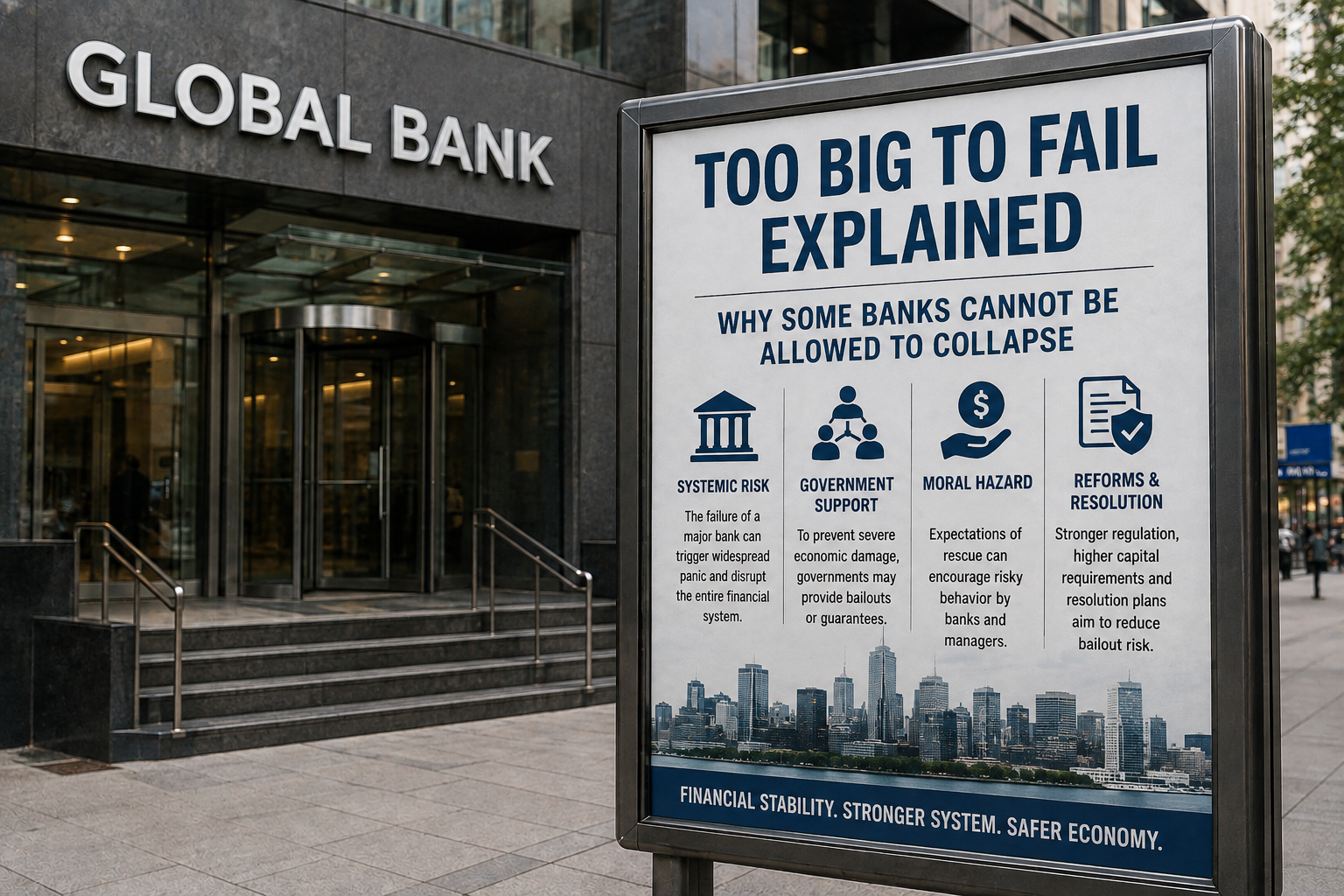
Too big to fail is one of the most powerful and controversial phrases in modern finance. It sounds like a description of size, but it is really a description of consequence. A financial institution is considered too big to fail when its sudden collapse could damage the wider financial system so severely that authorities may feel forced to intervene.
The phrase does not mean that a large bank deserves protection because it is important or prestigious. It means that its disorderly failure could impose costs on depositors, borrowers, other banks, markets, businesses, workers and taxpayers. In that sense, too big to fail is not a compliment. It is a warning.
A normal company can fail without threatening the national economy. A restaurant can close. A factory can go bankrupt. A retailer can lose customers. These failures are painful for owners, workers and creditors, but markets can usually absorb them. Financial institutions are different because they sit inside the payment, credit and confidence system. Their liabilities are someone else's assets. Their failure can create panic.
Size is the easiest reason to understand. A very large bank holds deposits for millions, lends to many businesses, clears payments, funds trade, participates in government securities markets and connects to other financial institutions. If such a bank fails suddenly, the issue is not merely shareholder loss. The issue is whether credit lines freeze, payments are delayed, other banks face losses and depositors start doubting the safety of the system.
But size alone is not the whole story. Some institutions are systemically important because they are interconnected. They have contracts with many other banks, insurers, funds, brokers and corporations. Their failure would transmit losses through the network. Others are important because they are hard to substitute. If one institution dominates a payment service, clearing function, custody business or specialised lending market, its failure can interrupt essential financial activity.
Complexity also matters. A financial group with many subsidiaries, cross-border operations, derivatives contracts and off-balance-sheet exposures may be difficult to unwind quickly. In a crisis, authorities need to know who owes what, which assets can be sold, which contracts can continue and which entities must be protected. Complexity makes failure messy. Messy failure creates panic.
Too big to fail creates a moral hazard problem. If managers, investors and creditors believe that a large institution will be rescued in a crisis, they may take more risk than they otherwise would. Creditors may lend cheaply because they expect public support. Management may grow aggressively because market discipline is weaker. Shareholders may enjoy gains in good times while taxpayers face losses in bad times. This is why the phrase became politically toxic after the 2008 financial crisis.
The dilemma is real. Letting a systemically important institution fail can discipline markets, but it can also trigger panic. Rescuing it can prevent collapse, but it can reward bad behaviour. The policy challenge is to design a system in which important institutions can fail safely. That means losses should fall on shareholders and creditors where possible, while critical functions continue and taxpayers are protected.
After the global financial crisis, regulators around the world developed frameworks for systemically important financial institutions. Globally systemically important banks, or G-SIBs, face additional capital requirements and closer supervision. Many countries also identify domestic systemically important banks, or D-SIBs, whose failure would seriously affect their national financial systems.
India has its own D-SIB framework. The Reserve Bank of India identifies banks that are domestically systemically important based on factors such as size, interconnectedness, substitutability and complexity. These banks must hold additional capital buffers. The logic is straightforward: if a bank can create larger systemic damage, it must carry stronger shock absorbers.
Capital buffers are one response. Capital is the layer that absorbs losses before depositors and other senior creditors are affected. A bank with more high-quality capital is better able to withstand loan losses, market shocks and economic stress. Higher capital does not make failure impossible, but it reduces the probability that ordinary losses become systemic crises.
Liquidity requirements are another response. A bank may be solvent on paper but fail because it cannot meet immediate withdrawals or funding needs. Liquidity rules require banks to hold enough high-quality liquid assets to survive short periods of stress. This matters because many crises are not slow accounting events. They are sudden confidence events.
Resolution planning is equally important. Regulators now want large banks to prepare living wills: plans that show how they could be resolved if they fail. A credible resolution plan identifies critical functions, legal entities, funding needs, operational dependencies and loss-absorbing instruments. The aim is to avoid a situation where authorities have only two choices: chaotic bankruptcy or taxpayer bailout.
Another reform is bail-in capacity. Instead of using public money first, resolution frameworks may require certain creditors to absorb losses or convert debt into equity when a bank is being resolved. This is meant to ensure that private investors who funded the bank bear risk before taxpayers. But bail-in must be handled carefully, because imposing losses on the wrong instruments or investors can itself create panic.
Stress testing also plays a role. Regulators simulate severe scenarios - recession, market crash, loan losses, liquidity shocks, interest-rate moves - and test whether major institutions can survive. Stress tests are not perfect predictions, but they force institutions to examine vulnerabilities before the real crisis arrives.
Too big to fail is not limited to banks. Insurance companies, clearing houses, payment systems, money market funds, non-bank lenders and even technology platforms can become systemically important if they perform critical functions or concentrate risk. Modern finance is increasingly networked, digital and market-based. Systemic importance can therefore arise outside traditional banking.
The Indian context requires a broad reading. Large public and private banks matter. But non-bank finance companies, housing finance companies, mutual funds, payment operators, government securities markets and digital payment infrastructure also affect financial stability. A modern too-big-to-fail discussion must ask not only which banks are large, but which functions are essential.
Too big to fail can also become too interconnected to fail, too complex to fail or too many to fail. A large number of small institutions following the same risky strategy can create systemic danger even if no single institution is dominant. A financial market that everyone uses for funding can become critical even if it has no single owner. This is why regulators increasingly focus on functions and networks, not only on institution size.
Competition policy also matters. When financial markets become concentrated, a few institutions can gain pricing power and political influence. But forcing size down mechanically is not always simple. Large banks may support large infrastructure, trade finance and national payment systems. The better question is not whether every large institution is bad; it is whether large institutions are adequately capitalised, supervised, resolvable and accountable.
There is also a fairness question. Citizens often ask why governments rescue financial institutions while ordinary borrowers face strict repayment rules. The answer is uncomfortable: authorities may intervene not to save owners, but to protect the system. However, intervention becomes legitimate only if shareholders lose money, management is held accountable, public funds are protected and future risk-taking is restricted. Otherwise, rescue becomes privilege.
A well-designed regime should make institutions safer before failure, not merely rescue them after failure. Strong supervision, capital buffers, liquidity rules, transparent governance, early intervention, credible resolution and accountability are all part of the answer. The goal is not to guarantee that no large institution will ever fail. The goal is to ensure that failure does not become a national economic emergency.
Too big to fail therefore teaches a larger lesson about finance. Private financial institutions may be owned by shareholders, but some of their functions are public in effect. Payments, deposits, credit and market confidence are part of economic infrastructure. When a private institution becomes central to that infrastructure, society has the right to demand stronger discipline.
The phrase should not be read as surrender to large banks. It should be read as a call for better rules. If an institution is too important to collapse casually, it is too important to be weakly supervised. If its failure can hurt the public, its risk-taking cannot remain purely private. The real solution to too big to fail is not blind rescue. It is resilience, accountability and the ability to let failure happen without letting the system break.
Disclaimer
This article is for general educational and editorial use. It is not banking, investment, legal, regulatory or crisis-management advice. Institution-specific classifications and capital requirements should be verified from current official regulator releases before publication.