Tidal and Wave Energy: How Ocean Power Works, Benefits, Challenges and Future Potential
Tidal and wave energy attempt to turn the natural movement of water into useful electricity. The basic idea sounds straightforward: moving water contains energy, and generators can convert part of that movement into electrical power just as wind turbines capture moving air and conventional hydropower captures flowing or falling water.
The engineering reality is much harder. Oceans combine saltwater corrosion, storms, waves, currents, marine growth, difficult access and large mechanical forces in an environment where even routine inspection can require specialised vessels, divers or remotely operated equipment. A machine that performs perfectly in a laboratory has to survive years of operation in conditions that repeatedly bend, pull, twist and corrode it.
That explains the central paradox of marine energy. The resource is enormous, geographically widespread and renewable, yet tidal and wave power remain much smaller industries than wind, solar or conventional hydropower. The limiting question is not whether the ocean contains enough energy. It is whether developers can extract enough of that energy reliably, maintainably, environmentally responsibly and cheaply enough to justify large-scale deployment.
Tidal and wave energy are also frequently discussed together even though they are fundamentally different resources. Tides arise mainly from the gravitational interaction of Earth, the Moon and the Sun. Ocean waves are generated primarily when wind transfers energy to the surface of the water. Tides are therefore exceptionally predictable, while waves remain connected to weather and wind conditions.
Understanding that difference is the starting point for understanding ocean power.
What Is Marine Energy?
The U.S. Department of Energy uses marine energy as an umbrella term for renewable energy captured from waves, tides, river currents, ocean currents and, in some systems, differences in ocean temperature or salinity. Tidal and wave energy are therefore two major branches of a larger marine-energy field.
Offshore wind is usually treated separately. An offshore wind turbine stands in or over the ocean, but the energy it captures comes from moving air rather than moving water.
For this article, the most important categories are tidal range, tidal stream and wave energy. Tidal-range projects exploit differences in water level between high and low tide. Tidal-stream systems capture horizontal tidal currents. Wave-energy converters capture the more complex oscillating movement associated with ocean waves.
These distinctions matter because the machines, suitable locations, ecological effects and economics can be very different.
Tidal Energy vs Wave Energy
| Feature | Tidal energy | Wave energy |
|---|---|---|
| Main source | Gravitational interaction of Earth, Moon and Sun | Wind transferring energy to the water surface |
| Predictability | Extremely high | Forecastable but weather-dependent |
| Main movement | Rising/falling water levels or directional tidal currents | Oscillating surface and subsurface motion |
| Typical technologies | Tidal turbines, barrages, lagoons | Point absorbers, oscillating water columns, attenuators, overtopping devices and other WECs |
| Best sites | Straits, channels, estuaries and high tidal ranges | Energetic coastlines with strong consistent waves |
| Technology maturity | Barrages mature; tidal stream moving toward larger arrays | Still diverse, with no single dominant converter design |
| Key engineering challenge | Strong currents, underwater maintenance, foundations | Surviving highly variable waves and extreme storms |
| Environmental questions | Collision, habitat, noise, flow alteration; barrages can substantially change estuaries | Habitat, moorings, noise, cables and interactions with marine life |
| Generation pattern | Cyclical but highly predictable | Variable with sea state |
| Commercial position | Several large tidal-range plants exist; tidal-stream sector emerging | Predominantly demonstration and pre-commercial deployment |
Neither technology is automatically superior. Their usefulness depends heavily on geography.
A country with powerful tidal channels may have excellent tidal-stream resources but mediocre wave conditions. Another coastline may receive strong Atlantic or Pacific swells but lack economically useful tidal currents.
Why Tides Are So Predictable
Tides result primarily from the gravitational forces exerted by the Moon and Sun together with Earth's rotation and the geometry of ocean basins and coastlines. Because the astronomical cycles are known, tide timing can be predicted far into the future.
Local geography determines how dramatic the resulting movement becomes. A wide open coast may experience modest tidal currents, while a narrow strait can force enormous volumes of water through a constricted area and generate much faster flows.
That predictability is a major power-system advantage. Grid operators can know well in advance when a tidal resource is likely to strengthen, weaken and reverse.
But predictable does not mean continuous.
A tidal-stream turbine generates most strongly when the water is flowing rapidly. Near periods of slack water around tidal reversals, current speed can fall substantially before increasing in the opposite direction.
Output therefore rises and falls on a regular cycle.
Projects spread across different geographic locations can reduce some of that variation because high and low tides do not occur simultaneously everywhere. Nevertheless, tidal generation remains periodic rather than constant.
How Tidal-Stream Turbines Generate Electricity
A tidal-stream turbine works on a principle similar to a wind turbine.
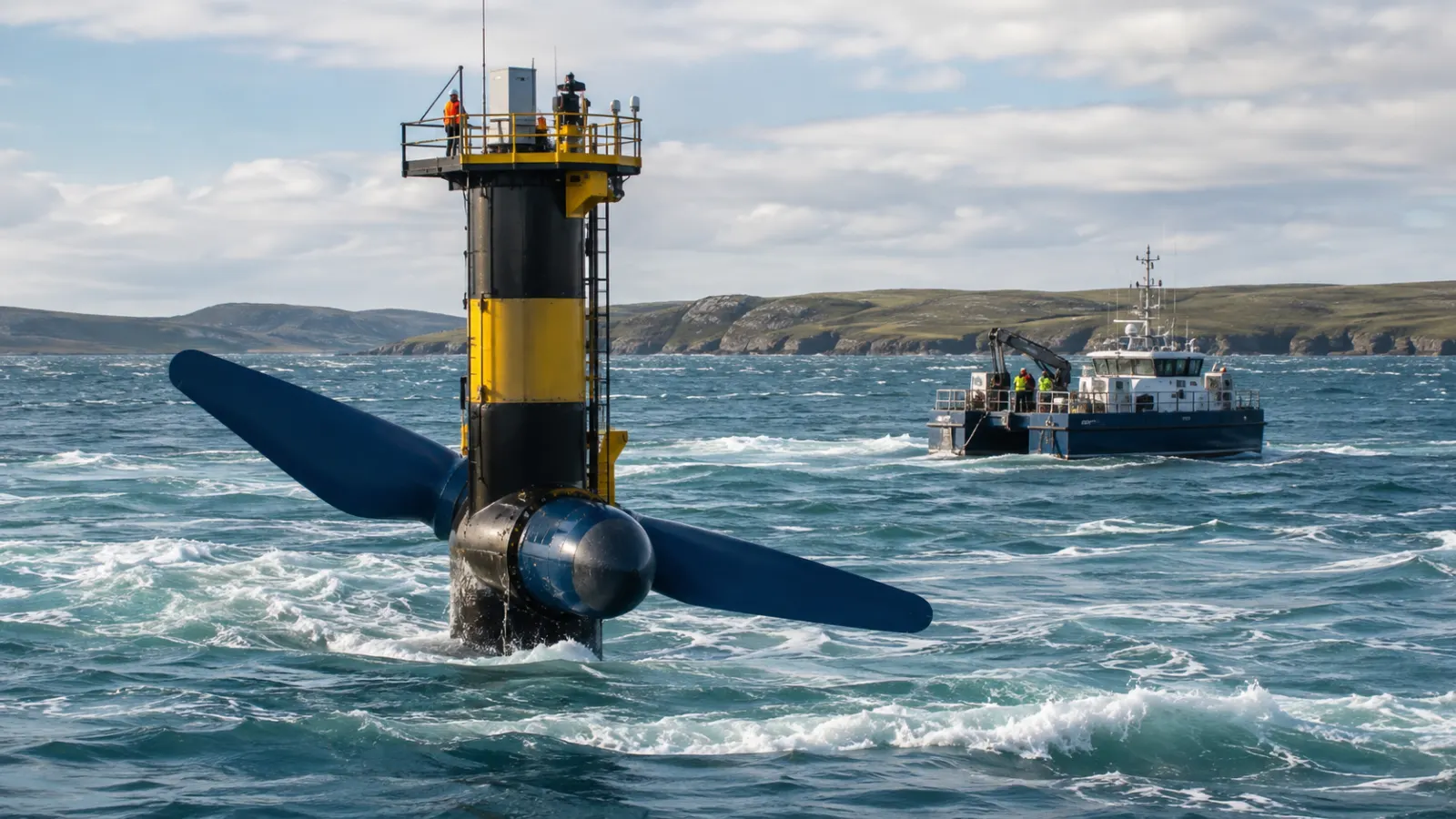
Moving water passes across blades, creating rotational force. The rotor turns a drivetrain or generator, and electricity travels through subsea cables toward shore or another electrical system.
The similarity to wind should not obscure the physical difference between water and air. Water is roughly 800 times denser than air, which means tidal turbines experience much larger forces at relatively modest flow speeds. EIA notes that this allows tidal turbines to capture substantial energy with smaller rotor dimensions than equivalent wind machines, but it also requires structures that are considerably stronger.
Tidal turbines can be mounted directly to the seabed or attached to floating platforms anchored in place. Some floating designs allow major components to be raised toward the surface for maintenance, potentially reducing the need for expensive underwater intervention.
Horizontal-axis turbines resembling underwater wind turbines are common, but they are not the only design. Developers continue experimenting with rotor geometry, support structures and floating systems suited to different channels and depths.
The most valuable locations are usually where coastal geography concentrates moving water: narrow straits, passages between islands, inlets and channels.
Tidal Barrages Use the Tide Differently
Not all tidal power relies on underwater current turbines.
A tidal barrage is a dam-like structure placed across an estuary or tidal basin. Gates allow water levels on opposite sides of the structure to diverge as tides rise or fall. When sufficient head develops, water is released through turbines to generate electricity.
The approach resembles low-head hydropower more than an underwater wind farm.
Unlike tidal-stream technology, tidal barrages are not new experimental machines. Large installations have operated for decades. EIA identifies Sihwa Lake in South Korea at 254 MW as the world's largest operating tidal power station and La Rance in France at 240 MW as the oldest major modern tidal installation.
The main problem is environmental and geographic.
A barrage physically changes how an entire estuary exchanges water with the sea. It can alter tidal range, sediment transport, habitat, navigation and water quality. Because estuaries are biologically productive transition zones, those changes can be significant.
That makes barrage development fundamentally different from placing several turbines in an existing tidal current.
It can generate large amounts of predictable electricity, but the infrastructure intervention is much larger.
Tidal Lagoons
A related concept is the tidal lagoon, in which an enclosed or partially enclosed coastal basin is created rather than blocking an entire natural estuary.
Water enters and leaves through turbines as tides change.
The concept attempts to capture tidal-range energy while reducing some of the ecological and navigational consequences associated with placing a barrage directly across an estuary.
But lagoons require enormous civil engineering structures and therefore face substantial capital-cost, permitting and environmental questions of their own.
The distinction illustrates a recurring rule in marine energy: the resource may be renewable while the infrastructure required to capture it is still substantial.
How Wave Energy Is Created
Ocean waves are driven primarily by wind.
As wind moves across the water surface, friction and pressure transfer energy from the atmosphere into the sea. Small ripples can develop into larger waves, and those waves can continue travelling long after leaving the weather system that generated them.
This is why coastlines can receive strong swell even when local winds are relatively light.
Wave energy is fundamentally different from a steady directional current. Individual water particles often move in approximately orbital or oscillating paths as the wave passes. Motion can occur vertically, horizontally and through pressure changes below the surface.
That complexity has produced an equally complex range of machines.
Wind power eventually converged overwhelmingly around the three-bladed horizontal-axis turbine.
Wave power has not yet experienced an equivalent technological convergence.
How Wave Energy Converters Work
A wave energy converter, or WEC, turns some aspect of wave motion into mechanical or electrical power. There are several major approaches, and each interacts with waves differently.
Point absorbers are floating or semi-submerged devices that move relative to waves, often using vertical motion between a buoy and another component to drive a generator or hydraulic system.
Oscillating water columns contain a chamber in which waves make a column of water rise and fall. That movement compresses and decompresses air above the water, forcing it through a turbine.
Attenuators are elongated floating structures positioned roughly parallel to incoming waves. Sections move relative to one another as waves pass, and that motion can drive a power take-off system.
Overtopping devices allow waves to fill an elevated reservoir, after which the captured water returns to the sea through turbines in a process resembling very small hydropower.
Other concepts use hinged flaps, submerged pressure differences or specialised flexible structures.
DOE's current marine-energy glossary reflects this technological diversity, listing multiple wave-converter families rather than one standard machine.
This diversity is simultaneously a strength and a sign of immaturity.
Engineers have many ways to attack the problem.
The industry still has not determined which approaches will dominate at scale.
Why Wave Energy Is Attractive
The physical resource is enormous.
EIA estimates the theoretical annual wave-energy potential off U.S. coasts at about 2.64 trillion kilowatt-hours, equivalent to around 63% of U.S. utility-scale electricity generation in 2023.
That number should not be interpreted as electricity that could realistically be generated.
It is a theoretical resource estimate.
Actual development is reduced by technical limits, device spacing, environmental constraints, shipping routes, military areas, transmission access, economics and the need to leave substantial portions of the resource untouched.
Nevertheless, the scale explains why wave energy continues to attract research investment.
Waves also offer geographic advantages. Many major population centres and industrial facilities are near coastlines. Islands and remote coastal communities may depend on expensive imported fuel. Marine energy can potentially power offshore sensors, aquaculture, desalination systems and other equipment without requiring long transmission links from shore.
DOE increasingly treats these distributed and offshore applications as potentially important markets rather than assuming marine power must immediately compete with enormous utility-scale solar or wind farms.
Wave Power Is More Predictable Than It First Appears
Wave energy is less predictable than tidal energy because it ultimately depends on weather.
But waves can sometimes be forecast usefully because they travel across long distances from the storms that generated them. A weather system hundreds or thousands of kilometres away can produce swell that reaches a coastline later.
This provides some forecasting lead time.
Wave resources can also follow strong seasonal patterns. Some regions experience much higher wave-energy availability during winter, when storms are more energetic.
The practical benefit depends heavily on location.
Wave energy should therefore be described as forecastable but variable, while tidal energy is astronomically predictable and cyclical.
Confusing the two exaggerates the reliability of wave power.
Why Water's Density Is Both an Advantage and a Problem
Marine-energy advocates frequently point out that water is far denser than air.
That density allows substantial energy transfer through relatively compact machinery.
But every useful force imposed on a turbine blade or wave device also produces structural stress.
A tidal turbine may experience powerful cyclic loading as currents reverse.
A wave device experiences continuously changing forces from different directions.
Storms can expose a wave-energy converter to conditions far more severe than the ordinary waves from which it is supposed to generate electricity.
This creates one of the most difficult engineering trade-offs in the field.
A device should move enough to capture energy efficiently during normal conditions.
Yet it must be strong—or intelligently controllable—enough to survive extreme conditions without becoming prohibitively expensive.
A structure designed only for maximum strength may cost too much.
A lightweight structure optimised only for ordinary waves may fail during storms.
Successful marine-energy engineering therefore depends heavily on survivability.
The Ocean Is a Difficult Place to Maintain Machinery
Mechanical durability is only part of the challenge.
Saltwater accelerates corrosion.
Marine organisms attach themselves to surfaces through biofouling, changing hydrodynamics and complicating inspection.
Moving parts must operate while exposed to sediment, pressure and continuous mechanical cycling.
Electrical cables need protection.
Foundations and mooring systems must withstand both ordinary loads and rare extreme events.
Then something eventually needs repair.
Maintenance at a land-based solar farm may require a technician and a vehicle. Offshore maintenance can require suitable weather, specialist vessels, divers, cranes or remotely operated equipment.
A relatively minor component failure can therefore create substantial downtime and cost.
This is why reliability matters disproportionately in ocean energy.
The cheapest repair is often the one that never becomes necessary offshore.
Installation and Infrastructure Add Major Costs
The electricity-generating device is only one part of a marine-energy project.
Tidal turbines may require foundations or anchors. Floating systems require moorings. Wave devices need station-keeping systems. Power has to travel through subsea cables. Electricity must then be conditioned and connected to an onshore grid or used locally.
Installation vessels can be expensive.
Ports need suitable infrastructure.
Permitting requires surveys and environmental assessment.
Testing new technology itself can become a financial barrier because developers need real ocean conditions before they can prove reliability to investors.
This creates a classic technology-development problem.
Investors want long operating records before financing large deployments.
Developers need money to build deployments long enough to generate those operating records.
Public test facilities are designed partly to break this cycle.
PacWave South Marks an Important 2026 Development
One of the most important recent developments in U.S. wave energy occurred in August 2026.
PacWave South, off the Oregon coast, officially opened following a ribbon-cutting ceremony on 27 August 2026. DOE describes it as the first fully operational, pre-permitted and grid-connected wave-energy test facility in the continental United States.
That matters because marine-energy developers previously had relatively few places where full-scale machines could be tested in real ocean conditions while connected to electrical infrastructure.
A grid-connected test facility allows engineers to study not only whether a device survives but how reliably it converts irregular ocean motion into usable electricity.
PacWave does not mean commercial wave power has suddenly arrived.
It means the infrastructure required to test and improve devices has become significantly stronger.
For an emerging industry, that distinction matters.
Where the Industry Stands in 2026
Marine energy is no longer merely a laboratory concept, but neither is it a mature mass-market electricity technology.
The IEA-OES Annual Report 2025, released in March 2026, describes technologies operating for longer periods in real-sea conditions, pilot arrays progressing toward pre-commercial scale and regulatory frameworks becoming clearer in several countries.
This is progress.
But the global contribution remains tiny relative to wind, solar and conventional hydropower.
Stanford's current ocean-energy overview places ocean energy at less than 0.01% of the global energy mix in the dataset it summarises.
Tidal and wave technologies are also at different stages.
Large tidal barrages have operated commercially for decades.
Tidal-stream developers are progressing toward larger arrays and repeated-generation designs.
Wave-energy developers are still testing a wider variety of architectures and power-take-off approaches.
That makes the phrase “marine energy industry” slightly deceptive if it suggests one uniform level of technological maturity.
There are several industries developing at different speeds.
Tidal Stream Is Moving Toward Larger Arrays
Tidal-stream technology has several advantages in its path toward commercialisation.
The resource is directional and highly predictable. Turbine engineering can draw on experience from wind turbines, marine propellers and hydropower. Developers have accumulated increasingly long operating records at high-energy test sites.
At the European Marine Energy Centre in Orkney, Scotland, multiple tidal developers are now progressing toward multi-device arrays. EMEC has described projects including Orbital Marine Power's planned 9.6 MW tidal array and Nova Innovation's 4 MW, 16-turbine SEASTAR project.
These are still small compared with modern offshore wind farms measured in hundreds of megawatts or gigawatts.
But arrays matter because commercial electricity projects require more than proving that one machine can operate.
Developers have to demonstrate how multiple machines interact, how maintenance scales, how subsea electrical systems perform and whether production can be standardised.
Moving from one prototype to an array is therefore a major industrial step.
Wave Energy Is Still Exploring More Designs
Wave-energy technology remains less converged.
Some developers use floating point absorbers. Others use oscillating-water-column systems, submerged pressure devices or articulated structures.
This does not necessarily mean wave power will fail.
Early aviation, automobiles and wind energy all went through periods of major design diversity before particular architectures became dominant.
But convergence matters economically.
A standard architecture allows suppliers to specialise, factories to scale and maintenance expertise to spread across projects.
The IEA-OES 2025 assessment suggests wave technologies are accumulating increasingly credible operating experience, while EMEC is preparing for larger demonstrations. CorPower Ocean, for example, has announced a 5 MW, 14-device wave array for deployment at EMEC's Billia Croo site in 2029.
That is significant progress.
It also illustrates how far wave power remains from gigawatt-scale deployment.
Environmental Impacts Depend on the Technology and Site
Marine energy produces electricity without continuously burning fuel, but placing structures and moving machinery in marine ecosystems creates legitimate environmental questions.
Turbines may create collision risk for marine animals.
Operating devices can produce underwater noise.
Subsea electrical cables create electromagnetic fields.
Foundations, anchors and moorings can alter habitat.
Large tidal-range structures can change currents, sediment transport and water levels much more extensively.
These risks should neither be dismissed nor automatically assumed to be catastrophic.
PNNL's Triton programme identifies four major monitoring categories for marine-energy development: collision risk, underwater noise, electromagnetic fields and habitat change. Researchers have developed and tested cameras, acoustic instruments, magnetometers and other monitoring methods so regulators can base permitting decisions on empirical evidence.
Scale matters enormously.
The environmental effect of one experimental tidal turbine cannot automatically predict the effect of an array containing hundreds of devices.
Likewise, conclusions drawn from one species or coastal environment cannot always be transferred to another.
Marine-energy expansion therefore needs to occur alongside environmental monitoring rather than waiting until large projects already exist.
Tidal Barrages Have a Different Environmental Profile
Tidal-stream projects and tidal barrages should not be discussed as though their ecological footprints are equivalent.
A group of turbines placed in an existing current extracts some kinetic energy while allowing the tidal system itself to continue.
A barrage changes the hydrology of an estuary much more directly.
EIA notes that barrages can alter tidal levels, increase turbidity and affect navigation and recreation. Changes in sediment transport and water exchange can also alter habitats.
This does not make every barrage unacceptable.
Existing projects demonstrate that tidal-range power can produce substantial electricity over long periods.
But new barrage proposals require site-specific evaluation that goes far beyond the environmental questions associated with several free-stream turbines.
Are Tidal and Wave Energy Renewable?
Yes.
Tidal energy ultimately comes from astronomical gravitational interactions, while wave energy derives mainly from wind driven by atmospheric processes ultimately powered by solar heating.
The resources replenish continuously on human timescales.
But renewable does not mean impact-free.
Steel, concrete, composites, copper, subsea cables, vessels and ports are required to build and maintain marine-energy systems.
Manufacturing those materials has environmental impacts.
Installation changes the marine environment.
Decommissioning eventually has to be managed.
A responsible comparison therefore uses lifecycle analysis rather than treating “renewable” as equivalent to “zero environmental cost.”
The relevant question is whether the electricity can be produced with sufficiently low lifecycle impacts while providing useful system benefits.
How Much Energy Could Marine Power Produce?
The resource figures are enormous, but they require careful interpretation.
DOE estimates that the total available marine-energy resource in the United States is equivalent to approximately 57% of total U.S. electricity generation in 2019. EIA separately estimates theoretical U.S. wave-energy potential at approximately 2.64 trillion kWh annually, equivalent to around 63% of 2023 U.S. utility-scale electricity generation.
Neither figure means the United States could realistically obtain 57% or 63% of its electricity from marine energy.
Theoretical resource estimates answer a physical question:
How much energy moves through these waters?
Commercial potential asks much harder questions.
Can a turbine survive there?
Is the site close enough to transmission?
Would a project interfere with shipping?
Is the seabed suitable?
What does installation cost?
Are there important fisheries, cultural resources or protected ecosystems?
How much energy can be removed without unacceptable effects?
Does the project compete economically with other technologies?
Every additional constraint reduces the realistically developable resource.
That distinction between resource potential and deployable power is one of the most important concepts in renewable-energy reporting.
Advantages of Tidal Energy
Tidal energy's strongest advantage is predictability. Developers and grid planners know in advance when the resource will rise and fall.
Water's high density also allows compact turbines to interact with substantial power flows.
Tidal-stream equipment generally has less visual impact than large wind farms because much of the machinery can remain below the water surface.
The technology could also provide valuable electricity to islands and coastal areas located near strong tidal channels.
Its disadvantages are equally important. High-quality sites are geographically limited, installation is difficult, underwater maintenance is expensive and environmental assessment can be complex.
Predictability therefore makes tidal power valuable.
It does not automatically make it cheap.
Advantages of Wave Energy
Wave energy has a broader geographic resource in some parts of the world and can be especially strong along energetic western coastlines exposed to long-distance ocean swell.
It may also complement other renewables. Wave conditions can remain energetic when local solar generation is low, and in some regions the strongest wave climate occurs during winter when electricity demand can be high.
Wave power is also potentially attractive for offshore applications where supplying electricity from shore is expensive.
But the engineering difficulty is severe.
Waves arrive with varying height, period and direction. A converter must generate efficiently from ordinary waves yet survive extreme storms.
The industry has not converged on one machine architecture, limiting manufacturing scale and standardisation.
Wave energy therefore offers enormous physical potential alongside unusually difficult mechanical design.
Main Advantages and Disadvantages
| Potential advantage | Corresponding challenge |
|---|---|
| Renewable water movement | Harsh marine environment |
| High energy density | High structural loads |
| Highly predictable tides | Tidal output is cyclical |
| Large wave resource | Waves remain weather-dependent |
| Coastal and island applications | Limited high-value sites and grid access |
| Low operational fuel requirements | Expensive installation and maintenance |
| Can complement wind and solar | Technology remains relatively immature |
| Many devices have low visual impact | Subsea monitoring is technically difficult |
| Possible offshore/desalination applications | Competes against mature low-cost renewables |
| Large theoretical resource | Only part is technically and economically developable |
The central trade-off is therefore straightforward: the ocean offers excellent energy physics but difficult engineering economics.
Could Marine Energy Help Stabilise Renewable Grids?
Potentially, yes.
A future grid dominated by variable renewable resources benefits from technologies whose generation patterns differ from one another.
Solar output follows daylight.
Wind follows weather.
Tides follow predictable astronomical cycles.
Waves are weather-driven but may arrive according to different timing from local wind and sunlight.
A diverse renewable portfolio can therefore reduce dependence on any one resource.
Tidal power's predictability is particularly attractive because variations can be scheduled years in advance.
However, tidal power alone does not remove the need for flexibility. Output still falls around slack tide, and peaks may occur at times of low electricity demand.
Storage, transmission, flexible demand and other generators remain important.
Marine energy should therefore be viewed as one potential component of a diversified grid, not as a replacement for all other renewables.
Islands and Remote Communities May Be Early Markets
Utility-scale electricity is not the only useful market.
Remote islands and coastal communities sometimes rely on imported diesel fuel with substantial transportation and storage costs.
An energy technology that appears expensive compared with mainland solar power may become much more competitive if it replaces fuel delivered by ship.
The same logic applies to offshore monitoring stations, aquaculture farms, navigation systems and subsea equipment.
Marine energy can also be paired directly with processes rather than the electrical grid.
DOE has funded research into using wave energy for desalination, where mechanical wave motion can help provide energy for producing freshwater.
This is strategically important.
Emerging technologies do not always commercialise first in the largest possible market.
They often begin where their unusual characteristics solve a particularly expensive problem.
Marine Energy and Desalination
Desalination normally requires significant energy to move water and separate salts.
Coastal and island communities with limited freshwater frequently possess both a need for desalination and access to waves.
Some wave-energy concepts therefore attempt to use ocean motion directly for pumping or pressure generation rather than first converting all of the mechanical energy into electricity.
The potential benefit is system simplification.
If a wave-powered desalination device can produce useful freshwater without expensive offshore electrical infrastructure, it may find a commercial niche even before grid-connected wave electricity becomes competitive.
This illustrates a broader principle.
The future of marine energy may not be determined solely by its cost per kilowatt-hour.
For some applications, avoiding fuel transport, batteries, cables or offshore servicing can create value beyond electricity price alone.
Could Tidal or Wave Energy Replace Wind and Solar?
Probably not in the sense implied by the question.
Wind and solar have enormous global manufacturing industries, mature financing models and rapidly deployed standardised technologies. Marine energy is starting from a much smaller industrial base.
The more realistic question is whether tidal and wave power can become complementary renewable resources in locations where ocean conditions create an advantage.
Tidal-stream electricity may become particularly valuable in regions with strong channels and high electricity prices.
Wave power may support energetic coastlines, islands and offshore industries.
Marine technologies could also share offshore infrastructure with wind, storage or hydrogen production in future hybrid systems.
The industry does not need to replace solar or wind to become economically meaningful.
Even a relatively modest share of electricity generation could represent a substantial global market.
Why Costs Have Not Fallen Like Solar and Wind
Solar panels and wind turbines benefited from repeated manufacturing at enormous scale.
Companies learned to produce millions of nearly standardised components.
Supply chains became specialised.
Developers repeated similar project designs.
Banks accumulated performance data.
Competition reduced margins.
Marine energy has not yet experienced that cycle.
Many devices remain unique or produced in very small numbers. Ports and vessels are not always optimised for them. Financing is expensive because performance uncertainty remains high. Developers must repeatedly prove technology in demanding conditions.
This creates a chicken-and-egg problem.
Costs need scale to fall.
Investors want lower costs before financing scale.
Demonstration programmes, test centres and early market support attempt to bridge that gap.
If one or several architectures begin achieving long operating lives with predictable maintenance costs, commercial scaling could accelerate.
If they do not, enormous theoretical resource estimates will matter little.
What Could Make Marine Energy Cheaper?
Cost reduction can come from several directions.
Devices can become more reliable, reducing maintenance visits.
Floating turbines can be designed so expensive components are accessible at the surface.
Modular wave devices can simplify manufacturing and replacement.
Shared foundations, subsea cables or offshore infrastructure can reduce balance-of-system costs.
Better forecasting and control algorithms can increase energy capture while protecting machines during storms.
Standardised components can create supply-chain economies.
Improved environmental monitoring can also reduce permitting uncertainty.
The most important breakthrough may therefore not be a revolutionary new turbine.
It may be a combination of incremental engineering improvements that make ordinary operation predictable enough for investors.
Commercial infrastructure succeeds when exceptional maintenance events become boringly rare.
What Would Commercial Success Actually Look Like?
A prototype generating electricity for several months proves that the physics works.
That is only the beginning.
Commercial success requires devices to operate over years, survive extreme events, achieve predictable availability and allow maintenance without destroying project economics.
Manufacturers must be able to produce repeated units with consistent quality.
Developers need bankable performance data.
Insurers need to understand failure modes.
Regulators need confidence in environmental effects.
Ports and vessels need repeatable installation procedures.
Power purchasers need predictable electricity.
That is why the latest IEA-OES evidence of devices operating for longer durations and pilot arrays moving forward is meaningful.
The industry is accumulating exactly the operational evidence commercial finance requires.
It has not yet accumulated enough of it everywhere.
Frequently Asked Questions About Tidal and Wave Energy
What is tidal and wave energy? Tidal and wave energy are forms of marine renewable energy that convert naturally moving water into electricity or other useful energy. Tidal energy comes primarily from gravitational tidal cycles, while wave energy comes mainly from wind-generated ocean waves.
What is the difference between tidal and wave energy? Tidal energy uses predictable tidal water-level changes or tidal currents. Wave energy captures the oscillating motion and pressure associated with waves generated mainly by wind.
How does tidal energy work? Tidal energy can be captured with turbines placed in tidal currents or with barrages and lagoons that use differences between high and low water levels.
How does wave energy work? Wave-energy converters use floating movement, pressure changes, oscillating water columns, overtopping or other mechanisms to turn wave motion into useful power.
Is tidal energy predictable? Yes. Tidal cycles can be forecast far in advance because they are driven primarily by known astronomical forces.
Is tidal energy continuous? No. Tidal-current output rises and falls through the tidal cycle and becomes low around periods of slack water.
Is wave energy predictable? Wave conditions can be forecast, sometimes with useful lead time, but they remain dependent on weather and are much less deterministic than tides.
Why is water useful for energy generation? Water is far denser than air, allowing moving water to exert large forces on relatively compact turbines.
What are the disadvantages of tidal energy? High installation costs, limited suitable sites, difficult underwater maintenance and environmental concerns are major limitations.
What are the disadvantages of wave energy? Extreme storms, variable wave directions, corrosion, maintenance costs and lack of one dominant converter design remain major challenges.
Are tidal and wave energy renewable? Yes. Tidal cycles and wind-generated waves continuously replenish the underlying resources on human timescales.
Are tidal barrages environmentally harmful? Barrages can significantly alter estuary water levels, sediment movement, habitat, turbidity and navigation, so impacts must be evaluated site by site.
Can tidal turbines harm marine animals? Collision, underwater noise and habitat effects are among the issues being studied. Actual risk depends on species, turbine design, site and project scale.
How big is the marine-energy resource? DOE estimates the total available U.S. marine-energy resource at an amount equivalent to approximately 57% of U.S. electricity generation in 2019, but only a fraction could realistically be developed.
Is wave power commercially available? Demonstration and pre-commercial projects exist, but wave electricity remains a very small global industry and has not yet reached the commercial maturity of wind or solar.
Are there commercial tidal plants? Yes. Large tidal-range projects including Sihwa Lake and La Rance have operated commercially, while tidal-stream technology is progressing toward larger arrays.
Does the United States have commercial tidal power plants? EIA currently reports no commercially operating tidal power plants in the United States, although several demonstration projects and potential sites exist.
Does the United States have commercial wave-energy projects? EIA's current wave-energy overview says there are no commercially operating U.S. wave-energy projects, although research and testing are active.
What is PacWave South? PacWave South is a grid-connected wave-energy test facility off Oregon. It officially opened in August 2026 and gives developers access to real ocean conditions and electrical infrastructure for device testing.
Could wave power produce drinking water? Potentially. DOE is supporting technologies that use wave energy for desalination and other offshore applications.
Will tidal and wave energy replace wind and solar? That is unlikely to be their primary role. They are more plausibly complementary resources for suitable coastal regions, islands, offshore industries and diversified renewable grids.
The Ocean Has Plenty of Energy—the Challenge Is Building Machines That Can Survive It
The most important conclusion about tidal and wave energy is that resource abundance alone does not determine whether an energy technology succeeds.
The tides will continue moving enormous quantities of water through coastal channels.
Ocean swells will continue carrying energy across thousands of kilometres.
Those flows contain vastly more energy than today's marine-energy industry captures.
The difficult part occurs between the moving water and the electrical grid.
A turbine has to survive.
A mooring has to hold.
A subsea cable has to keep functioning.
A wave converter has to generate efficiently in ordinary conditions without being destroyed by exceptional ones.
Marine growth has to be managed.
Corrosion has to be controlled.
Maintenance has to occur during limited weather windows.
Environmental impacts have to remain acceptable.
And after all of that, the electricity still has to compete economically with technologies produced by enormous global solar and wind industries.
That is why tidal and wave power have developed more slowly than their impressive theoretical resource estimates might suggest.
But slow progress should not be confused with no progress.
Tidal-range plants have demonstrated that gravitational ocean energy can produce utility-scale electricity for decades.
Tidal-stream developers are moving from individual turbines toward multi-device arrays.
Wave developers are accumulating longer real-sea operating records.
The IEA-OES 2025 assessment describes increasingly mature devices, pilot arrays and clearer regulatory frameworks.
And in August 2026, PacWave South opened a new phase of U.S. wave-energy testing by providing a fully operational, pre-permitted and grid-connected facility specifically designed for full-scale ocean testing.
None of that guarantees commercial success.
It does clarify what the industry now needs to prove.
The key metric is no longer simply whether an experimental device can generate electricity from moving water.
That physics was established long ago.
The real test is whether thousands of hours of operation become tens of thousands, whether maintenance becomes predictable, whether arrays can be manufactured repeatedly, whether ecological effects remain manageable and whether all of those improvements reduce cost enough to attract ordinary project finance.
If that happens, tidal and wave energy do not need to dominate the electricity system to matter.
Predictable tidal generation could complement wind and solar.
Wave energy could serve energetic coastlines and islands.
Marine devices could power offshore sensors, aquaculture and desalination.
Hybrid offshore projects could combine several renewable resources.
The ocean's greatest advantage is therefore also its greatest challenge.
It contains enormous amounts of moving energy.
But it demands unusually capable machines from anyone attempting to capture it.
The resource is abundant. Commercial reliability remains the scarce commodity.