When Machines Changed the Meaning of Society
The Industrial Revolution was not only a technological event. It was a transformation in how human beings worked, lived, consumed, moved, organised time, imagined progress and related to nature. Before industrialisation, most people lived in rural societies, worked according to agricultural rhythms and produced goods through household labour, small workshops or local craft systems. After industrialisation, production increasingly moved into factories, energy came from coal and steam, cities expanded, labour became disciplined by clocks and machines, and economic growth acquired a new scale. Society was no longer organised primarily around land; it was increasingly organised around capital, industry, wage labour and markets.
Its effects were enormous and contradictory. It increased productivity, lowered the cost of many goods, created new industries, expanded transport and helped produce modern economic growth. But it also generated dangerous factories, polluted cities, child labour, labour exploitation, social dislocation and new class conflict. It created wealth and misery together. It gave humanity unprecedented power over production while binding millions to exhausting industrial routines.
The Industrial Revolution reshaped society because it altered the basic relationship between energy, labour and production. Human and animal muscle were no longer the main limits. Water, coal, steam and later electricity allowed machines to multiply output. Once production could be mechanised, societies changed around it: towns grew, families adapted, education changed, politics responded, labour movements emerged and empires searched for raw materials and markets. The revolution was not a single invention. It was a civilisational shift from organic economies to industrial modernity.
Time, Place and the First Industrial Transformation
The Industrial Revolution began in Britain in the eighteenth century and later spread to Europe, North America and other parts of the world. Britannica describes it as the process of change from an agrarian and handicraft economy to one dominated by industry and machine manufacturing, beginning in Britain in the eighteenth century and spreading elsewhere. This definition captures the essential shift: production moved from dispersed manual systems toward mechanised, concentrated and increasingly capital-intensive systems.
Britain was the first major site because several conditions converged. It had coal and iron resources, navigable rivers, ports, commercial networks, colonial markets, agricultural change, financial institutions, political stability relative to many rivals and a culture of practical invention. No single factor caused industrialisation. It emerged from the interaction of resources, markets, labour, technology and institutions. The timing was also connected to global history. Atlantic trade, empire and slavery helped generate capital and markets, while colonial connections supplied raw materials such as cotton.
The revolution did not happen everywhere at once. Some regions industrialised quickly; others remained rural for generations. Even within Britain, industrialisation was uneven. Textile districts, coalfields, iron regions and port cities changed faster than many agricultural areas. The classic period from roughly the mid-eighteenth to mid-nineteenth century saw textiles, steam power, iron, coal, canals and railways transform economic life. Later industrialisation added steel, chemicals, electricity, telegraphs, petroleum and mass production. The Industrial Revolution was therefore both an event and a long process. Its first phase began in Britain, but its consequences became global.
Before Industry: Agriculture, Craft and the Domestic System
Before industrialisation, most production occurred through agriculture, household labour, guilds, small workshops and putting-out systems. In the domestic system, merchants supplied raw materials to workers who spun, wove or produced goods in their homes. Families combined agricultural work with craft production. Work rhythms were irregular, seasonal and tied to household needs. Skill mattered, but output was limited by manual labour and simple tools.
Agricultural change helped prepare the ground for industry. Enclosure, crop rotation, selective breeding and improved farming methods increased productivity in parts of Britain. These changes could produce more food for growing populations, but they also displaced some rural labourers and weakened older village rights. People who could no longer survive comfortably on land became available for wage labour. Industrialisation therefore did not simply create opportunity; it also emerged from rural disruption.
The pre-industrial world was not timeless or stagnant. Markets were expanding, merchants were active, colonial trade was growing and artisans were skilled. But production remained constrained by organic energy sources: human labour, animal power, wind, water and wood. The major breakthrough of industrialisation was to escape some of these limits through fossil energy and mechanisation.
Understanding the pre-industrial background prevents a simplistic story of progress. Industrial society did not replace poverty with prosperity overnight. It disrupted older communities, changed family economies and redefined work. The domestic system offered flexibility but limited output. The factory system offered scale but imposed discipline. The Industrial Revolution was born from this tension between older forms of production and new demands for volume, speed and profit.
Textiles and the Mechanisation of Work
Textiles were at the centre of early industrialisation. Demand for cloth was high, and cotton became especially important because it was adaptable, washable and increasingly supplied through global networks. Inventions such as the spinning jenny, water frame, spinning mule and power loom transformed production. Mechanised spinning dramatically increased yarn output, creating pressure to mechanise weaving. Factories gathered machines and workers under one roof, using water power and later steam power to drive production.
Textile industrialisation changed the meaning of labour. Instead of working at home with flexible rhythms, workers entered mills where machines set the pace. Time became measured by bells, shifts and discipline. Women and children formed a large part of the textile workforce because employers considered them cheaper and more manageable. The factory was not merely a building; it was a new social order.
Cotton also connected industrialisation to empire and slavery. British textile mills depended heavily on raw cotton, much of it produced by enslaved labour in the Americas. Industrial capitalism and plantation slavery were not separate worlds. They were linked through trade, finance, shipping, insurance and manufacturing. Cheap raw materials helped feed mechanised production, while industrial goods were sold across expanding markets.
The textile revolution therefore reveals both technical ingenuity and moral complexity. Machines increased output and transformed consumption, making cloth more available. But the system also exploited workers and depended on violent global labour regimes. The first great industrial sector was not a clean story of invention alone. It was a story of machines, bodies, capital and empire woven together.
Coal, Steam and the New Energy Regime
Industrialisation required energy. Water power drove many early mills, but water tied factories to specific locations and seasonal flows. Coal and steam changed the scale of possibility. Coal provided dense fossil energy. Steam engines converted heat into mechanical power. Earlier steam engines pumped water from mines, while James Watt’s improvements in the late eighteenth century made steam power more efficient and adaptable. Over time, steam engines powered factories, mines, locomotives and ships.
The shift to coal was one of history’s great energy transitions. Organic economies depended on land to produce food, fodder, wood and human labour. Coal allowed societies to draw on ancient stored energy. This released production from some ecological limits but created new environmental costs. Smoke, soot, mining damage and later carbon emissions became part of industrial civilisation’s hidden price.
Steam also transformed geography. Factories no longer had to rely only on rivers. Mines could be drained more effectively. Iron production expanded. Railways and steamships reduced the friction of distance. Goods, people and information moved faster. Markets widened. Regions became economically integrated in new ways.
The energy revolution changed social power. Those who controlled coal, machinery and capital gained influence. Workers were gathered in industrial towns. States became interested in infrastructure, patents, tariffs and resource control. The machine age was therefore also a political age. Coal and steam did not merely make production faster. They reorganised society around fossil energy, industrial capital and mechanical time. The modern world still lives inside the consequences of that transition.
Iron, Railways and the Compression of Distance
Iron and railways gave the Industrial Revolution physical reach. Improved iron production supplied machines, tools, bridges, rails and engines. The development of railways in the early nineteenth century changed transport more dramatically than almost any earlier innovation. Goods that once moved slowly by road or canal could now move rapidly, regularly and in large quantities. People could travel farther, markets could expand and regions could specialise economically.
Railways were more than transport systems. They were engines of industrial growth. They required iron, coal, engineering, finance, land acquisition, labour and administrative coordination. Building railways stimulated multiple industries at once. Railway companies developed complex management structures, timetables and investment systems. They also changed perceptions of time, leading to standardised railway time in many regions.
The social effects were profound. Cities became connected to hinterlands. Food supply improved in some areas. Migration increased. Newspapers and mail travelled faster. Tourism expanded for some classes. Military movement became easier. National markets became more integrated. Railways helped make the modern nation-state more governable because officials, soldiers, goods and information could move with unprecedented speed.
Yet railways also brought displacement, accidents, labour exploitation and environmental alteration. They cut through landscapes, reorganised towns and intensified extraction of coal and iron. In colonies, railways often served imperial economic priorities by moving raw materials to ports and troops to strategic locations. The railway symbolised progress, but progress was never neutral. It served whoever controlled the tracks, finance and state power behind it.
Urbanisation and the Industrial City
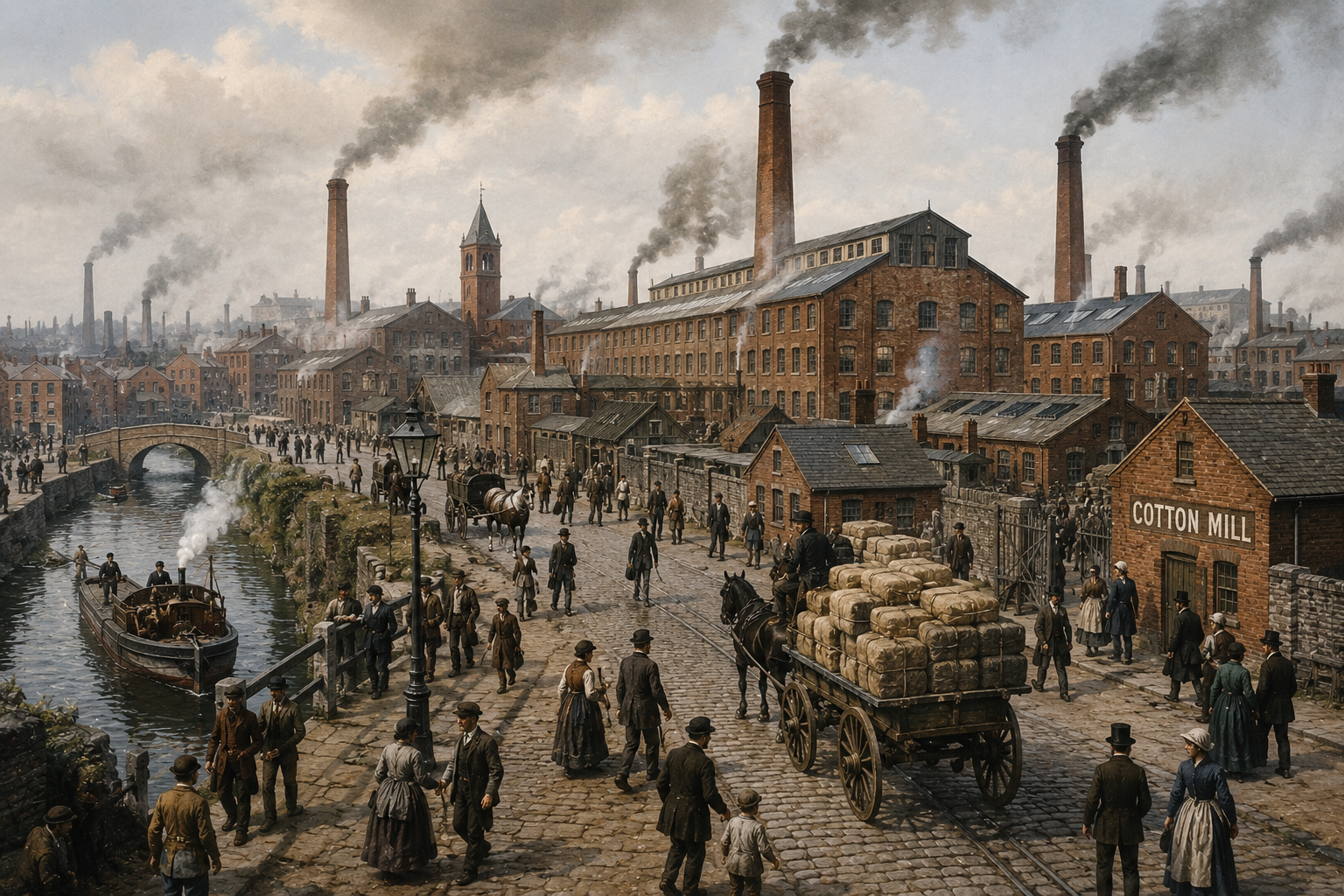
Industrialisation produced rapid urban growth. Factory districts, mining towns and port cities expanded as people moved from rural areas in search of wages. Manchester became a symbol of the new industrial city: productive, crowded, polluted, dynamic and unequal. Urbanisation created opportunities for employment, education, politics and cultural life, but it also produced overcrowding, disease, poor sanitation and dangerous housing.
The industrial city changed daily life. Workplaces were separated from homes. Streets filled with workers, carts, smoke and machinery. Families lived in cramped housing near factories. Epidemics spread through poor sanitation. Noise and pollution became normal. The older village community gave way to anonymous urban neighbourhoods and class-segregated districts. Rich and poor lived in the same city but increasingly in different worlds.
Urbanisation also created new forms of politics. Workers could organise because they were concentrated. Reformers could investigate poverty. Newspapers could reach literate urban audiences. Municipal governments had to address water, sewage, policing, transport and public health. The modern city was therefore both a problem and a laboratory of reform.
The industrial city also reshaped culture. Leisure, pubs, music halls, clubs, libraries, chapels, unions and political meetings became part of working-class urban life. Middle-class observers often described industrial workers as dangerous or degraded, but workers built communities of mutual aid and resistance. Urbanisation was one of the most visible signs that society had changed. The factory did not only produce goods. It produced a new human environment.
Class, Labour and the Factory Discipline
The Industrial Revolution created new class relations. Industrial capitalists owned factories, machinery and mines. Wage labourers sold their time and labour. The old distinctions of landlord, peasant, artisan and merchant did not disappear, but they were joined by a sharper industrial divide between capital and labour. This divide shaped nineteenth-century politics and social thought.
Factory discipline was central. Workers had to arrive at fixed times, follow rules, maintain machine pace and accept supervision. The clock became an instrument of power. Skilled artisans often resisted mechanisation because it threatened their independence and craft identity. The Luddites, who broke machines in the early nineteenth century, were not mindless enemies of technology; they were workers protesting economic insecurity, deskilling and employer power.
Labour conditions were often harsh. Long hours, low wages, unsafe machinery, mine accidents and child labour produced public outrage and political pressure. Reform legislation gradually limited some abuses, especially child labour and working hours, but change was slow and contested. Employers argued that regulation threatened competitiveness; reformers argued that unregulated industry degraded human life.
The labour movement emerged from these conflicts. Trade unions, cooperatives, socialist ideas, Chartism and later labour parties developed in response to industrial capitalism. Workers demanded not only wages but dignity, political representation and control over working conditions. Industrialisation therefore did not simply create a working class; it created class consciousness. People began to understand their hardships as part of a system. That awareness became one of the most powerful forces in modern politics.
Women, Children and the Family Economy
Industrialisation transformed family life. In pre-industrial households, work and home were often connected. Families farmed, spun, wove, kept animals or ran small shops together. Industrialisation separated workplace from household and changed the economic roles of men, women and children. Factories employed women and children in large numbers, especially in textiles, because they could be paid less and were seen as easier to discipline.
Child labour became one of the darkest features of early industrial society. Children worked in mills, mines and workshops for long hours under dangerous conditions. Their wages contributed to family survival, especially where adult male wages were insufficient. Reformers exposed abuses and campaigned for factory acts, but many poor families depended on children’s earnings. The moral problem was therefore tied to economic structure: families needed income because industrial wages and urban living costs were harsh.
Women’s work also became ideologically contested. Middle-class ideals increasingly imagined men as breadwinners and women as domestic guardians, yet many working-class women continued paid labour because necessity demanded it. Industrialisation did not simply remove women from work; it changed how their work was valued, regulated and represented. Domestic labour remained essential but unpaid and often invisible.
The family economy adapted under pressure. Migration separated kin networks. Factory schedules reshaped childcare and household routines. Education reforms later pulled children gradually out of labour and into schools, preparing them for an industrial society that required literacy and discipline. The Industrial Revolution therefore remade not only production but childhood, gender roles and the emotional structure of family life.
Political Economy, Capitalism and Empire
The Industrial Revolution strengthened capitalism as a global system. Investment in machinery, factories, mines, railways and trade required capital. Banks, joint-stock companies, insurance, credit and stock markets became increasingly important. Profit depended on productivity, markets, raw materials and labour discipline. Economic thought evolved alongside this transformation. Adam Smith, David Ricardo and later Karl Marx analysed the new world of production, markets and class relations from sharply different perspectives.
Industrial capitalism was inseparable from empire. Britain used imperial networks to secure raw materials, markets and strategic routes. Cotton, sugar, tea, opium, metals and other commodities moved through systems shaped by colonial power. Industrial goods could undermine local crafts in colonised regions, while colonial infrastructure often served extraction rather than balanced development. The Industrial Revolution gave industrial powers a military and economic advantage that intensified imperial expansion in the nineteenth century.
This does not mean industrialisation was caused only by empire, but empire magnified it. Global trade supplied resources and demand. Colonial profits, shipping and finance contributed to capital formation. Industrial technology then strengthened imperial control through steamships, railways, telegraphs and modern weapons. The relationship was circular: empire fed industry, and industry strengthened empire.
Political economy changed because society had to explain new wealth and new misery. Liberal economists praised free markets and productivity. Socialists criticised exploitation. Conservatives feared social disorder. Reformers sought regulation. Industrialisation made economics a central language of modern politics. Questions of wages, prices, trade, tariffs, ownership and welfare became questions of civilisation itself.
Public Health, Reform and the Social Question
The misery of industrial cities forced societies to confront the social question: what responsibility did the state, employers and society have toward workers and the poor? Early industrial ideology often treated poverty as personal failure or unavoidable market outcome. But overcrowded cities, epidemics, child labour and visible inequality made non-intervention increasingly difficult to defend.
Public health became one major area of reform. Cholera outbreaks and urban disease revealed the need for clean water, sewage systems and sanitary regulation. Reformers such as Edwin Chadwick in Britain argued that poor sanitation produced disease and social cost. Over time, municipalities invested in waterworks, sewers, street cleaning and housing regulation. The modern public health state emerged partly because industrial cities made private suffering a public danger.
Factory reform also developed. Laws gradually restricted child labour, limited working hours and required some safety measures. Education reforms expanded schooling. Trade unions fought for wages and conditions. The franchise expanded over the nineteenth century in part because industrial society created new political pressures. Workers who powered the economy demanded representation.
These reforms did not end exploitation, but they changed the meaning of government. The state could no longer be only a protector of property and order. It increasingly became responsible for social welfare, regulation and public infrastructure. Industrialisation therefore helped produce modern social policy. The same system that created urban suffering also created the political movements and administrative tools to address it. The social question remains alive wherever economic growth produces inequality and demands reform.
Environmental Transformation and the Cost of Progress
Industrialisation changed humanity’s relationship with the environment. Coal smoke darkened skies. Rivers received chemical waste. Mines scarred landscapes. Urban air became unhealthy. Forests, soils and waterways were reorganised around production. The Industrial Revolution taught societies to celebrate mastery over nature, but that mastery carried long-term costs.
At first, pollution was often treated as the price of progress. Smoke meant work, wealth and power. Factory chimneys became symbols of modernity. Only gradually did reformers and communities challenge industrial environmental damage. The problem was difficult because industry brought jobs and goods as well as pollution. People depended on the same factories that harmed their health.
The deeper environmental legacy lies in fossil energy. Coal-powered industrialisation began the large-scale carbon economy that later expanded through oil and gas. The climate crisis of the twenty-first century is rooted partly in the energy transition of the eighteenth and nineteenth centuries. Industrialisation released productive power by burning ancient carbon stores. For generations, the benefits were immediate and the planetary costs invisible or ignored.
This does not mean industrialisation should be judged only as environmental disaster. It improved material life for many over time and enabled medicine, transport and communication. But its environmental history warns that technological progress is never cost-free. A civilisation can become more powerful while also becoming more dangerous to its ecological foundations. The Industrial Revolution reshaped society by giving humanity more control over production; it also made humanity responsible for consequences on a planetary scale.
Historical Debates About the Industrial Revolution
Historians debate many aspects of the Industrial Revolution. One debate concerns timing. Traditional accounts place its beginning in eighteenth-century Britain, especially from the mid-1700s. Some recent research pushes attention earlier, arguing that changes in labour structure, manufacturing and commercial organisation were visible before classic factory industrialisation. This debate matters because it changes whether we see the revolution as a sudden technological break or a long transformation.
Another debate concerns living standards. Did workers benefit quickly from industrial growth, or did their conditions worsen before improving? Optimists emphasise rising output, cheaper goods and long-term wage gains. Pessimists stress early exploitation, urban misery, child labour and inequality. Both perspectives capture different phases and groups. Industrialisation created national wealth before it reliably improved working-class life.
A third debate concerns causes. Was Britain first because of coal, wages, colonies, institutions, science, culture, geography, agriculture or empire? No single explanation is sufficient. The Industrial Revolution emerged from the convergence of many factors. Coal without markets is not enough. Invention without capital is not enough. Labour without demand is not enough. Britain’s advantage lay in combination.
Finally, historians debate whether the Industrial Revolution should be celebrated as progress or criticised as domination. It was both. It increased human productive capacity on an unprecedented scale and created the modern world. It also intensified exploitation, empire and environmental damage. A mature interpretation must resist both nostalgia for pre-industrial life and blind worship of machines. Industrialisation was the great engine of modernity, but engines can injure as well as move.
Legacy: The Industrial World We Still Inhabit
The Industrial Revolution’s legacy is the modern world itself. Factories, cities, railways, mass production, wage labour, public health systems, labour politics, global capitalism, fossil energy and consumer society all trace major roots to industrialisation. It changed how people measured time, valued work, organised families, designed cities and imagined the future. The word progress became tied to machines, output and growth.
Its benefits are undeniable. Industrialisation eventually made possible mass-produced goods, modern transport, improved medicine, expanded education and higher living standards for many societies. It enabled states to build infrastructure and support larger populations. But its costs are equally undeniable: exploitation, inequality, colonial extraction, environmental damage and social dislocation. Modern civilisation inherits both sides.
The Industrial Revolution reshaped society because it changed the basic unit of power. In agrarian societies, land was the central resource. In industrial societies, capital, machines, energy and labour organisation became decisive. This shifted class relations, state policy and global hierarchy. Countries that industrialised early gained enormous advantages over those that did not. The industrial gap became a geopolitical gap.
Today, as societies face automation, artificial intelligence, climate change and energy transition, the Industrial Revolution remains deeply relevant. It reminds us that technological change is never merely technical. It reorganises power, work, culture and morality. The first industrial age asked whether machines could multiply production. The present age asks whether humanity can govern the systems it creates. The Industrial Revolution’s deepest legacy is therefore not only the factory or the steam engine. It is the unfinished challenge of making technological power serve human dignity rather than consume it.
Additional Analytical Perspective
This final analytical note reinforces the central lesson of the topic: history is not a chain of isolated dates, but a layered process in which power, economy, society, culture and memory interact. The event or transformation discussed above mattered because it altered institutions and expectations, not merely because it produced dramatic episodes. Its consequences moved beyond rulers and battlefields into law, labour, belief, identity and public life. That is why its legacy survives in political language, social structures and historical debate. This final analytical note reinforces the central lesson of the topic: history is not a chain of isolated dates, but a layered process in which power, economy, society, culture and memory interact. The event or transformation discussed above mattered because it altered institutions and expectations, not merely because it produced dramatic episodes. Its consequences moved beyond rulers and battlefields into law, labour, belief, identity and public life. That is why its legacy survives in political language, social structures and historical debate. This final analytical note reinforces the central lesson of the topic: history is not a chain of isolated dates, but a layered process in which power, economy, society, culture and memory interact. The event or transformation discussed above mattered because it altered institutions and expectations, not merely because it produced dramatic episodes. Its consequences moved beyond rulers and battlefields into law, labour, belief, identity and public life. That is why its legacy survives in political language, social structures and historical debate. This final analytical note reinforces the central lesson of the topic: history is not a chain of isolated dates, but a layered process in which power, economy, society, culture and memory interact. The event or transformation discussed above mattered because it altered institutions and expectations, not merely because it produced dramatic episodes. Its consequences moved beyond rulers and battlefields into law, labour, belief, identity and public life. That is why its legacy survives in political language, social structures and historical debate. This final analytical note reinforces the central lesson of the topic: history is not a chain of isolated dates, but a layered process in which power, economy, society, culture and memory interact. The event or transformation discussed above mattered because it altered institutions and expectations, not merely because it produced dramatic episodes. Its consequences moved beyond rulers and battlefields into law, labour, belief, identity and public life. That is why its legacy survives in political language, social structures and historical debate. This final analytical note reinforces the central lesson of the topic: history is not a chain of isolated dates, but a layered process in which power, economy, society, culture and memory interact. The event or transformation discussed above mattered because it altered institutions and expectations, not merely because it produced dramatic episodes. Its consequences moved beyond rulers and battlefields into law, labour, belief, identity and public life. That is why its legacy survives in political language, social structures and historical debate. This final analytical note reinforces the central lesson of the topic: history is not a chain of isolated dates, but a layered process in which power, economy, society, culture and memory interact. The event or transformation discussed above mattered because it altered institutions and expectations, not merely because it produced dramatic episodes. Its consequences moved beyond rulers and battlefields into law, labour, belief, identity and public life. That is why its legacy survives in political language, social structures and historical debate. This final analytical note reinforces the central lesson of the topic: history is not a chain of isolated dates, but a layered process in which power, economy, society, culture and memory interact. The event or transformation discussed above mattered because it altered institutions and expectations, not merely because it produced dramatic episodes. Its consequences moved beyond rulers and battlefields into law, labour, belief, identity and public life. That is why its legacy survives in political language, social structures and historical debate. This final analytical note reinforces the central lesson of the topic: history is not a chain of isolated dates, but a layered process in which power, economy, society, culture and memory interact. The event or transformation discussed above mattered because it altered institutions and expectations, not merely because it produced dramatic episodes. Its consequences moved beyond rulers and battlefields into law, labour, belief, identity and public life. That is why its legacy survives in political language, social structures and historical debate. This final analytical note reinforces the central lesson of the topic: history is not a chain of isolated dates, but a layered process in which power, economy, society, culture and memory interact. The event or transformation discussed above mattered because it altered institutions and expectations, not merely because it produced dramatic episodes. Its consequences moved beyond rulers and battlefields into law, labour, belief, identity and public life. That is why its legacy survives in political language, social structures and historical debate. This final analytical note reinforces the central lesson of the topic: history is not a chain of isolated dates, but a layered process in which power, economy, society, culture and memory interact. The event or transformation discussed above mattered because it altered institutions and expectations, not merely because it produced dramatic episodes. Its consequences moved beyond rulers and battlefields into law, labour, belief, identity and public life. That is why its legacy survives in political language, social structures and historical debate. This final analytical note reinforces the central lesson of the topic: history is not a chain of isolated dates, but a layered process in which power, economy, society, culture and memory interact. The event or transformation discussed above mattered because it altered institutions and expectations, not merely because it produced dramatic episodes. Its consequences moved beyond rulers and battlefields into law, labour, belief, identity and public life. That is why its legacy survives in political language, social structures and historical debate. This final analytical note reinforces the central lesson of the topic: history is not a chain of isolated dates, but a layered process in which power, economy, society, culture and memory interact. The event or transformation discussed above mattered because it altered institutions and expectations, not merely because it produced dramatic episodes. Its consequences moved beyond rulers and battlefields into law, labour, belief, identity and public life. That is why its legacy survives in political language, social structures and historical debate.