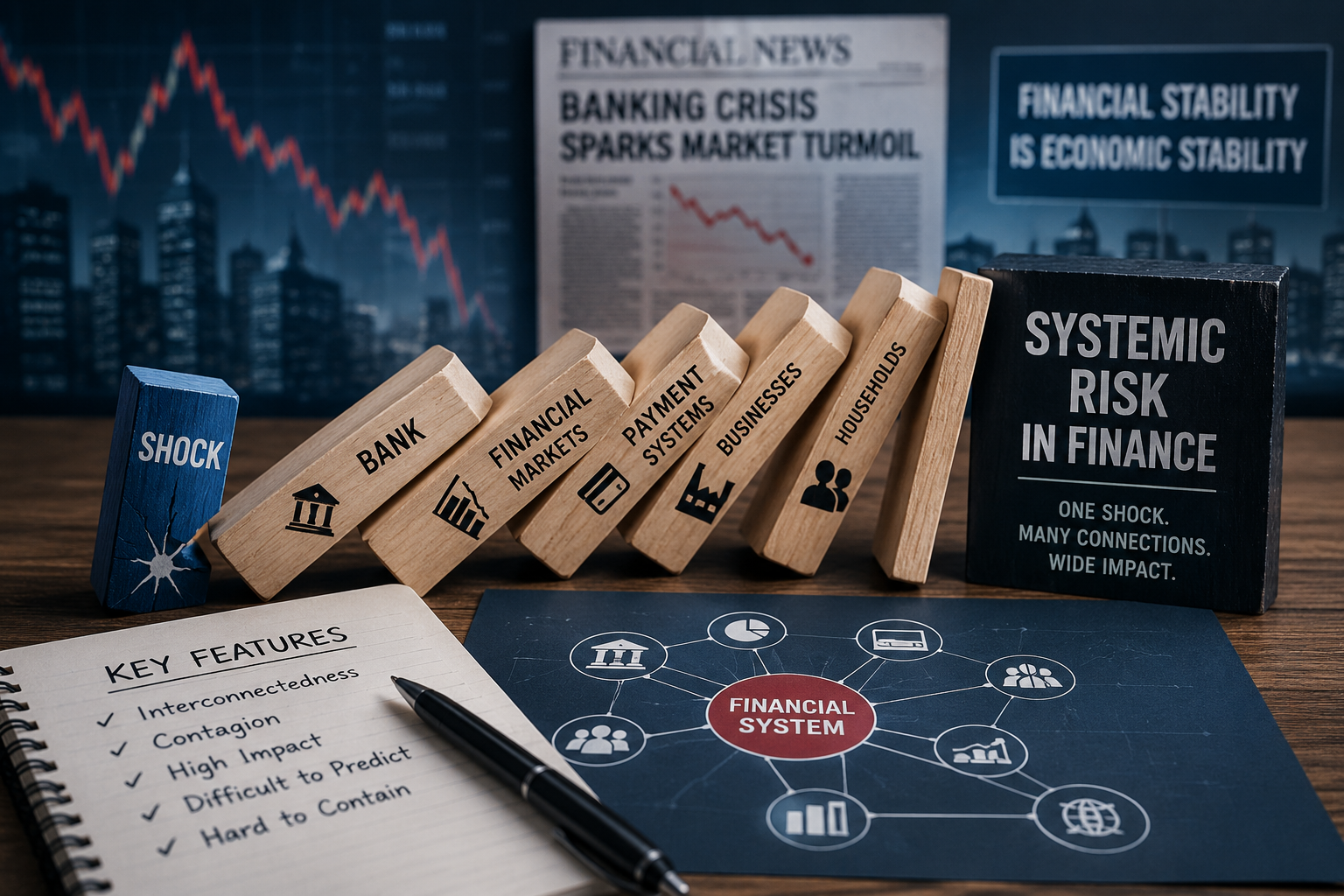
Most financial risks look small when they are seen alone. A bank may make bad loans. A borrower may default. A stock may crash. A mutual fund may face withdrawals. A company may fail because it borrowed too much. These are serious events, but they do not automatically become systemic. Systemic risk begins when one failure threatens to spread so widely that the financial system itself becomes unstable.
In simple terms, systemic risk is the risk that stress in one part of the financial system will damage many other parts at the same time. It is the risk of contagion. It is the possibility that banks, markets, lenders, borrowers, payment systems and investors become so connected that a shock does not remain local. It travels.
The best way to understand systemic risk is to compare finance with the human body. If one finger is injured, the body can continue functioning. If the nervous system, blood circulation or heart fails, the whole body is affected. In finance, the banking system, payment system, credit market and confidence mechanism perform similar system-wide functions. When these stop working, the damage goes beyond one institution.
Ordinary financial risk is about loss. Systemic risk is about transmission. A bank losing money is not automatically systemic. A bank losing money becomes systemic if its failure can make depositors panic, freeze lending, disrupt payments, force other institutions to sell assets, weaken businesses and reduce household confidence. The danger lies not only in the first loss, but in the chain reaction.
There are several channels through which systemic risk spreads. The first is interconnection. Banks lend to each other, invest in similar securities, use common clearing systems and depend on shared market infrastructure. If one important institution fails, others may suffer direct losses or indirect fear. This is why regulators study who is connected to whom, how strongly, and through which contracts.
The second channel is common exposure. Even if financial firms do not owe money to one another, they may all hold the same risky asset. If the value of that asset falls, many balance sheets weaken together. In a housing bubble, for example, banks, mortgage lenders, insurers, investors and households may all be exposed to property prices. Once prices fall, losses appear across the system at the same time.
The third channel is leverage. Leverage means using borrowed money to increase exposure. In good times, leverage makes returns look attractive. In bad times, it magnifies losses. A highly leveraged financial institution may be forced to sell assets quickly when prices fall. If many institutions do the same thing, prices fall further, causing more losses and more forced selling. A private balance-sheet problem can become a market-wide spiral.
The fourth channel is liquidity risk. Many financial firms own long-term assets but rely on short-term funding. This works as long as lenders and depositors continue to provide money. If confidence breaks, funding can disappear quickly. An institution may still own valuable assets, but if it cannot convert them into cash fast enough, it may fail. Liquidity crises are dangerous because they move at the speed of fear.
The fifth channel is confidence. Finance runs on trust. Depositors trust banks. Banks trust borrowers. Investors trust markets. Businesses trust credit lines. When trust collapses, even healthy institutions can face stress because people stop distinguishing between strong and weak players. Panic does not wait for perfect information. It spreads through uncertainty.
Systemic risk is also connected to the real economy. Banks are not isolated trading houses. They provide credit to businesses, loans to households, working capital to exporters, payment services to merchants and funding to governments. If the financial system freezes, factories may not receive working capital, builders may not get project finance, homebuyers may not get loans and small businesses may not meet payroll. The financial shock becomes an employment and growth shock.
This is why regulators do not treat all institutions equally. Some institutions are systemically important because their size, complexity, interconnectedness or lack of substitutes makes their failure unusually damaging. A small finance company may fail without threatening the system. A major bank, payment operator, clearing house or large non-bank lender may create wider stress if it fails suddenly.
Systemic risk can also build quietly during good times. When credit is cheap, asset prices rise and defaults are low, the system may look safe. But that apparent safety can encourage more borrowing, more risk-taking and weaker lending standards. This is called procyclicality: the financial system strengthens the economic cycle instead of stabilising it. It lends aggressively in booms and cuts credit sharply in downturns.
Shadow banking can add another layer. Shadow banking refers to credit activity outside traditional commercial banks. It may include certain non-bank finance companies, money market funds, securitisation vehicles, private credit funds and other market-based lenders. These institutions can support credit growth, but if they are less transparent or less regulated, risks may accumulate outside the direct view of banking supervisors.
India has seen why systemic-risk thinking matters. Episodes involving large non-bank finance companies, stressed infrastructure lenders, cooperative banks and sudden market panic have shown that financial distress can move through mutual funds, bank exposures, depositors, borrowers and investor confidence. Even when the formal banking system remains stable, stress in one corner can affect broader credit conditions.
The regulatory response to systemic risk is known as macroprudential policy. Traditional regulation looks at the safety of individual institutions. Macroprudential regulation looks at the stability of the system as a whole. It asks whether credit is growing too fast, whether leverage is high, whether institutions have enough capital, whether funding is stable, whether risks are concentrated and whether failure can be managed without panic.
Tools include higher capital buffers, liquidity requirements, stress tests, limits on risky exposures, closer supervision of systemically important institutions, resolution planning and stronger market infrastructure. Central banks and financial regulators also monitor data on credit growth, asset prices, interbank exposures, foreign funding, deposit behaviour and non-bank finance.
Systemic risk cannot be eliminated completely. Finance exists to take risk, allocate capital and support growth. An economy with no risk would also have little credit, little innovation and weak investment. The aim is not to make finance risk-free. The aim is to ensure that risk-takers can fail without destroying the wider system.
This is the moral and economic challenge. If authorities rescue every important firm, they may encourage reckless behaviour. If they allow a major institution to collapse disorderly, they may damage the economy. Good financial policy therefore tries to build resilience before crisis: more capital, better supervision, transparent balance sheets, credible resolution mechanisms and early warning systems.
For ordinary readers, systemic risk matters because financial crises do not remain inside financial newspapers. They affect jobs, loans, savings, taxes, public spending and business survival. A banking panic can reduce credit. A credit freeze can reduce investment. Lower investment can reduce employment. Government rescues can increase public costs. The consequences reach households that never bought a risky security.
Early-warning signals are therefore important. Rapid credit growth, rising real-estate prices, heavy short-term borrowing, large foreign-currency exposures, falling lending standards and crowded investment positions can all suggest that risk is accumulating. None of these signals guarantees a crisis, but together they warn that confidence may be resting on fragile foundations. Good regulators do not wait for collapse; they study the pressure points before markets are forced to reveal them.
Digital finance adds a newer dimension. Payment apps, instant settlement, algorithmic trading, cloud infrastructure and cyber dependence can make finance faster and more efficient, but they can also make stress travel faster. A cyberattack, technology outage or data failure at a critical service provider can become a financial-stability issue if many institutions depend on the same infrastructure. Modern systemic risk is therefore not only about banks and loans. It is also about data, software, operational resilience and public trust in digital rails.
Systemic risk is therefore the hidden risk of connected finance. It asks one central question: what happens if many promises in the system are tested at the same time? A stable financial system is not one where no institution ever makes mistakes. It is one where mistakes can be absorbed, losses can be allocated and essential functions continue. The strength of finance is not measured only in profits during good years. It is measured in resilience when confidence is under pressure.
Disclaimer
This article is for general educational and editorial use. It is not investment, banking, legal, regulatory or risk-management advice. Financial-stability concepts should be verified against current regulator and central-bank documents before publication.