Sushruta: Surgery, Anatomy and the Making of an Ancient Medical Tradition
Few names in the history of Indian medicine carry as much symbolic weight as Sushruta.
He is routinely called the “father of surgery” or “father of plastic surgery.” Popular biographies describe him as an ancient surgeon who performed complex operations, trained students on models before allowing them to operate, classified surgical instruments, studied human anatomy, treated fractures and wounds, reconstructed damaged noses and described procedures for eye disease.
There is a substantial historical foundation behind that reputation.
The Sushruta Samhita is one of the foundational Sanskrit medical compendia and preserves unusually extensive material on surgery, anatomy, wounds, fractures, instruments, operative training, eye disease, therapeutics and postoperative care.
But the familiar biography becomes misleading when it imagines Sushruta as a modern-style individual author whose entire surviving textbook can be placed securely at one precise date—often stated as 600 BCE—and whose every passage records his personal experience.
The textual history is much more complicated.
The Sushruta Samhita reached the present through centuries of copying, teaching, revision and redaction. Modern scholarship generally treats it as a layered work rather than a book produced in its surviving form at one historical moment.
That requires three separate questions:
Who was the person or medical lineage remembered as Sushruta?
What does the surviving Sushruta Samhita actually contain?
How did that textual and surgical tradition develop and influence later medicine?
The second question is considerably easier to answer than the first.
Sushruta at a glance
| Detail | Historical position |
|---|---|
| Known for | Surgical and medical tradition associated with the Sushruta Samhita |
| Traditional location | Kashi, or ancient Varanasi |
| Traditional teacher | Divodasa-Dhanvantari |
| Major text | Sushruta Samhita |
| Major subjects | Surgery, anatomy, wounds, fractures, eye disease, instruments, therapeutics and medical training |
| Traditional date often quoted | Around 600 BCE |
| Modern historical position | The date of the text and historical Sushruta is uncertain; the surviving work contains multiple chronological layers |
| Oldest securely dated surviving manuscript | Nepalese palm-leaf manuscript dated 878 CE |
| Historical significance | One of the most important surviving sources for ancient South Asian surgical knowledge |
| Modern medical status | Historically important, but not a substitute for evidence-based contemporary medicine |
Who was Sushruta?
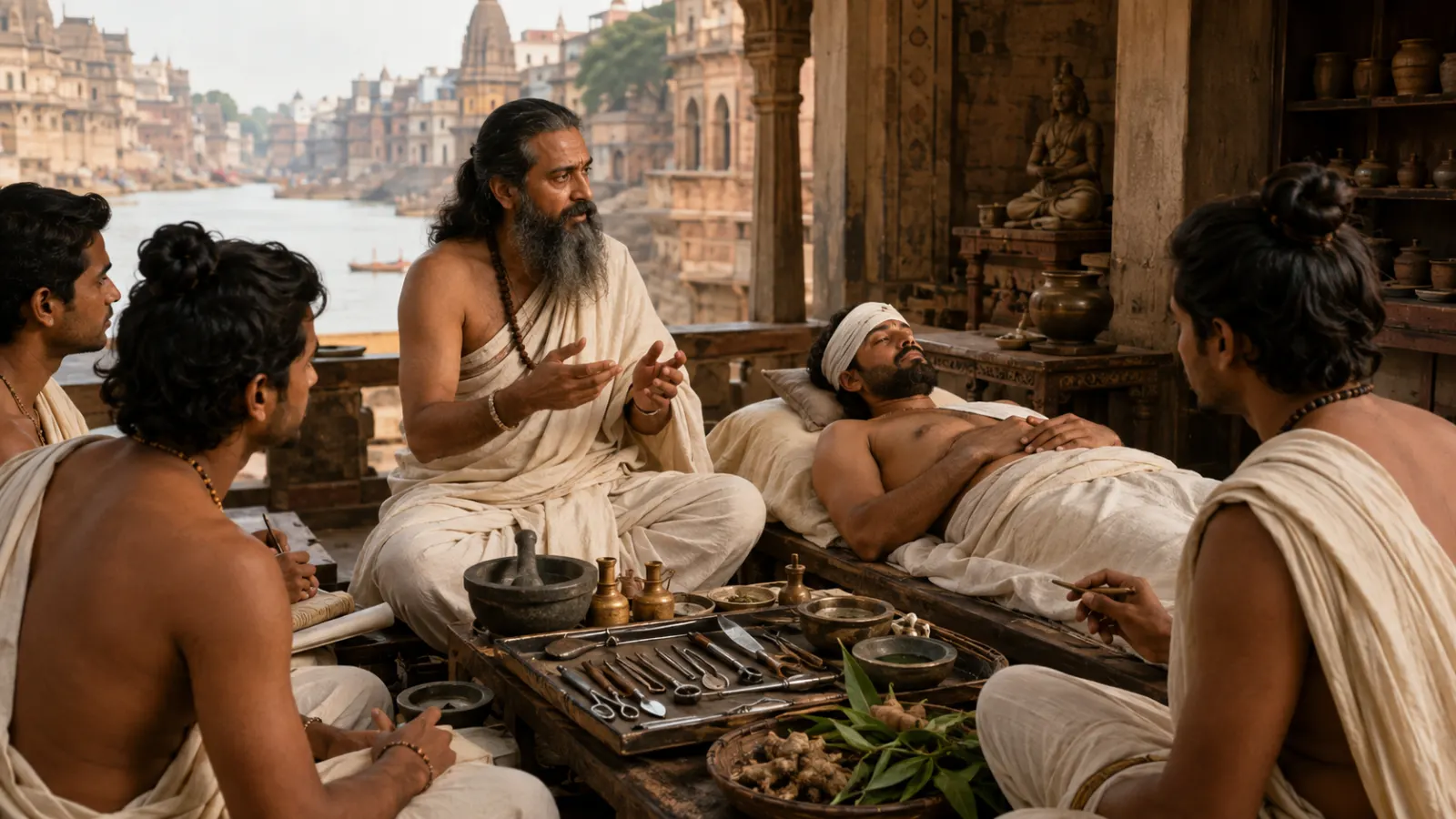
Traditional accounts place Sushruta in Kashi, the ancient city associated with modern Varanasi.
Within the text, medical teaching is presented through a teacher-disciple framework. Sushruta and other pupils receive instruction from Divodasa, associated with the medical figure Dhanvantari.
Such narratives belong to the intellectual and literary conventions of Sanskrit medical literature.
They are historically important because they show how medical authority and teaching were understood.
But they should not automatically be converted into a modern biography.
We do not possess the sort of contemporary evidence that would allow historians to reconstruct Sushruta's life as confidently as the career of a modern surgeon.
The name may represent:
-
a historical practitioner,
-
an authoritative teacher,
-
a surgical lineage,
-
a textual school,
-
or some combination of these.
The safest conclusion is not that Sushruta was fictional.
It is that the historical individual cannot be reconstructed with precision from the surviving evidence.
The problem with the date “600 BCE”
Few historical claims about Sushruta are repeated more confidently than:
“Sushruta lived in 600 BCE.”
The date appears in textbooks, medical articles, websites and popular histories.
It should be treated cautiously.
Specialist scholarship on Sanskrit medical literature has moved well beyond the idea that the complete surviving Sushruta Samhita can simply be assigned to 600 BCE.
The text contains several historical layers.
Some portions may preserve very old traditions.
Other material appears to have been composed, reorganised or added later.
The Uttaratantra, the substantial final section containing material including ophthalmology and other subjects, is particularly important in discussions of textual development.
The result is that one cannot responsibly take every passage in the modern printed Sushruta Samhita, assign it to a single individual and date all of it to one moment in the first millennium BCE.
This is not unusual.
Ancient scholarly works often developed over generations.
Texts were taught orally.
Manuscripts were copied.
Earlier material was reorganised.
New chapters were incorporated.
Commentarial explanations affected interpretation.
Authoritative names became attached to bodies of knowledge that continued evolving.
A layered text is not less valuable.
It often tells us more about the persistence of an intellectual tradition.
The oldest dated Sushruta manuscript
Manuscript evidence gives the discussion a firmer chronological anchor.
A palm-leaf manuscript preserved in Nepal and known as MS Kathmandu KL 699 is dated to 878 CE.
It is one of the earliest securely dated surviving manuscripts of a major Sanskrit medical work.
The manuscript does not prove that the Sushruta Samhita originated in the ninth century.
The text is clearly older.
What it provides is physical evidence that a recension of the Sushruta tradition was circulating by that time.
The distinction between:
the date of a surviving manuscript
and
the date when the textual tradition began
is crucial.
A manuscript can be hundreds of years younger than the material it preserves.
Nagarjuna and the problem of redaction
Later tradition associates a figure named Nagarjuna with the revision or redaction of the Sushruta Samhita.
This should also be described carefully.
Several historical figures carry the name Nagarjuna, and the precise history of the recension cannot simply be reconstructed from later attribution.
The important point is broader.
The text itself was understood within Indian scholarly tradition as something that had undergone transmission and revision.
Modern textual scholarship independently confirms that the surviving compendium contains different chronological layers.
Rather than imagining one immutable book, it is more useful to think of the Sushruta Samhita as a medical tradition preserved in textual form.
Why surgery occupies such a prominent place
The Sushruta Samhita is not merely an operating manual.
It discusses a broad medical world including:
-
diagnosis,
-
therapeutics,
-
diet,
-
anatomy,
-
toxicology,
-
wounds,
-
fractures,
-
eye diseases,
-
medicines,
-
obstetric and other conditions,
-
and medical ethics and training.
Nevertheless, surgery occupies a particularly prominent place.
The text classifies operative procedures into broad categories traditionally translated in ways such as:
-
excision,
-
incision,
-
scraping,
-
puncturing,
-
probing,
-
extraction,
-
drainage,
-
and suturing.
The exact translation of Sanskrit technical terminology varies.
The historical importance lies in the classification itself.
Surgery is presented not merely as a collection of isolated manual tricks but as a teachable field of knowledge.
Procedures can be categorised.
Instruments can be matched to tasks.
Students can be trained.
Patients can be prepared.
Wounds can be classified.
Outcomes can be assessed.
That organisational structure is one of the strongest reasons the text occupies such an important place in the global history of surgery.
Surgery as organised knowledge
Human beings performed invasive procedures long before the Sushruta Samhita.
Archaeological evidence of trepanation, wound treatment and other interventions extends deep into prehistory.
Ancient Egyptian, Mesopotamian, Greek, Chinese and other medical traditions also developed surgical and trauma knowledge.
Sushruta's importance therefore does not depend on claiming that surgery began with one man in India.
The distinctive achievement of the Sushruta tradition is the systematisation of surgical knowledge.
Operations were classified.
Tools were named.
Students were instructed.
Wounds were differentiated.
Anatomy mattered.
Preparation mattered.
Aftercare mattered.
Prognosis mattered.
The decision whether or not to intervene mattered.
This is much stronger historically than simply calling one individual the inventor of surgery.
Learning before operating
One of the most striking sections of the surgical tradition concerns training.
The text recommends that students practise manual techniques on substitute materials before attempting procedures on patients.
Different materials could be used for different skills.
Depending on the exercise, descriptions include practice using substances such as:
-
vegetables,
-
gourds,
-
leather,
-
pieces of animal tissue,
-
bags or sacs,
-
and other materials intended to reproduce aspects of cutting, puncturing, scraping or suturing.
A modern comparison with simulation training is tempting.
But the analogy should be kept within limits.
A contemporary surgical simulation laboratory uses standardised curricula, advanced models, imaging, robotics, objective assessment and evidence-based training methods unavailable in antiquity.
The historical principle, however, is recognisable:
manual competence should be developed before a learner performs a dangerous procedure on a living patient.
That is a significant educational insight.
Surgical instruments and the material culture of medicine
Surgery depends on tools.
The Sushruta Samhita devotes considerable attention to instruments, including distinctions between different kinds of blunt and sharp devices.
Popular summaries frequently quote exact totals such as 101 blunt instruments and 20 sharp instruments.
Those numbers appear in commonly used textual classifications, but they should not become the entire story.
More important is the existence of a highly differentiated instrument vocabulary.
Different tools were associated with different functions.
Their shapes could be explained through analogies with:
-
animal jaws,
-
beaks,
-
claws,
-
leaves,
-
or familiar objects.
Such comparisons were practical ways of describing form in a world without modern industrial catalogues, photographs or engineering drawings.
The text also pays attention to the qualities of good instruments.
A tool's usefulness depended not simply on possessing it but on:
-
its shape,
-
its condition,
-
the operator's skill,
-
the procedure,
-
and the circumstances of the patient.
This shows surgery as a material craft as well as an intellectual discipline.
Anatomy and direct examination of the body
Sushruta's reputation in anatomical history comes partly from passages that recommend direct examination of a human body.
The procedure described is very different from modern cadaver dissection.
The body was to be prepared and allowed to decompose under specified conditions. Layers could then be examined gradually.
This has attracted considerable attention from historians of anatomy because it indicates that direct bodily observation formed part of at least one ancient Indian medical tradition.
The significance should neither be dismissed nor exaggerated.
The anatomy in the Sushruta Samhita does not correspond completely to contemporary anatomical science.
Some observations arise from physical examination.
Other descriptions reflect ancient theoretical concepts and classifications that modern medicine no longer accepts.
The correct historical conclusion is therefore balanced.
The text does not demonstrate possession of modern anatomy thousands of years in advance.
But it does contradict any simplistic claim that ancient Indian medicine relied entirely on abstract speculation and never involved direct examination of the human body.
Anatomy did not mean modern anatomy
Modern anatomy is supported by:
-
systematic dissection,
-
histology,
-
microscopy,
-
radiology,
-
embryology,
-
molecular biology,
-
pathology,
-
and standardised anatomical terminology.
None of those systems existed in Sushruta's world.
Ancient descriptions should therefore be assessed within their own conceptual environment.
Historians are interested not only in whether a particular anatomical number agrees with a modern textbook.
They also ask:
How did practitioners observe the body?
How were structures classified?
How did anatomical ideas influence treatment?
Which observations were empirical and which belonged to inherited theory?
This prevents the history of medicine from becoming a competition to discover modern terms in ancient texts.
The famous reconstruction of the nose
The most internationally famous surgical material associated with Sushruta concerns nasal reconstruction.
The Sushruta Samhita preserves a description of repairing a damaged or severed nose using nearby living tissue shaped to recreate the missing structure.
In commonly cited versions of the procedure, a leaf or other template helps determine the amount of tissue required.
A flap is prepared from neighbouring skin and attached to the damaged nose.
Hollow tubes or similar supports are described for maintaining the nostrils during healing.
For historians of reconstructive surgery, this is important evidence of an ancient flap-based reconstructive technique.
It should not be confused, however, with every later operation known as the “Indian method” of rhinoplasty.
The history is more complicated.
Ancient rhinoplasty and the later “Indian method”
Indian nasal reconstruction attracted major European attention in the late eighteenth century after British observers reported a reconstructive operation performed in India.
A famous case involving a man commonly identified as Cowasjee was publicised in the 1790s.
The later procedure used a forehead flap and became influential in the development of European reconstructive surgery.
Joseph Constantine Carpue subsequently performed operations in Britain based on reports of the Indian method.
The ancient Sushruta description, however, is usually interpreted as involving tissue from the cheek rather than being identical in every detail to the later forehead-flap operation.
The historical relationship between ancient textual description and later Indian surgical practice is fascinating.
But continuity across more than two millennia should not simply be asserted without evidence.
What can be stated securely is:
Ancient Sanskrit medical literature preserves an important description of nasal reconstruction, and sophisticated traditions of nasal reconstruction were also practised in India in much later historical periods.
Why nasal reconstruction mattered
Reconstructive surgery did not arise simply from aesthetic preference.
Damage to the nose could result from:
-
violence,
-
trauma,
-
disease,
-
or deliberate mutilation.
In several historical societies, cutting the nose or other body parts was used as punishment or humiliation.
That created a practical demand for procedures capable of restoring both appearance and function.
This context is important.
The history of plastic surgery is not simply a history of cosmetic enhancement.
It also emerges from trauma, warfare, punishment, congenital differences and attempts to restore damaged structures.
The Sushruta material belongs to that longer reconstructive history.
Eye disease and cataract surgery
The Sushruta Samhita contains substantial material on diseases of the eye.
One of the most debated topics is its description of an operation for a condition traditionally associated with cataract.
Older medical histories frequently describe Sushruta as having performed extracapsular cataract extraction.
That terminology is problematic.
Closer historical examination suggests the ancient operation is more accurately understood within the long history of cataract couching and related techniques.
In couching, an opacity associated with the lens is displaced away from the visual axis using an instrument.
This is radically different from modern cataract surgery.
Modern procedures can involve:
-
microsurgical techniques,
-
phacoemulsification,
-
controlled sterile environments,
-
intraocular lenses,
-
sophisticated anaesthesia,
-
preoperative imaging,
-
antibiotics,
-
and detailed postoperative monitoring.
Ancient couching could produce some restoration of vision in selected circumstances, but it also carried substantial risks.
The historical achievement lies in recognising eye disease as something that could sometimes be approached surgically.
It should never be used as justification for reproducing ancient cataract techniques today.
Why cataract history requires unusual caution
The ophthalmological history of the Sushruta Samhita illustrates a broader problem in historical medical writing.
Modern medical papers sometimes repeat claims from earlier secondary literature without checking the Sanskrit textual tradition or current Indological scholarship.
This can create circular citation.
One modern paper cites another.
That paper cites an older medical history.
Eventually a debatable interpretation begins to look like established fact.
Research on the history of cataract surgery has explicitly drawn attention to this problem.
It is therefore safer to distinguish:
what the text describes,
how earlier historians interpreted it,
and
how modern ophthalmology classifies procedures.
Those categories are not always identical.
Wounds and surgical judgement
The surgical material associated with Sushruta extends far beyond spectacular operations.
The text pays close attention to wounds.
It classifies injuries and discusses matters such as:
-
wound shape,
-
contamination,
-
bleeding,
-
healing,
-
dressings,
-
suturing,
-
and possible complications.
This suggests a culture of repeated clinical observation.
Practitioners who regularly treat trauma begin to recognise patterns.
Certain wounds behave differently from others.
Some require cleaning.
Some require closure.
Some require drainage.
Some may be unsuitable for intervention.
The precise treatments belong to ancient medicine.
The conceptual move toward classification as a basis for clinical decision-making is historically important.
Fractures and dislocations
The Sushruta Samhita also contains extensive discussion of bone and joint injuries.
Fractures and dislocations are differentiated and treated with approaches involving reduction, immobilisation, bandaging and supportive care.
Again, modern terminology must be used cautiously.
Ancient fracture treatment occurred without:
-
X-rays,
-
CT scans,
-
MRI,
-
modern orthopaedic implants,
-
sterile operating theatres,
-
antibiotics,
-
or contemporary pain control.
Nevertheless, trauma care depends on recognising that not all injuries are alike.
The Sushruta tradition demonstrates an effort to organise injury according to type and expected course.
That is historically significant even where individual treatments differ from current standards.
Prognosis and the decision not to operate
Surgery is often imagined as the branch of medicine defined by intervention.
But good surgical judgement also requires restraint.
A surgeon must ask not only:
Can I perform this procedure?
but:
Should I?
The Sushruta tradition includes discussions of prognosis and of conditions regarded as:
-
treatable,
-
difficult to treat,
-
or effectively untreatable.
Those categories were based partly on medical theories no longer accepted today.
They were not validated through randomised clinical trials or modern outcome statistics.
But the underlying problem remains fundamental.
Surgery creates risk.
A technically possible intervention may still be harmful if the patient is unlikely to survive or benefit.
The presence of prognostic thinking therefore makes the Sushruta Samhita more than a catalogue of procedures.
It presents surgery as part of a broader system involving:
diagnosis → preparation → procedure → aftercare → prognosis.
Pain control, wine and the “anaesthesia” claim
Popular accounts sometimes state that Sushruta invented anaesthesia.
That is too strong.
Ancient medical traditions in many parts of the world used:
-
alcohol,
-
intoxicating substances,
-
herbal preparations,
-
physical restraint,
-
and other methods
to reduce pain or distress.
The Sushruta tradition includes references to intoxicating drinks such as wine in relation to painful procedures.
This shows awareness that pain and distress needed to be managed.
But it is not equivalent to modern anaesthesiology.
Contemporary anaesthesia depends on specialised knowledge of:
-
pharmacology,
-
airway management,
-
ventilation,
-
analgesia,
-
unconsciousness,
-
cardiovascular physiology,
-
controlled drug dosing,
-
monitoring,
-
resuscitation,
-
and perioperative risk.
Ancient sedation should therefore not be marketed as modern anaesthesia discovered thousands of years early.
The more defensible historical claim is simple:
the surgical tradition recognised pain as a practical problem and used substances available at the time to reduce distress.
Cleanliness without germ theory
Ancient surgeons did not know bacteria.
They did not possess germ theory.
They had no concept equivalent to modern microbiology.
Yet people can observe the practical consequences of contamination without knowing microorganisms exist.
The Sushruta tradition includes instructions involving:
-
washing,
-
wound cleaning,
-
dressings,
-
environmental preparation,
-
and postoperative care.
These are historically significant.
They should not be transformed into the claim that Sushruta discovered antisepsis.
Modern antiseptic surgery is connected particularly with nineteenth-century developments in microbiology and Joseph Lister's application of germ-theory concepts to surgery.
The underlying scientific framework was entirely different.
Ancient cleanliness practices demonstrate accumulated empirical knowledge.
They do not demonstrate a hidden knowledge of bacteria.
Surgical aftercare mattered
Modern popular accounts often focus on spectacular operations.
But successful surgery depends heavily on what happens afterward.
The Sushruta tradition includes extensive attention to:
-
dressing wounds,
-
maintaining operated areas,
-
diet,
-
monitoring healing,
-
managing complications,
-
and deciding when intervention is succeeding or failing.
This matters because surgery cannot be reduced to the moment when an instrument touches tissue.
It is a process.
Preparation matters.
Technique matters.
Recovery matters.
That systems-oriented view helps explain why the compendium is historically more important than a list of unusual operations.
Ayurveda was never one frozen system
The Sushruta Samhita is one of the foundational texts associated with Ayurveda.
But Ayurveda should not be imagined as one unchanging set of doctrines created at a single moment and transmitted unchanged for thousands of years.
Medical traditions evolve.
Texts are copied.
Commentaries are written.
Regional practices interact with learned medicine.
Different schools emphasise different theories or treatments.
New materials enter pharmacology.
Older ideas are reinterpreted.
The Sushruta Samhita itself provides evidence of such change because its textual history is layered.
This historical perspective is more credible than treating “ancient Ayurveda” as a single timeless object.
The manuscript tradition is evidence of continuity
The layered nature of the Sushruta Samhita is sometimes presented as though it weakens its historical importance.
The opposite can be true.
A text survives because people continue to find it valuable enough to:
-
copy,
-
study,
-
teach,
-
comment on,
-
preserve,
-
and modify.
Changes between recensions may therefore reveal a living medical tradition.
Some material was inherited.
Some was reorganised.
Some terminology changed.
Some chapters may have been added.
Later scholars interpreted earlier teachings through the problems of their own periods.
The survival of the work is itself evidence that the Sushruta tradition retained authority across generations.
Transmission beyond Sanskrit
The Sushruta tradition eventually became known well beyond Sanskrit intellectual circles.
Indian medical works were translated and discussed in Arabic scholarly environments during the medieval period.
Later, European Orientalists, physicians and historians began translating and analysing Sanskrit medical texts.
The modern printed history of the Sushruta Samhita includes nineteenth- and early-twentieth-century editions and translations that made it accessible to a much broader scholarly audience.
This global circulation contributed greatly to Sushruta's modern fame.
But transmission should not be turned into an oversimplified story in which one ancient book directly created every later surgical tradition.
Ideas can move through complex networks.
Translations change concepts.
Techniques can be reinvented independently.
Practical knowledge may circulate separately from written texts.
Historical influence therefore requires evidence, not assumption.
Sushruta and the history of plastic surgery
Modern plastic surgeons have taken a particular interest in Sushruta because of the nasal reconstruction passages.
That interest is understandable.
Reconstructive surgery asks a highly sophisticated question:
How can tissue from one location be used to restore another damaged structure while keeping the transferred tissue alive?
Flap surgery remains a central concept in reconstruction.
Ancient descriptions of flap-based nasal repair therefore occupy a legitimate place in the long history of reconstructive technique.
But the correct conclusion is not:
“Modern plastic surgery was already fully developed in ancient India.”
Modern reconstructive surgery depends on:
-
detailed vascular anatomy,
-
microsurgery,
-
anaesthesia,
-
infection control,
-
antibiotics,
-
imaging,
-
reconstructive ladders and algorithms,
-
intensive postoperative monitoring,
-
and modern outcome research.
The ancient procedure belongs to the history of the field.
It is not the same as the field in its present form.
The “father of surgery” label
Calling Sushruta the father of surgery is useful as an honorific.
It is less useful as literal history.
Surgery does not have one father.
Human beings treated trauma and performed invasive procedures long before surviving surgical textbooks.
Archaeological evidence demonstrates extremely ancient operative practices.
Egyptian medical texts discuss wounds and injuries.
Greek physicians described surgical procedures.
Chinese and other medical traditions developed their own approaches.
The distinctive place of Sushruta lies elsewhere.
The corpus associated with his name contains one of the most extensive and organised bodies of surgical writing surviving from the ancient world.
That is historically impressive without requiring the invention of a single founder.
“Father of plastic surgery” is also an honorific
The same caution applies to the title father of plastic surgery.
The phrase reflects the importance modern reconstructive surgeons attach to the nasal reconstruction passage.
It should not imply that one ancient practitioner created every subsequent branch of plastic and reconstructive surgery.
The history of plastic surgery includes:
-
ancient wound repair,
-
Indian nasal reconstruction,
-
European reconstructive traditions,
-
treatment of war injuries,
-
advances in anaesthesia,
-
antisepsis,
-
skin grafting,
-
flap surgery,
-
microsurgery,
-
craniofacial surgery,
-
burn care,
-
and many other developments.
Sushruta belongs importantly within that history.
He does not need to stand alone at its beginning.
What Sushruta did not “invent”
Modern social media sometimes credits Sushruta with inventing:
-
surgery,
-
plastic surgery,
-
anaesthesia,
-
antisepsis,
-
ophthalmology,
-
orthopaedics,
-
anatomy,
-
medical simulation,
-
forensic medicine,
-
and dozens of modern operations.
Such claims blur the difference between:
an early description,
an organised ancient practice,
and
the creation of a modern scientific discipline.
They can also make genuine achievements look less credible.
Sushruta's importance is stronger when priority claims are limited to what the evidence actually supports.
The Sushruta Samhita preserves unusually rich ancient surgical material.
That is enough.
Medical history is not modern medical advice
Historical admiration should never become clinical recommendation.
No procedure from an ancient medical text should be reproduced simply because it is historically significant.
Modern surgery operates in a completely different scientific environment.
It depends on:
-
contemporary anatomy,
-
microbiology,
-
pharmacology,
-
anaesthesia,
-
imaging,
-
pathology,
-
blood banking,
-
intensive care,
-
antibiotics,
-
regulated surgical training,
-
clinical trials,
-
quality assurance,
-
and modern ethical standards.
Some ancient practices were insightful.
Some may have offered real benefit in their original context.
Some would be ineffective or dangerous by modern standards.
The correct way to honour medical history is to study it carefully.
It is not to bypass current evidence.
What modern surgical education can learn from the history
Historical medicine should not be mined for modern treatments.
But it can illuminate enduring problems in medical education.
The Sushruta tradition takes seriously:
-
training before independent practice,
-
familiarity with instruments,
-
anatomical observation,
-
classification of injury,
-
technical preparation,
-
manual competence,
-
prognosis,
-
and postoperative care.
Those categories remain recognisable today even though their scientific content has changed radically.
The deeper lesson is not that ancient and modern surgery are identical.
It is that surgeons across very different historical periods have had to solve some of the same fundamental practical problems:
How should a student learn?
How should instruments be selected?
What does the injury look like?
Can it be repaired?
Will intervention help or harm?
What happens after the operation?
Why Sushruta still matters
Sushruta matters because the medical tradition associated with his name preserved one of the most substantial bodies of surgical writing surviving from the ancient world.
It matters because the text treats manual skill as something that can be taught.
It matters because surgical instruments are differentiated rather than treated as generic tools.
It matters because anatomical observation forms part of the medical discussion.
It matters because the text attempts to classify wounds, fractures and operative techniques.
It matters because reconstructive and ophthalmic procedures broaden the history of surgery beyond a narrow Europe-centred narrative.
And it matters because Sushruta's modern reputation exposes two opposite failures in the way ancient medicine is discussed.
One approach dismisses premodern medical knowledge as superstition.
The other transforms ancient texts into evidence that essentially every modern medical discovery had already been made thousands of years earlier.
Neither is historically necessary.
The surviving evidence is remarkable on its own.
Frequently Asked Questions
Who was Sushruta?
Sushruta is the name associated with one of the foundational traditions of ancient Indian medicine and with the Sushruta Samhita, a major Sanskrit medical compendium containing extensive material on surgery, anatomy, wounds, fractures and medical training.
When did Sushruta live?
There is no securely established date for the historical individual. The often-repeated date of around 600 BCE should not be treated as certain. Modern scholarship regards the Sushruta Samhita as a layered work whose surviving form developed over time.
Was Sushruta a real person?
There may have been a historical medical teacher or practitioner behind the Sushruta tradition, but available evidence does not allow a detailed modern-style biography to be reconstructed securely.
What is the Sushruta Samhita?
The Sushruta Samhita is a Sanskrit medical compendium associated with the Sushruta tradition. It discusses surgery, anatomy, wounds, fractures, instruments, eye disease, therapeutics, toxicology and many other medical subjects.
Is the Sushruta Samhita really from 600 BCE?
The complete surviving text should not simply be dated to 600 BCE. Modern scholarship recognises multiple historical layers and later redaction. The tradition may preserve much earlier medical material, but the chronology is complex.
What is the oldest surviving manuscript of the Sushruta Samhita?
A Nepalese palm-leaf manuscript known as MS Kathmandu KL 699 is securely dated to 878 CE and is among the most important early manuscript witnesses to the text.
Did Sushruta perform plastic surgery?
The Sushruta Samhita preserves an important description of nasal reconstruction using a flap of nearby tissue. This gives the Sushruta tradition an important place in the history of reconstructive surgery.
Did Sushruta invent rhinoplasty?
It is more accurate to say that the Sushruta Samhita contains one of the important early surviving descriptions of nasal reconstruction. Rhinoplasty developed through many historical traditions and later techniques.
Did Sushruta perform cataract surgery?
The Sushruta Samhita contains a procedure associated with cataract treatment. Modern historical scholarship generally cautions against describing it as equivalent to contemporary cataract extraction. It belongs to the history of couching and related ancient ophthalmic procedures.
Did Sushruta invent anaesthesia?
No. Ancient medical traditions used intoxicating substances to reduce pain and distress, but this should not be equated with modern anaesthesiology.
Did Sushruta know about antisepsis?
The text contains practices involving cleanliness and wound care, but ancient practitioners did not possess modern germ theory. It is therefore misleading to say that Sushruta discovered antisepsis in the modern scientific sense.
Did Sushruta dissect human bodies?
The text contains instructions for examining a prepared human body through a process involving decomposition and gradual removal of tissue layers. Historians regard this as important evidence for direct anatomical observation in ancient Indian medicine.
Why is Sushruta called the father of surgery?
The title is an honorific reflecting the scale and systematic character of the surgical material associated with his name. It should not be taken literally to mean that surgery had one inventor.
Is Sushruta relevant to modern medicine?
Sushruta is highly relevant to the history of medicine and surgery. Ancient procedures themselves should not replace contemporary evidence-based medical care.
Conclusion
The simplest version of Sushruta is the least historically satisfying.
It presents a single surgeon living at exactly 600 BCE who wrote one complete textbook and personally invented surgery, plastic surgery, anaesthesia, ophthalmology and antisepsis.
The evidence reveals a richer story.
There was a powerful medical tradition associated with the name Sushruta.
That tradition preserved extensive surgical knowledge.
Students were taught manual skills.
Instruments were differentiated.
Anatomical observation mattered.
Wounds and fractures were classified.
Reconstructive procedures were described.
Eye disease received substantial attention.
Prognosis and postoperative care formed part of the system.
At the same time, the text developed through a long history of transmission and redaction.
The historical Sushruta cannot be separated from that textual tradition with the precision demanded by a modern biography.
That uncertainty is not a reason to diminish him.
It is a reason to describe him more accurately.
Sushruta does not need to be transformed into a twenty-first-century surgeon living two thousand years too early.
His real historical importance is substantial enough:
the tradition associated with his name helped turn surgery into organised, teachable medical knowledge and preserved one of the most important surviving records of operative practice in the ancient world.