Single-Use Plastic: Why Convenience Creates a Long-Lived Waste Problem
Single-use plastic represents one of the clearest contradictions in modern material design. Plastic is valued because it can be durable, lightweight, water-resistant and inexpensive, yet many plastic products are deliberately designed to remain useful for only minutes or hours. A takeaway fork may be discarded after one meal, a sachet after one use and a delivery wrapper almost immediately after a package is opened. The service life is short, but the material does not simply disappear when its usefulness ends.
That mismatch—brief use followed by a potentially long waste life—is why single-use plastic has become such an important environmental-policy issue. UNEP argues that tackling plastic pollution requires looking beyond waste collection alone and addressing the entire life cycle of plastics: how products are designed, how much material enters the economy, whether products can be reused, how realistically they can be recycled and what happens after disposal.
The problem is also more complicated than the slogan “ban plastic.” Disposable plastics perform real functions. Packaging can protect food, reduce contamination and simplify transport. Sterile disposable products can be important in healthcare. Lightweight plastic may sometimes require fewer resources to manufacture or transport than a heavier substitute. Effective policy therefore has to distinguish between unnecessary single-use products, products that can realistically move into reuse systems, products whose design can be improved and applications where disposability currently serves an important function.
What Is Single-Use Plastic?
Single-use plastics are generally products intended to be used once, or for a relatively short period, before being discarded. The European Commission describes single-use plastic products as items used once or briefly before being thrown away, while UNEP commonly discusses disposable packaging and service items such as bags, bottles, cups, containers, wrappers and cutlery.
The word “single-use” describes the product system more than the physical durability of the object. A thin shopping bag might survive several trips, and a takeaway container might technically be washed and used again. But if the product is cheap, distributed without a return mechanism and designed around disposal after the transaction, it belongs to a fundamentally different system from packaging intended to circulate repeatedly.
This difference becomes easier to understand by comparing a disposable beverage bottle with a refillable bottle. Both may be made from plastic. The important distinction is that one enters the waste stream rapidly, while the other is designed to stay in circulation through repeated collection, cleaning and refilling.
Common Examples of Single-Use Plastic
Single-use plastic appears throughout modern consumption. Familiar examples include lightweight shopping bags, disposable cutlery, straws, cups and lids, takeaway food containers, beverage bottles, packets, wrappers, sachets and many forms of shipping and retail packaging. The exact legal definition differs by jurisdiction, so a product considered single-use under one regulation may be treated differently elsewhere.
Packaging deserves particular attention because of its enormous scale. UNEP notes that plastic packaging accounts for about half of plastic waste, reflecting the fact that much packaging has an intentionally short service life.
Yet even “packaging” is too broad to treat as one environmental category. A snack wrapper, sterile medical package, reusable transport crate and package that prevents highly perishable food from spoiling perform different functions. The environmental question is therefore not simply whether packaging exists, but whether its function could be delivered with less material, through reuse, through better design or without packaging at all.
Why Did Single-Use Plastic Become So Popular?
Disposable plastic succeeded because it solves practical problems remarkably well. It is lightweight, mouldable, resistant to moisture, inexpensive at large scale and capable of preserving food or creating hygienic barriers. Manufacturers can make billions of nearly identical packages and move them through global supply chains at relatively low cost.
The system is also convenient for businesses. A restaurant using disposable containers does not need to collect containers from customers, transport them back, wash them, inspect them and send them into circulation again. Retailers using disposable bags do not need to operate a return network. The material moves in one direction—from manufacturer to consumer to waste management.
Consumers benefit from the same lack of friction. There is no deposit to recover, container to return or bottle to remember next time.
Those advantages explain why replacing disposability is harder than replacing one material. Single-use is not merely an object; it is a logistics model.
The Hidden Cost of Convenience
The transaction ends when the consumer throws the item away, but the physical material remains somewhere.
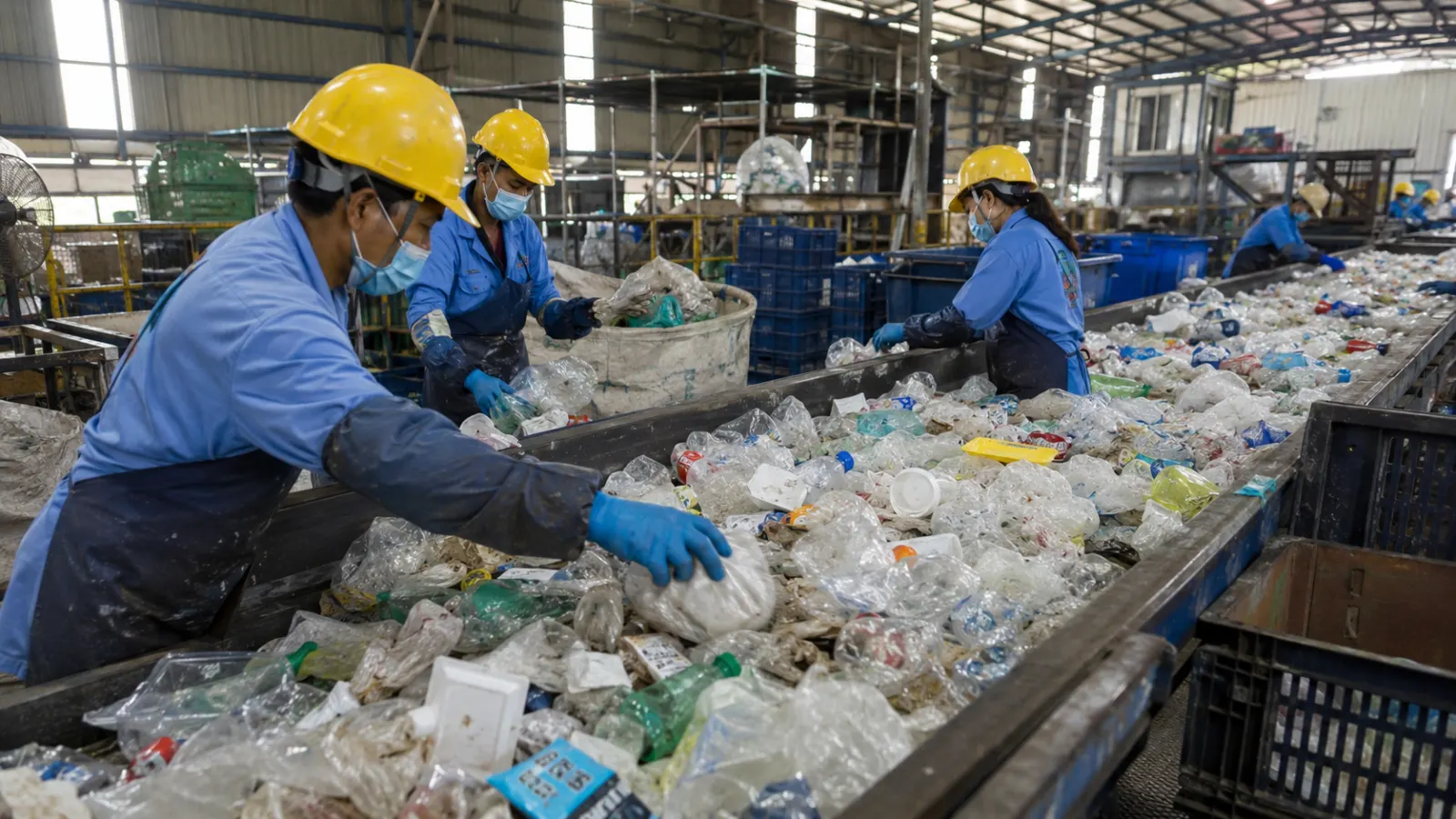
Municipalities collect it. Waste workers sort it. A landfill receives it. An incinerator burns it. A recycler may process part of it. Or the product escapes formal waste management altogether and enters roadsides, drains, rivers, coastlines or soil.
This creates a classic problem of costs being distributed beyond the original transaction. The convenience of disposability is experienced immediately by the producer, retailer and consumer, while collection, treatment, litter removal and environmental damage may be borne partly by municipalities and the wider public.
That is one reason modern plastic policy increasingly includes extended producer responsibility, deposit-return systems and product-design requirements. These approaches try to reconnect the product's end-of-life consequences with the businesses that place material on the market rather than leaving disposal almost entirely to households and local governments.
Why Plastic Persistence Matters
Plastic's durability is not inherently undesirable. Durability is exactly what makes plastic valuable in long-lived products, infrastructure and many medical or industrial applications.
The contradiction arises when durable material is engineered into an object whose useful life is extremely short.
If a discarded item reaches the environment, physical weathering, sunlight and abrasion can break it into progressively smaller pieces. Fragmentation is not the same as the material safely disappearing. It can instead contribute to the wider problem of microplastic pollution.
This is why the environmental impact of single-use plastic cannot be judged only at the moment a consumer throws something away. The relevant time horizon extends through collection, treatment, leakage and eventual environmental transformation.
Why Single-Use Plastic Easily Becomes Litter
Many disposable products have characteristics that make leakage especially likely. They are small, lightweight, inexpensive and distributed in enormous numbers. Bags and wrappers can be carried by wind. Street litter can enter drainage systems. Floodwater can move waste into rivers, while poorly controlled dumpsites may continually release material into surrounding land.
Even a relatively small leakage rate becomes significant when the number of products is extremely large.
OECD modelling shows the broader scale of the challenge. Without stronger policies, global plastics use is projected to rise from about 435 million tonnes in 2020 to 736 million tonnes in 2040, while annual plastic leakage to the environment could increase from approximately 20 million tonnes to 30 million tonnes.
Those projections cover the wider plastics economy rather than single-use products alone, but they show why relying only on waste systems to absorb ever-growing material flows is unlikely to be sufficient.
Plastic Pollution Is Not Only an Ocean Problem
Images of bottles, bags and fishing gear floating in the sea have made marine pollution the dominant visual symbol of the plastics crisis. Oceans are important, but plastic leakage also occurs across terrestrial environments.
OECD modelling indicates that a large share of macroplastic leakage by weight occurs on land, while rivers transport a portion of accumulated material toward aquatic environments. Under a business-as-usual scenario, OECD projects the stock of plastic in rivers and oceans could approach 300 million tonnes by 2040, almost double its estimated 2020 level.
This means plastic policy cannot focus only on beach clean-ups. Waste may be generated hundreds of kilometres inland, move through drains and rivers and reach the sea much later.
Preventing leakage close to the point where waste is generated is generally more effective than trying to recover widely dispersed debris afterward.
Why Packaging Is So Important
Packaging performs several valuable functions. It protects products during transport, extends shelf life, provides portion control, reduces contamination and carries essential product information.
Food packaging illustrates the trade-off particularly well. Excessive packaging generates material waste, but removing packaging without considering food spoilage can create another environmental burden because producing food also consumes land, water, energy and other resources.
UNEP's life-cycle work therefore cautions against assuming that every non-plastic alternative is automatically environmentally superior. Comparative assessment needs to consider raw-material production, manufacturing, transport, repeated use and disposal rather than simply the material visible after consumption.
The strongest strategy is usually to ask whether the function can be delivered more efficiently rather than simply replacing plastic with another disposable material.
Why “Recyclable” Does Not Mean “Recycled”
One of the most persistent misunderstandings surrounding single-use plastic is the assumption that a recycling symbol solves the environmental problem.
It does not.
An item can be technically recyclable in laboratory or specialised industrial conditions and still have almost no practical chance of being recycled where it is sold. Effective recycling requires collection, sorting, compatible processing infrastructure and a market willing to buy the resulting material.
UNEP reports that close to 80% of the plastic contained in single-use plastic products is not economically viable to recycle under current conditions. Problems include mixed materials, colouring, additives, contamination and insufficient infrastructure.
Small items pose another problem. A tiny piece of cutlery, flexible wrapper or lightweight film may be difficult to recover through high-volume sorting systems even when the polymer itself has theoretical recycling value.
The environmentally important question is therefore not “Could this material theoretically be recycled?”
It is “Will this specific item actually be collected and recycled in the system where it is sold?”
Why Multilayer Packaging Is Difficult
Modern packaging is often engineered for performance rather than end-of-life simplicity. Several materials may be combined to provide strength, oxygen barriers, moisture resistance, printing surfaces or food protection.
That design can work extremely well during the product's useful life.
It can work badly in a recycling plant.
If layers cannot be separated economically, the resulting package may have little recycling value despite containing materials that would individually be recyclable. Flexible pouches and sachets illustrate this problem particularly clearly.
This is why circular-design strategies increasingly emphasise simpler material combinations, recyclable formats and compatibility with existing collection systems.
Design determines waste-management possibilities long before the package reaches the bin.
Recycling Is Important—but It Cannot Carry the Entire System
Recycling remains an important part of plastic management. It can reduce demand for virgin material and recover value from products that have reached the end of their useful life.
But recycling operates after a product has already been produced, distributed, consumed and discarded.
UNEP's Turning off the Tap framework therefore places recycling alongside deeper system changes: reducing problematic and unnecessary plastic use, expanding reuse and redesigning products and markets. UNEP states that only about 9% of plastics produced are mechanically recycled, reinforcing the limits of relying on recycling as the primary response.
OECD modelling reaches a similar conclusion at system scale. Improving waste management without slowing the growth of plastic waste is unlikely to eliminate leakage.
The lesson is not “stop recycling.”
It is “do not use recycling as permission to produce unlimited disposable material.”
The Difference Between Recycling and Reuse
Recycling attempts to recover material after an item has become waste. Reuse attempts to prevent the item from becoming waste after one use.
That difference is fundamental.
A disposable bottle may be collected, sorted, washed, shredded and converted into recycled resin. A refillable bottle can instead be collected, cleaned and filled again while remaining a bottle.
Both systems require infrastructure, but reuse preserves more of the original product's value.
UNEP's analysis of single-use products reaches a particularly important conclusion: in many applications, the central environmental problem is “single-use” rather than plastic itself, and reusable products frequently provide the strongest environmental option when they actually circulate enough times.
That qualification matters. A heavy reusable container manufactured with far more material and used only once may perform worse than expected.
Reuse only becomes reuse when the object actually returns.
Why Return Systems Matter
A reusable container cannot deliver repeated-use benefits if nobody brings it back.
Successful reuse systems therefore require infrastructure. A restaurant may need standardised containers, convenient return locations, washing facilities and a way to track inventory. Beverage systems may use deposits to encourage customers to return bottles.
Deposit-refund programmes provide a simple economic mechanism. Consumers pay a deposit when purchasing a product and receive it back when the container is returned. OECD notes that such systems can improve collection, reduce leakage and provide relatively clean material streams for reuse or recycling.
The larger principle is important: behaviour often follows infrastructure.
Telling consumers to “reuse more” is much less effective than designing a system in which returning a container is straightforward.
Why Replacing Plastic With Paper Is Not Automatically Better
Plastic debates frequently turn into material competitions.
Plastic bad.
Paper good.
Glass good.
Metal good.
Life-cycle assessment shows why this logic is too simplistic.
UNEP's review of shopping-bag assessments found that alternative materials also create environmental impacts, and the number of times a bag is reused has a major influence on comparative performance. Production methods, transport, weight and waste management can substantially alter the result.
A heavier reusable product may require more energy and raw material during manufacturing. Its environmental advantage depends partly on being used enough times to spread that manufacturing burden across many services.
This is why policy should compare environmental impact per use, not merely material names.
Biodegradable Does Not Mean “Disappear Anywhere”
Terms such as biodegradable, compostable and bio-based are often treated as synonyms for environmentally harmless.
They are not.
Bio-based describes where the raw material came from. A bio-based plastic can still persist depending on its chemistry. Compostable products may require controlled industrial composting conditions that differ dramatically from a roadside, river or ocean. Biodegradation rates depend on temperature, moisture, microorganisms and the material itself.
UNEP's legislative guidance specifically cautions policymakers that biodegradable, compostable and bio-based plastics involve significant complexities and that alternatives should be assessed across their full life cycle.
The label therefore does not justify littering and does not eliminate the need for appropriate collection.
The Real Environmental Unit Is the Service
A useful way to escape material arguments is to ask what service the product provides.
The service of a shopping bag is carrying goods.
The service of a cup is holding a beverage.
The service of food packaging is protecting food until consumption.
Once the analysis shifts from object to service, different solutions become possible. A shopping trip might use one durable bag hundreds of times. A drink might be served through a deposit-return cup. A cleaning product might be sold as a concentrate rather than shipping a new bottle mostly filled with water.
UNEP's circular-plastics framework explicitly encourages redesigning the way products deliver their functions rather than merely substituting one disposable object for another.
That is a much deeper change than choosing a different bin.
Why Some Single-Use Plastic Is Harder to Eliminate
A serious plastic strategy must acknowledge legitimate disposable applications.
Healthcare is an obvious example. Syringes, gloves, sterile packaging, tubing and other products can play crucial roles in infection prevention and patient safety. The correct environmental response cannot simply be to replace every disposable medical product with a reusable version without considering sterilisation, contamination, occupational exposure and clinical requirements.
WHO's guidance on healthcare waste therefore combines waste minimisation with safety. It recommends switching to reusables when safe and viable, while maintaining proper segregation, treatment and disposal of healthcare waste.
The distinction is essential.
A disposable party fork and a sterile medical device should not automatically receive the same policy treatment merely because both contain plastic.
Necessary Uses Should Still Be Designed Better
Exempting an application from a ban does not mean its environmental impact should be ignored.
Healthcare organisations can reduce unnecessary packaging, improve procurement, separate recyclable non-infectious materials from hazardous waste and use reusable alternatives where evidence shows they are safe. WHO's updated 2026 healthcare-waste work continues to emphasise waste minimisation, segregation, treatment and sustainable management across the waste pathway.
The broader principle applies beyond medicine.
If single-use remains necessary for safety or performance, policymakers and manufacturers can still ask whether the item uses less material, avoids problematic additives, has a realistic collection route or could be redesigned.
The choice is rarely between ban everything and change nothing.
Why Plastic Pollution Becomes Microplastic Pollution
Large pieces of plastic exposed to sunlight, heat, waves and mechanical abrasion can break into progressively smaller fragments.
Once particles become extremely small, recovering them from the environment becomes vastly more difficult than collecting an intact bottle or bag.
Microplastics can also originate from sources other than disposable products, including tyre wear, synthetic textiles, paints and industrial pellets. It would therefore be inaccurate to describe single-use plastic as the sole source of microplastic pollution.
But preventing large disposable objects from escaping into the environment can reduce one pathway through which macroplastic becomes fragmented pollution.
This is another reason prevention is more attractive than clean-up after widespread dispersal.
Plastic Pollution Has a Climate Dimension
Most conventional plastic is produced from fossil-fuel feedstocks, and energy is consumed during extraction, refining, polymer production, manufacturing and waste treatment.
UNEP estimates that plastic production is responsible for more than 3% of global greenhouse-gas emissions, giving plastic pollution a climate dimension in addition to its waste and ecosystem impacts.
The climate argument also reinforces the need for life-cycle thinking. Replacing a lightweight plastic item with a much heavier disposable alternative can increase transport or manufacturing emissions even if it reduces some forms of litter.
The strongest solutions reduce the total quantity of material required to provide the service, particularly when durable products can circulate many times.
Human-Health Claims Require Care
Plastic pollution increasingly appears in discussions of human health, particularly because people can be exposed to plastic particles and chemicals used in plastic production.
The evidence should be communicated carefully.
UNEP notes that some plastics contain chemicals that may enter the environment or contribute to human exposure depending on how products are manufactured, used and disposed of. It therefore argues that a life-cycle approach should consider chemical risks as well as visible litter.
This does not justify claiming that every plastic package directly causes disease or that the health consequences of all forms of microplastic exposure are already fully understood.
The scientifically defensible point is simpler: plastic pollution creates exposure pathways that warrant prevention and continued research, while chemical safety should be considered during product design rather than only after waste is created.
Why Bans Became Popular
Governments have adopted bans or restrictions on items such as lightweight shopping bags, plastic cutlery, straws, stirrers, foam containers and selected packaging formats.
These policies are appealing because some products are highly visible in litter, have short useful lives and have readily available alternatives.
A well-designed restriction can remove billions of low-value disposable objects from circulation.
But the success of a ban depends on its design. The targeted product needs viable substitutes, businesses need time to adapt, enforcement has to be credible and consumers need to understand what has changed.
UNEP's policy guidance specifically recommends considering the life-cycle impacts of alternatives and building appropriate transition periods and supporting measures into restrictions.
A ban is a policy instrument, not an environmental guarantee.
How a Ban Can Produce Unintended Consequences
Imagine banning very thin shopping bags.
Retailers replace them with thicker plastic bags labelled “reusable.”
If customers actually reuse those bags many times, the policy may succeed.
If customers still take a new thick bag on every shopping trip, substantially more plastic may be consumed per transaction.
The same problem can occur when a plastic product is replaced with a heavier disposable alternative whose manufacturing impacts are greater.
This does not mean bans are ineffective. It means environmental performance depends on how behaviour changes after the ban, not simply what material disappears from the shelf.
Lifecycle analysis is particularly valuable because it identifies these trade-offs before policy is scaled.
Levies Can Change Behaviour Without a Complete Ban
Governments can also impose fees on disposable items rather than prohibiting them.
A small charge changes the economics of a product previously perceived as free. Consumers who genuinely need the item can still obtain it, while people who can easily avoid it receive a financial incentive to do so.
Fees can be especially effective for products such as shopping bags because consumers already have a simple alternative: bring a reusable bag.
The broader lesson is that environmental policy can combine regulation with price signals, producer responsibility, infrastructure and design standards rather than relying on one intervention.
What Is Extended Producer Responsibility?
Extended Producer Responsibility, or EPR, shifts more responsibility for a product's end-of-life management toward the companies placing it on the market.
Instead of municipalities and households carrying nearly all disposal costs, producers may be required to finance collection, recycling or recovery systems. Fees can also be structured so that difficult-to-recycle products cost more to place on the market than designs that fit circular systems.
This creates a powerful design incentive.
If packaging becomes expensive because it is complex, unrecyclable or waste-intensive, businesses gain a reason to simplify it before the product reaches consumers.
EPR therefore addresses plastic pollution upstream—during product design and business decision-making—not merely downstream at the bin.
Design Can Make Recycling More Realistic
If a product is likely to remain single-use, design choices still matter.
A package made from one commonly recycled polymer may have a better chance of recovery than a package containing several inseparable materials. Clear or lightly coloured material may have more recycling value than heavily pigmented plastic. Labels, adhesives and additives can affect processing.
UNEP's Turning off the Tap report therefore emphasises designing plastics to be recyclable in the market where they are sold, not merely theoretically recyclable somewhere in the world.
This principle connects product design directly with local infrastructure.
Recyclability is a system property, not just a chemical property.
Why Waste Collection Still Matters
Upstream reduction receives increasing attention, but basic waste collection remains essential.
A reusable or recyclable design provides little environmental benefit if waste is dumped openly because communities lack reliable collection. In many parts of the world, improving formal waste systems remains one of the most urgent measures for preventing plastic leakage.
The challenge is that waste management must expand while global plastic volumes are also increasing.
OECD modelling indicates that waste-management improvements alone are unlikely to keep pace with rapidly growing plastic use under business-as-usual conditions.
The strongest strategy therefore combines less unnecessary waste with better management of the waste that remains.
Informal Waste Pickers Are Part of the Plastics Economy
Plastic recycling in many countries depends substantially on informal workers who collect, sort and sell valuable materials.
Policies designed only from the perspective of formal waste companies can therefore produce unintended social consequences. Deposit systems, bans or centralised collection programmes may reduce access to valuable recyclables that previously supported livelihoods.
UNEP's life-cycle approach explicitly recognises the importance of considering millions of informal waste workers when redesigning plastics systems.
A just transition needs to improve environmental performance without simply transferring economic costs to workers with the least bargaining power.
That can involve formalisation, safer working conditions, social protection and meaningful participation in new collection systems.
Why Consumer Choice Is Not Enough
Individual habits matter.
Carrying a reusable bottle can prevent disposable bottles from being purchased. Reusable bags can reduce demand for shopping bags. Choosing refill options can support businesses experimenting with reuse.
But individual responsibility has obvious limits.
A consumer cannot choose refillable packaging if every available product is disposable. A household cannot recycle a polymer its municipality does not collect. A customer cannot participate in a container-return system that does not exist.
Plastic pollution is therefore partly a choice architecture problem.
Businesses and governments determine which choices are actually available, affordable and convenient.
Businesses Control Important Decisions Before Consumers See the Product
By the time a shopper sees a package, many environmentally important decisions have already been made.
The manufacturer chose the material.
A designer determined whether several polymers would be combined.
A brand selected the package size.
A retailer chose whether to offer a refill.
A logistics provider determined how products would move.
The customer controls only the final stage of a much longer chain.
This is why plastic policy increasingly focuses on product design, procurement, packaging standards, producer responsibility and reuse infrastructure rather than relying entirely on consumer education.
Reuse Requires Businesses to Redesign Logistics
A linear disposable system is operationally simple:
make → sell → discard.
A reuse system is more complex:
make → sell → return → collect → wash → inspect → refill → redistribute → repeat.
That complexity explains why reuse has not replaced disposable packaging automatically even when it may offer environmental benefits.
Businesses need reverse logistics, storage, washing capacity and methods for recovering containers. Standardisation can help because multiple businesses may be able to share the same container system rather than operating incompatible return schemes.
The environmental shift is therefore also an operations and infrastructure shift.
Convenience Can Be Redesigned
The most successful circular systems do not necessarily ask consumers to sacrifice all convenience.
Deposit machines located where people already shop make bottle returns easier. Refill stations integrated into normal retail trips reduce the need for special journeys. Standard containers can be returned to many participating businesses rather than one original store.
This matters because behavioural change is more durable when the sustainable option becomes normal rather than burdensome.
The environmental challenge is not to prove that people can tolerate inconvenience.
It is to design low-waste systems that compete with disposable systems on convenience.
The Three Rs Need an Order
Environmental education frequently uses the phrase reduce, reuse, recycle.
The order matters.
Reduce prevents unnecessary material from entering the system.
Reuse keeps products circulating before they become waste.
Recycle recovers material after the product's useful life ends.
Modern plastic strategies broadly follow the same hierarchy. UNEP's system-change framework starts by reducing problematic and unnecessary plastic use and then emphasises reuse, recycling and alternative delivery systems.
Recycling remains valuable.
It simply occurs later in the hierarchy.
What Could Happen Without Stronger Policy?
OECD's 2024 modelling provides a useful picture of the long-term challenge. Under business as usual, global plastics production and use could reach 736 million tonnes annually by 2040, around 70% above 2020 levels. Plastic waste could reach 617 million tonnes, while leakage to the environment could rise substantially.
The same analysis found that comprehensive policy across the plastics life cycle—including reducing demand, designing for circularity, improving recycling and stopping leakage—could reduce projected plastic leakage by about 96% relative to business as usual by 2040.
The modelling does not suggest one magic intervention.
Its central message is that partial measures perform much worse than coordinated action across production, consumption, design and waste management.
The Global Plastics Treaty Is Still Being Negotiated
The international response to plastic pollution is also evolving.
UN Member States agreed in 2022 to negotiate a legally binding international instrument addressing plastic pollution across its life cycle. Talks at INC-5.2 in Geneva in August 2025 ended without consensus on a final treaty text, and a short INC-5.3 session in February 2026 dealt with organisational matters rather than substantive negotiation.
As of September 2026, the treaty process remains active. UNEP has scheduled further informal meetings ahead of INC-5.4, planned for March 2027.
The unresolved negotiations demonstrate that countries broadly recognise plastic pollution as a global problem while continuing to disagree over important questions such as production, products, chemicals, finance and implementation.
For single-use plastics, the significance is clear: the policy debate has moved beyond beach litter toward the entire life cycle of plastic production and consumption.
What Would a Serious Single-Use Plastic Strategy Look Like?
A strong strategy would begin by identifying disposable products that provide little social value relative to the waste they create. Unnecessary items can be eliminated or reduced rather than replaced.
For functions that remain necessary, policymakers and businesses can examine whether reuse is realistic. Beverage containers, shipping crates, some takeaway packaging and refill systems can potentially move into repeated circulation when infrastructure exists.
Products that remain single-use should be designed for minimal material use and realistic end-of-life management. Waste collection needs to cover all communities, while recycling systems should concentrate on streams with genuine material value.
Economic tools such as deposits and producer responsibility can shift incentives. Procurement standards can create demand for reusable systems, while public policy can support workers affected by transitions in packaging and waste management.
The objective is not eliminating one material at any cost.
It is reducing unnecessary throughput and preventing durable material from becoming disposable pollution.
Frequently Asked Questions About Single-Use Plastic
What is single-use plastic?
Single-use plastic refers to plastic products designed to be used once, or for a short period, before being discarded. Common examples include bags, straws, disposable cutlery, cups, bottles, wrappers and takeaway packaging.
Why is single-use plastic a problem?
Its useful life is often extremely short while the material can remain in waste systems or the environment much longer. High production volumes, low product value and weak collection can also make disposable products particularly prone to leakage.
Is all single-use plastic unnecessary?
No. Some disposable plastic has important functions, particularly where hygiene, sterility or safety is essential. Healthcare is an obvious example. Policy is more effective when it targets unnecessary and problematic products while improving the design and management of necessary applications.
What are the most common single-use plastics?
Common examples include shopping bags, beverage bottles, straws, disposable cutlery, food containers, cups, lids, sachets, packets and wrappers.
Can single-use plastic be recycled?
Some can be recycled, but technical recyclability does not guarantee actual recycling. Collection, contamination, product size, mixed materials, economics and local infrastructure determine whether an item is realistically recovered. UNEP estimates that close to 80% of plastic used in single-use products is currently not economically viable to recycle.
Is paper always better than plastic?
No. Environmental performance depends on manufacturing, weight, transport, number of uses and disposal. UNEP's life-cycle reviews show that alternative materials also carry environmental impacts and that repeated use can strongly influence results.
Are reusable products always better?
Not automatically after one use. Durable products can require more material and energy to manufacture, so they need to be reused enough times to justify that initial impact. UNEP nevertheless finds that reuse systems are generally central to reducing single-use product pollution when they actually function as repeated-use systems.
What is the difference between single-use and reusable plastic?
Single-use products are designed around rapid disposal. Reusable plastic products are designed to remain in service across many use cycles, usually with collection, cleaning or refilling systems.
Are biodegradable plastics the solution?
Not by themselves. Biodegradation depends on the material and environmental conditions, while some compostable products require specialised facilities. UNEP recommends assessing alternatives through their full life cycle rather than assuming biodegradable automatically means environmentally superior.
Why can't we solve plastic pollution through recycling?
Recycling cannot prevent ever-growing waste volumes by itself, and many disposable products are difficult or uneconomic to recycle. UNEP and OECD both conclude that reducing unnecessary use, expanding reuse, improving design and strengthening waste management are needed alongside recycling.
What is Extended Producer Responsibility?
Extended Producer Responsibility makes producers responsible for more of the collection, recycling or end-of-life cost associated with the products and packaging they place on the market. Properly designed systems can also create incentives for easier-to-recycle or reusable designs.
Do plastic bans work?
They can substantially reduce targeted products when alternatives exist, rules are enforced and behaviour actually changes. Poorly designed bans can shift consumption toward heavier or environmentally costly alternatives, so life-cycle impacts matter.
What is a deposit-return system?
Consumers pay a deposit when purchasing a product and receive the money back when the container is returned. These systems can increase collection, reduce litter and support high-quality recycling or reuse.
Is plastic packaging always wasteful?
No. Packaging can protect products and reduce food spoilage or contamination. The relevant question is whether the same function can be achieved with less material, reuse or a better-designed package.
Can consumers solve the single-use plastic problem?
Individual choices can reduce demand, but consumers operate within systems designed by producers, retailers and governments. Large-scale change also requires product redesign, reuse infrastructure, producer responsibility, collection systems and public policy.
The Deeper Problem Is Not Plastic Alone
The most important insight from modern life-cycle research is that the problem cannot be reduced to the chemical category called plastic.
UNEP's comparative work on disposable products concludes that, in many applications, single-use itself is the larger problem. Replacing one disposable product with another may leave the fundamental system unchanged: extract resources, manufacture an object, move it through the economy once and discard it.
That does not mean material choice is irrelevant. Some materials are easier to recycle, some create greater leakage risks and some contain substances that require tighter control.
But an economy in which billions of objects are continually manufactured for minutes of service creates environmental pressure regardless of whether every object carries the same material label.
The more transformative question is therefore not simply:
What should replace this plastic fork?
It is:
Why does this service require a new disposable object every time?
The Central Idea
Single-use plastic became successful because it removed friction from everyday life. Products became lighter. Packaging became cheaper. Food could be moved hygienically. Businesses no longer needed to recover containers. Consumers could use something and immediately forget about it.
Environmentally, that is exactly the problem.
The consumer can forget the product.
The material does not disappear.
A genuinely circular plastics system therefore has to restore some of the responsibility that disposability removed. Products need to be redesigned. Unnecessary items need to disappear. Reusable containers need to return. Producers need incentives to consider what happens after sale. Municipalities need reliable collection, and necessary single-use products need realistic end-of-life systems.
Recycling remains part of that system, but it cannot be the excuse that allows the volume of disposable material to grow indefinitely. OECD's modelling shows that waste management alone cannot keep pace with business-as-usual growth, while UNEP places reduction and reuse alongside recycling at the centre of system change.
The goal is therefore not a world in which plastic is treated as morally forbidden.
Plastic is an extraordinarily useful material.
The problem is using an extraordinarily durable material in economic systems designed to make the product disposable almost immediately.
The most effective question is not whether society can live without every piece of plastic.
It is whether throwing something away after one brief use should remain the easiest and cheapest way to deliver so many everyday services.