Environmental Activism: How Citizens Influence Environmental Decisions
Environmental activism is often represented through its most visible moments: protesters marching through a city, residents blocking a development site or campaigners holding banners outside a government building. Those actions are part of environmental activism, but they are not its definition.
Environmental activism is better understood as organised civic action intended to influence decisions affecting the environment, public health, land, water, biodiversity or natural resources. A campaign may try to stop a specific project, strengthen pollution rules, protect a forest, change corporate behaviour, accelerate climate policy, clean a river or secure a community's access to a healthy environment.
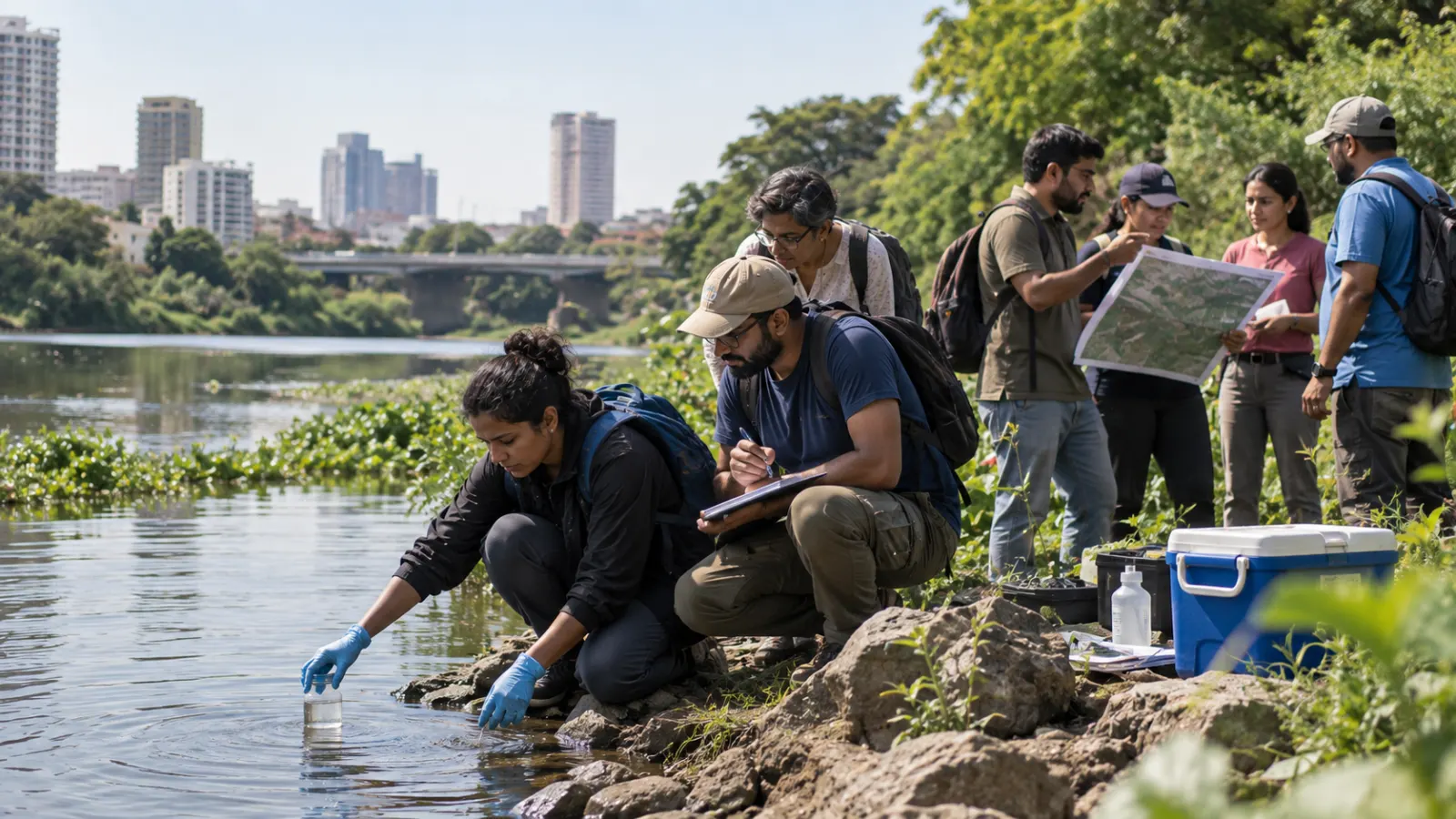
The methods can be quiet as well as confrontational. Residents may collect water samples and submit the results to a regulator. Lawyers may challenge an environmental permit. Researchers may document pollution. Investors may file shareholder resolutions. Citizens may participate in public consultations, submit information requests or campaign for stronger environmental standards.
What connects these activities is not one ideology or tactic. It is an attempt to change a decision, institution, rule or social norm rather than relying exclusively on personal lifestyle choices.
That distinction matters because many environmental problems are collective-action problems. One household can reduce its own waste, but it cannot establish a national fuel standard. One farmer cannot redesign a river-basin policy. One consumer cannot require an entire industry to disclose toxic chemicals. Environmental activism attempts to convert individual concern into collective influence over institutions capable of changing those conditions.
Activism begins when environmental concern becomes a public claim
Choosing to recycle, save electricity or consume less can be environmentally beneficial without necessarily being activism.
The character of the activity changes when people organise around a claim directed toward another decision-maker:
A factory should comply with an emissions limit.
A wetland should not be developed without adequate environmental assessment.
A municipality should disclose air-quality information.
A company should reduce a particular pollutant.
A government should strengthen enforcement of an existing environmental law.
These claims can be reformist or radical, local or global. Some campaigns simply want existing laws enforced properly. Others argue that the underlying legal or economic framework itself needs to change.
That range is important because “environmental activist” is not a precise description of one political position.
One group may seek stricter controls on a mining project while supporting mining under different conditions. Another may oppose the activity entirely. A conservation organisation may focus on biodiversity, while residents living nearby may focus on drinking water, land rights or employment. Climate campaigners may agree that emissions should fall while disagreeing about the mix of regulation, taxation, technology and public investment used to achieve it.
Environmental movements are therefore rarely single-minded actors.
They contain competing priorities, strategies and ideas about acceptable compromise.
Protest is one tool among many
The least dramatic forms of environmental activism are often among the most common.
Citizens attend planning meetings, write to representatives, submit comments on environmental assessments, conduct community surveys, organise local associations and collect evidence about pollution or ecological damage.
Technical knowledge can become an important source of influence. Community groups may map tree removal, photograph illegal dumping, monitor water quality or document changes in wildlife. Scientists may contribute measurements and expert analysis. Journalists can investigate failures of enforcement. Lawyers can test whether regulators or companies complied with existing law.
Environmental law itself has created formal channels for public participation.
The Aarhus Convention, adopted in 1998 within the UN Economic Commission for Europe framework, is built around three related principles: access to environmental information, public participation in environmental decision-making and access to justice. UNECE describes it as linking environmental protection with government accountability, transparency and responsiveness. (unece.org)
The Convention does not apply universally in the same way across every jurisdiction, but it illustrates a broader development in environmental governance: citizens increasingly have institutional routes through which they can contest or participate in environmental decisions.
Activism can therefore take place inside administrative processes as well as outside them.
A movement may begin with residents demonstrating against a proposed project and later spend months analysing permit conditions, submitting technical evidence or negotiating mitigation requirements.
The line between activism, advocacy and professional policy work can become blurred.
That is not necessarily a contradiction. It reflects the fact that environmental decisions are made through many different institutions.
Legal action has become a major environmental strategy
Courts are another arena in which environmental activism can operate.
Environmental litigation can challenge permits, seek enforcement of statutory duties, contest environmental assessments, assert constitutional or human-rights protections, or test whether governments have followed their own climate commitments.
Climate litigation has expanded particularly quickly.
UNEP's Global Climate Litigation Report: 2025 Status Review records 3,099 climate-related cases filed by 30 June 2025 across 55 national jurisdictions and 24 international or regional courts, tribunals or other bodies. The report describes litigation as an increasingly important route through which citizens, communities, organisations, companies and governments contest questions of climate responsibility and policy. (unep.org)
The existence of a court case does not mean activists will prevail.
Some cases are dismissed. Others succeed only on procedural grounds. A successful judgment may still be difficult to implement. Courts also vary greatly in the powers available to them and in the legal rights recognised within different jurisdictions.
But litigation can influence environmental governance in ways that extend beyond winning a single case.
A court can clarify how an environmental statute should be interpreted. A failed lawsuit can reveal a legislative gap. Disclosure produced during litigation can provide information for future regulation. A judgment in one jurisdiction can influence arguments elsewhere.
This illustrates a broader characteristic of activism: influence is often cumulative rather than immediate.
Environmental defenders overlap with activists, but the terms are different
The terms environmental activist and environmental defender are sometimes used interchangeably, but they describe overlapping rather than identical categories.
UNEP defines environmental human-rights defenders as individuals or groups who peacefully work to protect and promote human rights connected to the environment, including rights involving water, air, land, flora and fauna. (unep.org)
Some defenders are professional campaigners.
Many are not.
They may be Indigenous leaders, farmers, journalists, lawyers, scientists, fishers or residents trying to protect their homes, livelihoods or access to natural resources. A community opposing contamination of its water supply may understand its struggle primarily as one of health, property or human rights rather than participation in a broader environmental movement.
An environmental activist may likewise focus on changing policy without framing the campaign principally in human-rights language.
The distinction becomes particularly important because environmental defenders can face serious risks.
UNEP documents intimidation, harassment, criminalisation and violence against people defending environmental rights, while its Defenders Policy calls on governments and other institutions to protect environmental defenders and strengthen environmental rule of law. (unep.org)
A 2023 UN guidance note similarly calls for safe civic space, access to justice and meaningful participation by environmental human-rights defenders in decision-making. (unep.org)
This safety dimension should not be treated as peripheral.
Citizens cannot participate meaningfully in environmental governance if challenging a project exposes them to retaliation that other participants do not face.
Activism works best when pressure reaches a real decision point
Public attention is not the same as institutional change.
A campaign can dominate social media, attract large crowds or generate international news coverage without changing the decision it opposes.
Influence becomes more likely when activists identify who actually possesses authority and what specific decision can still be changed.
Is the relevant decision a planning permit?
A pollution licence?
A government budget?
A corporate procurement policy?
An environmental-impact assessment?
A court interpretation?
An election commitment?
A protected-area management rule?
A campaign aimed at “raising awareness” can become much more consequential when the awareness is connected to one of these decision points.
This is why environmental campaigns often combine tactics.
Research establishes the evidence.
Community organising demonstrates who is affected.
Media attention increases political visibility.
Public comments enter the formal administrative record.
Litigation tests legal duties.
Negotiation converts pressure into a possible remedy.
Consumer or investor action creates economic incentives.
The correct mix depends on the issue and political system.
A campaign attempting to prevent illegal dumping needs a different strategy from a global climate campaign or an Indigenous community defending land rights.
The shared principle is that visibility becomes more useful when it connects to an institution capable of acting.
Evidence can turn a grievance into an actionable claim
Environmental activism frequently begins with lived experience.
Residents may know that a river smells different, fish populations have declined, dust has increased or a neighbourhood floods more frequently after development.
That knowledge matters.
But influencing regulatory and legal systems often requires translating experience into evidence institutions can evaluate.
Measurements, photographs, maps, health records, company disclosures, environmental-impact assessments, permit conditions and scientific studies can help establish what has happened and who has responsibility for responding.
This does not mean only professional experts should participate.
Local knowledge can reveal problems that official monitoring misses. Community members know where flooding begins, which water sources have changed, when a species disappeared from a local area or how access restrictions affect livelihoods.
The strongest campaigns can connect these forms of knowledge rather than forcing a choice between them.
Evidence also imposes discipline.
Environmental claims can involve uncertain science, competing causal explanations or genuine trade-offs. Activists weaken their credibility when preliminary evidence is presented as certainty or when inconvenient information is ignored.
Responsible campaigns therefore distinguish between what is known, what is suspected and what remains disputed.
This standard should also apply to governments and companies.
Environmental debate improves when each side is expected to show the evidence supporting its claims.
Coalitions can broaden influence, but they also create disagreement
Environmental problems often intersect with other concerns.
Air pollution is simultaneously an environmental and public-health issue.
Forest protection can involve biodiversity, Indigenous rights, tourism, agriculture and livelihoods.
A transition away from fossil fuels raises questions about employment, energy prices, industrial policy and regional development.
Campaigns can therefore gain influence by building coalitions.
Residents, scientists, health professionals, farmers, workers, lawyers, faith groups, businesses and conservation organisations may support the same policy for different reasons.
That diversity can make an issue harder to dismiss as the concern of one narrow constituency.
But coalitions also create internal conflicts.
A conservation organisation may favour strict limits on resource use while local communities seek continued access under different management rules. Workers may support emissions reductions while resisting policies that threaten employment without a transition plan. National campaign groups may prioritise a symbolic victory while residents focus on immediate local compensation or safety.
Movements are therefore not single actors with one unified preference.
Coalition-building involves negotiation over which goals are essential, which compromises are acceptable and who has authority to represent affected groups.
That last question is particularly important.
A well-funded organisation should not automatically be assumed to speak for communities whose interests may differ from its own.
Environmental activism can fail, oversimplify or create backlash
Activism is a form of civic participation, not a guarantee of correctness.
Campaigners can misunderstand technical evidence.
They can exaggerate risk.
They can underestimate the economic or social costs of proposed policies.
A tactic intended to attract attention can alienate people whose cooperation is needed.
Movements can also create incentives for symbolic victories that look successful publicly while changing little materially.
Governments and companies may exploit this by making highly visible commitments that avoid the underlying structural issue.
Representation can create another problem.
Large organisations may possess lawyers, funding, communications teams and international networks while local communities directly affected by a project have far fewer resources. A campaign that claims to empower vulnerable communities can reproduce inequality if those communities become photographs and slogans rather than participants in actual decisions.
Responsible activism therefore requires questions similar to those asked of responsible government:
What evidence supports the claim?
Who is affected?
Who speaks for them?
What trade-offs are involved?
Who funds the campaign?
What outcome is actually being sought?
How will success be measured?
And what happens to people who disagree?
Activism becomes more credible when it can answer those questions rather than treating moral conviction as a substitute for evidence.
Disruption can attract attention, but attention has trade-offs
Street protest and civil disobedience remain among the most visible environmental tactics because visibility can change the political cost of ignoring an issue.
Marches, occupations, blockades and other disruptive actions can attract media attention that technical submissions never receive.
But disruption creates a strategic trade-off.
A tactic can increase awareness while reducing sympathy among people who experience the disruption. It can make an issue impossible for politicians to ignore while shifting public debate away from the environmental claim and toward the protest method.
There is no single rule determining whether disruption helps or harms a campaign.
Context matters: the severity of the issue, availability of conventional channels, target of the disruption, proportionality of the action and public interpretation all shape the result.
Legal consequences also differ substantially by country and locality. Rules governing public assembly, trespass, obstruction and civil disobedience are jurisdiction-specific.
This is another reason protest should not be treated as synonymous with activism.
Some movements deliberately use confrontation.
Others gain influence precisely by building technical credibility within institutions.
Many use both approaches at different stages.
Environmental law has changed what activism looks like
The expansion of environmental regulation has created a growing technical infrastructure around environmental disputes.
Permits, environmental-impact assessments, public hearings, pollution standards, disclosure rules and judicial review all create points where citizens and organisations can intervene.
The Aarhus Convention provides one particularly explicit model by linking environmental governance to rights of information, participation and justice. UNECE describes these mechanisms as tools for environmental democracy and public accountability. (unece.org)
This institutionalisation changes the work activists do.
Campaigning can require reading hundreds of pages of technical documentation.
Groups may need to understand emissions data, planning rules, corporate filings or administrative procedure.
Public-interest organisations may hire scientists, lawyers and policy specialists.
A grassroots campaign may eventually find itself negotiating detailed permit conditions with regulators.
The difference between an activist and a policy professional can therefore become surprisingly small.
The political character of the activity has not disappeared. The conflict simply moved partly into institutions.
Success is difficult to measure because policy change has many causes
Environmental campaigns often tell stories in which activism caused a government or company to change course.
Sometimes that causal connection is strong.
Often it is more complicated.
Environmental policy usually develops through interactions among activists, scientists, regulators, elected officials, businesses, courts, journalists and affected communities.
A company may adopt a cleaner technology because campaigners damaged its reputation—but also because regulators were preparing stricter standards and the alternative technology had become cheaper.
A government may protect an ecosystem following years of community campaigning, but scientific research and changing electoral incentives may also have contributed.
A lawsuit may fail yet influence future legislation.
A protest movement may win no immediate policy change but train organisers and build institutions used successfully several years later.
This makes activism difficult to evaluate through one simple question such as “Did the protest work?”
The useful questions are more specific.
Did it change public knowledge?
Did it produce new evidence?
Did it alter a company's behaviour?
Did it change regulatory practice?
Did it place an issue on an electoral agenda?
Did it establish a legal precedent?
Did it strengthen community organisation?
Did it modify the final project?
Not every campaign needs to achieve all of these outcomes to have influence.
But clarity about the intended decision helps distinguish meaningful impact from attention alone.
The democratic value of activism is participation, not guaranteed correctness
Environmental decisions distribute costs and benefits.
A mine can produce jobs and revenue while also creating ecological risks.
A protected area can conserve biodiversity while restricting traditional resource use.
A carbon policy can reduce emissions while raising particular costs if poorly designed.
A dam may provide electricity and water while displacing communities and changing ecosystems.
Scientific evidence can clarify many consequences, but science alone cannot decide how every competing interest should be weighted.
Those decisions involve rights, distribution, values and political judgement.
Environmental activism enters this space by allowing people to organise around interests or risks they believe institutions have ignored.
At its best, activism surfaces evidence, adds affected voices to decision-making and forces governments or companies to justify choices publicly.
At its worst, it can replace evidence with moral certainty, simplify legitimate trade-offs or imply that disagreement itself proves bad faith.
Democratic environmental governance requires something more demanding.
Citizens must be able to organise, investigate, protest, litigate and challenge powerful institutions.
Governments, companies, scientists and other citizens must also be able to question activists' claims.
The value lies in the contestability of environmental decisions—not in assuming that one side possesses automatic moral or technical authority.
Environmental activism is therefore best understood as one mechanism through which society tests who gets to make environmental decisions, what evidence they must provide and whose interests must be considered.
Its influence does not depend on protest alone.
It can operate through courts, science, elections, markets, journalism, regulation, negotiation and community organising.
The most consequential campaigns usually connect several of those tools to a concrete decision that somebody has the power to change.
That is the distinction between environmental concern and environmental activism:
concern asks whether something is wrong; activism organises people, evidence and pressure around the question of what should change, who can change it and how that decision can be influenced.