Shah Jahan Biography: Empire, Taj Mahal and the Politics of Mughal Splendour
A Shah Jahan biography almost inevitably begins with architecture.
The Taj Mahal rises beside the Yamuna at Agra. The Red Fort still defines the historic landscape of Delhi. The Jama Masjid remains one of South Asia's great congregational mosques. Mughal albums from his reign preserve an imperial world of jewels, textiles, flowers, calligraphy, marble and carefully controlled symmetry.
Few rulers in Indian history are remembered so powerfully through things they commissioned.
That visual legacy can make Shah Jahan appear primarily as a patron of beauty—or, in popular memory, simply as the grieving husband who built the Taj Mahal for Mumtaz Mahal.
Both descriptions are incomplete.
Monuments are also political documents.
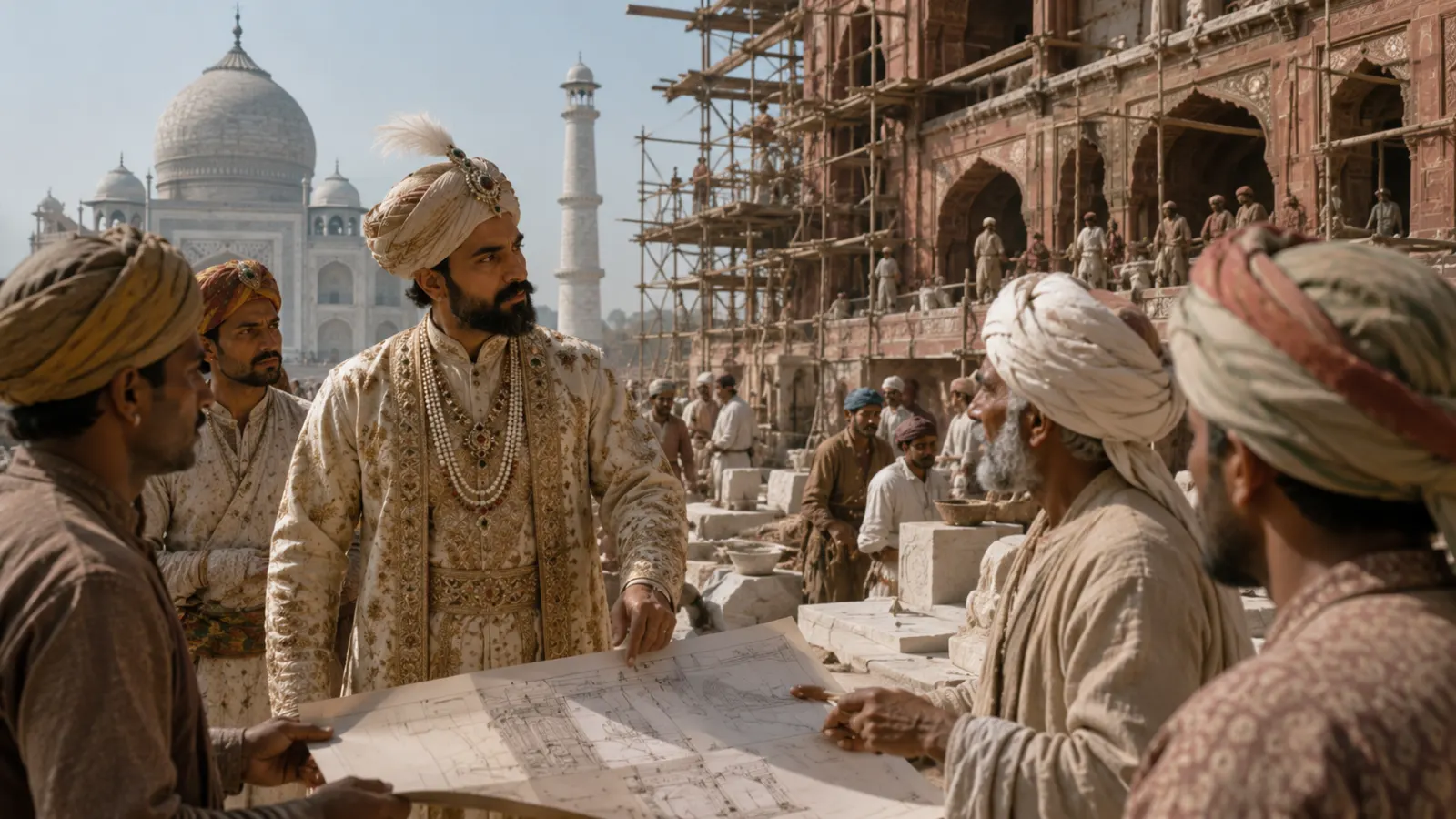
Buildings on the scale of the Taj Mahal or Red Fort required quarrying, transport, revenue, administrators, architects, masons, stonecutters, calligraphers, inlay specialists and an imperial system capable of coordinating resources across enormous distances.
Shah Jahan's architectural world was possible because the Mughal Empire had become one of the wealthiest and most administratively sophisticated states of the early modern era.
The same reign also contained relentless military ambition, campaigns in the Deccan and Central Asia, the permanent loss of Kandahar to the Safavids, catastrophic famine in western India and eventually a civil war among Shah Jahan's own sons.
To understand Shah Jahan, therefore, the marble has to be placed back inside the empire that produced it.
Shah Jahan at a glance
| Birth name | Prince Khurram |
| Born | 5 January 1592 |
| Birthplace | Lahore |
| Father | Emperor Jahangir |
| Mother | Rajput princess commonly known as Jagat Gosain |
| Dynasty | Mughal |
| Reign | 1628–1658 |
| Most famous consort | Mumtaz Mahal |
| Major monuments associated with his reign | Taj Mahal, Red Fort, Jama Masjid, Shahjahanabad |
| Major military theatres | Deccan, Central Asia, Kandahar frontier |
| Removed from power | 1658, during the Mughal succession war |
| Successor | Aurangzeb |
| Died | 22 January 1666 |
| Burial | Taj Mahal, beside Mumtaz Mahal |
Official Indian heritage material identifies Shah Jahan as the fifth Mughal emperor, born at Lahore in 1592 and ruling from 1628 until his displacement in 1658. (tajmahal.gov.in)
Prince Khurram: growing up inside the Mughal dynasty
Shah Jahan was born Prince Khurram, a son of Prince Salim—later Emperor Jahangir—and a Rajput mother commonly identified as Jagat Gosain.
He grew up inside one of the most powerful courts in the world.
But Mughal princes were not heirs simply waiting for an emperor to die.
They received military commands.
Governed territories.
Built factions among nobles.
Developed alliances.
Acquired revenue and military experience.
And competed continuously for imperial favour.
Akbar died in 1605 and Jahangir inherited the empire. During his father's reign, Khurram emerged as one of the dynasty's most important military princes.
He participated prominently in campaigns connected with Mewar and the Deccan and developed a reputation for command.
That experience mattered.
The future patron of the Taj Mahal was a military and political figure long before he became an architectural icon.
Mumtaz Mahal entered his life before he became emperor
In 1612, Prince Khurram married Arjumand Banu Begum, later given the title Mumtaz Mahal.
She was not his only wife, but she became the consort most closely associated with him in Mughal court memory.
Their marriage later became one of the world's most famous imperial love stories because of what happened after her death.
But during Khurram's rise, the marriage also belonged to the politics of the Mughal elite. Arjumand Banu came from a powerful Persian-origin family deeply connected with the court.
The romantic and political dimensions were not mutually exclusive.
Mughal royal marriages could involve affection, dynasty, status and political networks at the same time.
Prince Khurram also rebelled against his father
The later image of Shah Jahan as an emperor of perfect order can obscure how unstable his own road to power was.
During Jahangir's later years, court politics became increasingly shaped by the influence of Nur Jahan, Jahangir's powerful empress, and by competing succession interests.
Khurram eventually rebelled.
The rebellion of the 1620s placed him in direct conflict with his father's imperial government. He was defeated, moved through different regions seeking support and was eventually reconciled with Jahangir.
Even the dispute over Kandahar became entangled with this family conflict. Encyclopaedia Iranica notes that when Jahangir ordered Khurram to lead an army following the Safavid seizure of Kandahar in 1622, the prince instead became increasingly absorbed in his conflict with the court. (iranicaonline.org)
The episode reveals a larger truth about Mughal politics.
Imperial sons were simultaneously members of a family and potential competitors for sovereignty.
That structure would eventually destroy Shah Jahan's own hold on power.
Shah Jahan won the throne because Mughal succession had no simple rule
Jahangir died in 1627.
There was no binding law of primogeniture requiring the eldest surviving son automatically to become emperor.
Mughal succession worked through political support and military victory.
Princes had their own supporters.
Nobles made calculations.
Rival claimants could become existential threats.
Khurram emerged victorious from the struggle following Jahangir's death and took the throne as Shah Jahan in 1628.
Rivals were eliminated.
That violence should not simply be treated as evidence of an unusually cruel individual. The Mughal dynastic system repeatedly generated conflict because powerful princes had legitimate royal blood but no universally accepted succession mechanism that could prevent competition.
Shah Jahan benefited from that system when he became emperor.
Thirty years later, he would become its victim.
Shah Jahan inherited an empire of extraordinary scale
The new emperor inherited administrative institutions developed especially under Akbar and Jahangir.
The Mughal state linked enormous territories through:
provincial governors;
revenue officials;
military commanders;
the mansabdari system;
jagir assignments;
court patronage;
and Persian-language administration.
Agricultural production formed the main fiscal foundation of the empire.
Land revenue supported the court, army, administration and monumental building programmes.
At the same time, the Indian economy participated in extensive regional and international trade.
Cotton textiles and other manufactures moved through networks connecting India with Central Asia, Southeast Asia, the Red Sea, the Persian Gulf and Europe. Cambridge's economic history of Mughal India describes extensive agricultural production alongside significant manufacturing, with cotton textiles forming the country's leading manufactured export. (cambridge.org)
European trading companies were becoming increasingly visible at coastal centres.
But during most of Shah Jahan's reign they remained commercial actors operating within an Indian political world dominated by much larger indigenous states.
The Mughal Empire was not yet living under European political supremacy.
It was one of the powers Europeans had to negotiate with.
Imperial magnificence depended on agrarian revenue
The glittering surfaces of Shah Jahan's court can make Mughal wealth appear almost effortless.
It was not.
The empire's fiscal system ultimately depended heavily on agricultural production and the collection of land revenue.
That revenue maintained armies.
Supported nobles.
Financed the imperial household.
And made enormous architectural projects possible.
This does not mean a particular monument can simply be reduced to a crude equation of taxes collected and stones purchased.
The state economy was much more complicated.
But architecture cannot be separated from the material capacity of government.
The Taj Mahal required aesthetic imagination.
It also required logistics.
Shah Jahan's empire remained expansionist
His reign was not merely a period in which an already-secure empire relaxed into artistic achievement.
Military activity remained constant.
The Deccan was particularly important.
The Nizam Shahi kingdom of Ahmadnagar had resisted Mughal pressure over several reigns. Under Shah Jahan, Mughal expansion intensified and the independent Nizam Shahi state was finally eliminated.
The settlements of 1636 reshaped relations with Bijapur and Golconda.
Those Deccan sultanates remained important states but operated under greater Mughal pressure and accepted arrangements reflecting Mughal supremacy in significant respects.
For Shah Jahan, this represented an extension of imperial influence.
For the future of the dynasty, however, deeper involvement in the Deccan also created long-term commitments.
One of the Mughal princes who gained substantial experience there was Shah Jahan's son Aurangzeb.
That would matter enormously later.
The famine of 1630–32 reveals another Mughal reality
The early years of Shah Jahan's reign coincided with catastrophic famine in Gujarat, the Deccan and neighbouring regions.
Contemporary descriptions evoke severe hunger, population displacement and mass mortality.
Drought and crop failure combined with the disruption created by warfare and markets to produce devastating conditions.
Imperial sources record forms of relief, including remissions and food distribution.
But the suffering remained enormous.
This episode is essential to any serious assessment of Shah Jahan's reign.
The splendour visible in court paintings and imperial architecture does not necessarily tell us how ordinary people lived.
An empire can possess enormous aggregate wealth while large sections of its population remain vulnerable to harvest failure, war and food-price shocks.
The phrase “golden age” therefore needs careful use.
Mumtaz Mahal died in 1631
Mumtaz Mahal died at Burhanpur in 1631, while accompanying Shah Jahan during a military campaign.
She died after giving birth to their fourteenth child.
Her death produced the event for which Shah Jahan is remembered globally.
He commissioned a monumental mausoleum at Agra.
The building became the Taj Mahal.
Its familiarity can make its scale easy to underestimate.
This was not merely a tomb building.
It was an enormous funerary and garden complex involving architecture, landscaping, calligraphy, stone carving, inlay, hydraulic planning and carefully structured relationships between buildings and landscape.
The Taj Mahal was a collective creation
Popular stories like to search for one genius who “designed the Taj Mahal.”
Historical architecture rarely works that simply.
UNESCO records that construction began in 1632, that the principal mausoleum was completed by 1648, and that additional parts of the complex were completed by about 1653.
It identifies Ustad Ahmad Lahori as the main architect while also noting the involvement of masons, stonecutters, inlayers, carvers, painters, calligraphers, dome builders and other artisans recruited from across the Mughal Empire as well as Central Asia and Iran. (whc.unesco.org)
That collective character matters.
Shah Jahan was the patron.
His court financed, commissioned and organised the project.
But thousands of skilled people transformed imperial intention into marble.
What makes the Taj Mahal extraordinary?
The Taj Mahal is often described as a monument to love.
That interpretation has enormous cultural power.
But it is not the complete architectural meaning of the complex.
The Taj belongs to a longer history of Islamic, Timurid, Persian and Mughal funerary architecture.
Its design invokes ideas of paradise, dynasty, imperial authority, geometry and ordered space.
The famous white-marble mausoleum sits within a much larger composition.
Garden.
Gateway.
Mosque.
Guest pavilion.
Riverfront.
Calligraphy.
Red sandstone.
White marble.
Pietra dura inlay.
Water.
Vegetation.
Symmetry.
The result is carefully controlled without feeling mechanically repetitive.
UNESCO describes the Taj Mahal as a major achievement of Indo-Islamic architecture and specifically notes the innovative placement of the mausoleum at the end of the garden rather than simply at its centre. (whc.unesco.org)
The monument is therefore not an isolated miracle created from grief alone.
It is one of the culminations of centuries of architectural development.
Shah Jahan turned aesthetics into imperial politics
Architecture was one component of a much wider visual language.
Shah Jahan's court developed an aesthetic of hierarchy, symmetry and controlled magnificence.
The famous Peacock Throne represented one extreme version of this political visual culture.
Jewels, textiles and ceremonial objects transformed the emperor into the centre of an extraordinary material world.
Court painting did something similar.
The Shah Jahan Album, now dispersed among collections including the Metropolitan Museum of Art, contains portraits, nature studies, calligraphy and elaborately illuminated pages.
The album had begun under Jahangir, but Shah Jahan expanded it with new paintings and calligraphic works. The Met describes it as a major record of Mughal courtly life and patronage. (metmuseum.org)
Art was not simply decoration.
It communicated kingship.
Imperial portraits made hierarchy visible
Portraits of Shah Jahan frequently show the emperor surrounded by extraordinary refinement.
Clothing.
Jewels.
Weapons.
Textiles.
Halos.
Controlled posture.
Precise ranking.
One Met portrait painted around Shah Jahan's accession explicitly amplifies formulas already developed under Akbar and Jahangir, using rich dress, jewellery and a radiating halo to emphasise imperial status. (metmuseum.org)
The image does not merely tell us what Shah Jahan looked like.
It tells us how the Mughal court wanted sovereignty to look.
Shahjahanabad turned kingship into a city
Shah Jahan's architectural ambitions were not confined to individual buildings.
He created a new imperial capital at Delhi.
The city became known as Shahjahanabad.
Work on the Red Fort began in 1639, as Shah Jahan shifted the imperial centre from Agra toward Delhi. UNESCO identifies the Red Fort as the palace-fortress of Shahjahanabad and describes its planning as a major culmination of Mughal architectural development. (whc.unesco.org)
The city was organised around imperial, commercial and religious spaces.
The Red Fort served as the political centre.
The Jama Masjid became a monumental congregational mosque.
Markets and neighbourhoods created the everyday life of the city.
The great avenue associated with Chandni Chowk became one of its defining commercial spaces.
Shahjahanabad was not the first Delhi.
But its urban form profoundly influenced the Delhi that followed.
The Red Fort organised access to the emperor
A palace is also a political technology.
The Red Fort controlled movement.
Visitors did not simply walk from the city directly to the emperor.
Entrances, courts, halls and ceremonial spaces structured access through increasingly restricted zones.
Architecture translated hierarchy into movement.
The closer someone came to the ruler, the more carefully access could be controlled.
The Red Fort therefore communicated Mughal sovereignty not merely through expensive materials but through spatial organisation.
UNESCO describes its planning as a refined synthesis of Islamic, Persian, Timurid and Indian architectural traditions. (whc.unesco.org)
Shahjahanabad outlived the empire that created it
The later history of the Red Fort gives Shah Jahan's architecture meanings he could never have predicted.
The fort remained important through later Mughal decline.
It was transformed under British colonial occupation.
After the uprising of 1857, large parts of the complex were altered or destroyed.
In modern India, it became one of the most recognisable architectural symbols of national sovereignty.
India's Independence Day ceremony places the prime minister at the Red Fort.
UNESCO explicitly notes this later historical transformation, describing the fort as a site connecting Mughal power, colonial change and the celebration of Indian independence. (whc.unesco.org)
An architecture built to glorify Mughal monarchy became part of the symbolic vocabulary of a modern republic.
Jahanara Begum mattered to Shah Jahan's imperial world
Shah Jahan's reign cannot be reconstructed only through the emperor and his sons.
His daughter Jahanara Begum became one of the most influential members of the Mughal royal household.
After Mumtaz Mahal's death, she occupied an exceptionally important position within the court.
She controlled substantial resources.
Sponsored architecture and charitable works.
Participated in Sufi religious culture.
And exercised influence far beyond the private household.
Jahanara is also closely associated with the commercial development of Shahjahanabad, including the celebrated Chandni Chowk area.
Her career helps correct a simplistic picture of Mughal politics in which royal women existed only inside secluded domestic life.
The court remained profoundly patriarchal.
But elite Mughal women could control wealth, patronage networks and property and could shape urban, religious and cultural spaces.
The artisans behind “Shah Jahan's buildings”
We routinely say:
Shah Jahan built the Taj Mahal.
Shah Jahan built the Red Fort.
That language is historically understandable because rulers were patrons.
But it can hide labour.
Imperial architecture depended on:
architects;
engineers;
masons;
stonecutters;
calligraphers;
garden planners;
inlay specialists;
metalworkers;
woodworkers;
quarry workers;
transport workers;
and administrators.
Materials had to be identified, purchased, transported and shaped.
UNESCO records that artisans for the Taj were drawn not merely from the Mughal Empire but also from Central Asia and Iran. (whc.unesco.org)
The monument was therefore simultaneously:
Shah Jahan's commission;
a Mughal state project;
and the collective product of specialised labour.
All three descriptions can be true.
Shah Jahan also looked north toward the Timurid world
Mughal political identity retained a powerful memory of Central Asian origins.
The dynasty descended from Timur through Babur's paternal lineage, and places such as Samarkand carried dynastic prestige.
During the 1640s, Shah Jahan pursued campaigns in Balkh and Badakhshan.
The ambition was enormous.
So were the practical problems.
Maintaining armies across difficult terrain and long supply routes placed severe strain on Mughal forces.
The Central Asian venture ultimately failed to produce a durable territorial settlement.
The episode reveals an important limitation of imperial power.
A state wealthy enough to build the Taj Mahal could still fail militarily when distance, geography, logistics and local resistance worked against it.
Kandahar exposed another limit
Kandahar occupied a strategic position between the Mughal and Safavid empires.
Control had shifted repeatedly.
In 1638, the Safavid governor Ali Mardan Khan surrendered Kandahar to Shah Jahan, bringing it under Mughal authority. (iranicaonline.org)
The victory did not last.
Safavid Shah Abbas II moved against the city and captured it in 1649.
The Mughals attempted repeatedly to recover Kandahar.
They failed.
Encyclopaedia Iranica records successive Mughal efforts after the Safavid capture, including renewed sieges and a final major effort under Dara Shikoh. (iranicaonline.org)
The failure mattered strategically.
It also damaged Mughal prestige.
Once again, Shah Jahan's reign was not a continuous march of imperial success.
Court magnificence should be read as evidence—and propaganda
Shah Jahan's court became extraordinarily skilled at representing imperial order.
Portraits made hierarchy visible.
Architecture transformed symmetry into political language.
Court chronicles described campaigns and ceremonies within an official framework.
Ceremonial objects staged immense wealth.
These sources are invaluable.
They are also products of power.
An imperial chronicle can tell historians a great deal about government while presenting events in ways favourable to the dynasty.
A portrait can provide evidence about clothing, jewellery and political symbolism while also idealising the emperor.
A palace can demonstrate state capacity without proving that ordinary subjects enjoyed comparable prosperity.
The correct historical response is therefore not to reject court evidence as propaganda.
It is to read it critically alongside other evidence.
Dara Shikoh became the favoured prince
As Shah Jahan aged, succession became increasingly urgent.
His eldest son, Dara Shikoh, was closely associated with the emperor and widely treated as the favoured successor.
Dara became famous for intellectual and religious interests unusual enough to generate controversy long after his death.
He engaged deeply with Sufi thought and with Sanskritic philosophical traditions.
He sponsored Persian translations of the Upanishads, seeking points of connection between intellectual and mystical traditions.
His brother Aurangzeb developed a very different later reputation, associated much more strongly with military command and Islamic legal culture.
The contrast is historically important.
But later political narratives often turn Dara and Aurangzeb into overly simple opposites.
Both were Mughal princes competing for sovereignty.
And they were not the only competitors.
Shah Shuja and Murad Baksh also wanted the throne
Shah Jahan had four adult sons who became central to the succession crisis:
Dara Shikoh;
Shah Shuja;
Aurangzeb;
and Murad Baksh.
Each possessed status, resources and political ambitions.
That is essential to understanding what happened in 1657.
The conflict was not initially a straightforward duel between Dara and Aurangzeb.
It became a multi-sided imperial civil war.
Shah Jahan's illness triggered the succession war
In 1657, Shah Jahan became seriously ill.
The emperor did not immediately die.
But Mughal politics could not comfortably wait to discover whether he would recover.
Each prince understood the danger of allowing another brother to seize the initiative.
Military mobilisation began.
Alliances formed.
Claims were made.
Aurangzeb entered into a temporary alliance with Murad.
Shah Jahan backed Dara.
Cambridge's study of Mughal princes describes the emperor's incapacitation in late 1657 as the trigger for a full-scale succession war among all four adult sons. (cambridge.org)
The succession system that had helped Shah Jahan win power now destabilised his own reign.
The Battle of Samugarh changed everything
The decisive confrontation came near Agra in 1658.
At the Battle of Samugarh, forces associated with Dara Shikoh were defeated by Aurangzeb and Murad.
The victory transformed the political situation.
Aurangzeb gained control.
Shah Jahan, though alive and eventually recovered from his illness, was removed from effective government.
Aurangzeb became emperor.
The political order embodied in Shah Jahan's architecture had not collapsed because the empire lacked wealth or a functioning administration.
It collapsed at the centre because the dynasty had no peaceful mechanism for transferring supreme power among competing adult princes.
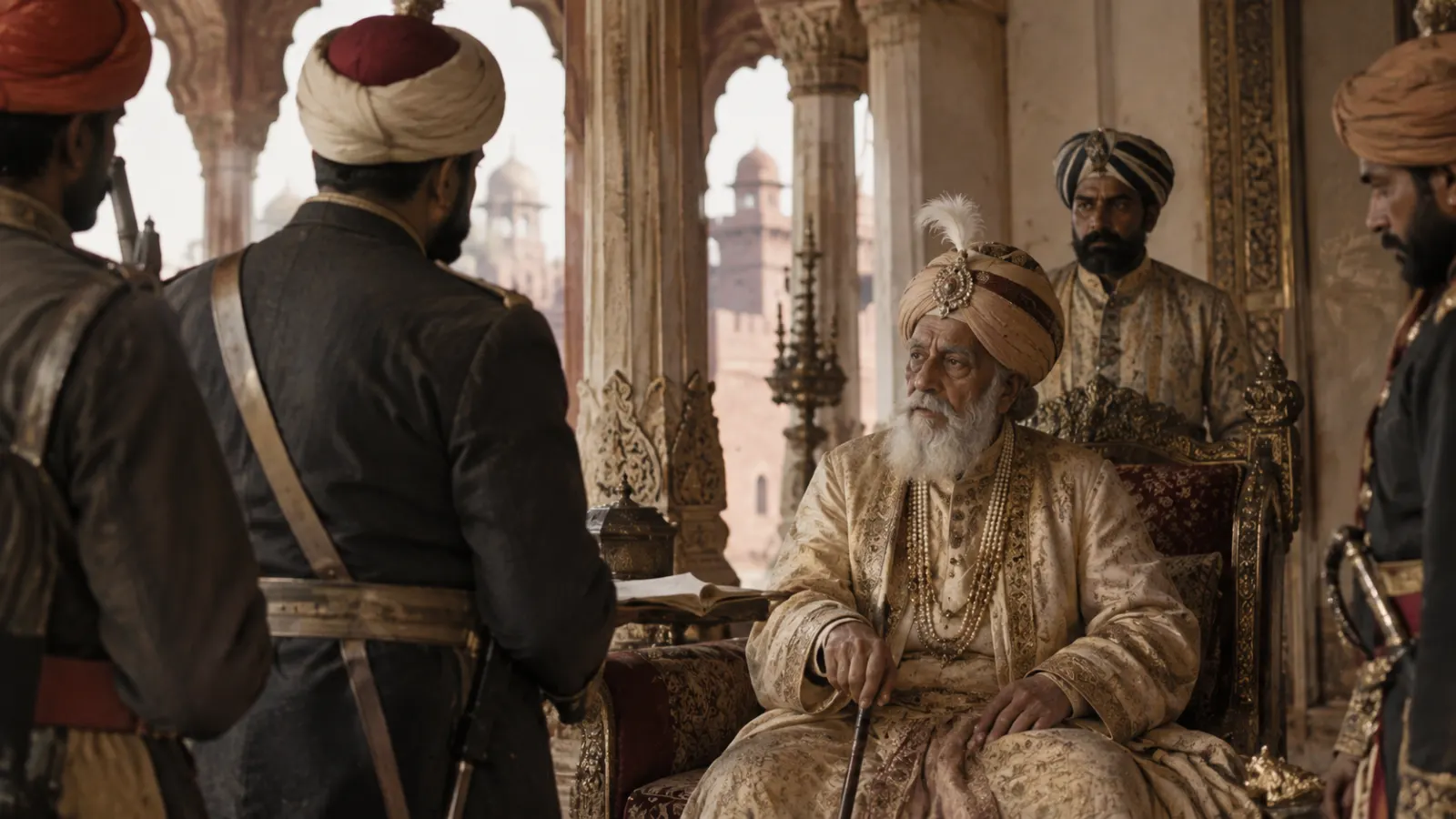
Aurangzeb confined his father at Agra
Shah Jahan spent the final years of his life under confinement at Agra Fort.
His daughter Jahanara remained closely associated with him during this period.
Popular memory has created one of the most powerful images in Mughal history:
the old emperor looking across the Yamuna toward the Taj Mahal, the monument he built for Mumtaz.
The symbolic power is irresistible.
The precise daily details are much harder to establish than later romantic storytelling implies.
The historically secure point is more important.
The ruler whose architecture projected almost perfect imperial control ended his life without political control of his own empire.
Dara Shikoh did not survive the struggle
Dara fled after defeat but was eventually captured.
He was executed in 1659.
Murad, once Aurangzeb's ally, was also eliminated.
Shah Shuja fled east and disappeared from the Mughal contest.
Aurangzeb emerged as the victor.
This was not an orderly royal succession.
It was civil war.
And it demonstrates why Shah Jahan's reign cannot be understood without the political system that produced both its magnificence and its final crisis.
Shah Jahan died in 1666
After years in confinement, Shah Jahan died in Agra in 1666.
He was buried inside the Taj Mahal beside Mumtaz Mahal.
The burial produced an unexpected architectural consequence.
The Taj's central composition had been organised around Mumtaz's cenotaph.
Shah Jahan's cenotaph was added beside hers.
UNESCO notes that Mumtaz Mahal's cenotaph occupies the precise centre of the tomb chamber, while Shah Jahan's larger cenotaph was installed beside it later. (whc.unesco.org)
The emperor associated more than almost any other Mughal ruler with symmetry became the element that disrupted the symmetry of his own greatest monument.
History could hardly have produced a more effective symbol.
Was Shah Jahan's reign really a Mughal “golden age”?
The expression golden age of Mughal architecture has good reason behind it.
The Taj Mahal.
Red Fort.
Jama Masjid.
Imperial gardens.
Court painting.
Jewellery.
Decorative arts.
Calligraphy.
Urban design.
Few periods in Mughal cultural history produced such concentrated refinement.
But a golden age of architecture is not automatically a golden age for everyone living within the empire.
The reign also contained:
famine;
heavy agrarian extraction;
continuous military expenditure;
social hierarchy;
failed campaigns;
and destructive dynastic conflict.
This distinction matters because historians measure different things.
A period can be artistically extraordinary.
Economically powerful.
Politically formidable.
And socially unequal.
All at once.
The Taj Mahal has accumulated myths almost as quickly as admiration
The global fame of the Taj Mahal has made it unusually vulnerable to legend.
Stories claim that Shah Jahan planned an identical Black Taj across the Yamuna.
Others say artisans had their hands cut off so they could never reproduce the building.
Modern political narratives sometimes claim that the Taj was simply a pre-existing non-Mughal sacred structure appropriated wholesale by Shah Jahan.
These stories vary greatly in origin and evidentiary quality.
They should not be repeated as established fact merely because they are memorable.
UNESCO's chronology, architectural evidence, inscriptions and Mughal documentation place the complex firmly within Shah Jahan's seventeenth-century building programme. (whc.unesco.org)
The documented history is already extraordinary.
Myth is unnecessary.
Shah Jahan's greatest achievement was not simply “building beautiful things”
Architecture under Shah Jahan represented a much larger political achievement.
The Mughal state could gather extraordinary resources.
Coordinate specialised labour.
Transport materials across regions.
Maintain major cities.
Sustain a sophisticated court culture.
And transform imperial ideas into physical environments.
The Taj Mahal is therefore simultaneously:
a mausoleum;
a work of architecture;
an expression of grief;
a dynastic monument;
an imperial project;
and evidence of Mughal administrative capacity.
Reducing it to only one of those categories makes it less interesting, not more.
Why Shah Jahan still matters
Shah Jahan remains one of the most recognisable Mughal emperors because his reign produced architecture capable of surviving the political world that created it.
The Mughal dynasty lost power.
The Peacock Throne disappeared from Delhi.
Shahjahanabad was transformed by conquest, colonialism and modern urban growth.
The imperial succession ended.
Yet the Taj Mahal still stands.
The Red Fort survived and acquired new political meanings.
The Jama Masjid remains a living religious monument.
Mughal paintings continue to preserve the visual ambitions of the court.
That durability can tempt us to remember the ruler only through marble.
But the more interesting Shah Jahan emerges when beauty and power are studied together.
His architecture depended on taxation, skilled labour, trade, administration and imperial command.
His political confidence existed alongside military limits at Balkh and Kandahar.
His court's splendour existed alongside catastrophic famine.
His apparently ordered dynasty contained no secure system for succession.
And the emperor who made symmetry into one of the defining visual languages of Mughal kingship ultimately saw his political world broken apart by his own sons.
Shah Jahan's reign was therefore not simply the story of the man who built the Taj Mahal.
It was the story of the Mughal Empire at an extraordinary moment of material and artistic power—and of the political contradictions hidden beneath that magnificent surface.
Frequently Asked Questions
Who was Shah Jahan?
Shah Jahan was the fifth Mughal emperor, ruling from 1628 until his displacement during the succession crisis of 1658. He is most famous for commissioning the Taj Mahal and for major architectural projects including the Red Fort and Shahjahanabad.
What was Shah Jahan's original name?
He was born Prince Khurram in Lahore in 1592.
Who was Shah Jahan's father?
His father was the Mughal emperor Jahangir, who ruled from 1605 to 1627.
Who was Mumtaz Mahal?
Mumtaz Mahal was the title of Arjumand Banu Begum, Shah Jahan's most famous consort. She died in 1631 after giving birth to their fourteenth child.
Why did Shah Jahan build the Taj Mahal?
Shah Jahan commissioned the Taj Mahal as a mausoleum for Mumtaz Mahal after her death. The complex also expressed Mughal architectural traditions, imperial patronage, ideas of paradise and dynastic commemoration.
When was the Taj Mahal built?
Construction began around 1632. UNESCO states that the principal mausoleum was completed by 1648, while additional elements of the complex were completed by approximately 1653. (whc.unesco.org)
Did Shah Jahan personally design the Taj Mahal?
No evidence suggests that Shah Jahan personally produced every architectural plan. He was the imperial patron. UNESCO identifies Ustad Ahmad Lahori as the main architect and records the participation of many specialised artisans and craftspeople. (whc.unesco.org)
Did Shah Jahan build the Red Fort?
Shah Jahan commissioned the Red Fort as the palace-fortress of his new capital, Shahjahanabad. Construction began in 1639 as part of the creation of the new Mughal imperial centre at Delhi. (whc.unesco.org)
Why did Shah Jahan lose Kandahar?
Safavid forces under Shah Abbas II captured Kandahar from the Mughals in 1649. Shah Jahan subsequently ordered several attempts to recover the strategic city, but they failed. (iranicaonline.org)
Why was Shah Jahan imprisoned?
Shah Jahan's serious illness in 1657 triggered a succession war among his sons. Aurangzeb defeated his principal rivals, gained control in 1658 and confined his father at Agra Fort.
Did Shah Jahan want Dara Shikoh to succeed him?
Dara Shikoh was Shah Jahan's favoured son and received his father's support during the succession crisis. However, Mughal succession had no fixed rule guaranteeing Dara's uncontested accession. (cambridge.org)
Who succeeded Shah Jahan?
His son Aurangzeb emerged victorious from the succession war and became Mughal emperor in 1658.
Where is Shah Jahan buried?
Shah Jahan is buried beside Mumtaz Mahal inside the Taj Mahal at Agra.
Was Shah Jahan's reign really a golden age?
It can reasonably be described as a high point of Mughal architecture and court culture. But the label becomes misleading if it implies universal prosperity, because the reign also experienced famine, warfare, heavy revenue demands and violent dynastic conflict.