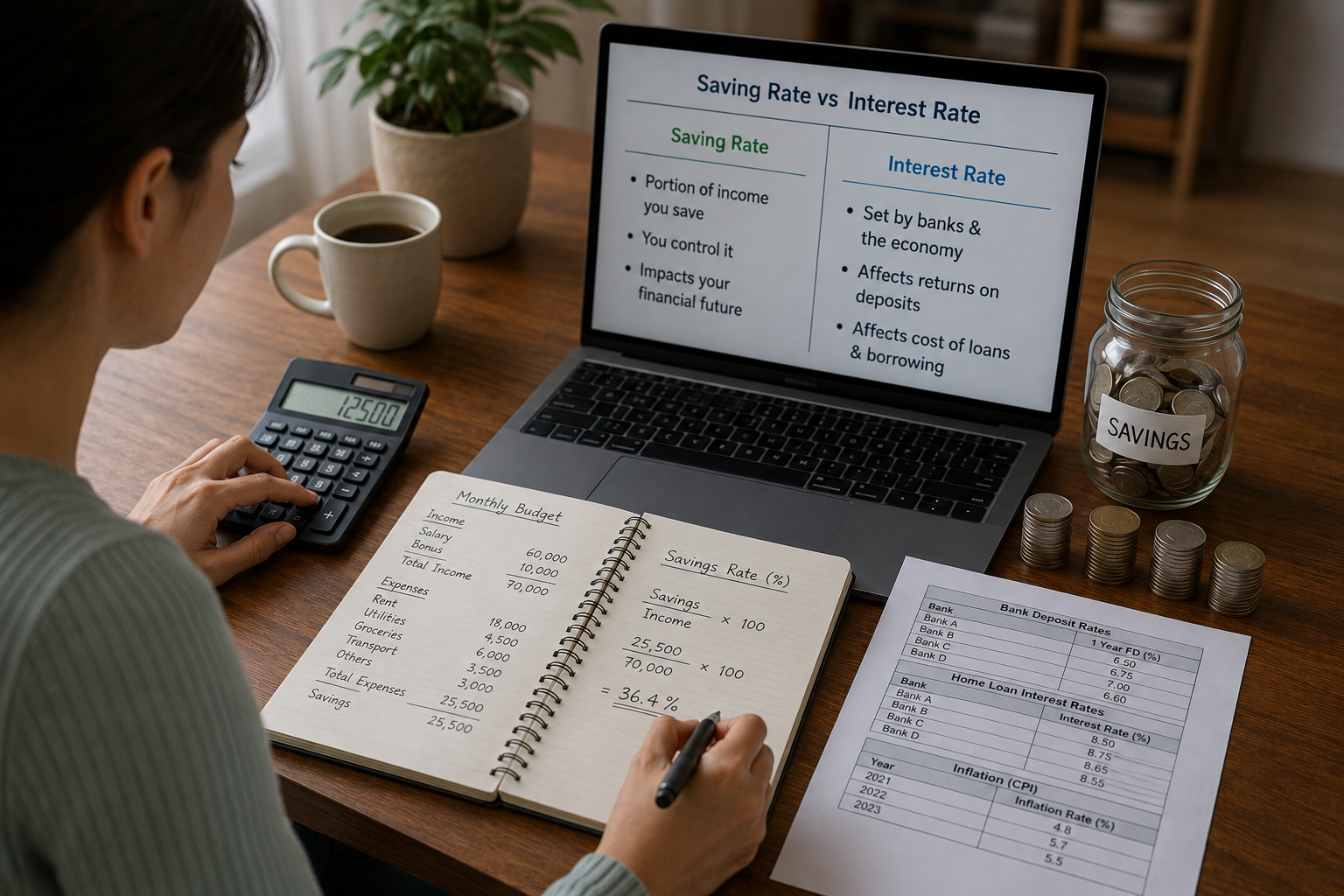
Two similar words, two very different ideas
Saving rate and interest rate are often confused because both belong to the language of money. But they answer different questions. The saving rate tells us how much of income is saved instead of spent. The interest rate tells us the price or reward for using money over time. One describes household or national behaviour. The other describes the cost of borrowing and the return from lending or depositing.
This difference matters because many people say, "interest rates are high, so saving rate must be high" or "people are saving less because interest rates are low." Reality is more complex. A household may save more even when deposit rates are low because it fears job loss. Another household may save less even when interest rates are attractive because food, rent, education and medical expenses have increased. The saving rate is about income allocation. The interest rate is about money pricing.
What saving rate means
The saving rate is the share of income that is not consumed. At the household level, it can be understood simply: if a family earns Rs 1,00,000 in a month and spends Rs 80,000, it saves Rs 20,000. Its saving rate is 20 percent. At the national level, statisticians use more formal definitions based on disposable income, consumption expenditure and pension-related adjustments.
Saving is not limited to cash lying idle. It can appear as bank deposits, provident fund contributions, pension savings, insurance-linked savings, mutual funds, bonds, small savings schemes, debt repayment, gold purchases or investments in property. Some forms are financial savings. Others are physical savings. Economists care about the mix because financial savings can be channelled through the banking and capital-market system into investment.
A high saving rate can support investment and resilience. But saving is not automatically good in every situation. If everyone cuts consumption suddenly during a slowdown, demand may weaken. The same act that is wise for one household can become a macroeconomic problem if every household does it at the same time.
What interest rate means
An interest rate is the price of money over time. If you borrow, it is the cost you pay for using someone else's money today. If you deposit or lend, it is the return you earn for allowing someone else to use your money. A home loan rate, personal loan rate, credit card rate, fixed deposit rate, government bond yield and central bank policy rate are all interest-rate concepts, though they operate in different markets.
Interest rates exist because money has time value. A rupee today is not the same as a rupee ten years later. Inflation may reduce purchasing power. Borrowers may default. Lenders give up liquidity. Interest compensates for time, risk, inflation and opportunity cost.
Central banks influence interest rates through monetary policy. Commercial banks set deposit and lending rates based on policy rates, liquidity, competition, funding costs, credit risk and business strategy. Markets set bond yields through demand and supply. This is why there is no single "interest rate" in the economy. There is a family of rates.
The simplest difference
The saving rate is a ratio of saved income to total income. The interest rate is a percentage charged or earned on money lent, borrowed or deposited.
The saving rate answers: how much are people saving? The interest rate answers: at what price is money being borrowed or lent?
Saving rate belongs to behaviour. Interest rate belongs to pricing. Saving rate is about income and consumption. Interest rate is about time and credit. Saving rate can rise because of fear, discipline, income growth or limited spending opportunities. Interest rates can rise because of inflation, tight monetary policy, higher credit risk or stronger demand for funds.
Confusing the two leads to bad personal finance decisions. A person may focus only on the deposit interest rate while ignoring whether they are saving enough. Another person may save a large share of income but keep it in products that fail to beat inflation. Good financial planning needs both: a healthy saving rate and sensible interest-rate awareness.
Why higher interest rates do not always increase saving
In theory, higher deposit rates should encourage saving because people get a better return. But households do not behave like formulas. If inflation is also high, the real return may remain weak. If incomes are stagnant, there may be nothing left to save. If debt EMIs rise because loan rates have increased, households may actually save less despite higher deposit rates.
There is also the income effect. Some retirees or fixed-income households may need less saving if interest income rises enough to support expenses. Younger households with loans may face the opposite: higher rates increase EMI pressure and reduce surplus.
Behavioural factors matter too. People save for emergencies, marriage, education, housing, retirement, medical security and social obligations. They may save out of anxiety rather than return maximisation. During uncertain times, saving can rise even when interest rates fall. During boom periods, saving can fall even when rates rise because confidence encourages spending.
Nominal interest rate versus real interest rate
The interest rate printed on a deposit receipt is the nominal interest rate. The real interest rate adjusts for inflation. If a fixed deposit earns 6 percent and inflation is 5 percent, the real return is roughly 1 percent before tax. If inflation is 7 percent, the real return is negative even though the deposit is still paying interest.
This distinction is critical. Savers often feel richer when they see interest credited to their account, but what matters is purchasing power. If prices rise faster than interest income, the saver can buy less despite having more rupees.
Tax also matters. Interest income may be taxable. A person in a higher tax bracket may earn a lower post-tax return than the headline rate suggests. Therefore, the real post-tax return is often the true measure of what an interest-bearing product delivers.
Household saving and the economy
Household saving supports the financial system. Bank deposits help banks lend. Insurance and pension savings help long-term investment. Mutual funds and bonds deepen capital markets. National saving can reduce excessive dependence on foreign capital.
But an economy also needs consumption. Shops, factories and service providers survive because households spend. A balanced economy needs enough saving to finance investment and enough consumption to sustain demand. If household budgets are squeezed by inflation, job insecurity or high debt, both saving and consumption can suffer.
This is why policymakers watch saving patterns carefully. Falling household financial savings may indicate stress if households are borrowing more to maintain consumption. Rising savings may indicate confidence and income growth, or it may indicate fear and demand weakness. Interpretation depends on context.
Practical personal finance lesson
For individuals, the first question is not "which product gives the highest interest rate?" The first question is "what share of income am I consistently saving?" A high interest rate cannot compensate for not saving enough. If a person saves only Rs 1,000 per month, even a very attractive return will not build a large corpus quickly. Discipline drives the base. Interest compounds the base.
The second question is whether the return beats inflation after tax and risk. Emergency money may rightly sit in safe and liquid products even if returns are modest. Long-term retirement money may need growth assets because fixed-income returns can be eroded by inflation. Debt repayment can also be a form of saving if it reduces future interest burden.
The third question is stability. A good saving rate is not a one-month achievement. It is a habit. A household that saves 15 percent regularly may be more financially secure than one that saves 40 percent occasionally and nothing during stress.
Final takeaway
Saving rate and interest rate are connected, but they are not the same. Saving rate measures how much income is preserved for the future. Interest rate measures the price or reward attached to money over time.
A healthy financial life needs both awarenesses. You must save enough of your income, and you must place savings in instruments that suit liquidity, safety, tax, inflation and time horizon. A high interest rate is useful only when there is a meaningful amount saved. A high saving rate is powerful only when the savings are not silently destroyed by inflation, tax or poor product choice.
The best personal finance habit is therefore not chasing rates blindly. It is building surplus, protecting liquidity, understanding real returns and matching money to purpose. Saving rate is the discipline. Interest rate is the engine. Long-term financial stability needs both.
Disclaimer
This article is for educational and editorial purposes only. It is not personal financial advice, tax advice or a recommendation for any deposit, loan, mutual fund, bond, insurance product or pension product. Readers should consult qualified advisers before making financial decisions.