Sant Tukaram: Life, Abhangs, Varkari Bhakti and the Voice of Marathi Devotion
Sant Tukaram occupies an unusual place in Indian cultural history. He was a seventeenth-century Marathi poet-saint associated with Dehu and the Varkari tradition, but his presence in Maharashtra extends far beyond the surviving details of his biography. His abhangs are sung during pilgrimage, quoted in everyday conversation, performed through kirtan, taught in schools and repeatedly reinterpreted through literature, theatre, cinema, social reform and political debate.
The historical Tukaram is nevertheless difficult to reconstruct with modern biographical precision. Even his dates vary across older sources: Maharashtra's state gazetteer gives 1598–1649, while later public traditions commonly place his birth around 1608 and his death or disappearance around 1649–50. Stories about manuscripts returning miraculously from the Indrayani River, encounters with Chhatrapati Shivaji Maharaj and Tukaram's bodily ascent to Vaikuntha belong centrally to devotional memory, but they cannot all be treated as independently verified events.
This uncertainty does not make Tukaram historically unimportant. It means that a responsible account has to distinguish between the recoverable seventeenth-century poet, the poetry transmitted under his name and the saint constructed through centuries of Varkari memory. His enduring authority comes from all three.
Who Was Sant Tukaram?
Sant Tukaram was a Marathi devotional poet associated with Dehu, a settlement near present-day Pune on the banks of the Indrayani River. He belonged to the Varkari devotional world centred on Vitthal or Vithoba of Pandharpur, a form of Vishnu-Krishna who became one of Maharashtra's most important devotional deities.
Older historical and literary sources differ on the exact chronology of Tukaram's life. Maharashtra's state gazetteer places him between 1598 and 1649 and describes him as one of the great devotional lyricists of Marathi literature. Modern commemorative traditions frequently use a birth date around 1608, while his departure is commonly placed around 1649 or 1650. The variation itself is a reminder that Tukaram's biography was transmitted through devotional literature and community memory rather than through a complete contemporary archival record.
What is much less uncertain is his literary and religious position. Tukaram became one of the greatest voices of the Varkari tradition and one of the defining poets of Marathi bhakti. His surviving reputation rests especially on the abhang, a compact devotional form capable of carrying theology, satire, grief, humour and direct conversation with God.
Dehu and the Geography of Tukaram's Memory
Tukaram cannot be separated from Dehu. The town remains one of the principal sacred locations associated with the Varkari tradition, just as nearby Alandi is inseparable from Sant Dnyaneshwar. Maharashtra's own tourism and pilgrimage institutions continue to present Dehu as a major centre of Tukaram devotion.
Place matters because Tukaram is not remembered only through books. His memory is embedded in a physical devotional geography connecting Dehu, Alandi, the pilgrimage routes and Pandharpur. These locations transform literary memory into movement: devotees do not simply read poems about Vitthal but walk routes associated with the saints while singing their compositions.
That living geography remains highly visible today. In July 2026, the Sant Tukaram Maharaj palkhi again departed from Dehu toward Pandharpur as part of the Ashadhi Wari, with large numbers of devotees participating in the pilgrimage. Government and public institutions continue to organise transport, policing and infrastructure around the procession, illustrating that Tukaram belongs simultaneously to seventeenth-century literature and twenty-first-century public culture.
Tukaram Did Not Create the Varkari Tradition
It would be misleading to present Tukaram as the founder of Marathi bhakti or the Varkari path. He inherited a devotional world several centuries old.
The Varkari tradition is closely associated with pilgrimage to Pandharpur and devotion to Vithoba. Maharashtra's historical gazetteers describe the term Varkari through the recurring wari, or pilgrimage, to Pandharpur and trace the tradition through figures including Dnyaneshwar, Namdev, Janabai, Chokhamela, Eknath and eventually Tukaram.
Dnyaneshwar's thirteenth-century Dnyaneshwari, a Marathi commentary on the Bhagavad Gita, had already demonstrated that profound religious thought could be expressed through Marathi rather than remaining restricted to Sanskrit intellectual culture. Namdev, Eknath and other saints expanded the devotional repertoire. Tukaram inherited this tradition rather than inventing it.
His achievement was to give that inheritance one of its most distinctive voices.
What Is the Wari?
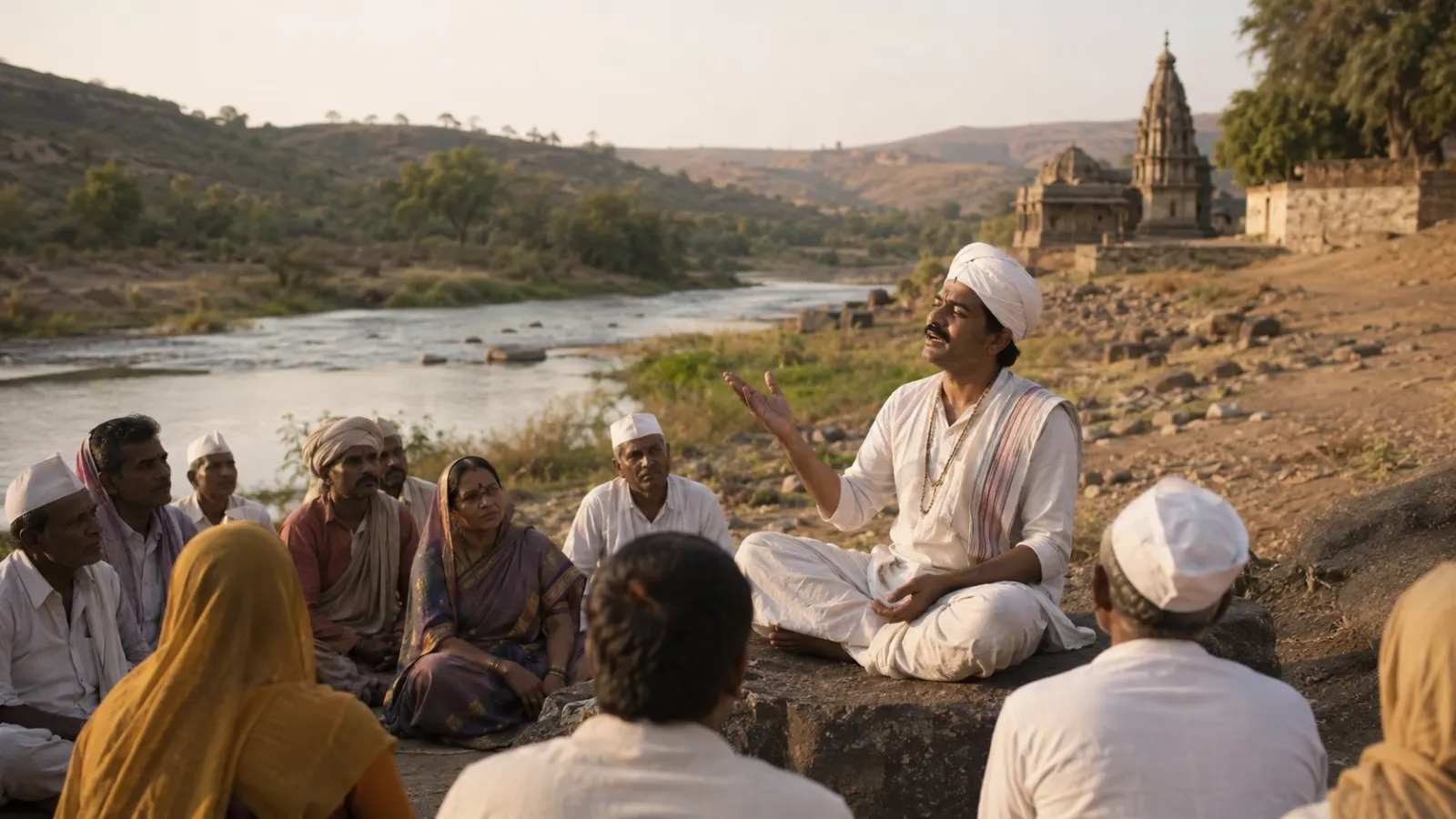
The wari is the recurring devotional pilgrimage associated particularly with Pandharpur. Pilgrims, known as Warkaris or Varkaris, travel in organised groups, singing devotional compositions, participating in collective worship and moving along routes connected with Maharashtra's saint traditions.
Sahapedia notes that the Pandharpur Wari includes several processions associated with saint-poets, with the Dnyaneshwar and Tukaram palkhis among the most prominent. Tukaram's abhangs and the practices of bhajan and kirtan form an important part of this devotional environment.
This setting is essential for understanding his poetry. An abhang was not created only for solitary reading. It could be memorised, repeated, sung collectively and interpreted in performance. The poem belonged to a social body as well as to an individual poet.
A Life Shaped by Ordinary Economic Pressures
Later biographies generally place Tukaram within a household involved in trade, agriculture or related local economic activity. Exact descriptions of his caste and community status vary across sources and over time, so modern accounts should avoid pretending that one later label resolves every historical question. What is relatively clear is that he did not belong to the Brahman ritual elite whose authority he frequently challenged in his devotional poetry.
This background helps explain the extraordinary amount of commercial and domestic vocabulary in the abhang tradition associated with him. Tukaram does not write only through abstract metaphysics. Spiritual life appears through accounts, debt, profit, loss, transactions, hunger, labour and household responsibility.
The result is religious poetry that often sounds startlingly close to ordinary experience. Moral hypocrisy can resemble dishonest accounting. Spiritual failure looks like a disastrous transaction. Attachment to worldly prestige becomes a bad investment.
The marketplace becomes a language for thinking about God.
Famine, Loss and the Fragility of Worldly Security
Tukaram's traditional biography places major suffering in his early adulthood. Hagiographical accounts associate him with economic hardship, famine, debt and family deaths during a period when the Deccan experienced severe scarcity.
Not every personal detail can be reconstructed securely, and devotional biography often reorganises suffering into a saint's spiritual journey. Yet the historical background of severe seventeenth-century famine and economic instability is real, and the emotional world of the poems repeatedly returns to loss, anxiety and the unreliability of worldly security.
This is important because Tukaram's spiritual voice is not the voice of someone contemplating impermanence from comfort. His devotional persona repeatedly confronts failure, humiliation, grief and instability.
Wealth can disappear.
Reputation can collapse.
Family life can become painful.
Even religious confidence can fail.
The question running beneath much of the poetry is therefore not merely “What is God?” but “What remains trustworthy when the structures on which ordinary life depends begin to fail?”
Vithoba Is Not a Distant God in Tukaram's Poetry
Tukaram's relationship with Vithoba is striking because it is emotionally flexible. The deity can appear as lord, parent, friend, protector, creditor, absent beloved or someone with whom the poet openly argues.
The poetry does not maintain one uninterrupted tone of ceremonial reverence. Tukaram can plead with God in one composition and complain in another. He can condemn his own weakness, question why divine help has not arrived and then return immediately to dependence on the same deity.
This makes his bhakti relational.
A distant theological absolute does not need to tolerate the devotee's irritation. A God treated as intimately present can be questioned precisely because the relationship is assumed to endure.
Tukaram's devotion therefore contains doubt without necessarily becoming disbelief.
Bhakti Does Not Eliminate Frustration
Popular summaries of devotion sometimes imply that a saint achieves permanent spiritual serenity. Tukaram's poetry resists that picture.
The speaker repeatedly discovers that surrender is difficult. Pride returns. Desire returns. Anxiety returns. The mind refuses to behave as religious teaching says it should.
Instead of hiding these failures, the poetry makes them material for devotion.
That is one reason Tukaram remains psychologically accessible. He rarely sounds like someone standing above ordinary human weakness and issuing instructions downward. He often sounds like a person diagnosing his own contradictions in public.
The saint and the struggling devotee coexist inside the same voice.
What Is an Abhang?
The abhang is one of the most recognisable forms of Marathi devotional poetry. The word is commonly connected with the sense of something unbroken or enduring, and the form became deeply associated with Varkari religious culture.
Abhangs are suited to oral and musical circulation. Their compact structure and rhythmic qualities allow them to be sung during bhajan, kirtan and pilgrimage. Tukaram's compositions frequently conclude with the identifying formula “Tuka mhane” — “Tuka says”, giving the impression that the poet is entering the performance personally to deliver the final observation.
But the signature creates an important scholarly problem.
A verse ending “Tuka says” is not automatically proof that the historical Tukaram composed it.
How Many Abhangs Did Tukaram Actually Write?
Thousands of compositions circulate under Tukaram's name, but the exact authentic corpus remains difficult to establish.
This uncertainty is not unique to Tukaram. Indian devotional poetry often moved through oral performance, memory, manuscript copying, discipleship and later compilation. Poems could be modified, recombined or newly composed under the authoritative signature of a revered saint.
A scholarly study of Tukaram and his later hagiographer Mahipati notes the extraordinary expansion of the attributed corpus. Drawing on Dilip Chitre's discussion, it observes that a manuscript tradition in Dehu was said to contain around 700 poems early in the twentieth century, while later estimates of the corpus attributed to Tukaram reached several thousand. The study emphasises that devotional traditions frequently accumulate compositions under prestigious saintly names.
This does not mean that almost every famous Tukaram abhang should be dismissed as fake. It means that authorship has to be treated as a textual-historical question rather than assumed from the signature alone.
Oral Transmission Preserved Tukaram—and Complicated Him
The same system that creates uncertainty about authorship is one of the reasons Tukaram survived.
A poem kept only in one manuscript can disappear if the manuscript is destroyed. A poem embedded in collective singing has many carriers. Pilgrims remember it, kirtankars perform it, families repeat it and religious communities reinterpret it.
Oral transmission therefore creates extraordinary cultural resilience.
But oral transmission also produces variation. Words change. Verses migrate. Performers adapt emphasis. Later devotees can create new compositions that sound authentically Tukaram-like.
The Tukaram tradition consequently sits between individual authorship and collective cultural memory.
Modern scholarship wants to identify the historical poet.
Devotional culture often wants to preserve the living voice.
Those are related but not identical objectives.
Why Tukaram's Marathi Matters
Tukaram's importance cannot be separated from the language in which he spoke.
Sanskrit possessed enormous religious and intellectual prestige. Persian played a major role in administration and elite political culture across the Deccan. Tukaram's devotional authority, however, emerged primarily through Marathi, the language ordinary communities could hear, remember and repeat.
This was not unprecedented. Dnyaneshwar, Namdev, Eknath and other predecessors had already established a powerful vernacular devotional tradition.
Tukaram nevertheless pushed Marathi religious poetry toward remarkable intimacy and flexibility. His voice can be conversational, self-mocking, sarcastic, angry, tender or spiritually concentrated without abandoning the rhythms of ordinary life.
Accessibility did not require intellectual simplicity.
Serious Philosophy in Ordinary Speech
Tukaram can sound deceptively simple because his language is often concrete.
Yet the poems repeatedly approach difficult philosophical questions. What is the relationship between the individual and God? What is the value of sacred knowledge without ethical transformation? Can ritual produce holiness? What happens when spiritual identity becomes another form of pride? Does devotion depend upon divine grace, personal effort or both?
Instead of treating these issues through formal scholastic argument, Tukaram compresses them into situations and images.
A fraudulent trader becomes a metaphor for religious hypocrisy.
An account that never balances becomes a metaphor for moral disorder.
A hungry family makes abstract detachment harder to romanticise.
This is philosophy conducted through ordinary Marathi rather than through a systematic treatise.
Tukaram's Critique of Caste Pride
Tukaram is frequently remembered as an anti-caste voice, and there is substantial reason for that reputation. The devotional world associated with him repeatedly undermines the idea that birth automatically establishes spiritual superiority.
The Varkari tradition itself remembered saints from widely different social backgrounds. Maharashtra's historical account of the tradition explicitly lists figures from different caste locations, emphasising devotion to Vithoba as a shared religious bond.
Tukaram repeatedly attacks pride based on ritual status, learning and inherited prestige. A person may possess scriptural knowledge yet remain spiritually empty. Another person denied high social status may possess genuine devotion.
The inversion is powerful because it relocates religious authority.
Birth does not guarantee holiness.
Conduct and devotion matter.
But Tukaram Should Not Be Turned Into a Modern Political Manifesto
Historical caution is important here.
Tukaram was a seventeenth-century bhakti poet, not a modern constitutional theorist writing a systematic programme for the abolition of caste. His criticism emerges through devotional theology, moral satire and attacks on spiritual arrogance rather than through the categories of modern political reform.
Turning him automatically into a twenty-first-century activist can erase the religious world in which the poetry operates.
But the opposite error is equally serious.
Because Tukaram was not a modern political organiser, some readers minimise the disruptive implications of his religious claims. If spiritual dignity does not depend on birth, and if a socially lower-status devotee can possess greater truth than a learned ritual specialist, inherited hierarchy loses an important source of religious legitimacy.
The historically defensible conclusion is therefore neither “Tukaram solved caste” nor “his poetry had nothing to say about caste.”
His devotional language undermined the claim that social rank and spiritual worth were naturally identical.
The Famous Story of the Manuscripts in the Indrayani
One of the best-known Tukaram stories describes a conflict with religious authority, often centred on a Brahman scholar identified in later tradition as Rameshwar Bhatt.
In the familiar narrative, Tukaram's right to compose or teach spiritual truth is challenged because of his social status. He is ordered to throw his manuscripts into the Indrayani River. Tukaram obeys, fasts and prays, after which the manuscripts miraculously return from the river unharmed.
The story is central to popular Tukaram memory.
It is not securely documented contemporary history.
That distinction does not make the story culturally unimportant. Its symbolism is extraordinarily clear: human hierarchy rejects the poems, but divine authority restores them. The river becomes the place where the judgment of social authority is reversed.
What the River Story Tells Us Even If the Miracle Cannot Be Verified
Hagiographies are often most useful when read at two levels.
At one level, devotees may accept the miracle as sacred history.
At another, historians can ask why communities repeatedly preserved this particular story.
The answer seems connected with authority.
Why should Tukaram be allowed to speak about God?
Who decides whether vernacular religious poetry is legitimate?
Can birth disqualify someone from spiritual instruction?
The miracle answers these questions dramatically. The poems survive because God, not social hierarchy, authenticates them.
The story therefore expresses what later Varkari communities believed Tukaram's historical significance to be.
Tukaram Did Not Reject Religious Practice
Tukaram is sometimes presented as though he opposed ritual itself.
That is too broad.
He belonged to a tradition structured through pilgrimage, remembrance of God's name, collective singing, temple devotion, bhajan and kirtan. He was not campaigning for religion stripped of all practice.
His criticism was directed particularly toward practice without transformation.
A person can visit Pandharpur and remain arrogant.
A scholar can recite scripture and remain cruel.
Someone can wear the visible signs of devotion while pursuing status.
A religious performer can make spirituality into a profession without becoming spiritually honest.
For Tukaram, practice acquires value through what it does to the person.
Hypocrisy Is One of Tukaram's Great Subjects
Few things provoke Tukaram's poetic energy as consistently as spiritual hypocrisy.
The hypocrite wants the appearance of holiness without its moral cost. Religious identity becomes reputation. Learning becomes pride. Renunciation becomes theatre.
This subject explains why Tukaram can feel remarkably contemporary even to secular readers.
Institutions change.
Human self-deception does not.
A seventeenth-century poem aimed at the religious performer who loves status more than God can easily be recognised in modern organisations, politics and public morality.
Tukaram's satire survives because it attacks a recurring human temptation: using virtue as a way to display oneself rather than transform oneself.
Tukaram and Household Life
Another reason Tukaram resists the stereotype of the detached saint is that his tradition places him inside household conflict.
He was married, had family obligations and lived within an economic world where food, debt and work mattered. Later stories frequently depict his second wife, usually known as Jijabai or Avali, as practical, frustrated and sharply critical when Tukaram's devotional commitments appear to neglect household responsibilities.
The scenes became popular because they are funny.
They are also philosophically serious.
If a saint says worldly attachment must be overcome while a household still needs grain, who carries the cost of that spirituality?
Avali Should Not Be Reduced to the “Materialistic Wife”
Traditional saint biographies often make domestic conflict serve the saint's spiritual development. The spouse can then become an obstacle representing attachment to worldly life.
That interpretation is especially unfair when applied too casually to Avali.
Her demands can be read differently. Food is not greed when children need to eat. Debt is not spiritual triviality when creditors exist. Household labour does not disappear because one member of the family discovers devotional intensity.
The Tukaram tradition is therefore most interesting when neither side is caricatured.
The poet exposes the instability of worldly attachment.
The household exposes the danger of spirituality that forgets material responsibility.
The tension is not fully resolved.
That is precisely why it remains compelling.
Why Kirtan Was So Important
Tukaram's influence cannot be understood through printed poetry alone.
Kirtan combines song, storytelling, exposition, moral argument and audience participation. It creates a public space in which religious ideas can circulate among people who do not need access to elite literary institutions.
Tukaram's abhangs are especially suited to such performance. Their compactness allows memorisation, while their imagery gives the performer material to explain and expand.
One abhang can become the centre of an hour-long public discourse.
In this environment, poetry becomes social communication.
Singing Changed the Scale of Tukaram's Influence
A manuscript has to be possessed and read.
A song can be heard once and carried away in memory.
That difference mattered enormously in societies where literacy, manuscripts and formal education were unevenly distributed. Tukaram's religious arguments could move through villages and pilgrimage routes because they were not dependent exclusively on silent reading.
Sahapedia's account of the Wari emphasises the importance of abhang, bhajan and kirtan within the devotional tradition.
This helps explain why Tukaram became far more than a regional literary author.
His poetry became a public repertoire.
Did Sant Tukaram Meet Chhatrapati Shivaji Maharaj?
Popular Marathi tradition frequently links Tukaram with Chhatrapati Shivaji Maharaj. Stories describe Shivaji sending gifts to the saint, Tukaram rejecting wealth, the king visiting him and the poet offering moral or spiritual advice.
The chronology makes some form of encounter possible because their lives overlapped.
But possibility is not proof.
Detailed meeting narratives are shaped heavily by later saint biography and cultural memory. Some modern historical discussions therefore treat the Tukaram-Shivaji connection cautiously, especially where elaborate conversations and specific incidents cannot be demonstrated through contemporary evidence.
The safest formulation is that a strong tradition associates Shivaji and Tukaram, while the historical detail of particular meetings remains debated.
Why the Shivaji-Tukaram Story Became So Powerful
The story has an obvious symbolic appeal.
Shivaji represents temporal and military power.
Tukaram represents devotional and moral authority.
When the ruler offers wealth and the saint rejects it, political greatness is shown bowing before spiritual independence.
That is an extraordinarily useful narrative for later communities seeking to connect Maharashtra's devotional and political traditions.
But the same usefulness is precisely why historians need caution.
Stories that satisfy later cultural expectations can become stronger over time whether or not contemporary documentation exists.
A responsible biography can respect the tradition without pretending that every reported conversation functions as a transcript.
Was Tukaram a Philosopher?
Yes—but not primarily in the sense of someone who wrote a systematic philosophical treatise.
Scholars and religious interpreters have tried to classify Tukaram through different schools of Vedanta and Vaishnava theology. Some abhangs can sound strongly relational, maintaining the distinction between devotee and Vithoba. Others use language that seems to dissolve ordinary distinctions and approach a more non-dual experience.
Forcing every poem into one rigid metaphysical system can therefore be unhelpful.
Lyric poetry does not have to behave like a philosophical textbook.
Tukaram's primary unit is often the devotional moment.
Devotion Can Move Between Difference and Unity
A devotee needs some difference from God in order to worship.
There must be a “Tuka” who addresses a “Vithoba.”
Yet intense devotion can also move toward experiences in which the boundary between self and divine appears less stable.
These two modes do not necessarily need to be reconciled into one technical doctrine before the poetry can be understood.
Tukaram may experience God as an intimate other in one composition and as an all-pervasive reality in another.
What matters is what the poem is trying to accomplish spiritually.
Theology is lived before it is systematised.
Self-Criticism Is Central to Tukaram's Spirituality
One of the most compelling features of Tukaram is that criticism does not only point outward.
He attacks religious pride, but he also attacks his own pride.
He mocks hypocrisy while worrying about his own sincerity.
He criticises attachment while repeatedly discovering attachment within himself.
This protects the poetry from becoming pure moral superiority.
The poet is not standing safely outside the human condition he criticises.
He is implicated in it.
That self-implication gives the satire credibility.
Poverty Is Not Romanticised Easily
Because Tukaram's tradition is associated with suffering and renunciation, modern readers can easily romanticise poverty as spiritually beneficial.
The household material in his poetry makes that interpretation difficult.
Scarcity hurts.
Debt creates pressure.
Loss damages families.
The saint may conclude that wealth is unreliable, but that is not the same as saying deprivation is pleasant.
This distinction matters. Tukaram's detachment becomes meaningful precisely because worldly insecurity is experienced as real rather than imaginary.
Bhakti offers another ground of value.
It does not magically turn hunger into comfort.
What Did Tukaram Teach About Wealth?
Tukaram frequently treats wealth and status as unreliable foundations for human worth.
Money can disappear.
People honour the wealthy and ignore them when fortune changes.
Accumulation creates anxiety because possessions have to be defended and eventually lost.
Yet the deeper criticism is not necessarily against every form of property or economic activity.
It is against mistaking possession for security and possession for moral worth.
The trader's vocabulary becomes especially useful here.
A profitable worldly account can still be a disastrous spiritual account.
What Did Tukaram Teach About Knowledge?
Tukaram does not dismiss learning simply because scholars can become proud.
His criticism concerns knowledge that does not transform conduct.
Someone can memorise sacred texts and remain consumed by ego.
Religious vocabulary can become another possession.
Intellectual sophistication can strengthen rather than weaken pride.
The poem therefore asks for a different standard of knowledge.
What does the knowledge do to the knower?
If the person becomes less compassionate, more self-important and more interested in status, religious learning has failed its own purpose.
What Did Tukaram Teach About Equality?
Tukaram's strongest egalitarian impulse comes from the spiritual value of devotion.
If God responds to devotion rather than inherited rank, then the religious field cannot be controlled completely through birth status. The Varkari saint tradition reinforced this through its memory of saints from varied occupational and caste locations.
This should not be converted automatically into the claim that seventeenth-century Varkari society functioned as a fully egalitarian social order.
It did not erase all hierarchy.
But devotional equality can still have social consequences.
When someone considered low in social hierarchy can be remembered as spiritually superior, hierarchy becomes harder to present as a complete description of human value.
Tukaram's Disappearance and the Vaikuntha Tradition
Traditional accounts do not end Tukaram's life with an ordinary death.
Devotional tradition holds that he departed bodily for Vaikuntha, the divine abode of Vishnu, in a celestial vehicle. The event is commemorated through Tukaram Beej, which remains an important devotional observance at Dehu.
Maharashtra public institutions in 2026 continued to describe Tukaram Beej explicitly as the day on which devotees believe Tukaram ascended bodily to Vaikuntha in 1650.
Historical method cannot independently verify a bodily ascent.
The appropriate distinction is therefore straightforward: this is a living devotional belief concerning Tukaram's departure, while historians can establish only that his life ended or he disappeared around the middle of the seventeenth century.
Respect for religion does not require presenting supernatural claims as empirically verified.
Historical caution does not require mocking religious belief.
Why Tukaram Beej Matters Historically
Even when historians cannot verify the supernatural event, the annual commemoration is historically significant because it demonstrates how a saint's biography is continually renewed.
Tukaram's departure does not remain a paragraph in an old book.
It becomes a recurring ritual date.
Devotees gather.
Abhangs are sung.
Stories are retold.
The community reconstructs the saint's presence through repetition.
This is an important feature of public memory: historical figures survive because communities repeatedly perform their importance.
Tukaram's Poetry Became a Collective Archive
Tukaram's abhang tradition preserves more than devotional teaching.
It contains traces of everyday moral life: debt, quarrels, spiritual competition, family responsibility, humiliation, hunger, gossip, pride, reputation and work.
That makes the corpus valuable as a cultural archive even when individual poems present attribution problems.
Poetry does not provide a statistically representative survey of seventeenth-century Maharashtra. It cannot be used as though every metaphor directly records Tukaram's biography.
But it reveals what kinds of experiences could become meaningful inside Marathi devotional discourse.
The sacred was discussed through the ordinary.
That is a major historical fact.
Tukaram and the Making of Marathi Literary Authority
Tukaram helped demonstrate that literary greatness did not require distance from spoken language.
Marathi could carry theological complexity, emotional intensity, satire and philosophy while remaining accessible to people outside narrow learned circles. Maharashtra's state literary history treats Tukaram as one of the culminating figures of the devotional tradition and emphasises the intensely human quality of his abhangs.
His importance therefore belongs simultaneously to religion and literature.
The abhang can be prayer.
It can also be lyric poetry.
It can function as ethical instruction, satire, philosophy and public performance.
These categories overlap rather than cancel one another.
Tukaram Was Not Merely a “Folk Poet”
Calling Tukaram a folk poet can acknowledge oral circulation and popular accessibility, but the phrase becomes misleading if it implies intellectual simplicity.
The abhang tradition contains subtle theological and moral reasoning.
Tukaram's language may be colloquial, but his concerns include the nature of selfhood, divine dependence, epistemic pride, ethical transformation and the limitations of ritual authority.
Complexity does not require technical vocabulary.
One of Tukaram's achievements was to make complexity sound ordinary.
That ability is much harder than simply writing difficult language.
The Varkari Public Sphere
Tukaram's legacy belongs to a network larger than one saint.
The Varkari world connects temples, pilgrimage routes, village communities, kirtankars, singers, manuscripts, households and seasonal gatherings. Through this network, poetry became prayer, memory, instruction and collective identity simultaneously.
This explains why the authority of an abhang was not necessarily established first by a printed critical edition.
Community repetition could authenticate the voice socially long before modern scholars attempted to establish authorship philologically.
For devotees, “Tukaram” could become more than the legal identity of one historical writer.
It could designate a recognisable devotional voice.
Living Performance Changes the Meaning of a Poem
The same abhang can function differently in different settings.
Printed in a school textbook, it becomes literature.
Sung during the Wari, it becomes collective devotion.
Explained by a kirtankar, it becomes moral teaching.
Quoted in a political speech, it becomes cultural authority.
Performed in theatre or cinema, it becomes dramatic characterisation.
Meaning therefore does not live entirely inside the words.
It also comes from where, when and by whom the words are performed.
This is one reason Tukaram remains a living cultural figure rather than merely an author from the seventeenth century.
The 1936 Film Sant Tukaram
Modern cinema played an enormous role in shaping how later generations imagined the saint.
Prabhat Film Company's 1936 Marathi film Sant Tukaram, directed by Vishnupant Govind Damle and Sheikh Fattelal and starring Vishnupant Pagnis, became one of the landmark works of early Indian cinema.
Its international significance can be documented directly. La Biennale di Venezia records Sant Tukaram as an Indian entry at the 1937 Venice International Film Festival, where it received a jury commendation. The film later returned to Venice in a 1982 retrospective.
This was more than an adaptation of an old saint biography.
Cinema gave Tukaram a modern visual body.
How Cinema Changed Public Memory
Film inevitably chooses what a historical character looks like, how he speaks, which episodes matter and what emotional relationships should dominate the story.
That has lasting consequences.
For viewers who never study seventeenth-century manuscripts or hagiographies, the cinematic Tukaram can become more psychologically real than the uncertain historical figure.
The 1936 film's extraordinary reputation helped stabilise popular images of Tukaram, Avali, religious opposition and saintly humility.
This is a broader lesson in historical memory.
Modern media does not merely reproduce inherited tradition.
It selects, intensifies and redistributes it.
Tukaram in Social Reform and Modern Politics
Modern Maharashtra repeatedly returned to Tukaram because his poetry offered resources for several different arguments.
Social reformers could emphasise his attacks on caste pride and empty ritual.
Literary critics could present him as evidence of Marathi's extraordinary vernacular tradition.
Varkari communities could emphasise devotional surrender.
Political movements could invoke him as part of Maharashtra's cultural inheritance.
These are not necessarily fraudulent appropriations. Great historical figures are almost always reinterpreted.
The analytical task is to distinguish what Tukaram's historical poetry can support from what later communities wanted Tukaram to represent.
There Is More Than One Modern Tukaram
The saint encountered in a temple is not identical to the poet encountered in a university literature course.
The Tukaram invoked in anti-caste interpretation is not identical to the Tukaram presented through devotional hagiography.
The cinematic Tukaram is not identical to the uncertain historical householder of seventeenth-century Dehu.
All of these versions interact.
None can simply be declared the only legitimate Tukaram.
But they should not be confused with one another either.
A strong historical article has to keep poet, saint, social memory and later representation analytically distinct.
Why the Wari Still Matters to Tukaram's Legacy
The continuing Wari demonstrates something that literary statistics cannot capture.
Tukaram's poetry still has a social body.
In 2026, devotees again moved from Dehu toward Pandharpur through a pilgrimage managed at a scale requiring major contemporary administrative and public-safety arrangements. The Maharashtra authorities describe the procession as carrying Tukaram's padukas while devotees sing abhangs along the route.
This makes Tukaram unusual among canonical poets.
His poems are not merely commemorated.
They still accompany movement through physical space.
Why Sant Tukaram Still Matters
Tukaram remains powerful because he begins with problems that are small enough to recognise immediately and large enough never to disappear.
What should a person trust when money fails?
Does education make someone good?
Can religion become another form of vanity?
Who has the authority to speak about God?
Does social status reveal spiritual worth?
Can a person be devoted while neglecting family obligations?
What happens when God seems absent?
How much of spiritual life is surrender, and how much is struggle?
These questions survive because they do not depend entirely on the political arrangements of seventeenth-century Maharashtra.
Tukaram's God Is Tested in Everyday Life
One of the deepest insights in Tukaram's poetry is that spirituality cannot be separated comfortably from ordinary conduct.
It is easy to claim detachment before money is threatened.
It is easy to claim humility before someone challenges status.
It is easy to speak of compassion in the abstract.
The household, marketplace and community expose whether religious language actually changes behaviour.
This is why ordinary life matters so much in Tukaram.
It is not the distraction from religion.
It is where religion is tested.
Common Myths About Sant Tukaram
“Tukaram founded the Varkari tradition.” He did not. The tradition predates him by centuries and includes major earlier saints such as Dnyaneshwar, Namdev and Eknath. Tukaram became one of its greatest later voices.
“Every abhang attributed to Tukaram can be proved to have been written by him.” No. Oral transmission and later compilation make authorship complicated, and the attributed corpus expanded substantially over time.
“The manuscripts definitely floated back from the Indrayani exactly as later stories describe.” The episode is central to hagiographical tradition but cannot be independently established as documentary history.
“Tukaram rejected all ritual.” His criticism was directed particularly at ritual without moral or spiritual transformation. He belonged to a devotional tradition built around pilgrimage, singing and collective practice.
“Tukaram was simply a modern anti-caste political activist born three centuries too early.” His poetry powerfully attacks birth-based spiritual pride, but his historical framework was seventeenth-century bhakti rather than modern political ideology.
“His meeting with Shivaji is completely documented.” Traditions connect them, and a meeting is chronologically possible, but detailed narratives require historical caution.
“Tukaram's Vaikuntha departure is historically proven.” It is a living devotional belief. Historians cannot independently verify a bodily ascent.
Frequently Asked Questions About Sant Tukaram
Who was Sant Tukaram?
Sant Tukaram was a seventeenth-century Marathi Varkari poet-saint associated with Dehu near Pune. He is best known for abhangs devoted particularly to Vithoba of Pandharpur and for poetry addressing devotion, hypocrisy, suffering, social pride and spiritual equality.
When was Sant Tukaram born?
His exact birth date is uncertain. Older Maharashtra historical sources give 1598, while widely followed later traditions place his birth around 1608. The variation reflects the limits of the surviving biographical record.
Where was Sant Tukaram born?
He is associated with Dehu, near Pune in present-day Maharashtra, on the Indrayani River. Dehu remains a major centre of Tukaram devotion and the starting point of his palkhi procession toward Pandharpur.
What is Sant Tukaram famous for?
He is famous above all for Marathi abhangs, for his devotion to Vithoba, his role in the Varkari tradition and his critiques of religious hypocrisy, caste pride and spirituality without ethical transformation.
What is an abhang?
An abhang is a Marathi devotional poetic form strongly associated with the Varkari tradition. It is particularly suited to singing and collective performance, helping devotional poetry circulate through pilgrimage, bhajan and kirtan.
Who was Tukaram's God?
Tukaram's principal devotional focus was Vithoba or Vitthal of Pandharpur, understood within the Vaishnava devotional tradition and commonly associated with Krishna or Vishnu.
Was Tukaram a Brahmin?
No. Tukaram did not belong to the Brahman ritual elite. Historical descriptions of his specific community status vary, and modern accounts should avoid imposing overly simple caste terminology where sources differ.
Did Tukaram oppose caste?
His poetry strongly attacks pride based on birth and challenges the assumption that ritual or inherited status guarantees spiritual worth. However, he should be understood within seventeenth-century bhakti rather than simply converted into a modern political programme.
Did Tukaram reject rituals?
Not all religious practice. He participated in a tradition centred on pilgrimage, worship, singing and remembrance. His criticism focuses especially on outward religious practice that fails to transform character.
Did Tukaram's manuscripts return from the Indrayani River?
Varkari hagiography says they did after Tukaram had been forced to throw them into the river. The story is devotionally important but cannot be independently verified as a historical event.
Did Sant Tukaram meet Shivaji Maharaj?
Traditions connect Tukaram with Chhatrapati Shivaji Maharaj, and their lives overlapped. However, detailed accounts of their meetings are difficult to establish through contemporary evidence and should be described as tradition rather than certainty.
Who was Avali?
Avali, also known as Jijabai in many accounts, was Tukaram's wife. Later hagiography and popular performance often portray her as the practical household counterpoint to Tukaram's intense devotional life.
How did Sant Tukaram die?
Historical evidence does not establish the exact circumstances. He is generally believed to have disappeared or died around 1649–50. Devotional tradition holds that he ascended bodily to Vaikuntha, an event commemorated as Tukaram Beej.
What is Tukaram Beej?
Tukaram Beej is the annual observance commemorating Tukaram's traditional departure to Vaikuntha. It remains an important devotional event at Dehu.
What is the Tukaram Gatha?
The Tukaram Gatha is the major collected corpus of abhangs transmitted under Tukaram's name. Because the poetry circulated through oral and manuscript traditions, scholars continue to distinguish between the cultural corpus and questions concerning the authorship of individual poems.
Why is Sant Tukaram important to Marathi literature?
He demonstrated the extraordinary expressive range of Marathi devotional poetry, using accessible language to address sophisticated spiritual and ethical questions. His abhangs became foundational to Marathi literary and devotional culture.
Is Tukaram still important today?
Yes. His poetry continues to be sung, performed and studied, while the Tukaram palkhi remains a major part of the contemporary Pandharpur Wari. The 2026 pilgrimage again demonstrated the continuing scale of this living tradition.
Tukaram Is More Than the Biography of One Saint
A conventional biography tries to stabilise a person.
It establishes a birth date, family background, sequence of events, important meetings and death.
Tukaram refuses to become that simple.
His dates are uncertain. Hagiography and recoverable history overlap. Thousands of poems circulate under his signature even though individual attribution can be difficult. Miraculous traditions surround both his manuscripts and his departure. Stories connect him with Shivaji. Later performers, editors, reformers and filmmakers repeatedly reconstructed his image.
Yet Tukaram is not historically vague in every respect. His association with Dehu, Vithoba, the Varkari tradition and Marathi abhang poetry is profound. The devotional world in which his voice emerged can be reconstructed. The transmission history can be investigated. Modern scholarship can distinguish older manuscripts and later hagiographical developments even where complete certainty remains impossible.
The uncertainty belongs primarily to the details of one life.
The cultural consequences are unmistakable.
The Central Idea
Sant Tukaram's enduring importance comes from the extraordinary meeting of vernacular poetry, devotional intensity and ordinary human experience.
He could address God without sounding like a distant theologian because the language of devotion was also the language of debt, hunger, family frustration, work, pride and failure. He could criticise religious hierarchy without writing a political manifesto because the spiritual logic of bhakti already contained a disruptive claim: inherited status does not guarantee access to truth.
He could become a major literary figure without separating poetry from public performance because the abhang travelled through kirtan, pilgrimage and collective memory.
And he could remain culturally alive centuries after his death because the Varkari tradition continued to carry him physically through Maharashtra. The 2026 Wari is contemporary evidence of that continuity: the Tukaram palkhi still leaves Dehu, devotees still walk toward Pandharpur and abhangs still accompany the journey.
That survival changes how Tukaram should be understood.
He is not merely a historical author whose work survived in libraries.
He is a poet whose language entered a living devotional system.
He is not simply an anti-caste slogan, though his attacks on spiritual hierarchy remain important.
He is not simply a saint floating above ordinary life, because family conflict, economic uncertainty and self-doubt remain central to his poetic world.
He is not simply a figure of faith beyond historical inquiry, because manuscripts, hagiographies and later representations can be examined critically.
The strongest account therefore does not force readers to choose between Tukaram the poet, Tukaram the saint and Tukaram the historical problem.
All three matter.
His biography may remain partly uncertain.
His voice does not.
For centuries, that voice has continued to insist that devotion without humility is empty, knowledge without transformation is hollow and social prestige cannot determine the value of a human soul.
That is why Sant Tukaram remains one of the defining voices of Marathi culture.