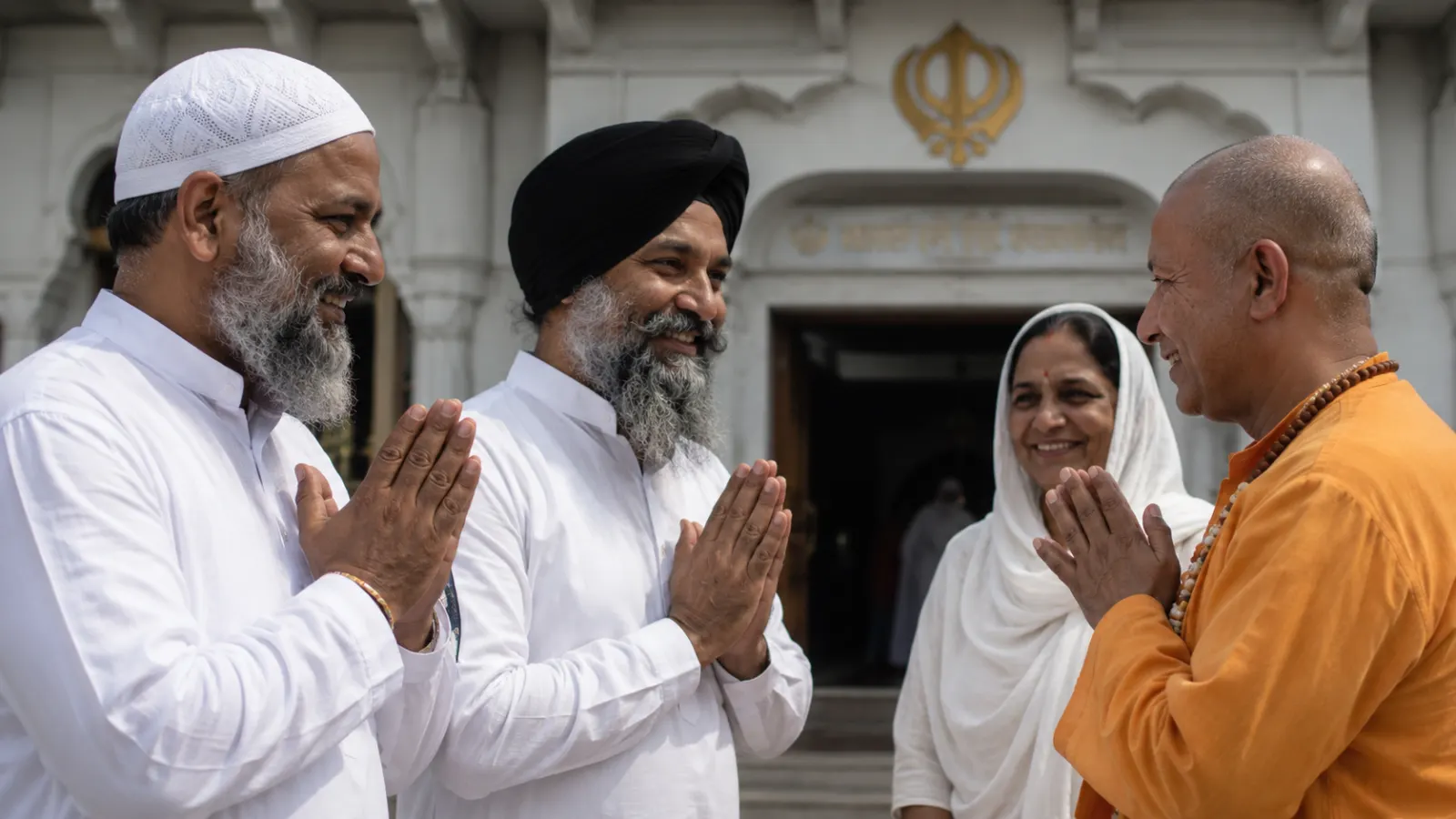
Religious Tolerance: Meaning, Importance, Examples and Why It Matters
Religious tolerance means allowing people to hold, practise, change or reject religious beliefs even when those beliefs differ sharply from your own.
It does not require believing that every religion is equally true.
It does not require abandoning your own convictions.
And it does not mean that every action claimed in the name of religion must be accepted.
At its core, religious tolerance asks something more difficult:
Can people disagree about some of life's deepest questions while still recognising one another as equal members of society?
That question matters wherever people with different religions—or no religion—share schools, workplaces, neighbourhoods, institutions and political systems.
Religious tolerance is therefore more than politeness.
It sits at the intersection of:
freedom of conscience, equality, human rights, social coexistence and pluralism.
Religious tolerance at a glance
| Question | Short answer |
|---|---|
| What is religious tolerance? | Allowing people to hold and practise beliefs different from your own without coercion, persecution or unjust discrimination. |
| Does tolerance mean agreement? | No. Tolerance becomes meaningful precisely when disagreement remains. |
| Must I believe all religions are true? | No. People can maintain exclusive religious or non-religious convictions while supporting equal freedom for others. |
| Is tolerance the same as religious freedom? | No. Tolerance is partly a social attitude; religious freedom is also a legal right. |
| Is tolerance the same as pluralism? | No. Tolerance allows difference; pluralism asks how durable differences participate in shared institutions. |
| Does religious freedom include atheists? | Yes. International human-rights interpretation protects theistic, non-theistic and atheistic beliefs, as well as the right not to profess a religion. |
| Can religion ever be legally restricted? | Belief itself receives extremely strong protection, while manifestation may face narrowly defined lawful restrictions to protect specified public interests or others' rights. |
| Can religion be criticised? | Yes. Protecting people from discrimination does not make religions or religious institutions immune from criticism. |
| Is tolerance enough? | It is a minimum condition. Equal citizenship, non-discrimination and pluralistic institutions go further. |
| Why does it matter? | It allows people with deep disagreements to coexist without coercion, exclusion or violence. |
What Is Religious Tolerance?
A useful basic definition is:
Religious tolerance is the willingness to allow people to hold and practise religious beliefs with which one disagrees.
That definition contains an important feature.
There must be some genuine disagreement.
If two people believe exactly the same thing, tolerance is not being tested.
Tolerance begins when one person thinks:
“I believe your religious conclusion is wrong, but I still recognise your right to hold it.”
The disagreement may concern:
-
God,
-
revelation,
-
salvation,
-
morality,
-
scripture,
-
religious authority,
-
worship,
-
ritual,
-
life after death,
-
or whether religion itself is true.
Religious tolerance does not eliminate those disagreements.
It creates conditions under which people do not use coercion simply because disagreement exists.
Tolerance Begins Where Agreement Ends
This is why tolerance should not be confused with approval.
Imagine three people.
One is a committed Christian.
One is a practising Hindu.
One is an atheist.
They cannot all hold identical theological conclusions.
Yet each can support the others' freedom of conscience.
The Christian does not need to become less Christian.
The Hindu does not need to become less Hindu.
The atheist does not need to pretend religious claims are convincing.
Tolerance asks them to distinguish two questions:
What do I believe is true?
and
What freedom should another person have to reach a different conclusion?
A society capable of keeping those questions separate has created an important foundation for peaceful coexistence.
UNESCO's Definition Goes Beyond “Putting Up With” People
The ordinary meaning of tolerance can sound weak.
To say:
“I tolerate you”
can imply reluctant permission.
UNESCO's 1995 Declaration of Principles on Tolerance uses a more ambitious formulation.
It connects tolerance with respect for diversity, human rights, freedom of thought and conscience, democracy and the rule of law.
It also makes a crucial point:
Tolerance does not require people to abandon or weaken their own convictions.
That protects both sides of the idea.
You are free to believe deeply.
Others are free to believe differently.
Neither person's conviction creates an automatic right to force the other into agreement.
Why Is Religious Tolerance Important?
Religious tolerance matters because religion often concerns beliefs people regard as fundamental to identity and meaning.
For many people, religion shapes:
-
family life,
-
diet,
-
clothing,
-
festivals,
-
prayer,
-
ethics,
-
marriage,
-
community,
-
education,
-
burial,
-
and ideas about life's ultimate purpose.
For others, non-religious conviction is equally important.
When people disagree about subjects this significant, conflict cannot simply be avoided by pretending differences are superficial.
A stable diverse society needs rules for handling deep disagreement.
Religious tolerance provides one of those rules:
difference alone is not sufficient justification for coercion or unequal citizenship.
Religious Tolerance, Religious Freedom, Equality and Pluralism Are Different
These concepts overlap, but they should not be treated as synonyms.
| Concept | Main question |
|---|---|
| Religious tolerance | Will people allow beliefs and practices they disagree with? |
| Religious freedom | What legal freedom does a person have to believe, practise, change or reject religion? |
| Equality | Are people treated as equal citizens regardless of religion or belief? |
| Non-discrimination | Are people denied opportunities or rights because of religion or belief? |
| Pluralism | How do different groups participate together in common institutions? |
| Interfaith dialogue | How do people from different traditions communicate and understand one another? |
A country can perform well on one dimension and poorly on another.
A constitution might guarantee religious freedom while social discrimination remains widespread.
Neighbours might have friendly personal relationships while the law privileges one religious group.
A society may tolerate minority worship while excluding minorities from public institutions.
Religious coexistence therefore has several layers.
Religious Freedom Is Stronger Than Permission
Historically, the language of toleration sometimes implied that a ruler or majority had authority to decide which minorities would be permitted to exist.
That is weaker than modern human-rights language.
A citizen does not possess freedom of conscience because a majority generously chooses to permit it.
The freedom belongs to the person as a right.
This distinction changes the political relationship.
Tolerance asks the powerful not to interfere.
Rights establish that the individual does not require their permission in the first place.
That is why modern discussions increasingly connect tolerance with equality and religious freedom rather than treating tolerance as the final objective.
Freedom of Religion Includes Freedom of Conscience
Article 18 of the International Covenant on Civil and Political Rights protects freedom of:
thought, conscience and religion.
The protection is broader than organised religion.
The UN Human Rights Committee's interpretation of Article 18 states that it encompasses:
-
theistic beliefs,
-
non-theistic beliefs,
-
atheistic beliefs,
-
and the right not to profess any religion or belief.
This is crucial.
Religious tolerance cannot mean only:
Christians tolerate Muslims, Muslims tolerate Hindus, Hindus tolerate Christians, and so on.
It must also include people who:
-
have no religion,
-
are agnostic,
-
are atheists,
-
are questioning,
-
or hold non-traditional systems of belief.
Freedom of conscience belongs to the person rather than to a religious category.
The Freedom to Change Religion Matters
Freedom of religion would be incomplete if a person could inherit a belief but could never reconsider it.
A meaningful freedom of conscience includes the ability to:
-
adopt a religion,
-
change a religion,
-
leave a religion,
-
reinterpret beliefs,
-
or hold no religion.
This can be socially difficult.
Conversion may be experienced by family members as rejection.
Leaving a religious community may create emotional conflict.
Interfaith relationships can challenge inherited expectations.
But disappointment is not the same as legitimate coercion.
Tolerance requires space for people's convictions to change.
Coercion Is the Opposite of Conscience
A belief held only because punishment prevents a person from expressing anything else is not freely held in the ordinary sense.
This is why international human-rights law places particular emphasis on freedom from coercion in matters of belief.
Coercion can come from different directions.
It can come from:
-
governments,
-
religious authorities,
-
families,
-
employers,
-
schools,
-
social groups,
-
or violent organisations.
A tolerant society therefore protects people both:
from being forced out of their beliefs
and
from being forced to remain within beliefs they no longer hold.
Belief and Religious Practice Are Related but Legally Different
A useful distinction in international human-rights law separates:
the freedom to have or adopt a religion or belief
from
the freedom to manifest that religion or belief.
Internal belief receives exceptionally strong protection.
Public manifestation may include:
-
worship,
-
observance,
-
teaching,
-
clothing,
-
religious gatherings,
-
dietary practice,
-
symbols,
-
festivals,
-
and other expressions.
These manifestations also receive legal protection.
But unlike internal belief, they can in some circumstances be limited.
Religious Tolerance Does Not Mean Every Religious Practice Is Exempt From Law
This is one of the most important misconceptions.
Religious freedom does not normally mean:
“If I say my action is religious, no law can apply to me.”
Under Article 18 of the ICCPR, limitations on the manifestation of religion or belief must satisfy specific requirements.
They must be prescribed by law and necessary for recognised purposes such as protecting:
-
public safety,
-
public order,
-
health,
-
morals,
-
or the fundamental rights and freedoms of others.
This is intended to create a high threshold rather than a convenient excuse for governments to suppress unpopular religions.
The question is therefore not simply:
“Is this religious?”
or:
“Does the majority dislike it?”
The question is whether a restriction is lawful, necessary, proportionate and non-discriminatory.
Examples of Religious Tolerance in Everyday Life
Religious tolerance becomes easier to understand when translated into ordinary situations.
In a neighbourhood
A resident does not object to a neighbour simply because they attend a mosque, church, temple, synagogue, gurdwara or another place of worship.
At work
An employee is not mocked, excluded or professionally disadvantaged because of religious clothing or observance.
In school
Students can learn about religious diversity without classmates being pressured to adopt one another's beliefs.
In a family
Relatives may strongly disagree about religion while refusing to use threats or coercion to control belief.
In public life
Citizens of different religions and none can participate in institutions without one religious identity becoming a prerequisite for full citizenship.
In conversation
A person can criticise another's theology without denying that person's dignity or civil rights.
These examples show that tolerance is not merely an abstract philosophical virtue.
It appears in ordinary choices.
Religious Tolerance in the Workplace
Modern workplaces often include people with different religions and beliefs.
Practical issues may involve:
-
religious holidays,
-
prayer times,
-
dress,
-
dietary requirements,
-
fasting,
-
scheduling,
-
or use of shared spaces.
Tolerance does not mean every request must automatically be granted.
Workplaces still have legitimate requirements involving:
-
safety,
-
staffing,
-
essential duties,
-
cost,
-
and the rights of others.
The pluralist question is whether adjustment is possible without imposing disproportionate burdens.
This is where reasonable accommodation becomes important.
What Is Reasonable Accommodation?
A general rule can appear neutral while affecting religious groups differently.
Consider a workplace that requires everyone to work on the same day.
For most employees, the rule may create no conflict.
For someone whose religion treats that period as especially important, the burden may be much greater.
Accommodation asks:
Can the rule be adjusted without undermining the legitimate purpose of the rule?
Examples might include:
-
flexible scheduling,
-
uniform modifications,
-
dietary alternatives,
-
leave arrangements,
-
or adjustments to examination timing.
Accommodation is not automatic permission.
It is a method of asking whether equality sometimes requires more than identical treatment.
Identical Treatment Is Not Always Equal Treatment
Suppose a public institution says:
“We treat everyone exactly the same.”
That sounds fair.
But imagine its entire calendar, dress norms, food arrangements and public symbols already fit the majority culture.
The majority experiences the institution as neutral because adaptation is unnecessary.
Minorities experience the same institution differently.
This is why formal sameness and substantive equality can diverge.
Religious tolerance becomes stronger when institutions notice that difference rather than assuming the majority's normal experience is culturally neutral.
The Majority Often Does Not Notice Its Own Religion
Majority customs can disappear into the background.
A majority holiday becomes simply:
“the holiday.”
A majority religious building may be described primarily as:
“heritage.”
Majority dietary patterns appear normal.
Minority practices remain visibly religious.
This does not mean majority traditions should be erased.
It means equal citizenship requires awareness of asymmetry.
The question is not whether the majority may retain its culture.
The question is whether public institutions make majority identity an unnecessary condition for belonging.
Minorities Are Not Internally Uniform
Religious groups are often discussed as though every member shares one interpretation.
They do not.
Inside religious communities there may be disagreement among:
-
conservatives,
-
reformers,
-
women,
-
younger members,
-
clergy,
-
lay members,
-
converts,
-
former members,
-
different sects,
-
and people with varying levels of observance.
This creates another requirement for tolerance:
tolerance within religions, not only between religions.
Protecting a religious community from state interference cannot mean giving internal leaders unlimited authority over every individual member.
Religious Freedom Protects Individuals as Well as Communities
Religions often require collective institutions.
People worship together.
They form organisations.
They train religious leaders.
They maintain buildings.
They organise education and charitable work.
Collective freedom therefore matters.
But individual freedom matters too.
A person may:
-
disagree with leadership,
-
reinterpret doctrine,
-
marry outside the community,
-
stop observing,
-
convert,
-
or leave.
A strong freedom-of-belief framework protects both dimensions.
Communities need room to exist.
Individuals need room to dissent.
Criticism of Religion Is Not Automatically Intolerance
Religious tolerance does not require religions to be immune from criticism.
Religious ideas influence:
-
morality,
-
education,
-
politics,
-
family life,
-
law,
-
culture,
-
and public institutions.
Like other influential systems of thought, they can be questioned.
A critic may argue:
a doctrine is false.
a religious institution acted wrongly.
a particular interpretation is harmful.
a leader should be held accountable.
Those statements can be controversial or offensive without necessarily constituting intolerance.
The distinction between people and propositions matters.
People possess rights.
Ideas can be debated.
Disagreement, Offence and Discrimination Are Not the Same Thing
Public discussion often collapses three very different categories.
Disagreement
“I believe your doctrine is mistaken.”
Offence
“Your criticism deeply offends me.”
Discrimination
“I will deny you a job because you belong to that religion.”
The first two belong primarily to debate and social interaction.
The third concerns unequal treatment.
The categories can overlap in complicated cases, but they should not automatically be treated as identical.
A tolerant society must leave significant room for disagreement while protecting people from discrimination and threats.
Tolerance and Freedom of Expression Need Each Other
Religious tolerance without freedom of expression can become superficial.
If nobody is permitted to discuss religious disagreement honestly, tensions may simply be hidden.
Believers should generally be able to:
-
explain their religion,
-
defend it,
-
debate it,
-
and attempt to persuade others within lawful limits.
Critics should generally be able to:
-
question religion,
-
reject it,
-
satirise ideas within applicable law,
-
challenge institutions,
-
and express non-religious viewpoints.
A society capable only of polite silence has not necessarily developed genuine tolerance.
Tolerance becomes more meaningful when disagreement can occur without coercion.
Religious Tolerance Is Not Moral Relativism
Another misconception is:
“If you tolerate other religions, you must believe all religious claims are equally true.”
That does not follow.
A person may believe strongly that:
-
one religion is true,
-
several traditions contain truth,
-
religion is culturally valuable but metaphysically uncertain,
-
or all supernatural claims are false.
Tolerance does not solve the philosophical dispute.
It concerns how people who hold incompatible conclusions treat one another.
A believer can defend religious freedom without accepting theological pluralism.
An atheist can defend religious freedom without believing religion is true.
This distinction is fundamental.
Tolerance Is Not Indifference
Indifference says:
“I do not care what you believe.”
Tolerance can involve something much harder:
“I care deeply, I disagree strongly, and I will still defend your freedom.”
That is why tolerance should not automatically be treated as lack of conviction.
It can require substantial conviction about another principle:
people should not lose basic freedom simply because their beliefs differ from mine.
Religious Tolerance Is Also Not the Same as Acceptance
The language of acceptance often suggests a warmer relationship than tolerance.
Tolerance may mean:
I disagree but will not interfere.
Acceptance may imply:
I recognise your identity positively as part of our shared society.
Different philosophers and institutions use the terms differently, so no universal hierarchy exists.
But the distinction exposes a weakness in the word tolerance.
A minority may reasonably ask:
“Why should my citizenship depend on somebody else's willingness to tolerate me?”
That leads from tolerance toward rights, equality and pluralism.
From Tolerance to Pluralism
Tolerance is a starting point.
Pluralism asks the next question:
Once people with different beliefs are free to exist, how do they actually live together?
A plural society must address practical issues involving:
-
schools,
-
workplaces,
-
political representation,
-
public symbols,
-
language,
-
holidays,
-
law,
-
accommodation,
-
and common institutions.
Tolerance prevents forced conformity.
Pluralism builds a workable civic structure around continuing difference.
The two concepts therefore overlap but are not interchangeable.
Religious Tolerance Does Not Automatically Create Social Mixing
One of the most interesting real-world examples comes from India.
A large Pew Research Center survey of 29,999 Indian adults, conducted in 2019 and 2020, found very strong stated support for religious tolerance.
Across the country, 84% said respecting all religions was very important to being “truly Indian.”
At the same time, the survey found substantial social separation among religious communities, including a tendency for close friendships to remain largely within religious groups.
That reveals something conceptually important.
A person can say:
“Other religions should be respected and allowed to practise freely”
while still preferring strong social boundaries.
Tolerance and integration are therefore not the same thing.
The India Example Shows Why Definitions Matter
The Pew findings should not be reduced to either:
“India is completely tolerant”
or
“claims of tolerance are meaningless.”
The evidence is more interesting.
Many people appear to understand tolerance as:
respecting other religions while maintaining distinct community boundaries.
That is one possible social model.
Other conceptions of pluralism put more emphasis on:
-
interfaith friendship,
-
shared institutions,
-
intermarriage,
-
or social mixing.
Neither “tolerance” nor “diversity” alone tells us which arrangement exists.
We need to examine actual social relationships.
Diversity Does Not Automatically Produce Tolerance
A society can contain many religions while remaining deeply intolerant.
People may live near one another but:
-
distrust one another,
-
attend separate institutions,
-
repeat stereotypes,
-
face unequal treatment,
-
or experience periodic conflict.
Diversity tells us:
different groups are present.
Tolerance tells us:
how difference is treated.
Pluralism goes further and asks:
how difference participates in shared civic life.
These distinctions are important because demographic diversity itself does not guarantee social harmony.
Religious Literacy Can Help
Ignorance can create strange assumptions.
People may know another religion only through:
-
political controversy,
-
stereotypes,
-
viral videos,
-
historical conflict,
-
or sensational news.
Religious literacy provides a broader picture.
Students can learn:
-
what major traditions teach,
-
how traditions developed historically,
-
what major practices mean,
-
and how much disagreement exists within each tradition.
This is different from religious instruction.
Religious literacy explains.
Religious instruction generally aims to form believers within a particular tradition.
Public education can teach about religion without requiring students to adopt a religion.
Education Should Also Teach Internal Diversity
A textbook description can accidentally create a new stereotype.
For example:
“Hindus believe X.”
“Muslims do Y.”
“Christians think Z.”
Each of these traditions contains enormous internal diversity.
Differences can involve:
-
theology,
-
ritual,
-
denomination or sect,
-
region,
-
politics,
-
class,
-
gender,
-
generation,
-
and levels of observance.
Religious literacy is strongest when it teaches both:
what traditions have in common internally
and
how much disagreement exists within them.
This prevents education from turning religious communities into caricatures.
UNESCO Places Education at the Centre of Tolerance
UNESCO's declaration explicitly identifies education as a major tool for preventing intolerance.
That makes sense.
Prejudice is easier to sustain when groups remain abstractions.
Education can develop:
-
knowledge,
-
critical thinking,
-
ethical reasoning,
-
awareness of rights,
-
and familiarity with difference.
But education is not simply the memorisation of religious facts.
A student can know the names of six religions and still discriminate.
Tolerance education also concerns the principle that people retain equal dignity despite disagreement.
Interfaith Dialogue Can Help—But It Has Limits
Interfaith dialogue creates direct contact among people from different religious traditions.
It may involve:
-
discussions,
-
joint service projects,
-
school programmes,
-
neighbourhood groups,
-
peace committees,
-
shared charitable activity,
-
or meetings among religious leaders.
Dialogue can be useful because stereotypes often survive where relationships do not exist.
Meeting an actual person complicates the imaginary version of their religion.
But symbolic dialogue should not substitute for structural equality.
A photograph of religious leaders standing together does little if discrimination in employment, housing or public institutions remains untouched.
Good Dialogue Allows Real Disagreement
Interfaith dialogue is sometimes designed so carefully that participants may discuss only what they share.
Common ground can be useful.
But genuine understanding also requires room for difference.
Participants should be able to say:
“Our traditions disagree about this.”
without interpreting disagreement itself as hostility.
A dialogue that requires everyone to pretend theological differences do not exist teaches politeness, not necessarily tolerance.
Real tolerance becomes visible when differences can be acknowledged without degrading one another.
What Religious Tolerance Looks Like in Schools
Schools are one of the first places where children encounter people whose family traditions differ from their own.
Practical tolerance can include:
-
preventing religious bullying,
-
teaching accurate information,
-
allowing lawful religious expression,
-
avoiding compulsory belief,
-
recognising dietary or clothing issues reasonably,
-
and creating fair rules around holidays and attendance.
The aim is not to make children less religious.
Nor is it to make them religious.
It is to teach them to participate in a shared educational environment where other students possess equal dignity.
What Religious Tolerance Looks Like in Families
Some of the hardest religious conflicts occur inside families rather than between strangers.
Differences may appear when someone:
-
changes religion,
-
becomes more religious,
-
becomes less religious,
-
marries outside the faith,
-
rejects a family practice,
-
or interprets tradition differently.
These situations can produce genuine grief and disagreement.
Tolerance does not require families to feel emotionally neutral.
It does require separating emotional pressure from coercion.
A relationship becomes more tolerant when people can disagree without using threats, violence or complete denial of another person's conscience.
What Religious Tolerance Looks Like in Public Institutions
Public institutions face an especially difficult task because they serve everyone.
They must decide how to handle:
-
religious symbols,
-
holidays,
-
prayer,
-
clothing,
-
food,
-
religious speech,
-
chaplaincy,
-
education,
-
and accommodation.
Different democratic societies reach different conclusions.
Some emphasise strict institutional secularism.
Others allow substantial public religious expression.
There is no single visual formula for tolerance.
The stronger test is whether the rules are:
-
fair,
-
justifiable,
-
non-discriminatory,
-
and compatible with equal citizenship.
Tolerance Has Limits Because Rights Can Conflict
Religious freedom sometimes intersects with other rights.
Conflicts can involve:
-
equality,
-
safety,
-
children's rights,
-
employment requirements,
-
healthcare,
-
education,
-
or freedom of expression.
There is rarely a useful answer in the slogan:
“religious freedom always wins”
or
“religion must always give way.”
Rights systems require balancing under legal standards.
The precise outcome depends on:
-
the right involved,
-
the burden imposed,
-
the legitimate objective,
-
available alternatives,
-
and proportionality.
Tolerance does not remove these conflicts.
It gives us a reason to approach them without assuming that unfamiliar religion is itself a problem.
The Right to Religion Includes the Right to Be Free From Religion
Freedom of conscience works in both directions.
People should generally be free to practise religion.
They should also be free from coercive religious practice.
This matters particularly in institutions where people cannot easily leave:
-
schools,
-
prisons,
-
militaries,
-
hospitals,
-
and government settings.
A religious-freedom framework should therefore protect:
the believer from forced secular conformity
and
the non-believer from compulsory religious conformity.
The principle is symmetrical.
Religious Tolerance and Secularism Are Not Opposites
Secularism is often misunderstood as hostility toward religion.
In political theory, secular arrangements can take several forms.
Some separate religious institutions sharply from government.
Others allow cooperation while trying to avoid state preference.
The relationship between secularism and tolerance therefore depends on the model.
A secular system can protect religious freedom.
It can also become intolerant if secular rules unnecessarily suppress religious expression.
Likewise, a religiously influenced society can protect minorities—or discriminate against them.
Labels alone do not settle the question.
Institutions and outcomes matter.
Why Religious Symbols Generate So Much Conflict
Religious difference becomes politically intense when it becomes visible.
Examples include:
-
head coverings,
-
turbans,
-
crosses,
-
processions,
-
dietary practices,
-
prayer spaces,
-
temples,
-
mosques,
-
churches,
-
gurdwaras,
-
or other public symbols.
Visibility can trigger a misleading psychological reaction:
“This did not exist before.”
Sometimes the community existed all along but had less public visibility.
Majorities may interpret visibility as expansion or challenge.
Minorities may interpret restrictions as pressure to hide.
A tolerant public order needs principles stronger than comfort with familiarity.
Social Media Creates New Religious-Tolerance Problems
Religious disagreement now occurs at extraordinary speed.
A local incident can become global within hours.
A misleading clip can circulate without context.
An offensive statement by one individual may be presented as representative of an entire religion.
Algorithms can repeatedly expose users to material that confirms existing suspicion.
This creates a modern literacy requirement:
Do not infer the beliefs of millions of people from the behaviour of one viral individual.
Religious tolerance in the digital era depends partly on distinguishing:
-
evidence from rumour,
-
individuals from groups,
-
criticism from dehumanisation,
-
and genuine threats from outrage designed primarily for engagement.
How Can Religious Tolerance Be Promoted?
There is no single intervention.
But several principles are practical.
1. Protect freedom of conscience
People need genuine legal security for belief, non-belief and change of belief.
2. Enforce non-discrimination
Formal freedom means little if people are excluded from employment, housing or services because of religion.
3. Improve religious literacy
Teach what traditions actually contain rather than relying on stereotypes.
4. Encourage meaningful contact
People often understand one another better through ordinary cooperation than through abstract debate.
5. Allow disagreement
Tolerance becomes stronger when people learn that disagreement need not equal hostility.
6. Use reasonable accommodation
Where possible, adjust rules that unnecessarily prevent participation.
7. Protect internal dissent
Religious communities should not be treated as monolithic institutions whose leaders speak for every member.
8. Challenge collective blame
Individuals should not automatically be treated as responsible for acts committed by unrelated members of the same religion.
9. Make public rules explainable
Restrictions affecting religion should have reasons stronger than majority discomfort.
10. Move from mere tolerance toward equal citizenship
The long-term objective is not simply peaceful permission.
It is a civic order in which religious identity does not determine a person's basic status.
Common Myths About Religious Tolerance
Myth 1: Tolerance means believing every religion is true
False.
Tolerance concerns freedom and coexistence, not theological agreement.
Myth 2: Tolerance means never criticising religion
False.
Religious ideas and institutions can be debated and criticised.
Myth 3: Religious freedom belongs only to believers
False.
Freedom of conscience includes atheistic and non-religious convictions.
Myth 4: Any religious practice must be legally permitted
False.
Manifestations of religion can face narrowly defined lawful restrictions where necessary to protect specified interests and the rights of others.
Myth 5: A diverse society is automatically tolerant
False.
Different groups can coexist geographically while remaining segregated, unequal or hostile.
Myth 6: Tolerance and pluralism are the same
False.
Tolerance permits difference.
Pluralism concerns how difference functions within shared institutions.
Myth 7: Tolerance requires giving up strong convictions
False.
UNESCO explicitly rejects that interpretation.
People can hold deep convictions while accepting that others possess equal freedom to disagree.
Is Religious Tolerance Enough?
This may be the most important question.
Tolerance is indispensable.
Without it, disagreement can become persecution.
But the word has limitations.
Imagine telling a citizen:
“We tolerate your existence.”
That does not sound like equality.
Modern human-rights thinking therefore goes further.
A person should not merely be tolerated.
They should possess:
-
equal legal status,
-
freedom of conscience,
-
protection from discrimination,
-
access to institutions,
-
and the ability to participate in civic life.
Tolerance is the floor.
Equal citizenship is the stronger objective.
Frequently Asked Questions
What is religious tolerance?
Religious tolerance is the willingness to allow people to hold and practise religious beliefs different from one's own without coercion, persecution or unjust discrimination.
Why is religious tolerance important?
It allows people with deeply different convictions to live together while preserving freedom of conscience, equal citizenship and peaceful social interaction.
Does religious tolerance mean accepting all religions as true?
No. A person can believe strongly in one religion—or reject religion entirely—while still supporting the freedom of others to believe differently.
What is an example of religious tolerance?
An employer allowing reasonable religious accommodation without discriminating against an employee because of their faith is one example. Another is defending a neighbour's right to worship even when you disagree with their religion.
What is the difference between religious tolerance and religious freedom?
Religious tolerance often describes attitudes and social behaviour. Religious freedom is also a legal right protecting thought, conscience, religion and belief.
Does freedom of religion protect atheists?
Yes. UN human-rights interpretation explicitly includes atheistic and non-theistic beliefs and the right not to profess a religion.
Can someone change their religion under freedom of conscience?
Freedom to have or adopt a religion or belief protects personal choice in matters of conscience. International human-rights interpretation recognises that individuals cannot be coerced into maintaining a religious belief.
Is criticism of religion intolerant?
Not automatically. Religious doctrines, ideas and institutions can be criticised. Intolerance is more closely connected with coercion, discrimination, harassment, dehumanisation or denial of equal rights because of religious identity.
Does religious tolerance permit every religious practice?
No. Public manifestations of religion can be lawfully restricted under narrow conditions where necessary to protect specified public interests or the fundamental rights and freedoms of others.
What is the difference between tolerance and pluralism?
Tolerance concerns allowing difference despite disagreement. Pluralism goes further by asking how different groups participate as equals within shared institutions.
What is the difference between tolerance and acceptance?
Tolerance can mean permitting beliefs one disagrees with. Acceptance often implies a more positive recognition of people as legitimate members of a shared society. The terms are used differently in different philosophical and social contexts.
Is religious tolerance the same as secularism?
No. Secularism concerns the relationship between religion and political institutions. Religious tolerance concerns treatment of differing beliefs. Different forms of secularism can support tolerance in different ways.
How can schools promote religious tolerance?
Schools can teach accurate religious literacy, prevent bullying and discrimination, protect freedom of conscience and expose students to the fact that religious communities contain significant internal diversity.
Does interfaith dialogue improve tolerance?
It can help reduce stereotypes and create relationships, particularly when participants engage honestly rather than simply staging symbolic events. Dialogue cannot replace legal equality and non-discrimination.
Can a country be tolerant but socially segregated?
Yes. Pew Research Center's India survey illustrates that strong stated support for respecting other religions can coexist with substantial social separation between religious communities.
Why Religious Tolerance Matters
Religious tolerance matters because human beings will continue to disagree about religion.
Those disagreements are not likely to disappear.
People will continue to hold incompatible beliefs about:
-
God,
-
revelation,
-
salvation,
-
morality,
-
authority,
-
and the nature of reality.
Others will continue to reject religious explanations altogether.
A free society does not require everyone to solve those disagreements.
It requires something both simpler and more difficult:
people must be able to disagree without trying to remove one another's equal place in society.
That means recognising that:
my conviction can remain strong,
while
your freedom can remain equal.
Tolerance begins there.
But it should not end there.
The stronger goal is a society in which people do not merely survive one another's differences.
They share institutions as citizens whose rights do not depend on belonging to the majority faith—or to any faith at all.