Recycling vs Reusing: What Is the Difference and Which Is Better?
Recycling vs reusing may sound like a comparison between two versions of the same environmental behaviour, but they operate at different stages of a product's life. Reuse keeps a product, package or component useful with relatively little transformation. Recycling takes material that has reached the waste or recovery stage, processes it and turns it into raw material for another manufacturing cycle.
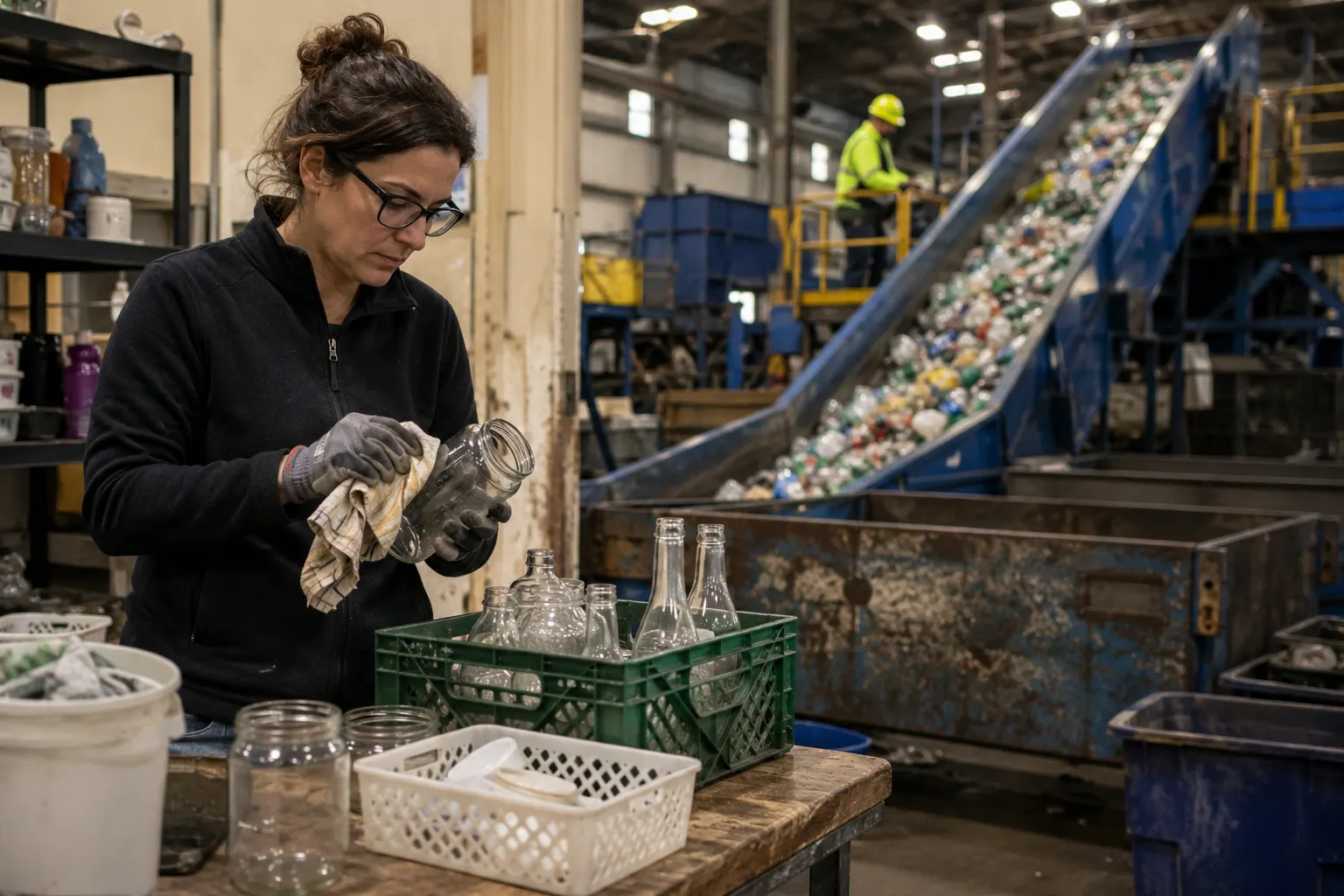
A glass bottle makes the difference easy to see. If the bottle is washed, returned and filled again, it has been reused. If it is collected, crushed, melted and manufactured into new glass, it has been recycled. Both can prevent immediate disposal, but reuse preserves much more of the work already invested in creating the bottle itself.
That is why environmental hierarchies usually place reuse ahead of recycling. The U.S. Environmental Protection Agency currently states that products should be recycled when they cannot first be reduced or reused and ranks source reduction and reuse above recycling and composting. UNEP's circularity framework follows the same broad logic by prioritising value-retention activities such as reuse, repair, refurbishment and remanufacturing before material recycling.
The hierarchy, however, is not an absolute law. A reusable product that is extremely heavy, transported long distances, washed inefficiently or used only a few times can sometimes perform worse than a well-designed single-use alternative. The correct question is therefore not simply “Is reuse always better than recycling?” It is “Which option preserves the most useful value while producing the lowest reasonable lifecycle impact in this particular system?”
Recycling vs Reusing at a Glance
| Reusing | Recycling |
|---|---|
| Keeps the product or component largely intact | Converts the discarded material into secondary raw material |
| Usually requires less physical transformation | Requires collection, sorting and processing |
| Preserves product-level value | Primarily preserves material value |
| Can include resale, refill, donation and repeated use | Includes processes such as pulping, melting, shredding or reprocessing |
| Often comes earlier in the waste hierarchy | Usually becomes important after reuse is no longer practical |
| Requires durable products and convenient return systems | Requires collection, processing infrastructure and markets for recovered materials |
| Can sometimes require washing, repair or transport | Always requires some form of material processing |
| Does not work indefinitely | Does not recover every material indefinitely |
The distinction is simple but important. Reuse tries to stop a useful object from becoming waste. Recycling tries to recover material value after the object can no longer continue in that form.
What Does Reusing Mean?
Reuse occurs when a product, package or component is used again without first being reduced to raw material. It may perform the same function or, depending on the system, another useful function.
Examples include a refillable beverage bottle completing another trip, a desk being sold to another office, clothing moving through a second-hand market, construction beams being installed in another building or reusable transport crates circulating between factories and warehouses.
Reuse can be very informal. A family may give furniture to relatives or use a jar again at home. It can also be highly organised. Deposit-return systems, refill programmes and reusable business-to-business packaging can move the same asset through dozens or hundreds of service cycles.
UNEP's circularity platform describes reuse as using a product again without the need to reduce it to material and emphasises its potential to retain product value for longer.
Repair frequently supports reuse. A product that cannot perform another useful cycle because one component has failed may return to service after that component is repaired or replaced. Refurbishment and remanufacturing go further but follow the same basic principle: preserve as much existing value as practical before moving down to material recycling.
What Does Recycling Mean?
Recycling begins later.
EPA defines recycling as collecting and processing materials that would otherwise be thrown away and turning them into new products. It generally includes collection, sorting, processing into secondary raw materials and manufacturing those materials into new products.
The original product normally disappears as a distinct object. Paper may be pulped into fibre. Glass can be crushed and remelted. Aluminium may be melted into secondary metal. Plastics can be sorted, washed and reprocessed through mechanical or, in some applications, chemical processes.
Recycling can provide substantial environmental benefits. It can reduce demand for virgin raw materials, avoid some energy-intensive extraction and manufacturing, provide industrial feedstock and reduce the quantity of material requiring landfill or other disposal.
But recycling requires more transformation than direct reuse.
A chair that moves to another household remains a chair. A chair that is dismantled and processed into secondary plastic and metal has lost its product-level value even if some material survives.
That is the fundamental difference.
Why Reuse Usually Comes Before Recycling
Waste hierarchies rank strategies because they do not preserve equal amounts of value.
EPA's current hierarchy places source reduction and reuse at the top, followed by recycling and composting, then energy recovery and finally treatment and disposal. EPA calls source reduction the most environmentally preferred strategy because preventing waste can conserve resources and energy before waste-management processes become necessary.
Consider a table.
If another person uses the table, the timber, fasteners, finishing, manufacturing energy, labour and original function all remain useful.
If the table is repaired, most of those investments still survive.
If usable boards are removed and installed elsewhere, some product and component value remains.
If the table is chipped into lower-value wood material, only part of the original material value survives.
The hierarchy is therefore really a value-retention hierarchy.
The closer the product remains to its original useful form, the more of its existing economic and material value is normally preserved.
Reuse Is Not Automatically Better in Every Situation
The fact that reuse sits higher in the hierarchy should not become a new environmental myth.
Reusable systems also consume resources.
Containers have to be manufactured strongly enough to survive repeated cycles. They may need to be transported back to filling facilities. Food and beverage packaging requires washing. Heavy materials can increase transportation emissions. Products can be lost or damaged before reaching their expected number of reuse cycles.
Recent lifecycle research illustrates why system design matters. A 2026 study comparing polyethylene packaging systems and alternatives found that the environmental outcome varied substantially by material, packaging level and system assumptions. Some reusable systems performed well, while some single-use polyethylene formats produced lower impacts than heavier reusable alternatives in particular comparisons.
Another 2026 lifecycle study of a temporary bridge found that reuse could create substantial avoided-production benefits when components successfully displaced the manufacture of new components, but transport assumptions materially affected the result.
The correct lesson is not that reuse is unreliable.
It is that reuse has to achieve enough useful cycles and genuinely replace new production.
A reusable bottle used one hundred times is very different from a reusable bottle purchased for environmental reasons and discarded after three uses.
Number of Reuse Cycles Matters
A reusable product generally requires more material or more robust construction than a disposable one.
That creates an initial environmental investment.
The product must then be used enough times for the avoided production of disposable alternatives to compensate for that investment.
This point is especially important for reusable packaging.
A returnable glass bottle may be relatively heavy, but if it circulates locally through many refill cycles, the environmental cost of manufacturing it can be spread across those uses. A reusable container that disappears from the system after only one or two trips cannot deliver the same advantage.
High return rates therefore matter almost as much as the reusable design itself.
This is why deposit systems, convenient return infrastructure and standardised containers can be so important. They increase the probability that the object actually completes the cycles assumed in an environmental comparison.
Transport and Washing Matter Too
Reuse systems often create reverse logistics.
A disposable package normally moves from producer to customer and then into waste collection. A reusable package may need to return to a collection centre, washing facility or manufacturer before completing another cycle.
If the return distance becomes very large, transportation can reduce the environmental advantage.
Washing also matters. Hot water, detergents and energy use are part of the lifecycle.
This does not invalidate reuse. It explains why good reuse systems are designed around efficient return routes, high utilisation, durable products and appropriate cleaning processes.
The environmental question is therefore not simply whether the container says reusable.
It is whether the reuse system works well.
When Keeping an Old Product Can Be Worse
Product-life extension is generally valuable, but there are exceptions.
Imagine an extremely inefficient refrigerator that consumes far more electricity than a modern replacement.
Repairing it indefinitely preserves the manufacturing value of the existing appliance, but the additional energy consumed during years of operation could eventually outweigh the impact of manufacturing a much more efficient replacement.
The same issue can arise with heating systems, industrial equipment or other products whose operational efficiency has changed dramatically.
A lifecycle comparison should therefore consider both embodied impacts from manufacturing and operational impacts during use.
Reuse is especially powerful when the existing product can continue providing the required service efficiently.
Reuse Preserves More Than Raw Material
One reason recycling receives so much attention is that material quantities are relatively easy to measure.
A facility can report tonnes of metal or paper recovered.
Reuse is quieter.
A repaired washing machine may generate no recycling transaction at all. A second-hand table moving from one family to another may never enter the waste-management system. A reusable crate completing its fiftieth logistics cycle may avoid waste without creating a dramatic recycling statistic.
But the absence of processing is often precisely the advantage.
A product contains more than material. It contains manufacturing energy, labour, design, component assembly, transport and economic value.
Reuse preserves much of that embedded value.
Recycling usually preserves only part of it.
Recycling Still Plays an Essential Role
Placing reuse higher in the hierarchy does not make recycling unimportant.
Every product eventually reaches limits.
A glass bottle can break. Clothing can wear beyond practical reuse. A motor can fail beyond economical repair. A building component may become unsafe. Packaging can become damaged or contaminated.
At that stage, material may still retain substantial value.
Recycling then prevents the remaining resource from moving directly to disposal.
A strong circular economy therefore needs both reuse and recycling. The objective is not to choose one strategy and reject the other. It is to use each at the appropriate stage.
The sequence is generally:
keep the product useful if practical; recover components if possible; recover material when the product can no longer continue; dispose safely only when higher-value options are exhausted.
Closed-Loop Recycling and Downcycling
Not all recycling preserves material equally well.
Closed-loop recycling generally refers to material being recovered for a similar application without major loss of performance. Aluminium cans becoming material suitable for new cans is a common idealised example.
Other materials may move into lower-value applications.
This is often called downcycling.
A plastic package might become fibre, outdoor furniture or another product that is more difficult to recycle again. Construction concrete may be crushed for use as lower-grade aggregate rather than becoming equivalent new structural concrete.
Downcycling can still provide environmental benefits because it delays disposal and can replace some virgin material.
But it demonstrates why a reported recycling rate does not tell the whole story.
We also need to ask what the recovered material became and whether it can remain in circulation again.
Material Quality Can Decline During Recycling
Some recycling processes change the quality of the material.
Paper fibres become shorter through repeated recycling. Some polymers experience degradation or contamination. Composite materials may be extremely difficult to separate economically.
Other materials, such as certain metals and glass, can potentially retain high material quality when collection and processing systems are well designed, although real-world losses still occur.
This is another reason circular systems attempt to preserve products and components before relying entirely on repeated material recycling.
Recycling is essential, but it is not a frictionless loop.
Recycling Depends on Real Infrastructure
A recycling symbol does not guarantee that an item will actually be recycled.
Successful recycling requires a complete chain: collection, sorting, processing, usable secondary material and a market willing to buy that material.
A technically recyclable package can still be disposed of if the local authority does not collect it or no economical recovery facility exists.
EPA's sustainable materials approach emphasises the entire lifecycle rather than treating waste labels alone as sufficient.
This is why consumers should follow local collection rules rather than assuming that every item carrying a recycling symbol belongs in every recycling bin.
Infrastructure determines what happens in practice.
Reuse Also Depends on Infrastructure
Reuse appears simpler, but large-scale reuse requires systems too.
Imagine a takeaway container designed to last one hundred uses.
If only one restaurant accepts it and customers have to travel across a city to return it, actual reuse rates may remain poor.
Now imagine dozens of restaurants using a standard container that can be returned at any participating location.
The same physical object becomes much more effective because the infrastructure surrounding it has changed.
Reuse systems need collection, washing, inspection, redistribution and sometimes tracking.
The difference is that the infrastructure tries to keep the original product intact rather than processing it immediately into raw material.
Where Reuse Works Especially Well
Reuse tends to be particularly attractive where products are durable, valuable, standardised and easy to inspect or clean.
Furniture is an obvious example. A good desk can pass between several owners with minimal processing.
Books can circulate for decades.
Tools can be rented, shared or sold second-hand.
Reusable pallets, crates and totes work well in business-to-business logistics because companies interact repeatedly and can manage return systems.
Construction provides major opportunities because doors, structural steel, timber, fixtures and other components can sometimes be recovered intact rather than immediately crushed or melted.
A study of a modular building designed for disassembly found substantial lifecycle benefits from component reuse compared with a conventional scenario focused heavily on recycling.
These opportunities become much larger when products are deliberately designed for repeated use and disassembly.
Electronics Show Why Repair Comes Before Recycling
Electronic devices contain valuable metals, engineered components, plastics and substantial manufacturing effort.
If a laptop with a failed battery is shredded immediately for material recovery, most of its functional value disappears.
Replacing the battery may preserve years of additional service.
If the device is no longer suitable for its first owner, refurbishment can allow another person to use it.
Only when the device or major components can no longer perform safely and economically should specialised recycling become the main recovery route.
This is why right-to-repair policies, spare parts and long software support are closely connected with circularity.
Recycling electronics well is important.
Preventing a repairable device from becoming e-waste prematurely can be even more valuable.
Clothing Often Has More Value as Clothing
Textiles provide another clear example.
A wearable jacket can be donated, resold or passed to another user with little transformation. Most of its manufacturing value remains intact.
If the jacket is instead reduced to fibre, more processing is required and the recovered fibre may not have the quality needed to make an equivalent garment.
Reuse therefore often makes sense while the clothing remains functional.
But reuse also has limits.
Sending enormous quantities of low-quality unwanted garments into second-hand markets does not automatically solve overproduction. Products still need genuine demand and useful life.
Again, the test is whether reuse replaces new consumption, not simply whether the item changes ownership.
Construction Materials Can Be Reused Before They Become Rubble
Buildings contain enormous stocks of material.
Traditional demolition often destroys components quickly. Doors, timber, steel members, fixtures and masonry can become mixed debris within hours.
Deconstruction reverses the process more carefully, removing valuable components so that they can be reused.
A steel beam reused directly retains far more manufacturing value than one melted and remade.
A historic door installed in another building remains a door.
Concrete that can no longer be reused structurally may still be crushed and recycled into aggregate.
This illustrates the hierarchy perfectly: reuse first where practical, then recycle what can no longer remain useful as a component.
Reusing Packaging Works Best as a System
Packaging is one of the most visible areas of the reuse-versus-recycling debate.
Single-use packaging can sometimes be efficiently collected and recycled. Reusable packaging can sometimes avoid many disposable units.
Which performs better depends heavily on container weight, number of uses, washing, product losses, transportation and local energy systems.
This is why headline claims that “reuse is always better” or “single-use is always lighter and therefore better” are both too simplistic.
A strong reusable packaging system needs high return rates and repeated cycles.
A strong recycling system needs high collection rates, efficient processing and recovered material that genuinely replaces virgin material.
Lifecycle comparison should evaluate the complete systems rather than the marketing label attached to one package.
Reuse, Repair, Refurbishment and Remanufacturing Are Different
These terms are related but should not be treated as identical.
Reuse keeps the product in another service cycle with little modification.
Repair fixes a specific defect so the product can function again.
Refurbishment involves more extensive restoration, replacement or upgrading.
Remanufacturing is an industrial process in which used products or components are restored to defined performance standards.
UNEP places these processes within its broader value-retention framework before recycling.
Together they show that there are several ways to preserve value before material recovery becomes necessary.
Recycling and Reusing in the Circular Economy
The circular economy is sometimes represented by a recycling symbol, but recycling is only one loop within a much larger system.
UNEP's current circularity approach begins with reduce by design and then identifies refuse, reduce, reuse, repair, refurbishment, remanufacturing, repurposing and recycling as different methods of retaining value.
The order matters conceptually.
A functioning product contains more value than its raw materials.
A functioning component contains more value than the metal from which it was made.
Circularity therefore attempts to keep economic and material value at the highest practical level before moving downward.
Recycling remains necessary because no product lasts forever.
But a society that manufactures enormous quantities of short-lived products and recycles part of them is not automatically circular.
It may simply be a linear economy with a better waste-management system.
What Consumers Should Do
For individuals, the hierarchy can remain relatively simple.
Before buying, ask whether the item is needed at all. When buying is necessary, choose products likely to last and that can be maintained or repaired.
Keep useful products in service. Pass them to another user when you no longer need them. Use refill and return systems where they operate effectively.
When an item no longer works, ask whether repair is practical.
When the product can no longer serve a useful function, follow the appropriate local recycling system.
This sequence does not mean maintaining every possession indefinitely.
It means avoiding the premature destruction of useful value.
What Businesses Should Do
Businesses often have far more influence because they decide how products and systems are designed.
Companies can make products durable, provide spare parts, use reversible fasteners, standardise reusable packaging, operate take-back systems and design components for disassembly.
Procurement can favour reusable transport packaging, remanufactured equipment and repairable products.
Businesses should also measure whether reuse actually replaces purchases of new items.
A warehouse reporting thousands of reusable crates is not necessarily circular if crates regularly disappear and are continually replaced.
The useful metric is how many effective service cycles the system creates and how much new material demand it avoids.
What Governments Can Do
Government policy shapes whether reuse and recycling are convenient or difficult.
Deposit-return systems can encourage containers to come back. Right-to-repair requirements can make product-life extension more practical. Extended Producer Responsibility can shift some post-use responsibility back toward manufacturers.
Governments can also fund collection, standardise labelling, regulate misleading environmental claims and use public procurement to create demand for durable, repairable and reused products.
Recycling requires infrastructure.
Reuse requires infrastructure too.
Policy can determine whether the environmentally preferred option becomes the easiest option or remains a niche choice available only to highly motivated consumers.
Reuse vs Recycling: Which Is Better?
There is no universal answer for every product.
As a general hierarchy, reuse is usually preferred when the existing product can safely and efficiently perform another useful cycle. It preserves more product value and avoids some of the processing required for recycling.
Recycling becomes essential when the product or component can no longer reasonably remain useful.
The practical decision depends on several questions: Is the product still functional? Can it be repaired? Will another user actually use it? How far must it travel? Does it require intensive washing? How many additional cycles are realistic? Does recycling infrastructure exist? Will recovered material genuinely replace virgin material?
These questions turn a slogan into lifecycle reasoning.
Common Myths About Reusing and Recycling
“Anything reusable is environmentally better.” Not necessarily. A reusable product needs enough service cycles to justify its manufacturing, washing and return impacts.
“Recycling makes disposable consumption sustainable.” No. Recycling recovers some material value but does not eliminate manufacturing, collection or processing impacts.
“If something has a recycling symbol, it will be recycled.” Not necessarily. Local collection, sorting and processing determine real recovery.
“Reuse means keeping things forever.” No. Reuse keeps products useful for additional cycles while that remains safe and practical.
“Recycling and reuse are competing strategies.” They are better understood as successive strategies. Reuse preserves product value first; recycling can recover remaining material later.
“Donating something always counts as successful reuse.” Only if the product reaches another user who genuinely needs and uses it. Moving unwanted goods elsewhere without demand can simply transfer the waste problem.
Frequently Asked Questions
What is the main difference between reusing and recycling?
Reusing keeps the product or component largely intact for another useful cycle. Recycling processes the discarded material into secondary raw material for manufacturing new products.
Why is reuse better than recycling in the waste hierarchy?
Reuse usually preserves more of the manufacturing, material and functional value already contained in the product and can avoid the collection and processing required for recycling. EPA therefore places source reduction and reuse above recycling in its hierarchy.
Is reuse always more environmentally friendly?
No. Transport, washing, product weight, operational efficiency and the number of reuse cycles can change the lifecycle result.
What are examples of reuse?
Examples include refillable bottles, second-hand clothing, donated furniture, reusable shipping crates, repaired appliances and salvaged construction components.
What are examples of recycling?
Examples include pulping waste paper, melting scrap aluminium, remelting glass and processing suitable plastics into secondary raw materials.
Is repairing something the same as reusing it?
Repair is a value-retention strategy that enables reuse by restoring a product's function. It involves more intervention than simple direct reuse but still preserves much more product value than immediate recycling.
Is second-hand shopping reuse?
Yes. When an existing product moves to another user and continues performing its function without being reduced to raw material, it is a form of reuse.
Is refilling reuse?
Yes, when the same container is returned or retained and used for another cycle.
Is composting recycling?
EPA includes composting alongside recycling within its materials hierarchy because suitable biological materials are processed into useful outputs, although composting belongs to a biological rather than technical material cycle.
What should happen after an item can no longer be reused?
Consider repair, refurbishment, component recovery and then appropriate material recycling before controlled disposal.
The Real Difference Is How Much Value Survives
The central lesson in recycling vs reusing is not that one strategy is good and the other bad.
Both are essential.
The difference is when they intervene and how much existing value they preserve.
Reuse acts while a product is still a product.
The bottle remains a bottle. The table remains a table. The computer remains a computer. The beam remains a structural component.
Recycling acts later.
The bottle becomes cullet. The table becomes wood fibre or fuel. The computer becomes separated metals and plastics. The beam becomes scrap steel.
The material may remain valuable, but much of the original manufacturing effort has already been surrendered.
That is why the familiar phrase reduce, reuse, recycle is ordered rather than random.
Prevent unnecessary material first. Keep useful products in service. Repair them when practical. Pass them to another user. Recover components. Then recycle materials when higher-value options have been exhausted.
EPA's current guidance makes that priority explicit, stating that products should be recycled when they cannot first be reduced or reused. UNEP's circularity model extends the same logic through a larger ladder of value-retention strategies.
But environmental decision-making should remain evidence-based rather than ideological.
A reusable system still needs enough trips, efficient washing and sensible transport. An obsolete machine may sometimes consume so much energy that replacement is justified. A recyclable package still needs a real collection and processing system.
The practical rule is therefore simple:
If the whole product can safely and efficiently perform another useful cycle, preserve that value first. If it cannot, recover as much component and material value as possible before disposal.
Reuse prevents a useful product from becoming waste too soon.
Recycling gives material another chance after that transition has occurred.
A genuinely resource-efficient economy needs both—and understands why they belong at different points in the hierarchy.