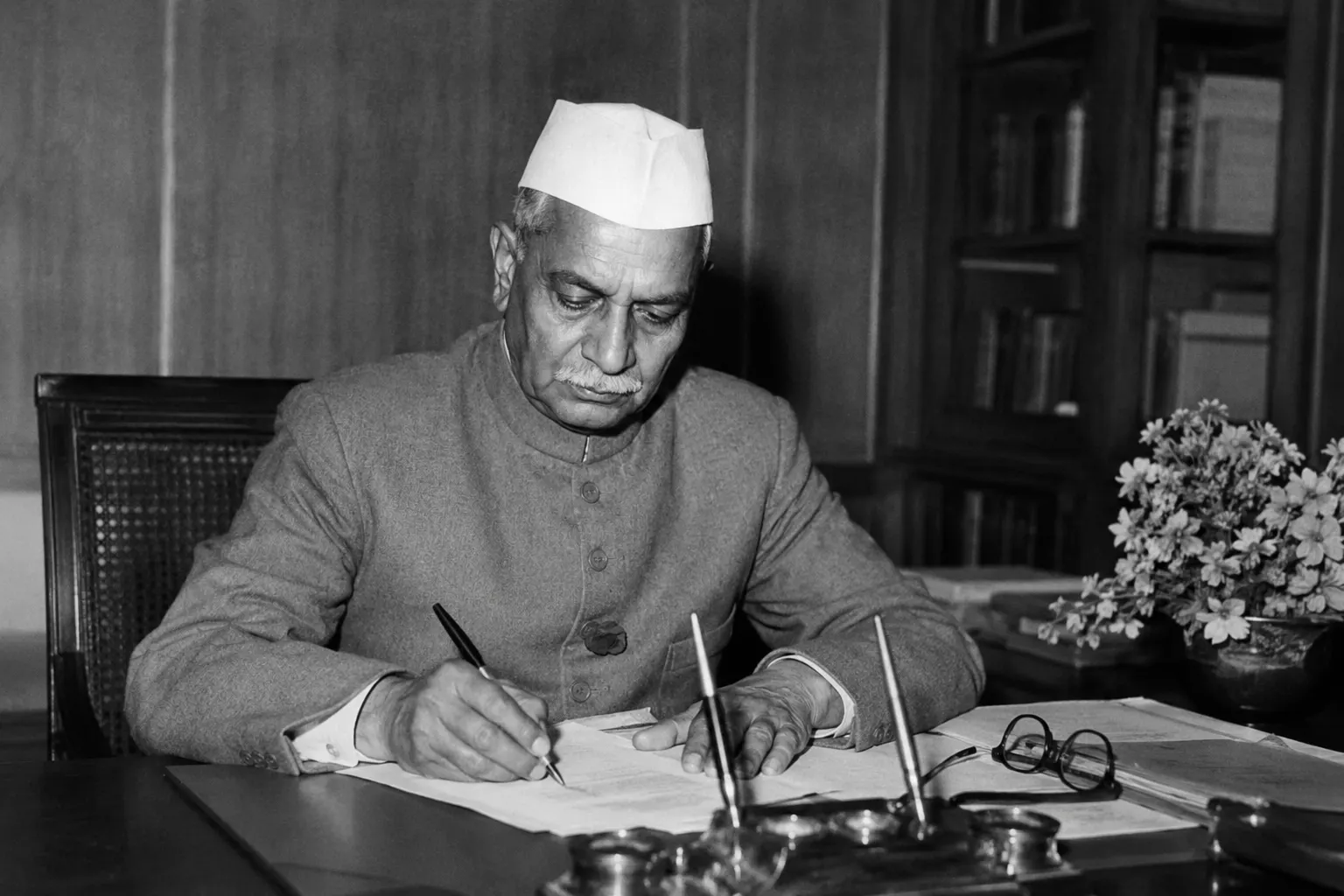
On 24 January 1950, two days before India became a republic, the Constituent Assembly elected Rajendra Prasad as the country’s first President.
The moment carried an unusual constitutional transition.
For more than three years, Prasad had presided over the Assembly that debated and adopted the Constitution. He was now moving from chairing the body that created the constitutional order to occupying one of the offices created by it.
That makes his career especially important.
Rajendra Prasad was not the Constitution’s principal drafter. B. R. Ambedkar chaired the Drafting Committee; B. N. Rau served as constitutional adviser; hundreds of Assembly members shaped provisions through committees and debate.
Prasad’s role was different.
He had to preside.
That sounds modest compared with drafting articles or delivering famous ideological speeches. In a deeply divided Assembly confronting partition, minority rights, federalism, language, representation and the structure of government, however, procedural authority was politically consequential.
He later faced another institutional challenge as President: how should a head of state operate in a parliamentary system where constitutional text, British-derived conventions and democratic politics were still new?
Rajendra Prasad’s legacy lies largely in how he inhabited these transitional institutions.
From Ziradei to Calcutta
Rajendra Prasad was born on 3 December 1884 in Ziradei in present-day Bihar.
He grew up in a landholding family and received an education that combined traditional learning with the expanding modern educational system of colonial India.
He became an outstanding student and later studied in Calcutta, one of the major intellectual centres of British India.
Prasad trained in law and built a successful legal career.
His academic ability became part of his public reputation, but professional success alone did not explain his move into nationalist politics.
That transformation occurred gradually through the Indian National Congress and, decisively, through his encounter with Mahatma Gandhi.
Champaran and Gandhi
The Champaran Satyagraha of 1917 became a turning point in Prasad’s life.
Peasants in Champaran faced coercive conditions associated with indigo cultivation and European planters. Gandhi travelled to the district to investigate their grievances and organise resistance through non-violent methods.
Prasad, already a respected Bihar lawyer and public figure, became involved in the campaign.
The encounter reshaped his political orientation.
Later in life, Prasad wrote extensively about Gandhi and Champaran. His recollections are valuable precisely because he was both a participant and an admirer. They offer insider evidence but must also be read as memory shaped by later reverence.
Champaran brought together legal skill, rural politics and Gandhian mass mobilisation.
For Prasad, it also marked the movement from professional nationalist to committed Gandhian organiser.
Giving up the security of a profession
The Non-Cooperation Movement demanded sacrifices from professionals who had prospered under colonial institutions.
Prasad moved away from legal practice and became increasingly immersed in Congress work.
This was not simply symbolic.
A successful lawyer possessed income, status and a predictable career. Full-time nationalist politics meant imprisonment, uncertainty and dependence on organisational networks.
Prasad’s later image as a simple and self-effacing public servant drew partly from this transition.
Yet simplicity should not obscure political skill.
He became one of the most important Congress leaders from Bihar and repeatedly held national responsibilities.
Bihar as his political base
Rajendra Prasad’s national career remained deeply connected with Bihar.
He worked on relief and public mobilisation during disasters, including the devastating 1934 Bihar earthquake.
Such work strengthened his reputation for organisation and public service.
The Congress of the interwar period relied heavily on provincial leaders capable of connecting national strategy to local society.
Prasad was one of those intermediaries.
He understood elite politics, village society, law and Congress organisation.
This breadth made him valuable to Gandhi and to the party.
Congress leadership and imprisonment
Prasad served as president of the Indian National Congress more than once during the final decades of colonial rule.
Like many senior Congress leaders, he spent periods in British prisons.
The Quit India Movement of 1942 resulted in the detention of most of the top Congress leadership, including Prasad.
He used imprisonment partly as a period of writing and reflection. His autobiographical work and political writings provide a substantial primary record of how he understood the nationalist movement.
This is one reason his legacy should not be confined to ceremonial office.
He was an intellectual participant in debates about India’s future as well as an organiser.
India Divided and the partition question
Prasad’s book India Divided, published in the 1940s, addressed proposals for partition and the political problem of Hindu-Muslim division.
The subject was among the most difficult in late colonial politics.
Prasad opposed partition, examining practical and political consequences of dividing India.
The eventual partition of 1947 made such arguments historically unsuccessful in immediate political terms, but they remain evidence of how senior Congress leaders thought through the constitutional crisis before independence.
A biography should not judge these writings only by whether events followed their recommendations.
Political thought is also a record of alternatives that were considered and rejected.
Minister before President
In the interim government before independence, Prasad held responsibility for food and agriculture.
India faced severe food insecurity during the 1940s, making the portfolio more consequential than its later ceremonial treatment sometimes suggests.
Yet his most important assignment began in December 1946.
He was elected permanent chairman—effectively President—of the Constituent Assembly.
Presiding over the Constituent Assembly
The Constituent Assembly was not an ordinary legislature.
It had to design the political architecture of a new state while the subcontinent was moving toward partition and mass violence.
Its members disagreed over federalism, minority safeguards, fundamental rights, representation, language, the judiciary, executive power and the relationship between social reform and individual liberty.
Prasad’s task as presiding officer was to maintain procedure and legitimacy.
Contemporary Assembly records show members repeatedly praising his patience and impartiality.
Such praise should not be romanticised—Prasad had his own political and social views—but it helps explain why he was able to command broad respect across factions.
His role was procedural leadership.
A presiding officer decides who speaks, manages amendments, interprets rules and maintains order. Done badly, those powers can distort a deliberative body. Done well, they make disagreement governable.
What Rajendra Prasad did not do
Popular memory sometimes treats Prasad as though he personally “made” the Constitution.
That is inaccurate.
Constitution-making was collective.
The Drafting Committee under Ambedkar had a specific technical and political role. Committees chaired by Vallabhbhai Patel, Jawaharlal Nehru and others shaped major provisions. B. N. Rau provided comparative constitutional expertise. Hundreds of members debated and amended proposals.
Prasad’s contribution was to preside over this process and chair several committees.
That role is significant enough without assigning him work performed by others.
26 November and 24 January
The Constituent Assembly adopted the Constitution on 26 November 1949.
At its final session on 24 January 1950, members signed the Constitution and addressed remaining symbolic questions of the new republic.
Prasad was elected President of India.
On 26 January, the Constitution came into effect.
India replaced the office of Governor-General with an elected presidency and became a republic.
The new office had text but almost no lived Indian precedent.
Prasad had to help create one.
What does a president do in a parliamentary republic?
India’s Constitution established a parliamentary system in which the elected government led by the prime minister exercises political power while the President serves as constitutional head of state.
But early constitutional practice still contained areas of uncertainty.
How much discretion did the President possess?
Could the President independently resist legislation?
How should the office communicate disagreement with the prime minister?
Rajendra Prasad and Jawaharlal Nehru confronted such questions directly.
The debates mattered because conventions are often created through disagreement, not consensus.
The Hindu Code Bill dispute
One major constitutional disagreement concerned reform of Hindu personal law.
Rajendra Prasad had reservations about aspects of the proposed Hindu Code legislation and also questioned whether the provisional Parliament possessed a sufficient democratic mandate to enact such sweeping social reform before the first general election.
Correspondence between Nehru and Prasad shows that the President explored the extent of his constitutional authority, including whether he could act independently in relation to assent or returning legislation.
Nehru’s position was strongly parliamentary: the President was not an alternative political executive and could not substitute personal judgment for the advice of the elected government.
The dispute did not produce a constitutional crisis.
Its importance lies in clarifying the office.
Prasad could warn, question and advise. The presidency was not designed to become a rival centre of day-to-day political authority.
A President with opinions
Calling the Indian President “ceremonial” can be misleading if it implies complete passivity.
Rajendra Prasad had political experience, religious convictions and strong views about social questions.
He travelled extensively, addressed institutions and represented the republic symbolically.
He could communicate concerns to the government.
But the office operated within a constitutional structure that privileged ministerial responsibility to Parliament.
Prasad’s presidency helped establish the practical balance between dignity and restraint.
Later presidents inherited not only constitutional articles but also conventions created in these early years.
Relationship with Nehru
The Prasad-Nehru relationship is often dramatised as a clash between conservative tradition and secular modernism.
There were genuine differences.
Prasad was more publicly comfortable with certain forms of religious and cultural tradition. Nehru emphasised scientific temper, secular statecraft and social reform more aggressively.
They disagreed on the Hindu Code and other questions.
Yet they also worked together through one of the most difficult periods of Indian history.
Reducing their relationship to personal rivalry obscures the institutional importance of their disagreements.
The early republic needed to discover whether strong personalities could disagree without breaking constitutional government.
In this respect, disagreement itself became part of democratic learning.
Re-election and the unusual length of his tenure
Rajendra Prasad served as President from 26 January 1950 until 13 May 1962.
He was elected under the new constitutional system and later re-elected, becoming the only Indian President to serve two full elected terms in addition to the initial republican transition.
The duration gave him unusual influence over the symbolic culture of the presidency.
He received foreign leaders, travelled through India, addressed Parliament and universities and represented continuity while governments and political controversies changed around him.
Long tenure can create risks of personalisation.
In Prasad’s case, however, the presidency did not become a personal political machine.
That restraint was itself institutionally significant.
The presidency and public symbolism
The first President had to embody a republic that was still becoming socially real.
India in 1950 was poor, recently partitioned and linguistically, religiously and regionally diverse. The state was integrating princely territories, resettling refugees and organising its first general election.
The President’s symbolic function therefore mattered more than ceremonial language suggests.
The office represented continuity of the constitutional order above ordinary party conflict.
Prasad’s Gandhian image of simplicity suited that role.
The contrast between the grandeur of Rashtrapati Bhavan and his personal reputation for modest living also became part of public mythology around the office.
Limits and conservative instincts
Rajendra Prasad should not be converted into a politically neutral saint.
He belonged to a generation shaped by social and religious assumptions that modern readers may contest. His positions on personal-law reform placed him at odds with more aggressive social reformers. His political instincts were often more culturally conservative than Nehru’s.
Those differences should be examined rather than hidden.
At the same time, constitutional restraint does not require ideological agreement.
One of the important lessons of Prasad’s presidency is that office-holders can possess strong personal beliefs while accepting limits on how those beliefs may be translated into state power.
Retirement and final years
Prasad retired from the presidency in 1962 as his health declined.
He was awarded the Bharat Ratna that year.
He returned to Bihar and spent his final months at Sadaqat Ashram in Patna. He died on 28 February 1963.
By then, the republic whose first constitutional institutions he had helped establish had completed three general elections and survived its first major transitions of democratic government.
The presidency had become recognisable as an Indian institution rather than a theoretical clause in a new Constitution.
Writing as historical evidence
Rajendra Prasad left behind memoirs, political writings and correspondence.
These include his autobiography and works on Gandhi, Champaran and the partition question.
Such material is valuable for historians because it reveals how a senior participant understood events from inside the nationalist movement.
But memoir is not neutral evidence.
Memory selects, interprets and justifies.
Prasad’s writings should therefore be read alongside government records, Constituent Assembly debates and correspondence with other leaders.
That method is especially important for figures later surrounded by reverence.
What his legacy is—and is not
Prasad’s legacy is sometimes summarised in three facts: freedom fighter, Constituent Assembly President, first President of India.
The list is accurate but static.
The more meaningful legacy lies in the transitions connecting those roles.
As a lawyer, he learned institutional procedure.
As a Gandhian, he entered mass politics.
As a Congress organiser, he built political legitimacy.
As Constituent Assembly President, he managed structured disagreement.
As President of India, he had to accept that constitutional office imposes limits even on leaders with enormous personal prestige.
That is a coherent political life.
Why Rajendra Prasad still matters
Modern constitutional democracies often focus on dramatic institutions: courts striking down laws, parliaments passing major reforms, governments winning or losing elections.
Presiding officers and heads of state appear less exciting.
But constitutional stability often depends on people performing restrained roles competently.
Rajendra Prasad mattered because he occupied two such roles at the birth of the republic.
He presided over a Constituent Assembly filled with disagreement without turning the chair into a personal platform.
He became the first President without trying to convert the presidency into a competing premiership.
He disagreed with Nehru without making institutional conflict unmanageable.
He carried the prestige of the freedom movement into an office whose legitimacy had to extend beyond the Congress party.
His legacy is therefore not only the honour of being “first.”
It is the quieter achievement of helping a new constitutional system develop habits.
Democracies survive not only because constitutions are well written.
They survive because early office-holders demonstrate what restraint looks like in practice.
Rajendra Prasad was one of the people who had to teach the Indian republic that lesson while the republic was still learning what it was.