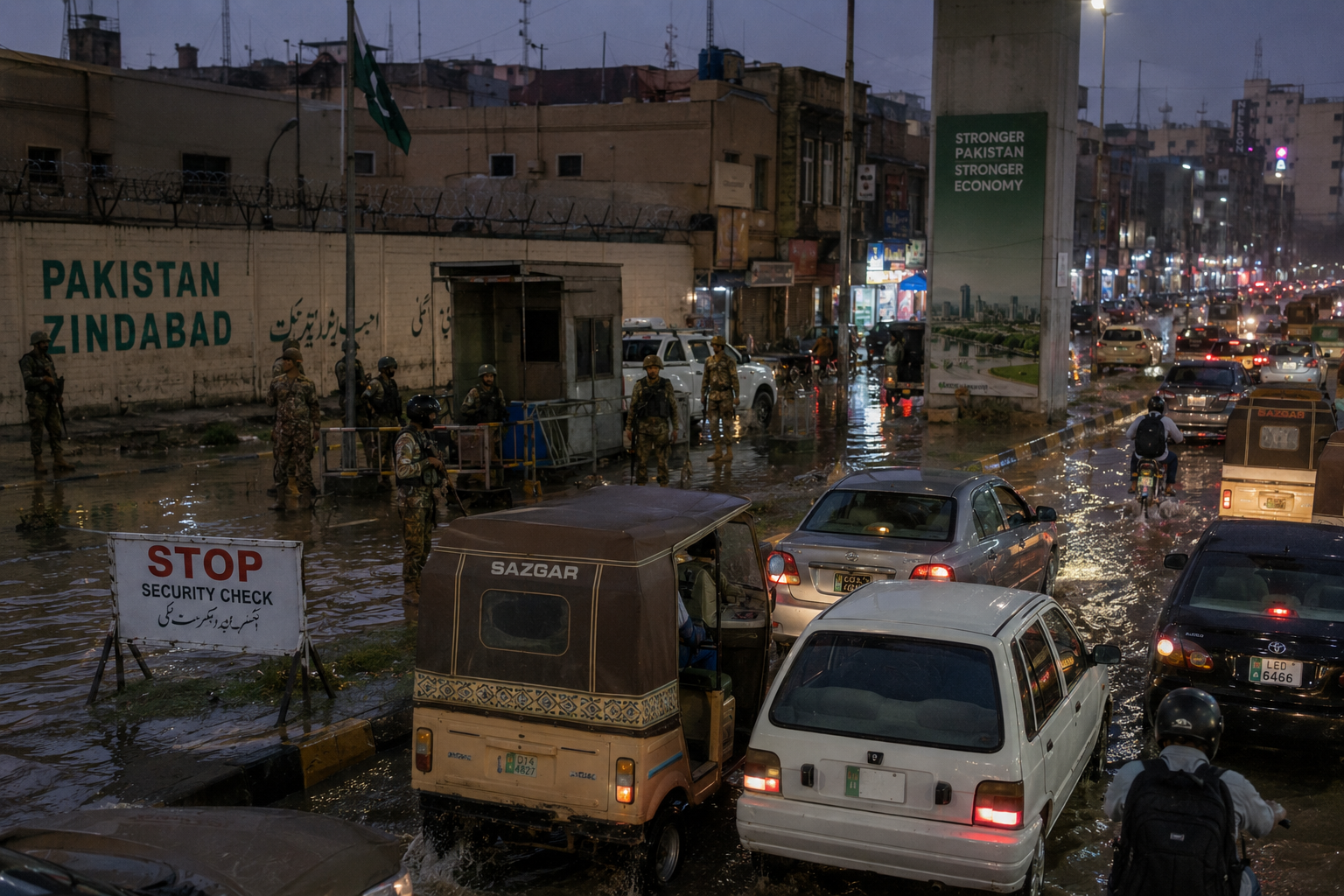
Pakistan instability: Why It Matters for India
Pakistan's instability is often treated as a South Asian problem. That is an underestimation. Pakistan is a nuclear-armed state, a neighbour of India, Afghanistan, Iran and China, a former frontline state in the war on terror, a country with deep military influence in politics, and a society struggling with economic stress, radicalisation, climate shocks and institutional distrust. When Pakistan becomes unstable, the consequences do not stop at the Wagah border.
Why the issue matters now
The first reason Pakistan matters beyond South Asia is nuclear risk. Pakistan's nuclear arsenal exists in a region where conventional conflict, terrorism and political volatility overlap. India and Pakistan have fought wars, faced crises after terrorist attacks, and managed escalation under global pressure. Even if both states understand the danger of nuclear conflict, instability increases the risk of miscalculation. A weak civilian government, a pressured military, a militant provocation or a domestic crisis can narrow decision-making space during a confrontation.
The second reason is terrorism and militancy. Pakistan has long been associated with militant networks that affect Afghanistan, India and parts of the wider region. Even when the Pakistani state itself becomes a victim of extremist violence, the legacy of using non-state actors as instruments of policy remains dangerous. Groups can split, rebrand, relocate and act autonomously. A state facing economic and political pressure may find it harder to control all armed networks. For India, this is not a theoretical concern; it is a security reality shaped by decades of cross-border terrorism.
The third reason is Afghanistan. Pakistan's relationship with Afghanistan has become more difficult after the Taliban's return to power. Islamabad expected strategic depth and influence, but it has also faced violence from groups such as the Tehreek-e-Taliban Pakistan. Border tensions, refugee issues and militant sanctuaries create a volatile western front for Pakistan. If Pakistan-Afghanistan tensions escalate, the effects can move into Central Asia, Iran and India's security calculations.
The strategic geography
The fourth reason is economics. Pakistan has repeatedly relied on external support to manage balance-of-payments pressure. The IMF's current Extended Fund Facility, approved in September 2024, is designed to restore macroeconomic stability and support reforms. In May 2026, the IMF completed a review that allowed further disbursements under the programme and emphasised priorities such as reserve buffers, tax reform, productivity, state-owned enterprise reform and energy-sector viability. These are not minor technical issues. They reflect structural weaknesses in Pakistan's economy.
Economic fragility matters geopolitically because it affects political legitimacy. Inflation, unemployment, energy shortages and taxation disputes can create public anger. When citizens lose faith in civilian institutions, the military's role can expand further. When the military dominates, political competition becomes distorted. When political competition is distorted, reform becomes harder. Pakistan's economic crisis is therefore not only about dollars and debt. It is about state capacity.
The BTI 2026 country report describes Pakistan's recent challenges as including a balance-of-payments crisis, domestic political instability, debt repayments, commodity price shocks, flood damage and the economic fallout of the pandemic. That combination matters because Pakistan is highly exposed to climate shocks. The 2022 floods showed how a climate disaster can become an economic and governance crisis. Future floods, heat stress and water shortages can intensify migration, food insecurity and political pressure.
India angle
The China factor adds another layer. China is Pakistan's closest major-power partner and has invested in the China-Pakistan Economic Corridor. For Beijing, Pakistan is important for access, strategic pressure on India and regional influence. But Chinese projects have faced security risks, debt concerns and local resentment in some areas. If Pakistan becomes more unstable, China's security involvement may deepen, which could further complicate India's western and northern strategic environment.
The Gulf and the United States also remain part of the equation. Gulf states have often provided financial support, employment opportunities and energy links. The United States may not view Pakistan with the same centrality it did during the war on terror, but Washington cannot ignore a nuclear state located near Afghanistan, Iran, China and India. Pakistan's instability therefore draws in multiple external actors, each with different priorities.
For India, the problem is complicated. A strong, stable and peaceful Pakistan would be easier to manage than a weak, unpredictable one. Yet India cannot build its security on hope. It must prepare for terrorism, border incidents, drone smuggling, radicalisation, information warfare, nuclear signalling and diplomatic manipulation. At the same time, India must avoid overreacting in ways that internationalise every crisis on Pakistan's terms.
Counter-view and complexity
The global implications are serious. Pakistan's instability can affect counter-terrorism cooperation, nuclear security concerns, IMF and creditor politics, China's regional strategy, Afghan stability, Gulf labour markets and regional trade connectivity. It also weakens South Asian regionalism. SAARC has already been paralysed for years, and Pakistan's domestic instability makes meaningful regional economic integration even harder.
The counter-view is that Pakistan has survived repeated crises and may continue to muddle through. Its military remains organised. Its society is resilient. Its diaspora is large. Its agricultural base, despite stress, remains significant. External creditors may keep rescuing it because collapse would be too dangerous. This argument has weight. Pakistan's state may not collapse. But survival is not the same as stability. A country can remain intact while exporting insecurity, delaying reform and generating periodic crises.
What happens next
What happens next will depend on three questions. First, can Pakistan implement economic reforms without triggering social backlash? Second, can civilian politics regain credibility in a system dominated by military influence? Third, can Pakistan rethink the security doctrines that have damaged its economy and international reputation? Without progress on these fronts, each financial rescue will buy time rather than transformation.
India should respond with realism. It should strengthen border security, intelligence coordination, cyber resilience and counter-terror capacity. It should keep diplomatic channels available where useful, but avoid illusions. It should work with international partners to ensure that financial support to Pakistan is linked to genuine reform and action against terror financing. It should also prepare for humanitarian and climate-linked instability without allowing security vulnerabilities.
A deeper reading of Pakistan's instability requires separating state weakness from state collapse. Pakistan is not a failed state in the simplistic sense. It has a powerful military, nuclear weapons, a large population, functioning sectors of society, agriculture, industry, universities, media and a resilient diaspora. But it suffers from chronic institutional imbalance. Civilian governments are repeatedly weakened, military influence remains dominant, economic reforms are delayed and security doctrines consume national resources.
The civil-military imbalance is central. When elected governments lack full control over national security and foreign policy, accountability becomes blurred. Citizens blame politicians for failures, politicians blame hidden power structures, and the military presents itself as the guardian of stability. This cycle prevents deep reform because no actor bears full responsibility. Economic policy, regional policy and internal security all suffer from this ambiguity.
Pakistan's fiscal weakness is not only a technical issue. A narrow tax base, energy-sector losses, state-owned enterprise problems, import dependence and low productivity all reduce state capacity. When the government cannot raise enough revenue or deliver services effectively, legitimacy declines. When legitimacy declines, political polarisation grows. When polarisation grows, reform becomes harder. This is why IMF programmes can stabilise Pakistan temporarily but rarely transform it permanently.
Climate stress will make the problem harder. Floods, heatwaves, water scarcity and agricultural disruption can create internal displacement, food inflation and public anger. Pakistan's geography makes it vulnerable to glacial melt, river flooding and extreme weather. Climate shocks do not respect political timetables. They can hit when reserves are low, governments are weak and social trust is already damaged.
The security state also distorts Pakistan's development priorities. High security anxieties, especially regarding India and Afghanistan, encourage military spending, strategic depth thinking and tolerance of proxies. Yet the same policies often produce blowback. Militancy that was once seen through selective lenses can turn inward. The rise of the TTP threat demonstrates that militant ecosystems cannot be permanently compartmentalised.
Pakistan's relationship with China gives it strategic support but also reduces the incentive for difficult reorientation. CPEC was presented as transformative, but infrastructure alone cannot fix governance, productivity and security. If projects face debt stress, local resentment or militant attacks, the relationship becomes more complicated. China wants stability, but it also wants protection for its investments and citizens. That may increase pressure on Pakistan's security apparatus.
India's strategic community must avoid emotional thinking about Pakistan. Schadenfreude is not strategy. A deeply unstable Pakistan can create terrorism risks, refugee pressures, nuclear anxiety, drug flows and international crisis diplomacy. India benefits from a Pakistan that is normal enough to focus on trade, development and internal stability. The problem is that India cannot create that Pakistan from outside. It can only manage risks and set incentives.
The international community also faces a dilemma. If it provides repeated financial support without reform conditions, it reinforces bad habits. If it withdraws support suddenly, it risks destabilising a nuclear state. This is why Pakistan repeatedly receives rescue packages while structural problems continue. The world fears the consequences of failure more than it insists on the discipline of success.
Media narratives often reduce Pakistan to coups, terrorism or cricket diplomacy. That misses social complexity. Pakistan has vibrant civil society, talented professionals, entrepreneurs, artists and reformist voices. But their ability to reshape the state is constrained by power structures, ideological pressures and economic insecurity. A serious analysis must recognise both Pakistan's human potential and its institutional blockages.
The deeper conclusion is that Pakistan's instability is a long-cycle problem. It will not be solved by one election, one IMF programme, one military reshuffle or one diplomatic thaw. It requires a new social contract, civilian supremacy, economic reform, regional normalisation and a break from using insecurity as a governing instrument. Until then, Pakistan will remain a country that repeatedly survives crises without escaping the conditions that produce them.
India should watch Pakistan's internal social changes as closely as its military moves. Youth frustration, urban unemployment, religious mobilisation, provincial grievances and digital political anger can reshape the country's future. Pakistan is not only a security problem; it is a society under stress. Ignoring that social dimension leads to shallow analysis.
Provincial tensions matter. Balochistan faces insurgency, resource grievances and resentment over external projects. Khyber Pakhtunkhwa is exposed to militancy and Afghanistan-linked instability. Sindh and Punjab have different political economies. A centralised security response cannot solve all provincial problems. These internal fractures can affect CPEC, border security and national cohesion.
Information warfare is now part of India-Pakistan rivalry. Social media narratives, disinformation, deepfakes, bot networks and emotional mobilisation can intensify crises faster than formal diplomacy can control them. India must build public communication capacity during crises so that escalation is not driven by rumours, outrage or manipulated media.
The long-term question is whether Pakistan can normalise its regional imagination. A country that sees India primarily through permanent hostility will keep sacrificing trade and development opportunities. Regional trade in South Asia remains far below potential partly because politics blocks economics. Until Pakistan rethinks this posture, instability will remain self-reinforcing.
The editorial insight is this: Pakistan's instability matters beyond South Asia because it sits at the intersection of nuclear weapons, terrorism, debt, climate stress and great-power rivalry. The danger is not only that Pakistan may collapse. The more likely danger is that it remains unstable enough to create recurring crises and stable enough to avoid fundamental reform.
Internal Links to Add
Related regional explainer articles from the Master Article Shell should be added during CMS upload based on topical proximity.