Nikola Tesla: The Engineer Behind the Myth of the Electrical Future
Nikola Tesla has become one of the most mythologised inventors in modern history. In popular culture he is often presented as a solitary genius who invented alternating current, radio, wireless electricity and much of the modern technological world, only to have his ideas stolen or suppressed by more powerful businessmen. That version is dramatic, but it obscures the real scale of Tesla’s achievement. He did not invent electricity or alternating current, and he was not the only engineer working on radio, motors or wireless transmission. His importance lies in something more precise: Tesla made foundational contributions to the practical polyphase alternating-current motor system, developed influential high-frequency electrical apparatus and pushed wireless and remote-control experimentation into territory that helped expand what engineers believed electrical technology could do.
Tesla’s career also reveals an important distinction between invention and infrastructure. Some of his strongest ideas succeeded because manufacturers, financiers, utilities and other engineers could turn them into repeatable industrial systems. His induction-motor work became part of the electrical economy because it could be integrated with generators, transformers and distribution networks. Other ambitions, most famously Wardenclyffe, did not reach comparable implementation because technical feasibility, capital requirements, competition and commercial strategy all mattered alongside imagination. Tesla’s life is therefore not the story of a prophet whose future was deliberately stolen. It is the more instructive story of a brilliant engineer whose career shows both how breakthroughs become infrastructure and how visionary ideas can outrun the systems needed to make them real.
From Smiljan to Electrical Engineering
Nikola Tesla was born on 10 July 1856 in Smiljan, then within the Austrian Empire and now in Croatia, into a Serbian family. His father, Milutin Tesla, was an Orthodox priest. Tesla later spoke admiringly of the mechanical ingenuity of his mother, Georgina-Djuka Tesla, and biographical institutions associated with him continue to emphasise her influence on his early imagination.
Tesla received technical education within the Habsburg world and studied at the Austrian Polytechnic in Graz, although he did not complete a degree. He later worked in telegraphy and electrical engineering in Budapest and Paris.
The technological environment he entered was rapidly changing. Telegraph networks had already demonstrated the power of electricity to transform communication. Electric lighting systems were beginning to spread. Inventors, engineers and companies across Europe and the United States were competing to solve problems involving generation, motors and distribution.
The central problem was not simply how to create electricity.
The harder challenge was how to generate it economically, transmit it over useful distances, control it safely and convert it into mechanical work.
Tesla would become particularly important in solving one part of that larger system: the alternating-current motor.
Alternating Current Existed Before Tesla
One of the most persistent Tesla myths is that he “invented AC.”
He did not.
Alternating current was already known, and engineers in several countries had developed AC generators, transformers and distribution concepts before Tesla’s major work.
The technological debate involved entire electrical systems rather than one invention. Direct-current networks were already being installed, particularly by businesses associated with Thomas Edison. Alternating-current systems had major advantages for changing voltage and transmitting electricity over longer distances, but useful AC motors remained a serious engineering challenge.
That challenge mattered because an electrical distribution system becomes dramatically more valuable when electricity can efficiently power machinery rather than merely provide lighting.
Tesla’s historical importance begins here.
He did not create alternating current itself.
He helped solve a problem that made alternating-current power far more useful.
The Rotating Magnetic Field
Tesla later described conceiving the idea of a rotating magnetic field while in Budapest during the early 1880s.
Whatever the exact circumstances of that memory, the concept became the foundation of some of his most important engineering work after he moved to the United States.
Tesla arrived in New York in 1884 and briefly worked for Edison Machine Works. Their short association later became the foundation of countless stories depicting Tesla and Edison as lifelong enemies.
That simplification creates a misleading picture.
Tesla and Edison represented different engineering styles and eventually became associated with competing electrical systems, but the commercial struggle over electricity involved far more people: George Westinghouse, engineers working for multiple companies, financiers, patent attorneys, manufacturers, utilities and regulators.
Tesla left Edison’s organisation and eventually obtained backing for his own inventions.
By 1887 and 1888, he had developed and patented electrical motors and related apparatus based on polyphase alternating currents and rotating magnetic fields.
The basic principle was elegant.
When alternating currents are arranged with controlled phase differences, they can produce a magnetic field that effectively rotates.
That rotating magnetic field can interact with a rotor and cause it to turn without requiring the same commutator arrangements used by many earlier motors.
This principle became central to the induction motor.
Smithsonian collections preserve Tesla-related induction-motor material and identify his work as an important development in the commercial evolution of AC motors.
Why Tesla’s Motor Work Was So Important
Electrical transmission and electrical machinery have to work as parts of the same system.
It was not enough to generate alternating current and transmit it efficiently if factories and workshops could not use that power effectively.
Tesla’s polyphase system provided an important route from electrical energy to mechanical rotation.
That mattered enormously because electric motors eventually became basic components of industrial civilisation. Motors drive pumps, fans, compressors, conveyors, manufacturing equipment and countless machines.
Tesla should therefore be credited precisely.
He did not invent every AC component.
He made a foundational contribution to a practical polyphase AC motor system, particularly through the rotating magnetic field and induction-motor concepts.
That claim is historically stronger than the exaggerated statement that he “invented AC.”
George Westinghouse Turned Patents Into an Industrial System
George Westinghouse recognised the importance of Tesla’s patents and acquired rights to them.
This commercial relationship was decisive.
A patent cannot electrify a city by itself.
Industrial transformation requires factories capable of producing equipment, investment capital, transmission infrastructure, engineering standards, installation teams, maintenance systems and customers willing to adopt the technology.
Tesla contributed important intellectual property and engineering concepts.
Westinghouse provided an organisation capable of integrating technology into a wider commercial electrical system.
This distinction helps explain the larger history of invention.
A technological revolution rarely belongs to the person who first imagines one component. It emerges when numerous components can be manufactured reliably and made to work together at scale.
Tesla’s strongest ideas succeeded because they entered that process.
The “War of Currents” Was Not Simply Tesla Versus Edison
The famous “War of Currents” is frequently presented as a personal duel between Nikola Tesla and Thomas Edison.
Historically, that framing is too narrow.
Westinghouse was the principal commercial champion of alternating current in the major American competition with Edison-associated direct-current systems. Tesla’s patents were important to Westinghouse, but Tesla was not personally directing an industrial empire against Edison.
The dispute also involved public concerns over electrical safety. Advocates and opponents of high-voltage AC argued fiercely over its dangers, and the development of the electric chair became entangled with the public debate.
It is tempting to transform the conflict into a moral story in which Tesla represents enlightened science and Edison represents selfish corporate power.
That interpretation misses the real engineering issue.
Both alternating current and direct current can be dangerous. Both have useful applications. The question was which system could perform particular functions efficiently and how those systems could be designed and operated safely.
Modern electrical infrastructure ultimately uses both AC and DC in different contexts.
History did not end with one form of electricity permanently defeating the other.
Niagara Falls and the Symbolism of the AC Age
Large-scale alternating-current projects gave Tesla’s motor work enormous symbolic importance.
The development of hydroelectric generation at Niagara Falls became one of the most visible demonstrations that electricity could be generated at scale and transmitted to users beyond the immediate power source.
Westinghouse equipment and polyphase AC technology played central roles in this transition.
Tesla became strongly associated with the success of alternating-current electrification.
But even Niagara demonstrates why technological history should be written at the level of systems.
Civil engineers had to manage water and structures. Turbine manufacturers had to transform hydraulic energy into mechanical rotation. Generator engineers had to produce electricity reliably. Transmission designers had to move that power. Utilities had to deliver it to customers.
Tesla’s contribution was significant without being solitary.
There is no need to turn him into the sole inventor of electrification in order to recognise that his motor and polyphase concepts were major components of the emerging electrical age.
High Frequency and the Tesla Coil
After his most important motor work, Tesla increasingly explored high-frequency and high-voltage electrical phenomena.
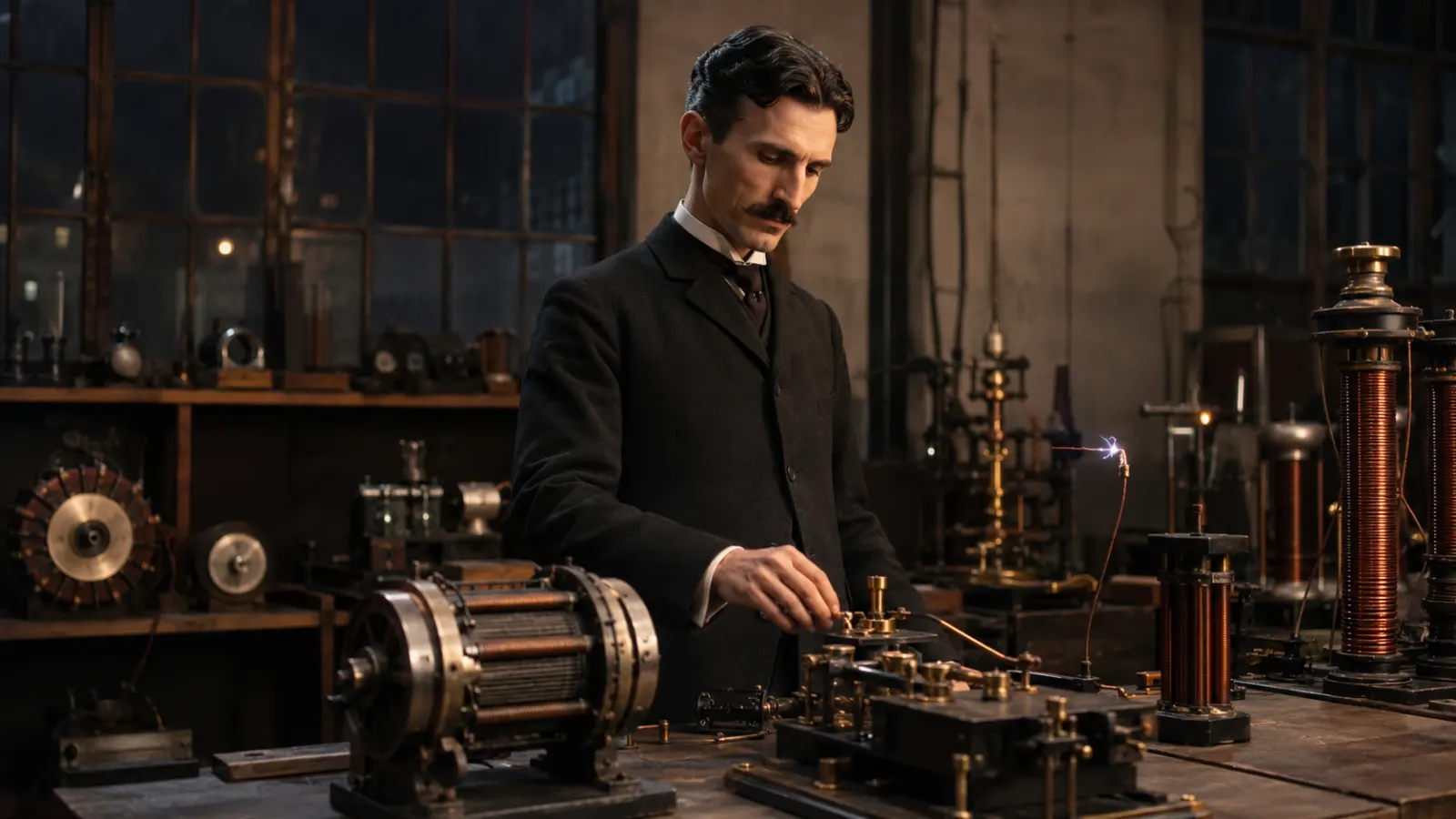
In 1891 he developed the device now known as the Tesla coil, a resonant transformer circuit capable of generating very high voltages at high frequencies.
Tesla coils became famous because of the dramatic electrical discharges they could produce, but their historical significance extends beyond spectacle. They formed part of the broader exploration of resonance and high-frequency electrical systems that influenced later radio-frequency experimentation.
Tesla became a particularly effective public demonstrator.
His lectures used glowing lamps, resonant circuits and striking electrical effects to show audiences that high-frequency electricity behaved in unexpected ways.
These performances blurred the boundary between scientific demonstration and theatre.
Tesla understood that public imagination mattered.
He was not always the isolated inventor later mythology describes.
At the height of his reputation, he was a technological celebrity who knew how to make electrical experimentation visually unforgettable.
The Lightning Photographs Created Their Own Mythology
Few images are more strongly associated with Tesla than photographs showing him seated calmly while enormous electrical discharges fill the room.
Those pictures helped create the image of Tesla as a man who could sit inside lightning.
They should not be interpreted literally.
Experimental arrangements and long-exposure photographic techniques allowed Tesla and photographers to create spectacular images that communicated the scale of his electrical work.
The photographs were part scientific documentation and part public performance.
Their continued circulation demonstrates how effectively Tesla understood visual reputation.
A century later, those images remain among the most recognisable representations of electrical experimentation.
Wireless Communication Was a Field, Not One Invention
Tesla became deeply interested in wireless transmission during the 1890s.
The later history of radio has generated especially intense priority disputes because radio did not appear from one isolated invention.
A workable wireless communication system required multiple technological components: electromagnetic-wave generation, antennas, tuning, detection, transmitters, receivers and signalling methods.
Heinrich Hertz demonstrated electromagnetic waves experimentally.
Guglielmo Marconi developed increasingly practical wireless telegraph systems.
Oliver Lodge, Alexander Popov, Nikola Tesla and numerous other researchers contributed to technologies and concepts associated with wireless communication.
Tesla patented wireless-related systems and performed important radio-frequency experiments.
He belongs securely within the history of wireless development.
But saying that he alone “invented radio” turns a cumulative international technological process into an inaccurate one-person story.
Patent Decisions Do Not Identify One Inventor of an Entire Technology
Tesla supporters often point to later patent litigation involving Marconi as proof that Tesla was legally declared the sole inventor of radio.
Patent law does not work that way.
Patent cases address particular legal claims concerning specific inventions and prior art.
A court decision concerning one patent does not automatically establish that one person invented every component of a complex technological field.
Radio developed through multiple inventions contributed across different countries over many years.
Tesla’s contribution remains important without requiring the entire history of radio to be reassigned to him.
Tesla’s Remote-Controlled Boat Was Genuinely Remarkable
In 1898 Tesla demonstrated a radio-controlled boat at Madison Square Garden.
To contemporary audiences, the demonstration seemed astonishing.
Tesla could command the vessel remotely using wireless signals, controlling its behaviour without a visible physical connection.
The experiment suggested something broader than a clever toy.
It demonstrated that electrical signals transmitted invisibly through space could control machines.
In retrospect, the device belongs within the early history of remote control and the technological ancestry of fields such as robotics and unmanned systems.
It would nevertheless be inaccurate to say Tesla directly invented modern drones or autonomous robotics.
Those technologies depend on later developments in electronics, digital computation, sensors, control theory and software.
Tesla’s contribution was conceptual and demonstrative.
He made remote wireless machine control visible.
Colorado Springs Allowed Tesla to Experiment at Extreme Scale
In 1899 Tesla moved part of his research to Colorado Springs.
The location allowed him to conduct large high-voltage experiments with fewer constraints than would have been possible in densely populated New York.
There he studied resonance, electrical discharges and possible methods for transmitting signals—and perhaps electrical energy—through the Earth and atmosphere.
This period produced some of the most spectacular imagery associated with Tesla.
It also produced some of the largest later exaggerations.
Tesla was conducting genuine frontier experimentation, but not every mechanism he proposed was established experimentally in the form he imagined.
His confidence could sometimes move beyond what the available evidence demonstrated.
This tension between extraordinary engineering ability and ambitious speculation became even more apparent at Wardenclyffe.
Wardenclyffe Was Tesla’s Most Ambitious Infrastructure Project
In 1901 Tesla began construction of a laboratory and transmission tower at Wardenclyffe on Long Island.
Financier J. P. Morgan initially supported the project.
Tesla intended the facility partly for transatlantic wireless communication at a time when several inventors and companies were racing to establish reliable long-distance wireless systems.
His ambition expanded.
Tesla increasingly envisioned a global wireless network capable of transmitting communication and potentially broader services across large distances. His more ambitious proposals included wireless power transmission.
The technological idea became inseparable from a financial problem.
A global communication infrastructure required enormous capital.
Marconi was demonstrating practical wireless communication using a different technological route.
Tesla’s project became more expensive, while the commercial model supporting it became less clear.
Morgan did not continue providing funding at the scale Tesla wanted.
The tower never became the global working system Tesla envisioned and was ultimately demolished in 1917. The laboratory building survived and is preserved today by the Tesla Science Center at Wardenclyffe.
Wardenclyffe Was Not Suppressed Because It Would Provide Free Energy
One of the most persistent modern Tesla myths claims that Wardenclyffe could have provided unlimited free electricity to the world and that wealthy financiers deliberately stopped it because they could not charge users for power.
The historical evidence does not support that simple explanation.
Tesla genuinely pursued ambitious wireless communication and power concepts.
But technological feasibility, transmission efficiency, cost, competition and the challenge of financing enormous infrastructure were real obstacles.
There is no evidence that Tesla possessed a completed, economically viable system capable of supplying free electrical power globally and that financiers deliberately buried a proven technology.
Wardenclyffe is more interesting when understood without conspiracy.
It shows how enormous the distance can be between a bold physical concept and a functioning commercial infrastructure.
Tesla the Inventor and Tesla the Futurist Should Be Distinguished
Tesla made numerous statements about technologies that sounded remarkably futuristic.
He imagined increasingly automated machines, global wireless communication and remote-controlled systems.
Some predictions resemble technologies that later became commonplace.
But resemblance does not establish direct technological ancestry.
When evaluating claims that Tesla “invented” something decades before everyone else, several questions are useful.
Did Tesla describe a workable mechanism?
Did he build it?
Did he experimentally demonstrate it?
Did he patent it?
Did later engineers explicitly develop their systems from his work?
These distinctions matter because imagining the general idea of a later technology is not the same thing as engineering the technology itself.
Tesla’s documented achievements are already substantial enough that speculative additions are unnecessary.
The Hard Problem Was Always Implementation
Technological history often celebrates the inventor who has the idea.
Real infrastructure requires far more.
Electrical systems need standard frequencies, compatible voltages, reliable motors, generators, transformers, safety procedures, manufacturing capacity and trained workers.
Tesla’s motor patents were important because they could become part of such a system.
Engineers and companies eventually standardised equipment so that components manufactured by different organisations could work together reliably.
This process is less glamorous than invention, but it determines whether inventions transform society.
An electrical motor used in demonstrations is interesting.
A motor design manufactured repeatedly, installed across industries and connected to standard electrical networks becomes infrastructure.
Tesla’s induction-motor work successfully crossed that boundary.
Standardisation Explains Why Some Tesla Ideas Endured
Early electrical systems experimented with different voltages, frequencies and equipment arrangements.
For large electrical networks to expand, engineers needed predictable compatibility.
Motors had to work with generators.
Transformers needed agreed electrical characteristics.
Utilities needed common operating practices.
Safety standards had to emerge.
Tesla did not accomplish all of this personally.
But his strongest ideas proved compatible with the industrial standardisation process.
That is one major reason the polyphase induction motor became historically important.
Many of his later concepts did not achieve equivalent integration.
The contrast offers a valuable measure of technological influence.
Ideas that enter standards, factories and maintenance systems usually transform society more deeply than ideas that remain primarily visionary proposals.
Engineering Ability and Business Ability Are Different
Tesla’s career also demonstrates that being an extraordinary engineer does not automatically make someone an effective business strategist.
He received significant financial backing and recognition at various points.
His patents generated real commercial value.
Yet he struggled repeatedly to establish enduring organisations around some later projects.
He moved among patrons and corporate ventures.
Some inventions lacked strong markets.
Some projects required more financing than supporters were willing to provide.
Some faced competitors pursuing more economical technologies.
Tesla’s later financial difficulties therefore cannot be explained simply as society refusing to recognise genius.
His career included genuine technical success, commercial risk, poor strategic outcomes and changing technological markets.
That complexity is more historically useful than the mythology of a brilliant inventor repeatedly robbed by everyone around him.
Tesla and Edison Were Not Opposite Moral Characters
Modern popular culture often places Tesla and Thomas Edison into opposing categories.
Tesla becomes the pure scientific visionary interested only in humanity.
Edison becomes the greedy businessman interested only in profit.
Neither portrait is historically adequate.
Tesla held patents, sought investment and wanted commercial success.
Edison was commercially aggressive, but he was also an experimenter who developed laboratories and engineering organisations capable of turning inventions into scalable systems.
Both men depended on collaborators.
Both participated in the patent economy.
Both cultivated public reputations.
Both needed capital.
Their most interesting differences concern engineering methods, business organisation and technological strategy.
Understanding Tesla does not require turning Edison into a villain.
Edison’s Great Strength Was Organisation
Edison’s historical importance partly came from his ability to organise teams, laboratories and manufacturing systems around invention.
Tesla’s strengths were different.
He possessed extraordinary physical intuition, visual imagination and capacity to conceptualise electrical systems.
This contrast helps explain why the two men are so often compared.
But technological civilisation needs both modes.
Someone has to imagine new mechanisms.
Someone also has to create systems capable of manufacturing, distributing and maintaining them.
The history of electricity cannot be reduced to deciding which personality type deserves more admiration.
Tesla Was Not Permanently Ignored During His Lifetime
Another common myth presents Tesla as an unknown genius whom society completely ignored until long after his death.
That is inaccurate.
Tesla enjoyed substantial fame during important periods of his career.
His lectures attracted attention.
His experiments were reported in newspapers.
His patents had commercial value.
His name became associated with spectacular electrical demonstrations.
What changed was his relative position within the rapidly developing electrical industry.
As technology matured, large companies, laboratories and standardised systems increasingly dominated areas once shaped by independent inventors.
Tesla remained famous, but many of his later projects did not achieve the same industrial importance as his earlier work.
The modern revival amplified his reputation far beyond that later decline.
Tesla’s Later Influence Declined as Electrical Industries Matured
During the early twentieth century, electricity and radio became increasingly institutionalised.
Utilities grew into major organisations.
Radio became a commercial industry.
Electrical equipment became standardised.
New electronic components appeared.
Industrial research organisations became increasingly important.
Tesla continued proposing inventions and discussing ambitious technological ideas, but he was no longer at the centre of these expanding industries.
This shift says as much about the changing structure of invention as it does about Tesla.
The era when a charismatic independent inventor could personally dominate an emerging electrical field was giving way to large-scale industrial research and engineering organisations.
Tesla’s Personal Eccentricities Should Not Replace His Engineering
Tesla spent many of his later years living in New York hotels and developed habits that biographers have repeatedly described as eccentric.
Popular accounts often focus heavily on his routines, unusual sensitivities, relationships with pigeons and various personal behaviours.
Such details contributed to his mythology.
They should not become the primary explanation of his technological career.
Historical figures are often turned into collections of entertaining anecdotes because eccentricity is easier to remember than engineering.
Tesla’s most important legacy lies in motors, electrical systems, resonance and wireless experimentation—not in proving how unusual his personality may have been.
Tesla Died Before His Modern Myth Was Created
Tesla died in New York on 7 January 1943 at the age of eighty-six.
The massive modern cultural phenomenon surrounding him developed later.
His reputation expanded through renewed interest in independent inventors, alternative histories of technology and dissatisfaction with large corporations.
The internet accelerated this transformation.
Tesla fit perfectly into a powerful cultural narrative: a brilliant outsider with spectacular ideas, insufficiently recognised by institutions and supposedly defeated by business interests.
The narrative contained enough real history to feel convincing.
It also encouraged increasingly exaggerated claims.
The Internet Turned Tesla Into a Technological Superhero
Online culture frequently credits Tesla with inventing technologies that did not exist in practical form during his lifetime.
Lists claim he invented modern radio, smartphones, radar, robotics, the internet, drones and limitless wireless energy.
These statements usually collapse several different kinds of contribution.
Sometimes Tesla performed genuine precursor research.
Sometimes he proposed broad concepts that resembled later systems.
Sometimes the connection is largely retrospective.
Technological influence should distinguish idea, prototype, demonstration, patent, implementation and direct historical lineage.
Without those distinctions, almost any imaginative inventor can be credited with technologies created decades later.
The Tesla Car Company Expanded His Modern Cultural Presence
The electric vehicle and technology company Tesla adopted the inventor’s name, further connecting Nikola Tesla with modern technological innovation.
This has helped introduce new audiences to the historical engineer.
It has also strengthened the cultural association between Tesla and futuristic technology generally.
The connection is symbolic rather than a direct continuation of one historical company into another.
Nikola Tesla’s electrical work remains important independently of the contemporary brand carrying his surname.
Tesla’s Secure Legacy Is Already Extraordinary
Removing exaggerated claims does not make Tesla less important.
His historically secure accomplishments are substantial.
He developed foundational polyphase AC motor technology.
His work on the rotating magnetic field and induction motor helped expand the usefulness of alternating-current systems.
He developed influential high-frequency resonant apparatus, including the Tesla coil.
He demonstrated sophisticated wireless remote control.
He experimented extensively with resonance and high-voltage electrical phenomena.
He pursued ambitious concepts involving global wireless communication.
These are major contributions to electrical-engineering history.
Tesla does not need to have invented every modern technology to deserve recognition.
The Induction Motor May Be More Important Than the Mythology
The induction motor lacks the visual drama of lightning-filled Tesla photographs.
Yet it represents one of the strongest reasons Tesla remains important to engineering history.
Industrial technology depends enormously on motors.
The ability to convert electrical power into reliable rotating mechanical work is fundamental to pumps, fans, compressors, manufacturing equipment and countless other systems.
Tesla’s contributions to polyphase induction-motor development therefore affected a foundational layer of industrial electrification.
The history may sound less exciting than secret wireless energy.
It is far more consequential.
Remote Control Revealed a Second Side of Tesla’s Vision
Tesla’s radio-controlled boat demonstrates that his imagination extended beyond power distribution.
He recognised that electrical systems could transmit information as well as energy.
Remote control suggested that machines could respond to signals without direct physical connection.
That concept eventually became fundamental across communication, automation and robotics.
Modern systems use technologies Tesla did not possess, but the 1898 demonstration remains historically striking because it made invisible electrical control publicly understandable.
Tesla was not merely building devices.
He frequently tried to demonstrate complete technological possibilities.
Tesla’s Global Communication Vision Was Remarkably Forward-Looking
Tesla imagined a world in which information could move wirelessly across enormous distances.
Modern communication systems arose through engineering paths substantially different from his largest Wardenclyffe ambitions.
Yet his intuition that wireless networks would become globally important was fundamentally correct.
The distinction between prediction and invention still matters.
Tesla did not engineer smartphones or the internet.
But he recognised that wireless communication could become an infrastructure connecting societies rather than remaining a specialised laboratory curiosity.
That makes his futurism historically significant even where direct technological lineage is limited.
Frequently Asked Questions
Who was Nikola Tesla?
Nikola Tesla was an inventor and electrical engineer best known for important contributions to polyphase alternating-current systems, induction motors, high-frequency electrical technology and wireless experimentation.
When was Nikola Tesla born?
He was born on 10 July 1856 in Smiljan, then part of the Austrian Empire and now located in Croatia.
Was Nikola Tesla Serbian?
Tesla was born into a Serbian family in territory that is now part of Croatia.
Did Nikola Tesla invent electricity?
No. Electricity had been studied for centuries before Tesla.
Did Tesla invent alternating current?
No. Alternating current existed before Tesla. His major contribution was to polyphase AC systems and practical induction-motor technology.
What is Tesla’s rotating magnetic field?
It is a magnetic field created using alternating currents with controlled phase relationships so that the resulting magnetic field effectively rotates and can drive a motor.
What is an induction motor?
An induction motor uses electromagnetic induction to generate current in the rotor and produce rotation without requiring the same electrical connections used by some earlier motor designs.
Did Tesla work for Thomas Edison?
Yes. Tesla briefly worked for Edison Machine Works after arriving in New York in 1884.
Were Tesla and Edison lifelong enemies?
The popular rivalry is exaggerated. They were associated with competing electrical approaches, but the larger industrial contest involved many companies, engineers and financiers.
Who supported Tesla’s AC patents commercially?
George Westinghouse acquired rights to Tesla’s important AC motor patents and incorporated the concepts into broader Westinghouse electrical development.
What was the War of Currents?
It was the commercial and technological competition surrounding alternating-current and direct-current electrical systems, particularly in the United States.
Did Tesla build the Niagara Falls power station?
Tesla contributed important polyphase technology associated with the AC system, but the Niagara project involved numerous engineers, companies and technologies.
What is a Tesla coil?
A Tesla coil is a resonant transformer circuit capable of producing very high-voltage, high-frequency electrical signals.
Did Tesla invent radio?
Tesla made important contributions to wireless technology, but radio emerged through the work of multiple researchers and inventors including Hertz, Marconi, Lodge, Popov and others.
Did Tesla invent remote control?
Tesla publicly demonstrated an advanced radio-controlled boat in 1898, making him an important early figure in wireless remote-control technology.
What happened at Colorado Springs?
Tesla conducted large-scale experiments there in high-frequency electricity, electrical discharges, resonance and possible wireless transmission.
What was Wardenclyffe?
Wardenclyffe was Tesla’s Long Island laboratory and tower project intended for ambitious wireless communication experiments and related transmission concepts.
Did Wardenclyffe provide free electricity?
No completed, economically viable global free-power system was demonstrated at Wardenclyffe. Claims that such a working system was deliberately suppressed are not supported by the historical record.
Why did J. P. Morgan stop funding Tesla?
Tesla’s project became increasingly expensive while competition and questions about its commercial model and technical implementation grew. The history cannot be reduced simply to Morgan suppressing free energy.
Did Tesla invent modern robotics?
His 1898 remote-controlled boat is an important precursor in remote machine control, but modern robotics depends on many later developments.
Did Tesla invent the internet?
No. Tesla imagined global wireless communication, but the modern internet arose from later computing and networking technologies.
Did Tesla die poor?
Tesla experienced financial decline in later life and lived in New York hotels, but his career included periods of substantial recognition, investment and commercial success.
When did Nikola Tesla die?
He died in New York on 7 January 1943.
Why is Tesla so famous today?
His documented engineering achievements, spectacular experiments, eccentric public image, modern internet mythology and association with the contemporary Tesla brand have all contributed to his enormous modern reputation.
What was Tesla’s most important invention?
There is no single universally agreed answer, but his contributions to the rotating magnetic field, polyphase AC systems and induction motor are among his most consequential achievements.
Tesla Was an Engineer, Not a Magician
The most damaging Tesla mythology is not hostile to him.
It is excessively admiring.
When Tesla is credited with every major electrical invention, his genuine achievements become harder to see because real engineering gets replaced by legend.
Tesla did not need to invent AC itself to matter.
Helping solve the AC motor problem was enormously important.
He did not need to invent every form of radio to matter.
His wireless experiments and remote-control demonstration were significant contributions.
He did not need Wardenclyffe to be a secretly completed global free-energy machine.
Its ambition already reveals how far Tesla was willing to push the technological imagination.
Historical precision strengthens his reputation rather than diminishing it.
The Central Idea
Nikola Tesla’s life is best understood through the distinction between breakthrough and infrastructure.
His most successful work crossed that boundary.
The rotating magnetic field and polyphase induction-motor concepts could be patented, engineered, manufactured and incorporated into a larger AC power system. Westinghouse and other engineers could build around them. Standards could develop. Factories and utilities could use the technology repeatedly.
That is why Tesla’s AC motor work became historically transformative.
His later projects reveal the opposite problem. Tesla often imagined systems before the industrial environment possessed all of the technical, financial or commercial elements needed to implement them. Wardenclyffe combined genuine engineering ambition with an expanding vision whose cost, competition and business model became increasingly difficult.
This does not divide Tesla neatly into an early scientific genius and later dreamer.
Both periods reflect the same extraordinary characteristic: he frequently thought in terms of complete technological systems.
Sometimes the necessary pieces existed.
Sometimes they did not.
The mythology imagines Tesla as someone who already possessed the entire technological future and was prevented from giving it to the world.
The evidence supports something more valuable.
Tesla was an exceptional engineer operating inside a collective technological revolution. His strongest inventions mattered because other engineers, investors and manufacturers could connect them to infrastructure. His ambitious failures reveal how difficult that transition can be.
The real Tesla therefore teaches a deeper lesson about invention.
A brilliant idea becomes historically transformative only when it can move from imagination, to apparatus, to reproducible engineering, to infrastructure.
Tesla succeeded spectacularly in making that transition with some of his work.
With other ideas, he showed just how large the distance between those stages can be.
That is enough to make him one of the defining electrical inventors of his age.
He does not need the mythology.
The engineering is more impressive.