Nelson Mandela: Life, Apartheid Struggle, Prison, Presidency and the Making of a Democratic South Africa
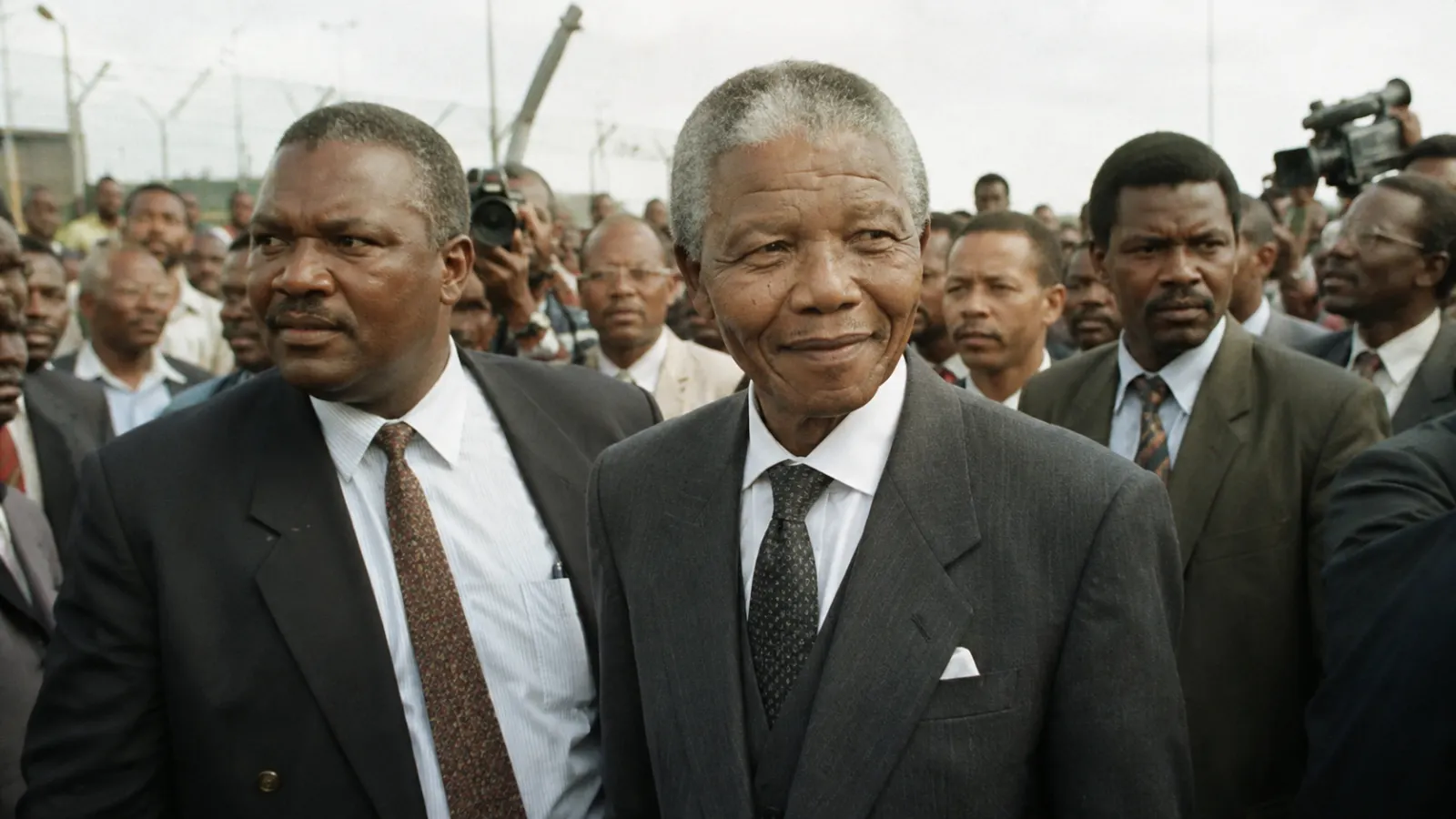
Nelson Mandela became one of the most recognisable political figures of the twentieth century. Images of his release from prison in 1990, his election as South Africa’s first democratically elected president in 1994 and his public embrace of reconciliation came to symbolise the end of apartheid. Yet the familiar image of Mandela as the prisoner who emerged preaching forgiveness captures only one part of a much more complicated political life.
Mandela was a lawyer, African nationalist, mass organiser, underground activist, founder and commander of an armed movement, political prisoner, negotiator, ANC leader, president and later an international campaigner on issues including poverty and HIV/AIDS. His political strategy changed repeatedly because the conditions confronting South Africa’s liberation movement changed. He participated in nonviolent mass action in the 1950s, supported sabotage after the apartheid government banned major opposition organisations, spent decades imprisoned, opened negotiations with the same state that had imprisoned him and ultimately helped build a constitutional democracy in which former enemies could compete politically rather than attempt to destroy one another.
The fuller history is therefore more demanding than either heroic legend or political caricature. Mandela supported armed resistance, but later became a central architect of negotiation. He championed reconciliation, but did not pretend that apartheid had been a misunderstanding between equal sides. His presidency dismantled the legal structure of white minority rule and expanded basic services, yet South Africa entered democracy with enormous racial and economic inequalities that his administration could not eliminate in five years. Understanding Mandela requires examining those tensions rather than removing them.
Who Was Nelson Mandela?
Nelson Rolihlahla Mandela was born on 18 July 1918 in Mvezo, in what is now South Africa’s Eastern Cape. He belonged to the Madiba clan of the Thembu people. His father, Nkosi Mphakanyiswa Gadla Mandela, was a counsellor to the Thembu royal house, while his mother was Nonqaphi Nosekeni. After his father died, Mandela became a ward of the Thembu regent Jongintaba Dalindyebo and was raised partly at the Great Place in Mqhekezweni.
His birth name, Rolihlahla, is often translated loosely as “troublemaker,” although its literal and cultural meaning is more nuanced. He received the English name Nelson from a teacher at primary school in Qunu, reflecting a colonial educational practice in which African children were frequently given European or Christian names.
Mandela’s childhood combined African customary authority with Methodist mission education. That background later mattered politically. He had observed traditional forms of deliberation and leadership within the Thembu community, but he also passed through institutions shaped by colonial Christianity and British-style education. His later politics cannot simply be derived from his childhood, yet his life repeatedly moved between African political traditions and modern constitutional institutions.
Education at Fort Hare and the Move to Johannesburg
Mandela attended Clarkebury Boarding Institute and Healdtown before enrolling at the University College of Fort Hare in 1939. Fort Hare was one of the most important institutions of higher education available to Black Africans in southern Africa. Mandela did not complete his degree there at the time; he left after becoming involved in a student protest and was effectively expelled.
When the Thembu regent later sought to arrange marriages for Mandela and his cousin Justice, the two men left for Johannesburg in 1941. The move transformed Mandela’s political education. He briefly worked as a mine security officer before entering a law firm as a clerk, completed his BA through the University of South Africa and later studied law at the University of the Witwatersrand.
Johannesburg exposed him to a very different South Africa from the rural Eastern Cape. Black urban residents faced housing restrictions, racial policing, labour exploitation and laws controlling where they could live and work. Mandela also entered a much wider political network that included African nationalists, trade unionists, communists, Indian activists and liberal opponents of racial discrimination.
Among the people who most influenced his early political development was Walter Sisulu, who became a lifelong friend, mentor and political comrade. Through Sisulu, Mandela entered political circles that would eventually reshape the African National Congress.
Mandela, Oliver Tambo and the Practice of Law
Mandela’s legal career was more than a professional chapter before politics took over. It exposed him directly to how racial domination worked through ordinary legal administration.
After gaining the qualifications then required to practise, Mandela and Oliver Tambo established the firm Mandela & Tambo in Johannesburg in 1952. The Nelson Mandela Foundation describes it as South Africa’s first Black law firm of its period. Much of its work involved Black clients confronting the practical consequences of apartheid and segregation.
Pass laws, residential restrictions, employment controls and other racial regulations did not operate only through spectacular political events. They affected marriages, movement, housing, work and encounters with police and administrators. Legal practice therefore placed Mandela inside the daily machinery of racial government.
The contradiction was obvious: he could use law to defend individuals while working inside a legal system deliberately structured to deny political equality to the majority of the population.
The ANC Youth League and a More Militant Politics
Mandela became increasingly involved with the African National Congress, founded in 1912. In 1944 he helped establish the ANC Youth League alongside figures including Anton Lembede, Walter Sisulu and Oliver Tambo. The younger generation believed that the ANC’s traditional reliance on petitions, deputations and polite appeals had achieved too little.
They pressed for boycotts, strikes, civil disobedience and mass political mobilisation. Their influence contributed to the ANC’s adoption of a more assertive Programme of Action in 1949.
This transformation occurred as South Africa itself was entering a more explicitly repressive phase. The National Party won the 1948 election and systematised apartheid, building on earlier racial segregation while extending state control through legislation governing racial classification, residence, political participation, education and movement.
Mandela’s early political career therefore developed not under a static system but while racial segregation was becoming more comprehensive and bureaucratically organised.
The 1952 Defiance Campaign
Mandela emerged as a national political organiser during the Defiance Campaign of 1952, a major campaign of nonviolent civil disobedience organised primarily by the ANC and the South African Indian Congress. Participants deliberately violated selected apartheid laws and accepted arrest as part of a disciplined strategy of resistance.
Mandela served as the campaign’s National Volunteer-in-Chief. More than 8,000 people were imprisoned for defying apartheid regulations, while ANC membership expanded dramatically. The campaign did not force the government to repeal the targeted laws, but it transformed the scale and character of opposition politics.
The state responded through arrests, prosecutions and restrictions. Mandela and nineteen others were convicted under the Suppression of Communism Act and received suspended prison sentences. He was also subjected to banning restrictions that limited his political activities.
The episode was important for Mandela’s political development. It demonstrated the power of organised nonviolent mobilisation, but it also revealed how readily the state could criminalise peaceful political opposition.
The Freedom Charter and the Vision of a Non-Racial Democracy
In June 1955, organisations associated with the Congress Alliance gathered at Kliptown for the Congress of the People, where the Freedom Charter was adopted. Because Mandela was under restriction, he could only observe the proceedings clandestinely.
The charter declared that South Africa belonged to all who lived in it and called for political equality, democratic rights and substantial social and economic transformation. Its non-racial vision became fundamental to the ANC’s later political programme.
The document also generated controversy. Some African nationalists believed cooperation with Indian, white, coloured and communist organisations weakened the principle of African political leadership. These disagreements eventually contributed to divisions within the broader liberation movement.
Mandela himself changed over time. His early politics had contained stronger Africanist elements, but his experience within the Congress movement increasingly drew him toward non-racial democratic politics.
The Treason Trial
On 5 December 1956, Mandela and scores of other activists were arrested in a nationwide operation and charged with treason. Ultimately, 156 people were drawn into what became the prolonged Treason Trial. The proceedings lasted for years before the remaining defendants, including Mandela, were acquitted on 29 March 1961.
The trial demonstrated how political repression could operate through legal process rather than imprisonment alone. Defendants had to devote enormous amounts of time and resources to defending themselves while organisations struggled to function under surveillance, restrictions and arrests.
Yet the trial also created sustained interaction among activists from different racial and ideological backgrounds. Like prison later in Mandela’s life, the courtroom became an unintended political space.
Sharpeville Changed the Political Environment
The most dramatic turning point came in 1960.
On 21 March, police opened fire on protesters at Sharpeville during a demonstration against pass laws, killing 69 people. The massacre became an international symbol of apartheid repression. The government declared a state of emergency, detained thousands and subsequently banned both the ANC and the Pan Africanist Congress.
For Mandela and others in the ANC, the strategic environment had changed fundamentally. The movement that had organised mass campaigns and civil disobedience could no longer operate legally. Meetings, recruitment and public organisation were severely restricted.
Mandela went underground. Newspapers eventually nicknamed him the “Black Pimpernel” because he moved secretly while avoiding arrest.
More importantly, the liberation movement began reconsidering whether nonviolent methods alone remained adequate.
Why Nelson Mandela Supported Armed Struggle
Mandela is sometimes remembered internationally almost exclusively as an apostle of peace. That image becomes historically misleading if it erases his role in the creation of an armed movement.
In 1961, Mandela became the first commander-in-chief of Umkhonto we Sizwe, commonly known as MK, which launched on 16 December that year. The organisation initially focused on sabotage against government installations and infrastructure, seeking at that stage to avoid loss of life.
Mandela’s argument was not that violence was inherently preferable to peaceful protest. He argued that state repression had closed legal avenues and that allowing the government to determine which methods opponents could use would eventually make effective resistance impossible.
This distinction is central to understanding his politics. Mandela was not an absolute pacifist who accidentally became associated with an armed organisation. He consciously supported a strategic shift toward sabotage.
At the same time, early MK strategy distinguished sabotage from indiscriminate attacks on civilians. Mandela and his colleagues understood that armed struggle could escalate and debated possible future forms including guerrilla warfare. The decision introduced moral and strategic risks that would remain part of the ANC’s history for decades.
A balanced biography should neither remove that history to create a harmless Mandela nor discuss it without the context of Sharpeville, political banning and apartheid state violence.
Mandela’s Secret Journey Across Africa
In January 1962, Mandela secretly left South Africa. He travelled through several African countries and also went abroad to seek political support for the liberation struggle. During this period he received some military training and explored assistance for MK.
He returned to South Africa and was arrested on 5 August 1962. Later that year he was convicted of leaving the country illegally and inciting workers to strike and was sentenced to five years’ imprisonment.
Mandela was therefore already imprisoned when police made the raid that would produce the case defining the next stage of his life.
The Rivonia Raid and Trial
On 11 July 1963, police raided Liliesleaf Farm at Rivonia, which had been used by underground activists. They arrested senior members of the movement and seized documents connected with sabotage and underground planning. Mandela, already in prison, was subsequently joined to what became the Rivonia Trial.
The defendants faced extremely serious charges and the possibility of death sentences.
On 20 April 1964, Mandela delivered his famous statement from the dock. Far from denying his role in resistance, he explained the political circumstances that had led to MK’s creation and defended the decision to turn toward sabotage. He also articulated the democratic principle that became central to his global reputation: opposition to both white domination and Black domination, and commitment to a society based on equal opportunity.
The final declaration that he was prepared to die for that ideal became one of the most famous statements of the anti-apartheid struggle.
Its power lies partly in the context. Mandela was not delivering a ceremonial speech after victory. He was speaking as a defendant confronting the possibility that the state might execute him.
Life Imprisonment Instead of the Death Penalty
On 12 June 1964, Mandela and seven co-defendants were sentenced to life imprisonment. Most were sent to Robben Island; Dennis Goldberg, who was white, was imprisoned separately in Pretoria.
Mandela would spend more than 27 years imprisoned, including roughly 18 years on Robben Island before transfer to Pollsmoor Prison in 1982 and later Victor Verster Prison.
The sentence removed one of the liberation movement’s most prominent leaders from public political activity.
It also eventually turned him into the world’s most famous political prisoner.
What Prison Was Really Like for Mandela
The later symbolism of Robben Island can obscure the physical and psychological reality of incarceration.
Political prisoners performed hard labour, endured restricted communication and lived under rules shaped by racial discrimination. Contact with family members was severely limited. Letters could be delayed, censored or withheld, and visits were tightly controlled.
Mandela’s mother died in 1968. His eldest son, Thembekile, was killed in a car accident in 1969. Mandela was refused permission to attend either funeral.
These losses reveal one cost often hidden by heroic political biography. Mandela’s imprisonment was not merely a long strategic waiting period. It separated him from children, marriages, deaths and ordinary family life.
Yet Robben Island also became a political environment. Prisoners debated strategy and ideology, educated one another and negotiated collectively over conditions. The prison intended to isolate opposition leaders, but it concentrated many of them in one place.
Mandela Did Not Simply Emerge From Prison as a Different Man
Popular retellings sometimes imply that Mandela entered prison as an angry revolutionary and emerged 27 years later miraculously committed to reconciliation.
The history is more continuous.
Even his Rivonia statement had rejected racial domination by either whites or Blacks. At the same time, imprisonment changed his experience of adversaries. Years of interaction with warders and officials, combined with changing political conditions outside prison, strengthened his interest in negotiation as a method of achieving objectives that military confrontation alone was unlikely to deliver.
This was not surrender.
Mandela’s approach increasingly depended on separating the political system he wanted to destroy from the individual people with whom he might eventually have to negotiate its end.
That distinction would become central to South Africa’s transition.
Why Mandela Rejected Conditional Release
By the 1980s, apartheid faced a deepening crisis. Internal resistance intensified, international isolation grew, economic pressure increased and the government struggled to restore political legitimacy.
In 1985, President P.W. Botha offered Mandela release on the condition that he reject violence as a political instrument. Mandela refused. The Nelson Mandela Foundation records that he rejected several conditional offers during his imprisonment.
His position was strategically important. The government wanted an imprisoned liberation movement to renounce armed struggle while apartheid legislation and the coercive power of the state remained intact.
Mandela nevertheless increasingly believed that negotiations had to begin.
Rejecting a conditional release and exploring talks were therefore not contradictory decisions. One resisted unilateral surrender; the other tested whether a negotiated political transformation had become possible.
Secret Talks With the Apartheid Government
During the mid-1980s, Mandela began exploratory contacts with South African officials. Following discussions involving Justice Minister Kobie Coetsee, he sought what effectively became “talks about talks” between the government and the liberation movement.
The move was politically risky. Mandela initially undertook some exploratory discussions without a formal collective mandate from the ANC leadership, although he did not claim authority to negotiate a final settlement independently.
His reasoning reflected another important feature of his leadership: willingness to test political possibilities before they became popular.
Mandela increasingly concluded that neither the government nor the liberation movement was likely to impose a complete military victory at acceptable cost. If both sides recognised that reality, negotiation might become another form of struggle rather than an abandonment of it.
F.W. de Klerk and the Political Opening
The transition accelerated after F.W. de Klerk became president in 1989.
On 2 February 1990, de Klerk announced the unbanning of organisations including the ANC and PAC. Nine days later, on 11 February 1990, Mandela walked out of Victor Verster Prison after more than 27 years of imprisonment.
The television images became historic almost immediately.
But Mandela’s release did not mean apartheid was already over. The legal, constitutional and security structures of white minority rule still had to be dismantled. Political organisations had to be legalised and rebuilt. Exiles returned. Prisoners were released. Armed organisations and state forces remained active.
Most dangerously, South Africa entered a period of severe political violence.
The Negotiations Were Not a Gentle Reconciliation Ceremony
The early 1990s are often compressed into a reassuring story of Mandela and de Klerk deciding to make peace.
The reality was much more unstable.
Negotiations unfolded amid killings, township conflict, violent competition involving ANC and Inkatha supporters, allegations of security-force involvement and the possibility that South Africa could slide toward wider civil conflict. Talks broke down and resumed. Demonstrations and strikes continued while constitutional negotiations proceeded.
Mandela himself could be extremely confrontational with de Klerk. Their relationship combined cooperation, mistrust, strategic dependence and public disagreement.
The transition succeeded not because political conflict disappeared but because enough major actors eventually concluded that negotiated democratic competition was preferable to continued attempts at unilateral victory.
That achievement is more significant than the simplified image of two former enemies suddenly becoming friends.
Why Mandela and de Klerk Won the Nobel Peace Prize
In 1993, Mandela and de Klerk jointly received the Nobel Peace Prize. The Norwegian Nobel Committee said the award recognised their work toward the peaceful termination of apartheid and the foundations of a democratic South Africa.
The joint prize reflected the political logic of the transition. Mandela had enormous legitimacy within the liberation movement but could not alone dismantle institutions controlled by the government. De Klerk controlled the state but could not create a legitimate democratic order without the participation of the majority and its political organisations.
Neither man represented every South African constituency, and their relationship remained contentious.
Nevertheless, both became indispensable to the final transition.
South Africa’s First Democratic Election
From 26 to 29 April 1994, South Africans participated in the country’s first national election based on universal adult suffrage. On 27 April, Mandela himself voted in a national election for the first time at the age of 75.
The ANC won a decisive victory, although not the two-thirds majority that would have allowed it to dominate constitutional drafting without substantial negotiation.
On 10 May 1994, Mandela was inaugurated as South Africa’s first democratically elected president.
The symbolism was extraordinary. A man sentenced to life imprisonment by the apartheid state now headed the state through an election in which the Black majority finally possessed national voting rights.
Yet Mandela understood that electoral victory did not erase the society apartheid had produced.
Mandela’s Presidency Was About More Than Reconciliation
Mandela served as president from 1994 to 1999. His presidency is remembered particularly for reconciliation: reaching out to former opponents, reassuring white South Africans, supporting national symbols and presenting democratic South Africa as a political community in which citizenship would not depend on race.
Those gestures mattered because the transition remained fragile. South Africa possessed armed security institutions shaped by apartheid, deep racial fear, political violence and enormous uncertainty about redistribution and majority rule.
Reconciliation was therefore not simply personal kindness.
It was statecraft.
Mandela sought to make it credible that majority rule would end white political domination without establishing racial revenge as the governing principle of the new state.
At the same time, reducing his presidency to symbolism hides substantial institutional and material changes.
The Reconstruction and Development Programme
The new government inherited enormous deficits in housing, electricity, water, healthcare and other services, particularly in Black communities. Mandela’s administration adopted the Reconstruction and Development Programme, or RDP, as an important framework for addressing apartheid-era deprivation.
Government programmes expanded access to electricity, clean water, housing, primary healthcare and school nutrition. By Mandela’s final State of the Nation period, official figures reported that millions of people had gained water and electricity connections, while hundreds of thousands of subsidised houses had been built or were under construction.
These improvements were substantial, particularly given the scale of apartheid exclusion.
They were also insufficient relative to the expectations created by political liberation.
South Africa remained deeply unequal, unemployment remained severe and apartheid’s geography continued to shape housing, transport, schools and access to economic opportunity.
Political Freedom Did Not Automatically Produce Economic Equality
This is one of the central tensions in Mandela’s legacy.
Apartheid was not merely a system regulating voting rights. It had structured land ownership, education, labour markets, housing, business ownership and the geography of cities. Removing its racial laws could not automatically reverse decades of accumulated inequality.
Mandela’s government therefore faced competing demands. Millions of people expected rapid material change. Business and financial institutions feared instability. The country needed investment and growth while simultaneously confronting enormous pressure for redistribution.
Debates intensified particularly after the government moved from the original RDP framework toward the Growth, Employment and Redistribution strategy, commonly known as GEAR, in 1996. Critics on the South African left argued that economic policy became too market-oriented and constrained redistribution. Supporters argued that fiscal discipline and economic stability were necessary during a vulnerable transition.
These arguments remain part of Mandela’s political legacy because democratic victory answered the question of political citizenship more quickly than it answered the question of economic power.
The 1996 Constitution
Perhaps the most durable institutional achievement of Mandela’s presidency was not a symbolic gesture but the consolidation of constitutional democracy.
After extensive negotiations and work by the Constitutional Assembly, Mandela signed South Africa’s final Constitution into law on 10 December 1996 in Sharpeville. It came into operation on 4 February 1997.
The Constitution entrenched a Bill of Rights, constitutional supremacy and a democratic system in which executive power was legally limited. It strengthened institutions including an independent judiciary and Constitutional Court.
Mandela was not the sole architect of that document. It emerged from negotiations among political parties, lawyers, civil-society organisations and elected representatives.
His contribution lay partly in accepting that the liberation movement itself would operate under constitutional constraints.
That principle is easy to overlook. Mandela possessed enormous personal prestige, but the new political order was designed so that even a popular president was subject to law.
Why Mandela’s Decision to Serve One Term Mattered
Mandela stepped down in 1999 after one presidential term.
The Constitution permitted him to remain president longer, and his political stature would probably have made reelection straightforward. Instead, leadership transferred to Thabo Mbeki.
Stepping down helped reinforce a principle that mattered in a new democracy: the presidency did not belong personally to the liberation hero.
Mandela’s importance was therefore partly expressed through his willingness to leave power.
Political systems become vulnerable when institutions depend entirely on the authority of one exceptional individual. By accepting succession, Mandela helped demonstrate that democratic South Africa was intended to outlast Mandela himself.
The Truth and Reconciliation Commission
Among the most famous institutions of the post-apartheid transition was the Truth and Reconciliation Commission, created under the Promotion of National Unity and Reconciliation Act of 1995 and chaired by Archbishop Desmond Tutu.
The TRC investigated gross human-rights violations committed during the political conflict and heard testimony from victims. It could grant individual amnesty for politically motivated acts when applicants met statutory requirements, including full disclosure of relevant facts.
The commission became internationally influential as a model of transitional justice.
It was also controversial.
Supporters argued that public testimony created an extensive record of abuses and allowed South Africa to confront its past without attempting mass prosecutions that could destabilise the transition. Critics argued that amnesty sometimes left victims without sufficient justice and that reconciliation could become a substitute for deeper material redress.
Those criticisms do not negate the TRC’s importance. They reveal the difficult question the institution confronted: how should a new democracy pursue truth, accountability, peace and political stability when it inherits widespread political violence?
There was no cost-free answer.
Mandela’s Reconciliation Was Not the Same as Forgetting
Mandela’s emphasis on reconciliation is sometimes interpreted as asking Black South Africans simply to forgive and move on.
That interpretation misses an important distinction.
Reconciliation did not require pretending apartheid had harmed everyone equally or treating apartheid as merely unfortunate history. The new state formally repudiated racial domination, created constitutional rights and established public processes such as the TRC specifically to document abuses.
Mandela’s political argument was instead that democratic South Africa could not permanently divide citizenship into victors and defeated enemies.
Former supporters of the old order would have to accept majority democracy.
The liberation movement, in turn, would have to govern them as citizens rather than as a permanently suspect racial population.
This was a political compromise—but an extraordinarily consequential one.
Mandela and the 1995 Rugby World Cup
One of the most famous symbols of this strategy came during the 1995 Rugby World Cup, hosted by South Africa.
Rugby had long been strongly associated with white Afrikaner identity. Mandela publicly embraced the national team, the Springboks, and appeared in a Springbok jersey during the final, turning a sporting event into a dramatic symbol of national inclusion.
The episode later acquired almost mythic status.
Its importance should neither be exaggerated nor dismissed. A rugby shirt could not redistribute land, create jobs or repair apartheid’s schools. But political communities are built partly through symbols, and Mandela understood that white South Africans needed to see themselves as participants in the new order rather than merely as people whose old political system had been defeated.
Symbolic politics and material politics were not substitutes for one another.
Mandela’s presidency needed both.
The Limits of the “Rainbow Nation”
The phrase “Rainbow Nation,” strongly associated with Desmond Tutu and post-apartheid optimism, captured a genuine democratic achievement: South Africa avoided the racial civil conflict many had feared and established universal citizenship.
But the metaphor can become misleading when it makes reconciliation sound complete.
Apartheid’s legal system disappeared far faster than its economic and spatial consequences. Black South Africans remained disproportionately affected by poverty and unemployment. Land distribution remained highly unequal. Formerly segregated communities did not suddenly become economically integrated.
Mandela’s presidency therefore succeeded more decisively at creating political equality and constitutional legitimacy than at eliminating structural inequality.
That is not a reason to dismiss the democratic transition.
It is a reason to distinguish different meanings of freedom.
The vote could be equalised through law.
Wealth, land, education and accumulated opportunity could not.
Mandela’s Record on HIV/AIDS Requires Nuance
HIV/AIDS became one of the most devastating public-health crises in post-apartheid South Africa. Mandela is remembered today as an important campaigner against HIV stigma, particularly after leaving the presidency.
His administration did take steps relating to HIV/AIDS, but the epidemic did not become the defining national mobilisation during his presidency that its scale ultimately demanded. The most notorious period of South African government controversy over HIV/AIDS would occur later under President Thabo Mbeki.
Mandela’s own activism became much more visible in retirement.
In 2005, when his son Makgatho Mandela died from an AIDS-related illness, Mandela publicly identified the cause of death. He explained that speaking openly was necessary to challenge the shame and secrecy surrounding HIV/AIDS.
The moment was characteristic of his later public role. Mandela used his personal standing to make an intensely private loss part of a public campaign against stigma.
Mandela’s Family Life Was More Complicated Than His Public Image
Heroic political biographies often reduce family members to supporting characters.
Mandela’s private life resists that simplification.
He married Evelyn Mase in 1944. They had children together, but political activity and prolonged absences placed increasing strain on the relationship, and the marriage ended in divorce.
Mandela later married Winnie Madikizela-Mandela in 1958. Winnie herself became one of the most recognisable figures of resistance during Mandela’s imprisonment, enduring banning orders, detention and harassment. She also became associated with serious controversies and abuses surrounding people in her political circle.
Mandela and Winnie eventually separated and divorced.
In 1998, Mandela married Graça Machel, the Mozambican humanitarian and former first lady.
The personal costs of Mandela’s political life cannot be separated completely from his public career. Decades of activism, underground life and prison meant that family members experienced his political sacrifice differently from the international public that later celebrated it.
Mandela Was Not a Political Saint
One of the least useful ways to understand Nelson Mandela is to treat him as morally flawless.
Mandela himself changed political positions. He could be forceful, tactical, impatient and highly conscious of political image. He participated in a liberation movement containing deep ideological disagreements and later led a government that had to make compromises critics considered inadequate.
He supported sabotage.
He negotiated with people he had once fought.
He accepted compromises over political and economic arrangements that left many liberation goals incomplete.
He placed extraordinary burdens on his family.
His government made mistakes.
None of these facts automatically destroys his significance. They make it possible to understand what political leadership actually involved.
Historical greatness does not require the absence of difficult decisions.
Sometimes it arises from how a leader responds when every available decision carries costs.
Was Nelson Mandela a Terrorist?
This question frequently appears in discussions of Mandela because the apartheid government and some foreign political actors historically described the ANC or its armed struggle using terrorist terminology.
A useful answer requires precision rather than slogans.
Mandela helped establish MK and explicitly defended sabotage. He was therefore directly involved in organising armed resistance. The initial MK strategy deliberately emphasised attacks on infrastructure while seeking to avoid deaths, although the wider armed struggle evolved over subsequent decades and included operations with civilian casualties.
Whether the broad political label “terrorist” adequately describes Mandela depends partly on definitions and historical framing. What cannot responsibly be done is to erase either side of the historical record: apartheid was a racially authoritarian system that violently suppressed political opposition, and Mandela did support organised armed resistance against it.
Reducing that history to a label explains less than examining why the strategy changed, which tactics were chosen and what political objectives were being pursued.
Mandela Was Not Responsible for Everything the ANC Did
Another historical mistake is to attribute every action taken by the ANC or MK during Mandela’s 27 years in prison personally to Mandela.
His symbolic authority remained enormous, but he was physically isolated from operational leadership for much of that period.
The ANC changed dramatically while he was imprisoned. New generations entered the struggle, international networks expanded, internal resistance organisations emerged and armed operations developed beyond the early sabotage strategy Mandela had helped initiate.
Mandela therefore remained foundational to MK’s creation without controlling every later action carried out in its name.
Biographical responsibility should be specific rather than collective by assumption.
Why Mandela Chose Negotiation
Mandela’s later willingness to negotiate is sometimes interpreted as evidence that imprisonment made him abandon his earlier beliefs.
A better explanation is strategic adaptation.
By the late 1980s, the liberation movement had demonstrated that apartheid could not regain stable legitimacy. The South African government still possessed overwhelming conventional military and state power, but repression was not producing a durable political settlement. International isolation and economic problems intensified pressure.
Neither side could easily achieve its preferred outcome unilaterally.
Negotiation therefore became possible because the balance of political costs had changed.
Mandela’s distinctive contribution was recognising that opening negotiations did not require him to pretend the previous struggle had been unnecessary.
He could defend the decision to resist and still conclude that the next stage required negotiation.
Mandela’s Greatest Political Skill May Have Been Adaptation
Looking across his life reveals several distinct phases.
The young Mandela embraced African nationalist mobilisation. The organiser of the early 1950s helped lead mass nonviolent resistance. The underground Mandela of the early 1960s supported sabotage. The imprisoned Mandela refused conditional surrender while quietly exploring negotiation. The Mandela released in 1990 combined mobilisation with constitutional talks. President Mandela placed reconciliation and institution-building at the centre of government.
These strategies were different because the political environments were different.
Consistency in politics does not always mean repeating the same tactic forever.
Mandela’s deeper continuity lay in the objective: replacing racial domination with a political order based on democratic citizenship.
His methods changed when he believed existing methods could no longer achieve that goal.
Why Mandela’s Constitutional Legacy May Matter More Than His Personal Symbolism
The international memory of Mandela often concentrates on personality: his smile, humour, endurance and ability to forgive.
Those qualities contributed to his political effectiveness, but institutions ultimately matter more than personality.
Mandela helped legitimate a system in which elections could remove leaders, courts could review government actions, opposition parties could operate legally and constitutional rights limited state power. The final Constitution was a collective achievement, but Mandela’s stature helped make constitutional restraint politically credible.
That may be a more consequential legacy than any individual act of reconciliation.
A democracy cannot rely permanently on having an unusually magnanimous president.
It needs rules that continue functioning when leaders are less admirable.
Mandela After the Presidency
After stepping down in 1999, Mandela remained one of the world’s most prominent public figures. He established and worked through organisations including the Nelson Mandela Foundation, supported children’s causes and became involved in peace initiatives and global advocacy.
He increasingly withdrew from public life as he aged, but his moral authority remained substantial.
His later HIV/AIDS work became especially important, as did his willingness to speak about poverty and inequality. At the same time, his status as an international icon sometimes produced the very simplification that serious biography needs to resist: Mandela the universally agreeable symbol replacing Mandela the political actor.
The real person had been involved in arguments about nationalism, communism, sabotage, negotiation, economic policy, constitutional compromise and liberation strategy.
That history is far more interesting than sainthood.
When Did Nelson Mandela Die?
Nelson Mandela died at his home in Johannesburg on 5 December 2013, aged 95.
His death produced an extraordinary global response. Presidents, former adversaries, activists and citizens across the world commemorated him, demonstrating how far his symbolic significance had expanded beyond South Africa.
Yet international commemoration also reinforced the reconciliation-centred version of his life.
To understand Mandela historically requires remembering everything that came before the presidential smile: segregation, resistance, underground politics, sabotage, trial, prison and difficult negotiation.
Common Myths About Nelson Mandela
“Mandela was always committed exclusively to nonviolence.” He participated in nonviolent mass resistance during the 1950s but later helped establish MK and defended sabotage after the ANC was banned.
“Mandela personally ended apartheid.” His leadership was enormously important, but apartheid ended through decades of resistance involving thousands of activists, mass movements, unions, international pressure, political organisations and negotiations involving multiple parties.
“He was imprisoned simply for opposing apartheid peacefully.” Mandela had already been convicted on other charges and was later sentenced to life during the Rivonia Trial for sabotage-related offences connected to the underground struggle. Understanding that fact does not require accepting the legitimacy of apartheid.
“He became democratic only after prison.” Mandela’s 1964 Rivonia statement already articulated opposition to racial domination by either whites or Blacks and defended the ideal of a democratic society.
“Mandela forgave everyone and wanted South Africans to forget the past.” His reconciliation strategy sought coexistence within a common democracy, while institutions such as the TRC were created specifically to investigate and record historical abuses.
“Apartheid’s inequalities disappeared after the 1994 election.” Political rights changed dramatically, but economic, spatial and social inequalities persisted.
“Mandela governed South Africa for decades.” He served one presidential term, from 1994 to 1999, before stepping down voluntarily.
Frequently Asked Questions About Nelson Mandela
Why is Nelson Mandela famous?
Mandela is famous for his leading role in the struggle against apartheid, his 27 years of imprisonment, his role in negotiations ending white minority rule and his presidency after South Africa’s first democratic election. His support for reconciliation helped stabilise the transition, while his life became an international symbol of resistance to racial oppression.
When and where was Nelson Mandela born?
He was born on 18 July 1918 in Mvezo, in South Africa’s Eastern Cape.
What does Rolihlahla mean?
It is Mandela’s Xhosa birth name and is often rendered idiomatically in English as “troublemaker.” His schoolteacher later gave him the English name Nelson.
What political party did Mandela belong to?
Mandela belonged to the African National Congress, or ANC. He helped establish its Youth League in 1944 and eventually became ANC president in 1991.
Why was Nelson Mandela imprisoned?
Mandela was first serving a five-year sentence after being convicted of leaving South Africa without permission and inciting a strike. He was then prosecuted in the Rivonia Trial and sentenced to life imprisonment in 1964 for sabotage-related offences.
How long was Nelson Mandela in prison?
He spent more than 27 years in prison, including approximately 18 years on Robben Island before later imprisonment at Pollsmoor and Victor Verster.
What was Umkhonto we Sizwe?
Umkhonto we Sizwe (MK) was the armed organisation established in 1961 in association with the ANC and allied activists. Mandela served as its first commander-in-chief. Its initial strategy focused on sabotage against infrastructure and state installations.
Did Nelson Mandela support violence?
Mandela supported the shift to sabotage after peaceful political organisations were banned and state repression intensified. He did not remain committed exclusively to nonviolent tactics. His later pursuit of negotiation represented a subsequent strategic change, not the erasure of this earlier history.
What was Nelson Mandela’s “I am prepared to die” speech?
It was Mandela’s statement from the dock on 20 April 1964 during the Rivonia Trial. He explained the anti-apartheid struggle, defended the formation of MK and described his commitment to a democratic society free of racial domination.
When was Nelson Mandela released from prison?
He was released on 11 February 1990 from Victor Verster Prison.
Why did Mandela win the Nobel Peace Prize?
Mandela and F.W. de Klerk jointly received the 1993 Nobel Peace Prize for their role in ending apartheid and laying the foundations for democratic South Africa.
When did Nelson Mandela become president?
He was inaugurated on 10 May 1994 after South Africa’s first democratic national election based on universal adult suffrage.
How long was Mandela president?
He served from 1994 to 1999 and stepped down after one term.
What was the Truth and Reconciliation Commission?
The TRC was created to investigate gross human-rights violations linked to South Africa’s political conflict. It heard victim testimony and could grant amnesty for qualifying politically motivated acts when applicants made full disclosure and met the statutory conditions.
What did Mandela achieve as president?
His administration consolidated constitutional democracy, dismantled apartheid-era legal structures, expanded access to basic services and supported national reconciliation. His presidency also operated within persistent unemployment, inequality, land disparities and apartheid-era spatial divisions that remained unresolved.
When did Nelson Mandela die?
He died on 5 December 2013, aged 95.
Nelson Mandela’s Legacy Is Stronger When It Is Not Simplified
Mandela’s most useful legacy is not the idea that extraordinary moral purity can solve political conflict. His actual life offers a more difficult lesson. He repeatedly faced situations in which every available strategy involved risk: mass protest could be suppressed, armed resistance could escalate violence, refusing negotiation could prolong conflict, negotiating could require painful compromises, and winning political power could create expectations that no government could immediately satisfy.
He did not respond to each phase in the same way. The organiser of 1952 was not tactically identical to the underground commander of 1961, the prisoner exploring talks in the 1980s or the president governing after 1994. Yet his central political objective remained recognisable: a South Africa in which political rights were not determined by race.
That is why the armed struggle cannot be removed from the reconciliation story, and reconciliation cannot simply be dismissed because armed resistance came before it. Mandela’s significance lies partly in understanding when one political strategy had reached its limits and another had become necessary.
His presidency likewise needs two perspectives at once. Politically and constitutionally, the transition was extraordinary. A racial authoritarian system gave way to universal suffrage, constitutional rights, an independent judiciary and competitive democratic politics without the full-scale civil war many had feared. Mandela helped make former political enemies accept the possibility of living under common institutions rather than seeking permanent domination over one another.
Materially, liberation remained incomplete. Apartheid had shaped far more than election law. It had accumulated inequalities in land, wealth, schools, employment, housing and geography over generations. Mandela’s government expanded water, electricity, housing, healthcare and other services, but five years could not undo that structure.
That unresolved tension is part of the legacy, not an argument against studying it.
Mandela should therefore be remembered neither as an untouchable saint nor reduced to one phase of his political life. He was a political actor who changed tactics, made controversial choices, endured extraordinary punishment, negotiated with adversaries and then helped construct institutions designed to prevent political victory from becoming another form of permanent domination.
His courage was not simply that he spent 27 years in prison.
It was also that after decades organised around defeating an unjust political order, he recognised that winning democracy required learning how to govern alongside people who had once defended it.
That is a more complicated story than the statue.
It is also a more consequential one.