Mirza Ghalib Biography: Life, Poetry, 1857, Letters and Legacy
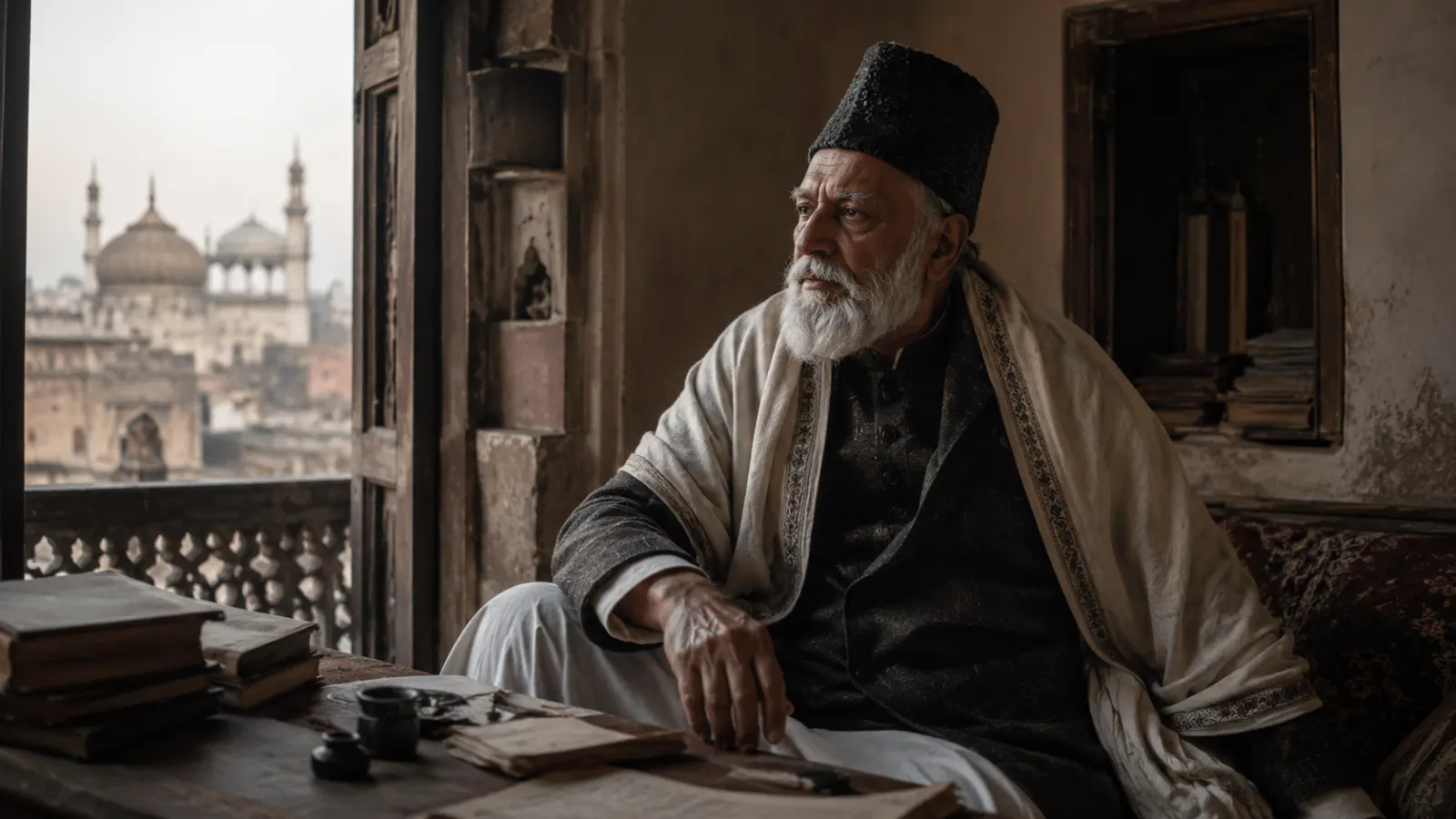
A serious Mirza Ghalib biography is also a biography of a disappearing world. Mirza Asadullah Beg Khan, better known by his pen name Ghalib, was born in Agra on 27 December 1797 and died in Delhi on 15 February 1869. Between those dates, he witnessed the final decades of the Mughal court, the growing authority of the British East India Company, the catastrophe of the 1857 uprising and the transformation of Delhi from an old imperial-cultural capital into a city reordered under colonial rule.
Ghalib survived all of this, but the world in which he had learned to imagine status, literary authority and patronage did not survive unchanged. He sought recognition from the Mughal court while petitioning British officials for financial support. He wrote extensively in Persian at a moment when Persian's institutional position in India was weakening. He became internationally famous through Urdu even though he personally valued his Persian writing enormously. His intensely compressed ghazals seem almost detached from ordinary political reportage, while his letters can sound startlingly immediate, intimate and historically specific.
These tensions are essential to understanding him. Ghalib was simultaneously an aristocrat without secure wealth, a court poet living through the collapse of courtly institutions, a Persian writer remembered mainly for Urdu, a traditional ghazal poet who repeatedly tested inherited conventions, and a nineteenth-century figure whose voice often feels unexpectedly contemporary.
Mirza Ghalib at a Glance
| Question | Answer |
|---|---|
| Full name | Mirza Asadullah Beg Khan |
| Pen names | Asad; later Ghalib |
| Born | 27 December 1797, Agra |
| Died | 15 February 1869, Delhi |
| Wife | Umrao Begum |
| Main literary languages | Persian and Urdu |
| Best known for today | Urdu ghazals and letters |
| Major literary form | Ghazal |
| Major historical turning point | The uprising and destruction of Delhi in 1857 |
| Important prose work on 1857 | Dastambu |
| Court association | Bahadur Shah Zafar's late Mughal court |
| Why he remains important | His linguistic brilliance, ambiguity, wit, philosophical depth, letters and witness to a changing Delhi |
From Agra to Delhi
Ghalib was born into a family connected with the military-aristocratic world of late Mughal India. His father died while Ghalib was young, and his childhood was subsequently shaped by the death of another male guardian and by the uncertainty that could accompany dependence on family arrangements and pensions.
In 1810, when he was about thirteen, Ghalib married Umrao Begum and moved to Delhi. Rekhta's biographical timeline records the marriage on 9 August 1810 and places his transition from the earlier poetic name Asad to Ghalib around 1816.
Delhi would become central to almost every dimension of his later identity. Politically, the Mughal emperor's authority had contracted dramatically. The British East India Company possessed decisive power. Yet political decline did not mean immediate cultural disappearance. The Red Fort, aristocratic households, bazaars, religious institutions and literary gatherings still supported a sophisticated Persianate and Urdu cultural world.
Ghalib entered that environment with a strong awareness of status. He wanted recognition, titles, patronage and financial security, and his correspondence reveals repeated concern with money. Yet he could also convert hardship into wit. This ability to observe his own pretensions and misfortunes with irony became one of the defining features of the personality preserved in his letters and anecdotes.
From Asad to Ghalib
Ghalib initially used Asad, meaning “lion,” as a poetic pen name or takhallus. He later adopted Ghalib, generally understood in the sense of victorious, dominant or prevailing.
The takhallus was an established feature of the Persian and Urdu ghazal tradition. Poets frequently inserted the pen name into the concluding couplet, allowing the poem to address or refer to its own authorial persona.
Ghalib used this convention with unusual flexibility. “Ghalib” inside a poem can boast, complain, mock himself, defend poetry or dramatise the gap between what the speaker desires and what reality provides.
This self-awareness is one reason his poetic personality remains so distinctive. He does not sound like a poet merely repeating inherited images. He uses familiar ghazal materials—love, wine, wounds, paradise, the beloved, the preacher, desire and death—but repeatedly turns them into intellectual problems.
Ghalib Did Not Invent the Ghazal
Ghalib's stature can sometimes make popular accounts treat him as though the Urdu ghazal began with him.
It did not.
He inherited an already sophisticated poetic tradition shaped by Persian literature and by major Urdu predecessors including Mir Taqi Mir, Sauda and Khwaja Mir Dard. The ghazal was governed by demanding formal conventions of metre, rhyme and refrain, while individual couplets could possess considerable semantic independence.
What Ghalib contributed was not the invention of the form but an extraordinary concentration of conceptual difficulty inside it.
A single couplet can support several possible readings. The beloved may be human, divine, imaginary or structurally unreachable. A statement that initially appears confident can undermine itself in the second line. Religious imagery can simultaneously support devotion, irony and scepticism.
Columbia University Press describes his poetry as ranging from remarkable simplicity to “unresolvable complexities of structure,” while emphasising the intelligence and wit that continue to make his ghazals central to Urdu literature.
This is why Ghalib is highly quotable but not always easily paraphrased.
A famous couplet can be short enough for social media while still resisting a single definitive explanation.
Why Ghalib's Poetry Feels Modern
Calling Ghalib “modern” can become historically careless if it implies that he somehow escaped his nineteenth-century Indo-Persian literary world. He did not. His imagery, metres, rhetorical conventions and literary references belong deeply to that world.
What feels modern is the intellectual restlessness.
Ghalib frequently refuses closure. Desire remains unsatisfied. Knowledge creates additional uncertainty. Certainty can turn into doubt. The self becomes both absurdly small and cosmically important. Religious and philosophical language is tested rather than simply repeated.
He often stages thought instead of delivering doctrine.
A proposition appears and then becomes unstable. A complaint becomes a joke. The joke becomes metaphysical. Confidence reveals its own impossibility.
Readers from very different backgrounds can therefore enter the poetry without agreeing on one philosophy that Ghalib supposedly taught.
The poems survive partly because they leave intellectual space around themselves.
Desire Without Final Resolution
The classical ghazal had long made frustrated desire central to poetic experience, but Ghalib intensifies the conceptual possibilities of that frustration.
The beloved is frequently unavailable. Fulfilment remains postponed. Even knowledge can behave like desire: reaching one answer exposes another question.
This is important because modern popular quotation can flatten Ghalib into a poet of romantic heartbreak.
Romantic longing is certainly part of the ghazal universe, but the language of desire can operate simultaneously as philosophical, theological and linguistic inquiry.
The lover's inability to possess the beloved can become a model for the human inability to possess certainty.
The wound becomes both emotional suffering and intellectual condition.
Ghalib's greatness lies partly in keeping those possibilities open.
The Persian Paradox: What Ghalib Valued and What Posterity Chose
One of the most important facts in any Mirza Ghalib biography is also one of the most frequently neglected.
Ghalib wrote considerably more in Persian than in Urdu and considered his Persian poetry and prose central to his literary achievement. Rekhta's profile notes explicitly that he wanted to be judged by his Persian works even though later generations came to love and remember him primarily through Urdu.
This makes his posthumous reputation deeply ironic.
The work on which he placed enormous importance became less accessible to the broad public as Persian lost its former institutional position in South Asia. Urdu, meanwhile, developed new readerships through print, education, criticism, recitation, music, film and broadcasting.
The comparatively smaller Urdu corpus therefore became culturally enormous.
This should change the way Ghalib is introduced. Describing him only as an “Urdu poet” accurately identifies the basis of his present fame but incompletely describes the writer he understood himself to be.
He belongs simultaneously to Urdu literary history and the late Indo-Persian literary world.
Print and Ghalib's Own Editing Helped Create the Canon
The Urdu Ghalib familiar to later readers is not simply everything he ever composed.
He revised, selected and excluded.
Rekhta's timeline records the first edition of his Urdu Diwan in 1841, alongside the first edition of a Persian Diwan that same year. Modern collections also preserve material excluded from the versions that eventually became canonical.
That means canon formation began partly with Ghalib himself.
He was not merely writing poems; he was deciding which earlier poems deserved continued circulation.
Print culture then helped stabilise those choices.
Later editors, commentators and teachers made further selections. Musicians chose particular ghazals. Anthologies repeated particular couplets. Cinema and television introduced particular versions of his personality.
Modern Ghalib is therefore both a surviving writer and the result of more than a century of editorial and cultural selection.
Money, Status and the Pension Dispute
The romantic image of the poor genius should not obscure how seriously Ghalib himself took financial security and aristocratic status.
He depended heavily on pensions and patronage while trying to maintain habits associated with the class background he valued. Debt became a recurring part of his life.
One of his most persistent financial struggles concerned a family pension claim. Ghalib travelled east and spent significant time in Calcutta while pursuing the matter before colonial authorities. Rekhta records an important hearing in April 1828 and the rejection of his appeal in January 1831. It also documents his literary activity in Calcutta during 1828, including participation in Urdu and Persian poetic gatherings.
The pension episode matters for more than biography.
Calcutta exposed Ghalib directly to another centre of British Indian administration, print culture and intellectual controversy. Yet his relationship with colonial power should not be forced into a simple ideological category.
He depended financially on institutions associated with the British state while remaining emotionally and culturally tied to an aristocratic Delhi profoundly transformed by British ascendancy.
Ambivalence is more historically accurate than a neat label.
Ghalib Was Not a Simple Nationalist or Colonial Loyalist
Later generations often want major literary figures to fit modern political categories.
Ghalib resists that demand.
He was not a straightforward nationalist activist in the later anti-colonial sense. Nor can his writings be reduced to uncomplicated loyalty to British rule.
His social position was contradictory. His class identity was tied to older Mughal-aristocratic systems of prestige, but his financial life increasingly depended on colonial authorities and princely patrons operating within British India.
These dependencies became particularly important during and after 1857.
Reading his political statements without recognising those pressures can produce a misleadingly simple Ghalib.
Personal Life, Loss and the Danger of Reading Poetry as Diary
Ghalib and Umrao Begum had several children, traditionally recorded as seven, none of whom survived infancy. Rekhta's biographical material also notes that Ghalib later became deeply attached to his wife's nephew Zain-ul-Abidin Khan “Arif,” whose early death caused another profound loss.
It is tempting to use these experiences as direct explanations for every melancholic Ghalib couplet.
That method is unreliable.
The ghazal already possessed elaborate conventions of separation, longing, death, abandonment and impossible desire long before Ghalib. A poetic speaker is not automatically the same thing as the biographical author.
Biography can illuminate poetry, but it should not turn metaphor into diary evidence.
The more defensible observation is that Ghalib possessed both an inherited literary vocabulary of loss and extensive personal experience of bereavement.
Those worlds may intersect without being identical.
Wine, Gambling, Mangoes and the Ghalib Persona
Ghalib's personality became almost as culturally famous as his poetry.
Accounts portray him as fond of wine, conversation, humour, games and good food. Stories about mangoes, debt, gambling, religious orthodoxy and creditors have become part of the popular Ghalib archive.
Some are grounded in letters and records; others have been polished through retelling.
Rekhta's timeline records his arrest in May 1847 in connection with gambling at his house, demonstrating that at least part of the colourful reputation has documentary basis.
The danger lies in allowing the witty anecdotal Ghalib to replace the writer.
His humour was not merely entertainment. It frequently functioned as a mode of thought. Self-mockery allowed him to expose contradiction without pretending he stood completely outside it.
The laughing Ghalib and the metaphysical Ghalib are therefore not separate personalities.
The wit is part of the philosophy.
Ghalib and Bahadur Shah Zafar's Court
By the middle of the nineteenth century, Ghalib became more closely associated with the final Mughal court of Bahadur Shah Zafar.
The emperor possessed little independent territorial power, but the Red Fort remained culturally significant. Zafar himself wrote poetry, and the court continued to support literary competition, ceremonial status and Persianate intellectual traditions.
Rekhta records that in July 1850 Zafar employed Ghalib to work on the history of the Timurid dynasty and awarded him court recognition. Ghalib received titles associated with this late stage of his career and later occupied an increasingly prominent literary position at court.
The court mattered because it preserved a cultural hierarchy to which Ghalib remained deeply attached.
It provided income, recognition and a symbolic connection to an older political order.
Only seven years later, that institutional world would be destroyed.
1857 Changed the Meaning of Ghalib's Delhi
In May 1857, rebelling soldiers entered Delhi and placed Bahadur Shah Zafar at the symbolic centre of the uprising against the East India Company.
Delhi became one of the major theatres of the conflict.
For Ghalib, 1857 was not a distant political event. He experienced shortages, uncertainty, violence and the breakdown of familiar social networks while living inside the city.
When British forces retook Delhi in September, the reprisals and restructuring were devastating. Residents were killed, expelled or dispossessed. Parts of the city were demolished or cleared. The Mughal court ceased to exist, and Bahadur Shah Zafar was eventually exiled.
Ghalib survived.
But the network of patrons, friends, families, institutions, streets and literary relationships through which his Delhi had functioned was fundamentally damaged.
Sahapedia's account of his response to 1857 emphasises that the loss he mourned was not simply political. His writings register the destruction of the cultural and social Delhi he had known.
Dastambu: Why Ghalib's Published Account Needs Context
Ghalib's Persian prose account of 1857, generally known as Dastambu or Dastanbu, is an essential but difficult source.
At first reading, its political stance can seem considerably more sympathetic to British authority and hostile toward the rebels than some of his private correspondence.
That difference cannot be interpreted without context.
Ghalib was writing under a victorious colonial regime whose suspicion could be dangerous. His pension and status mattered to him. He wanted his account to circulate among British officials and hoped to protect or improve his position.
Sahapedia notes that scholars have therefore read Dastambu partly as a text shaped by survival, patronage and petitioning. Ghalib's private letters can sound more openly distressed by British violence and the destruction inflicted on Delhi, even while he also criticised rebel actions.
This contrast does not prove that the published Ghalib was false while the private Ghalib was a hidden nationalist.
It reveals something more historically useful.
Different forms of writing operated under different pressures.
The Letters Bring Us Closer to Ghalib's Everyday Voice
Ghalib's Urdu letters are among the great achievements of his prose.
Earlier elite letter-writing in the Persianate tradition could be highly formal, ceremonious and rhetorically elaborate. Ghalib frequently moved toward a more direct, conversational and intimate style.
He discussed illnesses, friends, money, food, poetry, daily annoyances, literary controversies and political conditions with extraordinary immediacy.
Rekhta describes this shift as a rejection of artificial epistolary rhetoric in favour of communication that sounded much closer to conversation, and notes that his surviving letters continue to form a major part of his literary reputation.
This is why the letters matter not only to biographers.
They helped demonstrate what Urdu prose could sound like when it abandoned excessive ceremonial distance.
Saying that Ghalib single-handedly “invented modern Urdu prose” would be too strong. Literary history rarely changes because of one person alone.
But his correspondence unquestionably became a landmark in the development of intimate Urdu prose style.
Ghalib's Letters Are Also Historical Documents
The letters become especially powerful after 1857.
Formal histories can record armies, proclamations, trials and administrative decisions. Ghalib's correspondence records what institutional collapse felt like inside a life.
Friends disappeared.
Patrons died or lost property.
Communications became difficult.
Neighbourhoods changed.
The old court vanished.
Money became even less secure.
The result is a perspective on historical catastrophe that official documents cannot provide.
Sahapedia explicitly contrasts the guarded tone of Dastambu with the more personal grief visible in his correspondence.
This is an important lesson in historical method.
Neither source should simply replace the other.
Read together, they reveal both the public constraints surrounding Ghalib and the private emotional costs of Delhi's transformation.
A City Is More Than Its Buildings
Ghalib's experience of 1857 also offers a deeper way to understand urban loss.
Delhi physically survived.
Major monuments survived.
Yet Ghalib could still experience the city he knew as effectively destroyed.
That is because a city is made from more than architecture.
It consists of relationships, habits, institutions, markets, patronage, religious gatherings, literary circles, neighbourhood memory and the repeated movements that make a place familiar.
When those networks disappear, surviving buildings do not automatically reproduce the earlier city.
Ghalib's grief was therefore social and spatial at once.
The Delhi of his memory was not recoverable merely because portions of Shahjahanabad remained standing.
Faith, Scepticism and Why Simple Labels Fail
Religious imagery appears constantly throughout Ghalib's poetry.
God, paradise, sin, prayer, destiny, the preacher, wine, the tavern and mystical longing all belong to the symbolic vocabulary he inherited.
Yet his tone can move rapidly between devotion, scepticism, irony and irreverence.
This has encouraged later readers to claim many different Ghalibs: Sufi Ghalib, rationalist Ghalib, sceptical Ghalib, heterodox believer and even agnostic Ghalib.
None of these labels comfortably contains the whole poetic corpus.
Part of the problem is generic.
The speaker inside a ghazal is not necessarily making a straightforward autobiographical confession. Poetry can dramatise positions rather than endorse them permanently.
Ghalib's ability to make contradictory ideas inhabit the same poetic universe is more interesting than forcing him into one modern ideological category.
Why Ghalib Is So Difficult to Translate
Translation exposes another reason for his extraordinary reputation.
A Ghalib couplet may compress several meanings into a tiny space. One Urdu or Persian word can support multiple interpretations. Grammar may leave the relationship between clauses deliberately uncertain. Metre and rhyme produce effects that disappear when the lines move into English.
A literal translation can preserve semantic structure while sounding lifeless.
A poetic translation can produce beautiful English while eliminating the ambiguities that made the original powerful.
Columbia University Press's modern selection by Frances W. Pritchett and Owen T. A. Cornwall attempts to preserve line-for-line structures specifically because Ghalib's poetic effects often depend on tension between the two lines of a verse.
The difficulty does not prevent translation.
It means readers should treat confident one-sentence English versions cautiously, especially when they transform a difficult ghazal into a simple inspirational quotation.
Why Fake Ghalib Quotes Are Everywhere
Ghalib's popularity has produced a modern textual problem.
Thousands of couplets and aphorisms circulate online under his name. Some are authentic. Others belong to different poets. Some are modern compositions written in an Urdu-Hindi style that sounds vaguely “Ghalib-like.” Others are paraphrases or translations that have become detached from their original texts.
The problem grows because a famous name makes a quotation more shareable.
For serious publishing, attribution should therefore be verified against recognised editions or reliable archival resources.
Rekhta's archive contains multiple editions of Ghalib's Diwan, Persian writings and letter collections, including critical and scholarly editions.
For Editors Outlook, the editorial rule should be strict:
Never publish a famous Ghalib couplet merely because hundreds of websites attribute it to him. Check the Urdu or Persian text against a recognised edition first.
This will be particularly important for the planned companion article on Ghalib's couplets.
Ghalib and the End of the Mughal Court
Ghalib is often called the last great poet of the Mughal age.
The phrase is useful if interpreted carefully.
It does not mean Urdu literature ended after him. Urdu poetry continued to develop powerfully in Delhi, Lucknow, Lahore, Hyderabad and other centres, eventually producing major modern poets including Muhammad Iqbal, Firaq Gorakhpuri and Faiz Ahmed Faiz.
What ended was a particular institutional world.
The Mughal court disappeared as a living centre of patronage. Persian continued losing the administrative and cultural position it had possessed for centuries. Aristocratic networks in Delhi were transformed under colonial rule.
Ghalib stands directly across this transition.
He belonged intellectually and emotionally to Persianate courtly culture while becoming famous through a language whose modern literary public would grow after that culture's political base had collapsed.
His biography therefore links two historical orders.
Death and the Beginning of the Ghalib Afterlife
Ghalib died in Delhi on 15 February 1869 and was buried near the shrine of Nizamuddin. Rekhta's timeline records his death and burial in the family graveyard associated with the Loharu family.
Death did not stabilise his reputation.
It expanded it.
Critics produced commentaries explaining difficult verses. Editors established new texts. Urdu educational institutions canonised him. Singers turned ghazals into musical repertoire. Radio, cinema and television transformed both his poetry and personality into mass cultural memory.
Translations allowed readers without Urdu or Persian to encounter him. His letters made the nineteenth-century writer feel conversationally close. His famous wit generated anecdote after anecdote.
Modern Ghalib is therefore the result of preservation, interpretation and reinvention.
Posterity did not merely receive him.
Posterity selected him.
Why His Urdu Poetry Became More Famous Than His Persian Work
This question deserves a direct answer because it is central to the paradox of his literary career.
Ghalib believed his Persian writing deserved major recognition, and the surviving Persian corpus is considerably larger than the compact Urdu Diwan through which most contemporary readers know him.
But languages do not retain the same institutional position forever.
Persian's public role in South Asia declined under colonial rule, while Urdu acquired expanding print, educational and popular-media infrastructures. Ghalib's Urdu could therefore circulate inside a living and eventually global language community that continuously translated, performed and reinterpreted it.
The historical irony is striking.
Ghalib exercised considerable control over what he wanted posterity to value.
Posterity made a different decision.
A Short Mirza Ghalib Timeline
| Year | Event |
|---|---|
| 1797 | Born in Agra on 27 December |
| c. 1808 | Begins writing poetry using the pen name Asad |
| 1810 | Marries Umrao Begum and becomes closely associated with Delhi |
| c. 1816 | Adopts the pen name Ghalib |
| 1820s | Pursues the family pension dispute and travels toward Calcutta |
| 1828 | Pension case receives an important hearing; Ghalib also participates in Calcutta literary gatherings |
| 1831 | Pension appeal rejected |
| 1841 | Urdu Diwan and Persian collection appear in print |
| 1847 | Arrested in connection with gambling at his home |
| 1850 | Receives Mughal court recognition and employment connected with Timurid history |
| 1857 | Lives through the uprising, siege and devastation of Delhi; writes Dastambu |
| 1857–58 onward | Letters document the destruction and transformation of Delhi |
| 1868 | Ood-e-Hindi, an early printed collection of Urdu letters, appears |
| 1869 | Dies in Delhi on 15 February |
The dates above follow Rekhta's current Ghalib chronology; individual episodes can carry additional scholarly complexity beyond a compact timeline.
Common Myths and Misunderstandings About Mirza Ghalib
One common misconception is that Ghalib was only an Urdu poet. His modern fame rests primarily on Urdu, but his Persian output was substantially larger and personally important to him.
Another is that every line shared online under Ghalib's name is authentic. Misattribution is widespread, so serious publications should verify quotations against recognised texts.
It is also misleading to present him as either a straightforward anti-British nationalist or uncomplicated British loyalist. His political position was shaped by dependence, class, survival and attachment to a rapidly disappearing Mughal cultural world.
Another simplification is that his ghazals are autobiographical diary entries. Personal experience matters, but the ghazal is a highly conventional literary form in which first-person emotion cannot automatically be mapped onto specific biographical events.
Finally, calling him the last Mughal poet should not imply that Urdu poetry ended after 1857. The political and patronage system changed dramatically; Urdu literature did not disappear.
Frequently Asked Questions About Mirza Ghalib
Who was Mirza Ghalib?
Mirza Ghalib was a nineteenth-century poet and prose writer who wrote in Persian and Urdu and became one of the most influential figures in Urdu literary history.
What was Mirza Ghalib's real name?
His name was Mirza Asadullah Beg Khan. He initially used Asad as a poetic pen name before adopting Ghalib.
When was Mirza Ghalib born?
He was born on 27 December 1797 in Agra.
When did Mirza Ghalib die?
Ghalib died in Delhi on 15 February 1869.
Who was Mirza Ghalib's wife?
He married Umrao Begum in 1810 when he was about thirteen years old.
What is Mirza Ghalib famous for?
He is best known today for his Urdu ghazals, philosophical and ambiguous poetic style, influential Urdu letters and writings connected with nineteenth-century Delhi.
Did Ghalib write in Persian?
Yes. He wrote extensively in Persian, valued his Persian work greatly and produced a larger body of Persian writing than the Urdu corpus for which he is now most famous.
Why is Ghalib famous mainly for Urdu if he preferred Persian?
Persian's institutional position in India declined while Urdu developed expanding print, educational and popular cultural audiences. Posterity therefore elevated the smaller Urdu corpus far beyond the public reach of much of his Persian writing.
What is a ghazal?
A ghazal is a poetic form composed of metrically and formally connected couplets, traditionally using established rhyme conventions. Individual couplets can possess considerable semantic independence while sharing the poem's formal structure.
Did Ghalib invent the Urdu ghazal?
No. The Urdu ghazal had a major literary history before Ghalib, including poets such as Mir Taqi Mir, Sauda and Dard.
Why is Ghalib's poetry difficult?
His poetry often compresses several possible meanings into individual couplets and relies on linguistic ambiguity, Persianate literary references, unusual conceptual relationships and complex interactions between the two lines.
What happened to Ghalib during 1857?
He remained in Delhi during the uprising and experienced the siege, violence and subsequent British recapture of the city. His writings document profound loss among Delhi's people, institutions and cultural networks.
What is Dastambu?
Dastambu is Ghalib's Persian prose account of the events surrounding 1857. It should be read in the context of the political dangers and patronage pressures under which he wrote.
Why are Ghalib's letters important?
They are valued for their conversational Urdu prose, wit, personal immediacy and detailed perspective on Ghalib's life and nineteenth-century Delhi, particularly after 1857.
Was Ghalib a Mughal court poet?
He became closely associated with Bahadur Shah Zafar's late Mughal court and received titles and employment connected with the writing of Timurid dynastic history.
Was Ghalib against the British?
His position cannot be reduced easily to modern political categories. He relied partly on British-controlled pensions and sought colonial patronage while privately grieving and criticising aspects of the destruction inflicted on Delhi after 1857.
Did Ghalib have children?
Ghalib and Umrao Begum had several children, traditionally recorded as seven, but none survived infancy.
Was Ghalib religious?
His work is full of Islamic, mystical and theological imagery, but his tone ranges from devotional to sceptical and irreverent. Assigning him one simple modern religious label does not capture the complexity of the poetic voice.
Are all famous Ghalib quotes authentic?
No. Many lines circulate online under his name without reliable textual evidence. Quotations should be checked against recognised editions or scholarly archives.
Where is Mirza Ghalib buried?
He is buried in Delhi near the Nizamuddin area in the family graveyard associated with the Loharu family.
Why is Mirza Ghalib still important?
He remains important because of the linguistic and philosophical complexity of his ghazals, the intimacy and wit of his letters, his importance to Urdu prose and poetry, and his unique position as a witness to the transformation of nineteenth-century Delhi.
Why Mirza Ghalib Still Matters
The deepest reason a Mirza Ghalib biography remains worth reading is that his life and writing illuminate each other without ever collapsing neatly into one explanation.
His ghazals convert desire, doubt, ego, language and metaphysical uncertainty into extraordinarily compressed poetry. His letters move in almost the opposite direction, bringing readers close to everyday frustration, friendship, illness, money, food, literary quarrels and the devastation of Delhi.
His Persian writing reminds us that authors do not always control what posterity chooses to remember. The work Ghalib valued as central became less widely accessible, while the comparatively compact Urdu corpus developed an enormous cultural afterlife.
His experience of 1857 reminds us that literary history cannot be separated from institutions. Ghalib did not merely witness a rebellion. He watched the patronage networks, courtly structures and urban relationships that had supported his cultural world collapse around him.
And his modern popularity creates a final paradox.
The more famous Ghalib becomes, the easier he is to simplify.
Complex ghazals become motivational quotes. Ambiguous religious language becomes evidence for one fixed ideology. A politically vulnerable nineteenth-century aristocrat becomes either nationalist hero or colonial loyalist. Memorable anecdotes replace difficult writing. Lines he never composed circulate under his name because attaching “Ghalib” makes them sound more authoritative.
The best way to preserve Ghalib is therefore not simply to quote him more often.
It is to read him more carefully.
He was an aristocrat without secure wealth, a poet of Persian remembered primarily in Urdu, a court intellectual whose court disappeared, a man famous for wit who experienced repeated bereavement, and a writer whose greatest poetic strength may be his refusal to make uncertainty disappear.
That refusal remains one of the reasons his voice still feels alive.
Ghalib does not always tell the reader what to believe.
He shows how complicated it is to believe, desire, know, remember and survive.
That is why Mirza Ghalib remains not merely a nineteenth-century literary figure but a continuing presence in South Asian culture.