Mirabai Biography: Life, Krishna Bhakti, Poems, Legends and Legacy
Mirabai is one of the most famous women in Indian devotional history, yet writing a reliable Mirabai biography is more difficult than her fame suggests. She is remembered as a Rajput princess who placed Krishna above royal status, a widow who resisted the expectations imposed on elite women, a poet whose songs expressed intense longing for the divine, and a saint who eventually left courtly life for a world of pilgrimage and devotion.
Popular biographies often present these events as a continuous and well-documented life story. They describe her childhood attachment to Krishna, marriage to Bhoj Raj of Mewar, conflict with her husband's family, attempts to kill her with poison or a snake, journeys to Vrindavan and Dwarka, encounters with famous saints and a final miraculous disappearance into an image of Krishna. The difficulty is that the historical evidence becomes weakest precisely where the narrative becomes most detailed.
There is no surviving contemporary biography that records Mirabai's life year by year. Early references to her are brief, later hagiographies become increasingly elaborate, and the large body of devotional poetry attributed to her developed through centuries of oral and manuscript transmission. A careful biography must therefore distinguish between the probable historical Mirabai, the saint created through devotional memory and the much larger cultural Mirabai continually recreated in poetry, music, performance and modern interpretation.
This uncertainty does not diminish her importance. It reveals why Mirabai is such a fascinating historical figure. Her story belongs simultaneously to sixteenth-century Rajput politics, Krishna devotion, the wider world of bhakti, women's religious agency, vernacular poetry and the process by which societies turn historical people into enduring saints.
Mirabai's Early Life and Rajput Background
Mirabai is generally placed in the late fifteenth and first half of the sixteenth century. Many modern biographies give approximately 1498 as her year of birth, although the date should be treated as approximate rather than documentary certainty. She is associated with the Rathore Rajput aristocracy of the Merta region in present-day Rajasthan, and traditional accounts usually identify her father as Ratan Singh Rathore.
Her aristocratic background is essential to understanding her later cultural image. Mirabai was not remembered simply as a wandering devotee who happened to become famous. She belonged to a social world in which family reputation, dynastic marriage and political alliances carried enormous weight. A woman born into such a family was expected to embody obligations extending well beyond her private preferences.
Later traditions tell a charming childhood story in which the young Mira sees a wedding procession, asks her mother who her own bridegroom will be and is pointed toward an image of Krishna. Other versions describe her receiving or becoming intensely attached to a Krishna image when she was still a child. These stories perfectly anticipate the devotional identity for which she later became famous, but they should be presented as tradition rather than documented childhood episodes.
What matters historically is that Krishna became the defining centre of the Mirabai tradition. Across songs, biographies and later cultural memory, her relationship to Krishna eventually outweighs every other identity attached to her.
Marriage to Bhoj Raj and the World of Mewar
Mirabai is generally believed to have married Bhoj Raj, son of Rana Sanga of Mewar, during the early sixteenth century. The marriage connected her to one of the most powerful Rajput dynasties of the period. This was a politically turbulent world. Rajput states competed among themselves and confronted changing powers across northern India, while Babur's arrival dramatically altered the political balance. Rana Sanga's coalition was defeated by Babur at the Battle of Khanwa in 1527.
This political context matters because later stories sometimes reduce Mirabai's difficulties to a simple confrontation between personal spirituality and conservative relatives. In reality, a royal woman's conduct had dynastic consequences. Public religious activity, association with wandering devotees or refusal to conform to the expectations of widowhood could be interpreted not merely as eccentric spirituality but as behaviour affecting the honour and authority of the ruling household.
That does not prove every later story of persecution. It explains why Mirabai's remembered religious independence would have carried social and political significance.
Krishna as Beloved, Lord and True Husband
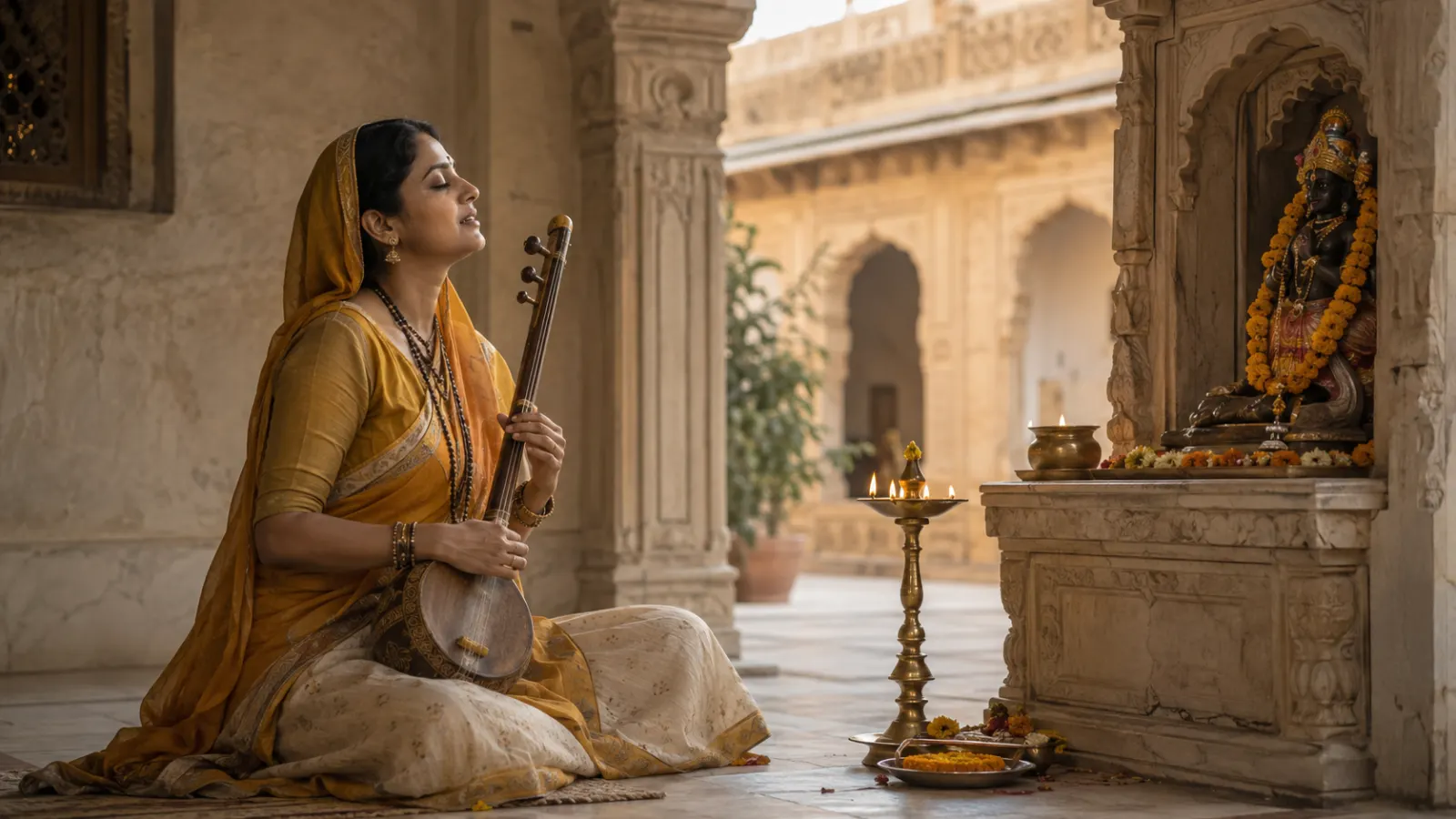
The central fact of Mirabai's cultural identity is her devotion to Krishna. In songs associated with her name, Krishna appears not simply as a distant deity but as beloved, lord, husband and intimate presence. The devotional voice repeatedly chooses Krishna over status, family pressure and worldly reputation.
This emotional mode belongs to a larger tradition within bhakti in which human relationships become metaphors for the relationship between the devotee and God. The divine can be approached as parent, child, friend, master or beloved. In the Mira tradition, the language of lover and bridegroom becomes especially powerful.
The theological idea has social consequences. If Krishna is the devotee's true husband, then ordinary marriage no longer possesses unquestioned authority over her deepest identity. If divine allegiance stands above dynastic loyalty, social disobedience can become religious obedience.
This helps explain why Mirabai's poetry could later be read as both complete surrender and extraordinary freedom. She does not become autonomous by rejecting every form of authority. She becomes free from worldly authority by submitting to one authority she considers absolute: Krishna.
Was Mirabai a Rebel?
Modern readers often describe Mirabai as a feminist rebel, and the description captures an important part of her later image. She is remembered as refusing to let widowhood end her public identity, associating with saints and devotees beyond tightly controlled courtly circles, singing publicly, ignoring criticism and ultimately leaving the royal environment rather than surrendering her devotional calling.
Yet describing her simply as a modern feminist born centuries too early would distort the historical world in which her resistance developed. Mirabai did not formulate a secular philosophy of individual rights or a programme demanding equality between men and women. Her freedom was articulated through devotion.
Her implied claim was not that the autonomous individual always outranks society. It was that Krishna outranks society.
That distinction matters because it allows us to recognise the emancipatory force of the Mirabai tradition without forcing a twenty-first-century ideology onto a sixteenth-century religious figure. Later feminist readers can reasonably find powerful resources in her story, but those resources emerged through bhakti rather than modern political theory.
Widowhood, Family Pressure and the Question of Sati
Bhoj Raj appears to have died relatively young, leaving Mirabai widowed. The exact chronology remains uncertain, but widowhood became one of the defining stages in later accounts of her life.
Elite Rajput widowhood could involve severe restrictions on a woman's public role, appearance, movement and expected conduct. The Mirabai tradition remembers a woman who did not disappear into social invisibility after her husband's death. Instead, her devotional identity became increasingly public and increasingly difficult for family authority to control.
Some modern biographies state that Mirabai explicitly refused to commit sati. That claim should be handled cautiously. Later traditions do introduce such an episode, and it fits the broader image of a widow refusing expected social submission, but the historical evidence does not justify presenting a specific sati confrontation as securely documented fact.
The more defensible point is that Mirabai's remembered life refuses the idea that widowhood should erase her religious identity or end her public agency.
Where History Turns Into Hagiography
The evidence problem becomes especially important when we reach the famous stories of Mirabai's persecution.
One of the most important relatively early references to her appears in Nabhadas's Bhaktamal, composed around the late sixteenth or early seventeenth century. The account is much shorter than later biographies, but several defining elements are already visible. Mira is remembered as a fearless devotee of Giridhar who disregards social shame and family bonds, while hostile forces fail to destroy her.
Later commentators greatly expand this framework. They add dialogue, motivations, miraculous episodes and encounters with other saints. The resulting literature is hagiography: writing concerned with expressing the holiness, spiritual authority and exemplary character of a saint.
Hagiography should not be treated as failed journalism. Its purpose is different. A modern historian asks whether an event probably happened. A devotional biography may ask what the event reveals about faith, divine protection or the nature of saintliness.
The appropriate response is therefore neither to report every miracle as established history nor to dismiss the stories as meaningless. Their historical value lies partly in what later communities believed Mirabai represented.
The Poison Cup and Snake Legends
The poison cup is perhaps the most famous Mirabai legend. According to the story, hostile relatives send her poison, expecting her death. Mira drinks it while trusting in Krishna and remains unharmed. Another story tells of a poisonous snake sent to kill her, only for the danger to become harmless through divine intervention.
These stories cannot be verified as ordinary historical events, but their symbolic structure is clear. Worldly authority attempts to destroy the devotee, yet divine allegiance proves stronger. Violence becomes powerless, and persecution becomes evidence of saintliness.
The stories also reverse the apparent hierarchy of power. The royal household may possess political authority, but the Mirabai tradition repeatedly insists that it cannot control the person who belongs to Krishna.
That message helps explain why the miracle stories remained culturally powerful even for audiences more interested in social resistance than supernatural intervention.
Mirabai, Vrindavan and the Jiva Goswami Story
Later tradition places Mirabai in Vrindavan, the landscape most closely associated with Krishna's childhood and youthful play. The association makes strong devotional sense because Mira's poetic identity draws heavily on the emotional world of Krishna bhakti, especially the longing associated with the gopis.
A famous story says that Mirabai sought to meet the Vaishnava theologian Jiva Goswami but was told that he did not see women. Mira supposedly replied that she had thought Krishna was the only true man in Vrindavan and everyone else stood in the feminine relation of the devotee to him.
The story is memorable because it turns devotional theology into a rebuke of gender exclusion. Yet it is best treated as hagiographic tradition rather than a historically documented conversation.
Its importance lies partly in what later devotees wanted Mirabai to represent: a woman whose spiritual understanding could overturn institutional claims about gender.
Leaving the Palace
Mirabai is traditionally said to have left Mewar and spent part of her later life in major Krishna devotional centres, particularly Vrindavan and Dwarka. A precise itinerary cannot be reconstructed confidently from contemporary evidence, but departure from the palace is central to the saintly narrative.
The symbolism is powerful. Royal security is exchanged for pilgrimage. Family identity gives way to devotional identity. A woman defined socially through marriage becomes defined religiously through chosen allegiance.
The act also reverses conventional ideas of value. The palace, normally a symbol of privilege, becomes something Mirabai is willing to abandon. The company of devotees becomes more valuable than aristocratic status.
This is one reason her story has remained meaningful far beyond Rajput history. It transforms renunciation into a critique of social ownership over the individual.
Mirabai and Dwarka
Later accounts strongly associate the final stage of Mirabai's life with Dwarka in Gujarat, another major centre of Krishna devotion. Her death is often placed there sometime around the middle of the sixteenth century, though exact dates remain uncertain.
The most famous devotional version says that representatives from Mewar eventually came to ask her to return. Mirabai entered Krishna's temple and disappeared into the deity's image, achieving literal union with the divine beloved.
Historical method cannot verify such an event. As hagiography, however, the conclusion is almost perfect. A devotional life built around longing for union ends with the complete disappearance of the distinction between devotee and Krishna.
The story therefore communicates theological meaning even when it cannot function as a medical or historical account of death.
The Biggest Problem: Which Poems Did Mirabai Actually Write?
Mirabai's fame today depends enormously on devotional poetry, yet individual authorship is one of the most difficult questions surrounding her.
A very large number of songs circulate under Mira's name across Rajasthan, northern India, Gujarat and modern Hindi devotional culture. But the surviving manuscript tradition is substantially later than her presumed lifetime, while oral transmission allowed songs to change as they moved between singers, regions and communities.
Language could be adapted. Verses could be added or removed. A song could acquire a new melody. New compositions could be created within an already familiar saintly voice. A poetic signature such as “Mira says” could indicate the identity of the devotional persona without functioning as modern documentary proof that one historical individual composed every word.
This kind of fluid authorship was not unusual in premodern devotional culture. Modern copyright assumptions cannot simply be projected backward.
Editors Outlook should therefore avoid statements such as “Mirabai wrote thousands of bhajans” as though an authenticated complete works survives. A more accurate formulation is that a vast devotional repertoire came to circulate under Mirabai's name, while scholars assign different levels of confidence to individual compositions.
Why the Songs Feel Like an Autobiography
Songs attributed to Mirabai often use an intensely personal first-person voice. The speaker suffers family opposition, longs for Krishna, rejects worldly prestige, addresses the rana and declares exclusive allegiance to Giridhar.
This creates the impression that the poetry can be read as a diary.
That would be risky.
Devotional poetry often works through established literary voices and inherited emotional conventions. The speaking “I” may be personally meaningful without corresponding directly to a single documented biographical event.
Using every poem as factual evidence can also create circular reasoning. Later stories shape the way listeners understand the songs, while those same songs are then used to prove the later stories.
The poetry is genuine historical evidence, but it is evidence of devotional imagination, performance and cultural memory as well as possible autobiography.
The Distinctive Voice of Mirabai
Even with uncertainty about individual poems, the Mira persona is remarkably recognisable.
She is associated with a voice that dismisses worldly status, accepts suffering for devotion, longs intensely for Krishna and refuses to let family pressure or public shame determine ultimate allegiance. The voice can be emotionally vulnerable while remaining extraordinarily uncompromising.
That consistency helps explain why the saint-name became larger than any one authenticated manuscript.
Later poets and singers could inhabit the Mira voice because audiences already understood what “Mira” represented.
The tradition therefore preserved more than poems. It preserved a devotional personality.
What Language Did Mirabai Use?
The linguistic history of Mirabai's songs reflects their movement across regions.
The repertoire survives in forms associated with Rajasthani, Braj and related north and western Indian traditions and was subsequently transmitted through Hindi, Gujarati and other linguistic environments.
It would therefore be misleading to imagine one completely fixed modern language in which every original Mira poem was composed and then perfectly preserved.
Variation is not merely textual corruption. It is evidence of circulation.
Songs survived partly because performers could adapt them while retaining the devotional identity attached to Mira.
Major Themes in Mirabai's Poetry
The dominant theme is devotion to Krishna as the beloved. This relationship frequently takes the form of longing or viraha, the pain of separation from the divine. Separation is not merely suffering; it intensifies devotion because absence makes the beloved more present in consciousness.
Another recurring theme is the rejection of worldly status. Royal prestige, family honour and social reputation become insignificant when measured against Krishna. The poetry also repeatedly dramatizes conflict between devotion and social expectation, making criticism or persecution evidence of the speaker's fidelity.
Surrender is equally important. The Mira voice does not present freedom as self-sufficiency. It repeatedly declares complete dependence on Krishna. Paradoxically, that surrender becomes the foundation of independence from everyone else.
These themes explain why Mirabai can simultaneously function as devotional saint, literary figure and symbol of resistance.
Mirabai and Ravidas
Later devotional traditions often identify Ravidas, the major bhakti saint associated with a leatherworking community, as Mirabai's guru.
The image is socially powerful. A Rajput aristocratic woman receiving spiritual authority from a saint associated with a marginalised caste reverses ordinary social hierarchy and reinforces the bhakti idea that spiritual worth does not follow inherited rank.
The precise historical relationship, however, is debated. The evidence does not justify stating a formally documented teacher-disciple relationship as unquestioned fact.
The better formulation is that later traditions strongly associate Mirabai with Ravidas and frequently present him as her guru, while the precise historical relationship remains uncertain.
This distinction preserves both historical caution and the cultural importance of the tradition.
Mirabai, Caste and the Meaning of Bhakti
Mirabai is often included in broad narratives portraying bhakti as a rebellion against caste. That interpretation contains something important but can become too simple.
There was no single centrally coordinated Bhakti Movement with one social programme. Different devotional traditions emerged across different regions, languages and centuries, and their relationships with caste and religious institutions varied considerably.
Mirabai's tradition nevertheless repeatedly places devotion above social rank. Her remembered association with wandering devotees and with Ravidas is especially powerful because she herself is connected with Rajput aristocracy.
The message later communities drew from this inversion is clear: spiritual authority need not follow inherited status.
Mirabai Among the Bhakti Saints
Comparing Mirabai with other major bhakti figures is useful if the differences remain visible.
Kabir's remembered authority comes largely through his attack on religious hypocrisy and inherited boundaries. Tukaram belongs to the Marathi Varkari devotional world and the tradition of the abhang. Surdas became closely associated with Krishna poetry in Braj. Ravidas became an enormously important voice of devotional equality and anti-caste memory.
Mirabai's distinctive position comes from the combination of Krishna devotion, female religious agency, Rajput status and the dramatic contrast between palace life and devotional surrender.
She therefore belongs within the broad history of bhakti without becoming merely a generic example of it.
How a Historical Woman Became Saint Mirabai
One of the most revealing aspects of Mirabai's story is the process through which her biography expanded.
A probable historical woman associated with extraordinary Krishna devotion became remembered in relatively early devotional sources. Later hagiographers added narrative structure. Stories of persecution explained the intensity of the poetic voice. Miracles demonstrated divine protection. Pilgrimages placed her inside Krishna's sacred geography. Encounters with famous saints gave theological authority to the tradition. The disappearance at Dwarka provided an ideal devotional ending.
This process is sometimes described as saint-making.
It should not be understood simply as the replacement of truth with fiction. Later communities were constructing explanations of why Mirabai mattered.
The biography grew because the songs needed a life capable of explaining the authority of the voice, while the expanding biography in turn shaped how listeners understood the songs.
Why Nabhadas's Bhaktamal Is Important
Nabhadas's Bhaktamal is particularly valuable because it shows that the broad outline of Mirabai's saintly identity had already developed relatively close to her presumed lifetime.
The account is brief compared with later versions, yet several fundamental features are already visible: devotion to Giridhar, disregard for worldly shame, conflict with family expectations and miraculous survival from attempts to harm her.
This means the oppositional Mirabai was not invented solely by modern feminists, filmmakers or nationalist writers.
Later centuries expanded and reinterpreted the tradition, but the image of a woman whose Krishna devotion outweighed social pressure appeared comparatively early.
Music Made Mirabai Immortal
Mirabai is not simply a poet who survived through manuscripts.
She is a poet-saint who survived through singing.
That may be one of the most important reasons her cultural presence remains so strong. Songs associated with Mira moved through temple worship, household devotion, regional folk traditions, classical and semi-classical performance, recordings, radio, cinema and contemporary devotional music.
Every new performance could preserve and alter the tradition simultaneously.
Melodies changed. Linguistic forms shifted. Some verses disappeared. Others were added. New songs could enter the repertoire under Mira's name.
For a textual historian, this fluidity creates problems.
For cultural survival, it was extraordinarily effective.
The same mechanism that makes authorship difficult to establish helped Mirabai travel across regions, languages and centuries.
Mirabai in Modern Music and Cinema
Twentieth-century recording technology and cinema transformed Mirabai into an even more widely recognised cultural figure.
Major singers brought compositions associated with Mira to national audiences. Films and dramatic works gave visual form to the saintly narrative. Schoolbooks presented her as one of the representative voices of the bhakti tradition.
Cinema was particularly influential because it could turn uncertain traditions into apparently concrete events. The poison cup could be shown. Palace confrontation could be dramatised. The journey away from royal life could become a visible act of rebellion. Divine intervention could appear before the viewer's eyes.
Once such versions entered popular culture, they could feel like remembered history even where their sources remained hagiographic.
Modern media therefore did not simply preserve Mirabai.
It helped create new versions of her.
Mirabai and Women's History
Mirabai's continuing importance to women's history comes from the unusual combination of devotion and agency in her tradition.
She is remembered as a woman whose deepest identity could not be determined by marriage, widowhood, clan or royal authority. Her first-person devotional voice claims the right to define ultimate loyalty for herself.
Modern readers can reasonably see resistance to patriarchy in this tradition.
But historically, the structure of that resistance remains theological. Mirabai gains freedom from family authority because she declares herself already bound to Krishna.
This makes her particularly interesting. Surrender and agency, which modern political language often treats as opposites, become inseparable.
She is free because she belongs completely to someone else—but that “someone” is divine rather than worldly.
Historical Mirabai, Hagiographic Mirabai and Performed Mirabai
The evidence becomes much clearer if Mirabai is understood through three overlapping layers.
The first is the probable historical core: a sixteenth-century Rajput woman associated with Merta and Mewar who became famous for extraordinary devotion to Krishna.
The second is the hagiographic Mirabai: the saint whose life includes persecution, poison, miraculous protection, encounters with religious authorities, pilgrimage and ultimate union with Krishna.
The third is the performed Mirabai: the devotional identity continuously recreated by singers, poets, translators, filmmakers, scholars, devotees and modern political readers.
These layers should not be treated as equally documented, but neither should they be collapsed into a simple opposition between truth and fiction.
Each reveals something different.
Did Mirabai Really Exist?
The uncertainty surrounding details of her biography should not be exaggerated into the claim that nothing historical can be known about Mirabai.
The more reasonable conclusion is that a historical figure lies behind the tradition, while the evidence does not support the detailed year-by-year biography often presented in popular accounts.
Her association with Rajasthan's Rajput world, Merta, Mewar and exceptional Krishna devotion forms a plausible historical core. The problem arises when later stories are reported with the same level of certainty as those broader facts.
The responsible historian therefore uses degrees of confidence.
This is not indecision.
It is what the evidence requires.
Mirabai's Birth and Death Dates
Many reference works give approximately 1498 for Mirabai's birth and place her death somewhere around 1546 or 1547.
These dates should not be treated like the precisely documented dates of a modern political leader.
Using c. 1498 and c. mid-sixteenth century is historically more responsible where exact dating is uncertain.
The same caution applies to the precise sequence of her marriage, widowhood, departure from Mewar and pilgrimage.
Mirabai's life can be placed broadly within the first half of the sixteenth century even when its detailed chronology remains contested.
Was Mirabai Really a Princess?
Calling Mirabai a Rajput princess is reasonable in popular biography provided the term is understood broadly.
She belonged by birth to the Rathore aristocratic family associated with Merta and married into the Sisodia ruling house of Mewar.
She was therefore unquestionably part of an elite dynastic environment.
That status is central to the meaning of her later tradition.
Renouncing social expectations has far greater symbolic force when the person doing so possesses significant status to begin with.
Did Mirabai Really Drink Poison?
The historically responsible answer is straightforward: devotional tradition says that she did, but historians cannot establish the miraculous episode as documented fact.
The poison story nevertheless appears relatively early in the development of her saintly memory and became one of the defining symbols of divine protection in the Mira tradition.
Its cultural importance does not depend on pretending that modern historical evidence can prove the miracle.
Did Mirabai Meet Ravidas?
Later traditions frequently connect Mirabai with Ravidas and often call him her guru.
The association is religiously and socially important, particularly because of the contrast between Mirabai's Rajput status and Ravidas's remembered social location.
However, the precise historical relationship remains uncertain.
It is best described as a powerful devotional tradition rather than unquestioned documentary biography.
Did Mirabai Meet Jiva Goswami?
The celebrated Vrindavan encounter with Jiva Goswami belongs primarily to later hagiographic tradition.
Its theological wit and challenge to gender exclusion have made it enduringly popular.
But it should not be quoted as though a contemporary witness recorded the exchange.
How Did Mirabai Die?
Historical evidence does not allow a precise reconstruction of Mirabai's death.
Later devotional tradition associates her final years with Dwarka and describes her disappearance into a Krishna image.
The story is best understood as a theological conclusion to a saintly life rather than a verifiable medical account.
Why Mirabai Still Matters
The importance of Mirabai does not depend on proving every miracle or authenticating every bhajan.
Her tradition created one of South Asia's most durable voices of personal devotion and religious agency. It imagines a woman for whom royal status matters less than Krishna, family command matters less than conscience and public reputation matters less than fidelity to the divine beloved.
That voice has remained meaningful because later generations could hear different things within it.
Devotees heard complete bhakti.
Women confronting restrictive social expectations heard refusal.
Musicians heard an inexhaustible devotional repertoire.
Literary scholars heard an unusually powerful first-person female voice.
Historians saw the complicated transformation of memory into hagiography.
Modern readers encountered questions about authorship, gender, caste, religion and personal freedom.
The historical uncertainty actually makes this legacy more revealing.
The poisoned cup can matter culturally without becoming established court history. Ravidas can be central to later Mira tradition even when their exact relationship cannot be reconstructed. A song can authentically belong to the Mirabai devotional repertoire even when modern textual scholarship cannot prove that the historical Mirabai personally composed every line.
Mirabai therefore survives through a productive tension between history and memory.
She is the Rajput woman and the wandering saint, the royal widow and the lover of Krishna, the possible historical poet and the voice inhabited by generations of later singers.
The palace and the temple continually pull in opposite directions in her story.
So do surrender and freedom.
That may be the deepest reason Mirabai remains powerful nearly five centuries later. She belongs unmistakably to the devotional world of early modern India, yet the central question of her remembered life remains immediately understandable: who has the right to determine a person's deepest allegiance?
For the Mirabai tradition, the answer was uncompromising.
Not dynasty.
Not reputation.
Not social pressure.
Krishna.