The smallest payment is not the safest payment
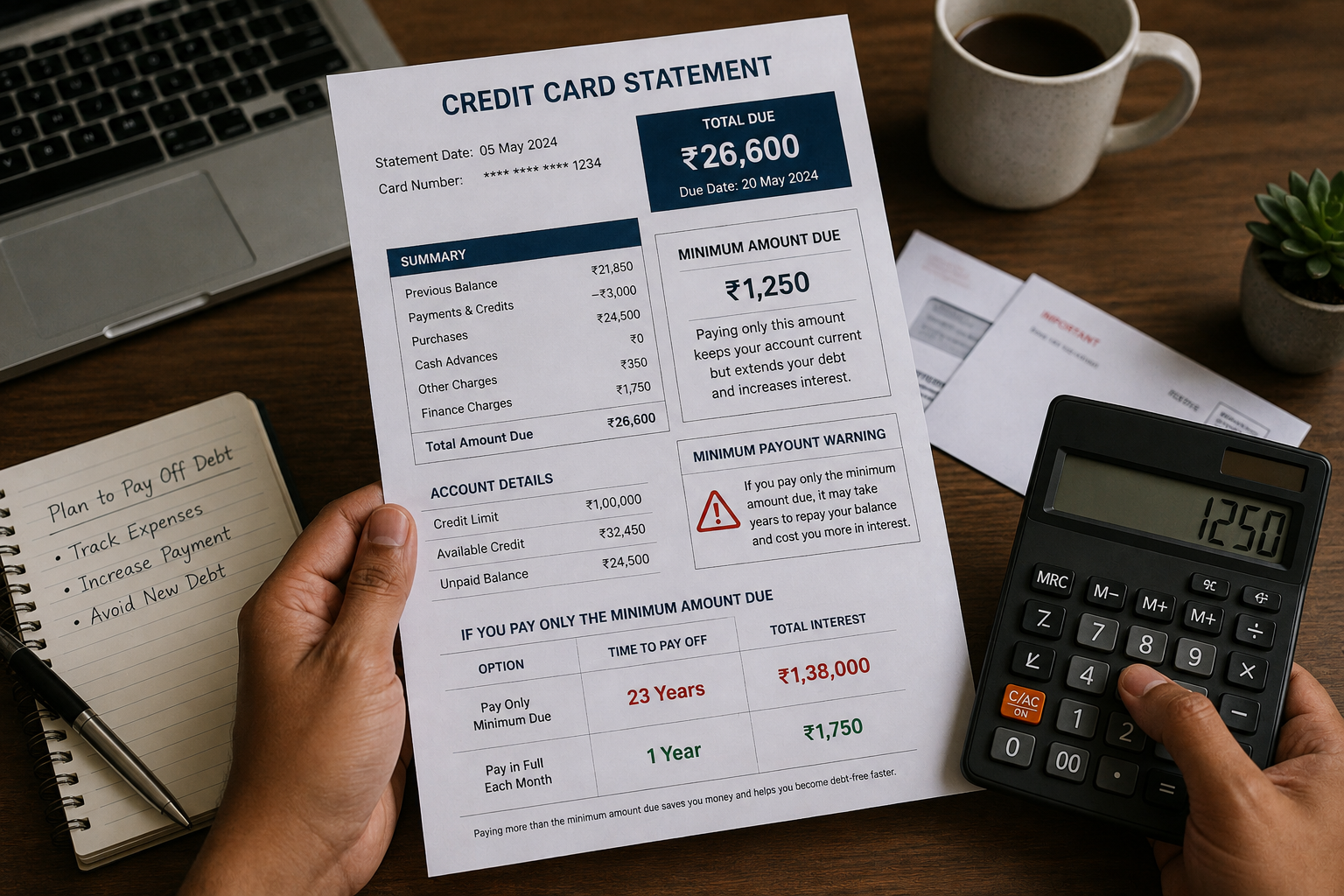
The minimum amount due on a credit card looks like relief. The bill may show a large total amount due, but below it appears a smaller number that seems manageable. A person who cannot pay the full bill may think, “At least I can pay this much and avoid trouble.” In a narrow sense, that is true. Paying the minimum generally helps the user avoid being treated as immediately overdue. But it does not make the debt disappear, and it certainly does not make the debt cheap.
The minimum amount due trap begins when the cardholder confuses account survival with debt reduction. The account remains active, the card may continue to work, and the borrower may feel that nothing serious has happened. In reality, the unpaid balance has been carried forward. Interest or finance charges begin to apply according to the card terms. New purchases may also lose the benefit of the interest-free period when the previous bill is not cleared in full. What looked like flexibility becomes a machine that keeps debt alive.
The danger is psychological as much as mathematical. A credit-card statement gives the user two choices: pay the full amount or pay the minimum. The second option is legal and convenient, so it feels acceptable. But a payment option is not the same as a healthy financial strategy. The bank gives a minimum amount because it keeps the account moving; the borrower needs to ask whether it actually reduces the burden.
What minimum amount due actually means
The minimum amount due is the smallest payment a cardholder must make by the due date to keep the account from slipping into immediate non-payment status. It is usually calculated as a small percentage of the outstanding balance, sometimes with fees, interest, EMI dues or past unpaid amounts added. The exact method differs across card issuers and products, so the statement and Most Important Terms and Conditions matter.
The phrase is easily misunderstood. Minimum amount due does not mean settlement amount. It does not mean discounted amount. It does not mean the rest of the balance is free. It only means this is the minimum payment required at that billing cycle to avoid certain immediate penalties. The remaining balance continues as borrowed money.
A cardholder who repeatedly pays only the minimum may feel responsible because payments are being made. But the main loan is barely reducing. In some months, the payment may mostly cover interest, fees, taxes and a small part of principal. The debt can therefore stay for a long time even though the borrower is paying every month.
Why the trap is expensive
Credit-card debt is among the costliest forms of retail borrowing. The reason is simple: it is unsecured, instantly available and behaviourally risky. Unlike a home loan backed by property or an auto loan backed by a vehicle, a credit-card balance often has no collateral. The issuer prices that risk through high finance charges.
When the full bill is paid on time, the credit card can function as a convenient payment instrument. The user may get an interest-free period, digital record, rewards and safety features. But when the bill is not paid in full, the same card turns into revolving credit. The unpaid amount moves into the next cycle, and the cost compounds through time.
A simple example shows the problem. Suppose a cardholder owes Rs 50,000 and pays only a small minimum amount every month while continuing some new spending. Even if every minimum payment is made on time, the outstanding balance may decline painfully slowly or may not decline at all if fresh purchases keep adding to it. The borrower sees monthly payments leaving the bank account, but the debt refuses to shrink. That is the trap.
The hidden loss of the interest-free period
Many users believe credit cards always provide free credit until the due date. That is true only when the previous bill is fully paid according to the card rules. Once a cardholder carries an unpaid balance, the interest-free benefit can be affected. New purchases may start attracting finance charges depending on the issuer terms until the outstanding dues are cleared.
This is where the minimum amount due becomes especially misleading. The user thinks the old balance is being managed, so new spending appears normal. But the card may no longer be operating like a free short-term payment tool. It may be operating like an expensive borrowing line. Every swipe can add to a costly revolving balance.
The safest rule is straightforward: if you cannot pay the full credit-card bill, stop using the card until the balance is cleared. Otherwise, the card becomes both the source of past debt and the channel for new debt.
Why people keep paying only the minimum
The minimum payment option survives because it fits human behaviour. People avoid financial discomfort. A large bill creates anxiety; a smaller minimum creates temporary relief. The borrower chooses immediate emotional comfort over long-term cost. This is not stupidity. It is a common behavioural response to stress.
There is also optimism bias. Many users believe next month will be better. Salary may rise, a bonus may come, expenses may fall, or a pending payment may arrive. So they pay the minimum “just this once.” The problem is that one month becomes two, two becomes six, and the debt becomes normalised.
Finally, credit cards hide the pain of spending. Unlike a loan with a clear EMI schedule, a card balance can feel flexible. Flexibility is useful when the borrower is disciplined. It is dangerous when the borrower uses it to postpone reality.
How it affects credit health
Paying at least the minimum may prevent immediate overdue reporting, but it does not automatically make the borrower financially healthy. If outstanding balances remain high, credit utilisation rises. High utilisation can signal stress because the borrower is using a large share of available credit. Lenders may interpret this as dependence on short-term borrowing.
If the borrower eventually misses even the minimum payment, the damage becomes more visible. Late fees, interest, collection calls, blocked limits and credit-score impact can follow. Once a credit-card account becomes delinquent, access to future credit may become costlier or harder.
The minimum due is therefore not a credit-score strategy. It is an emergency fallback. A strong credit profile is built by spending within repayment capacity, paying the full bill, keeping utilisation moderate and avoiding repeated rollover.
How to escape the minimum due cycle
The first step is to stop new spending on the card. A leaking bucket cannot be filled by adding more water. The second step is to write down the total outstanding amount, interest rate, fees and due date. Many borrowers avoid looking at the full number because it is uncomfortable. But without clarity, repayment remains vague.
The third step is to pay more than the minimum, preferably much more. Any extra payment reduces principal and shortens the debt cycle. If there are multiple cards, one strategy is to pay the highest-cost card aggressively while maintaining required payments on others. Another is to clear the smallest balance first for psychological momentum. The right method depends on behaviour and cash flow.
The fourth step is to negotiate or restructure only with caution. A lower-cost personal loan may help if it genuinely replaces high-cost card debt and the card is not used again. But consolidation is dangerous if it only creates fresh space for more spending. The problem is not solved by moving debt; it is solved by changing the repayment behaviour that created the rollover.
A simple reader test before paying the minimum
Before choosing the minimum amount due, a cardholder should run a simple test: if I pay only this amount, when will the full balance actually become zero? Many users cannot answer because the statement does not feel like a loan schedule. It feels like a monthly bill. But once a balance is rolled over, the card must be analysed like a high-cost loan.
The second test is behavioural: why am I unable to pay the full amount? If the reason is a one-time emergency and the next month’s cash flow is secure, the minimum may be a temporary bridge. If the reason is routine overspending, unstable income, multiple EMIs or lack of budgeting, the minimum payment is not a bridge. It is a warning that the household budget is already under pressure.
The third test is opportunity cost. Money paid as credit-card interest cannot be invested, saved for emergencies or used for real needs. The borrower is not only paying the lender; the borrower is also losing the chance to build financial resilience. This is why the minimum due trap is costly even when default does not occur.
Final takeaway
The minimum amount due is useful in a temporary emergency, but dangerous as a habit. It protects the account from immediate default; it does not protect the borrower from high-cost debt. The real credit-card discipline is not paying the minimum on time. It is paying the full bill on time.
The trap works because it feels responsible while keeping the debt alive. A person who wants financial control should treat the minimum amount as a warning signal. If you can pay only the minimum, your spending has already crossed your safe repayment capacity.
A credit card should be a payment instrument, not a lifestyle-support loan. The moment the minimum due becomes the normal payment, the card is no longer serving you. You are serving the card balance.